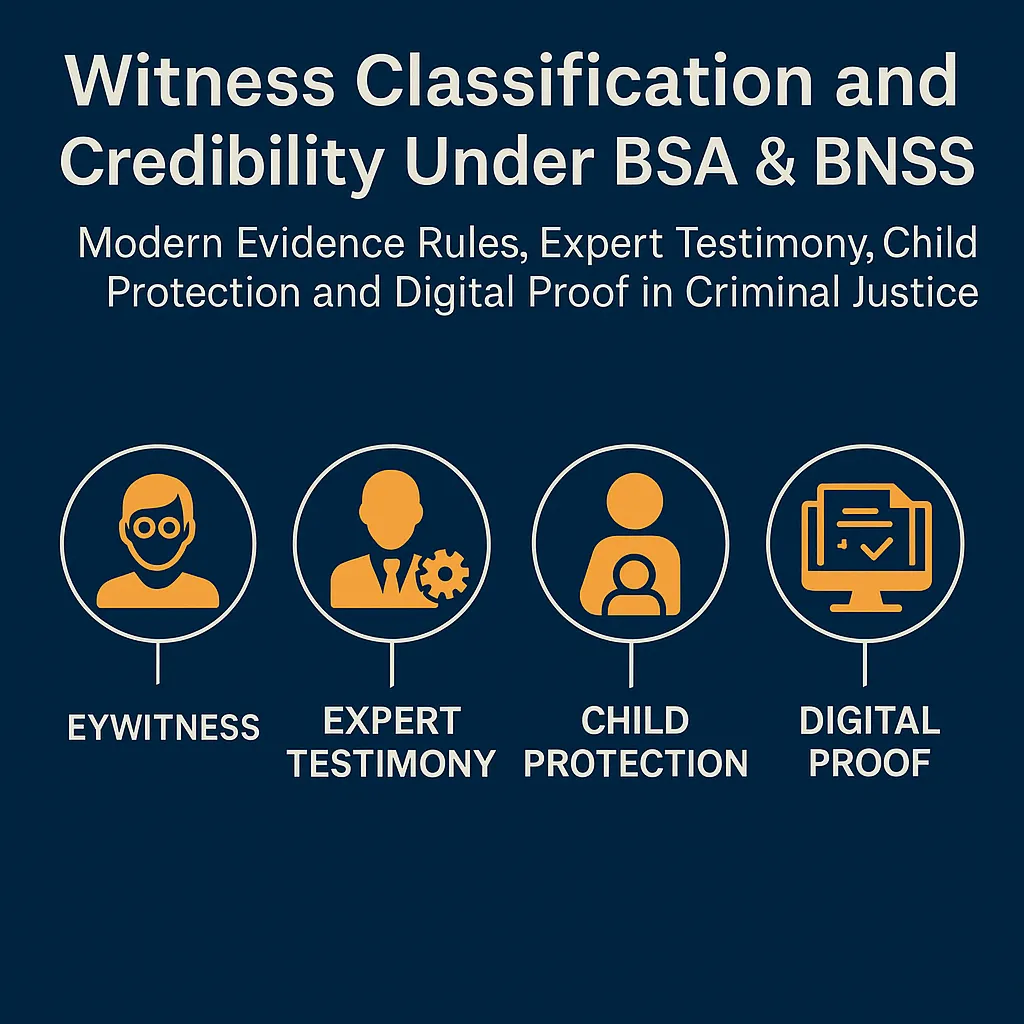
Witnesses continue to occupy the centre-stage of criminal justice. Even in an age dominated by DNA, CCTV and digital forensics, the Supreme Court has repeatedly held that the credible testimony of a single witness is sufficient to sustain a conviction (Ramanand Yadav v. Prabhu Nath Jha, (2003) 9 SCC 606).
The enactment of the Bharatiya Sakshya Adhiniyam, 2023 (BSA) and the Bharatiya Nagarik Suraksha Sanhita, 2023 (BNSS) has modernised the legal framework by incorporating technological advancements, strengthening victim-sensitive procedures, and emphasising scientific rigour. The new laws have refined the manner in which witnesses are classified, examined, protected and evaluated.
Courts have long drawn a clear distinction between the most reliable and the most unreliable witnesses. Independent and neutral eyewitnesses who have no personal stake in the outcome are placed in the highest category of reliability (State of U.P. v. Krishna Master, (2010) 12 SCC 324). At the other end of the spectrum lie stock or habitual witnesses who routinely figure in police cases; their evidence is viewed with grave suspicion and requires strong independent corroboration before it can be acted upon (State of U.P. v. Sukhbasi, AIR 1985 SC 1224).
Under the new criminal laws, witnesses may be classified into the following broad categories.
An eyewitness or witness of fact is one who directly perceives the incident through senses. Sections 54 and 55 of the BSA preserve the settled principle that credible ocular testimony, even if solitary, is sufficient for conviction.
Expert witnesses render opinion evidence on scientific, medical, technical or professional matters under Sections 39 to 45 of the BSA. Their opinions remain advisory in nature and cannot supplant the reasoning of the court (State of H.P. v. Jai Lal, 1999).
Every person is competent to testify unless the court finds that, by reason of tender age, extreme old age, disease or any other cause, he or she is incapable of understanding the questions put or of giving rational answers (Section 3 BSA, Interpretation clause). A child witness falls within this general rule but is additionally protected by Section 398 of the BNSS which mandates special measures such as testimony through video-link, presence of a support person and avoidance of aggressive cross-examination. The Supreme Court has clarified that the evidence of a child witness must be approached with caution but cannot be discarded merely on the ground of age (Dattu Ramrao Sakhare v. State, 1997).
Statements of women and child victims of sexual offences are now mandatorily recorded through audio-video electronic means under Section 176 BNSS to minimise trauma and ensure transparency.
Persons who are deaf or mute, or both, are equally competent and may depose through signs, writing or a qualified interpreter (Section 3 BSA). Courts satisfy themselves about the accuracy of interpretation before placing reliance on such testimony. A witness who resiles from his earlier statement or turns unfavourable to the party calling him may be declared hostile. Section 157 of the BSA permits the use of previous statements for contradiction or corroboration, and the court retains the discretion to allow the calling party to cross-examine the witness. Truthful portions of a hostile witness’s testimony can still be accepted (Sat Paul v. Delhi Administration, 1976).
Related or interested witnesses are natural in many crimes, particularly domestic or neighbourhood offences. Relationship by itself is no ground for rejection; courts scrutinise their evidence with greater care but do not discard it mechanically (Dalip Singh v. State of Punjab, 1953). Independent witnesses, especially for recoveries under Section 23(2) BSA, carry high credibility, though their non-availability is not fatal if satisfactorily explained.
Chance witnesses must offer a plausible explanation for their presence at the scene (Rana Pratap v. State of Haryana, 1983). Circumstantial witnesses help complete the chain of circumstances which must point unerringly to the guilt of the accused and exclude every hypothesis of innocence (Sharad Birdhichand Sarda v. State of Maharashtra, 1984).
Recovery or panch witnesses who attest seizures gain significance when they are truly independent. An accomplice turned approver falls under Section 136 BSA; his testimony, being that of a tainted witness, requires independent corroboration in material particulars (Kashmira Singh v. State of M.P., 1952). Investigating officers routinely depose to establish procedural compliance and chain of custody; their evidence is vital in modern trials.
The authentication of electronic records has been considerably simplified under Section 63 BSA. The person in whose device the record is first stored, the system administrator or the forensic examiner can prove the record; the requirement of a certificate under sub-section (4) stands dispensed with if the maker deposes in person (Arjun Panditrao Khotkar v. State of Maharashtra, 2020 and subsequent rulings).
Vulnerable witnesses, particularly victims of sexual offences and children, receive comprehensive protection under Section 398 BNSS read with the Witness Protection Scheme, 2018. Measures include in-camera trials, video-conferencing, anonymity, voice distortion and physical security (Mahender Chawla v. Union of India, 2019). Character evidence remains of limited relevance (Sections 52–55 BSA), while dying declarations and other recognised exceptions to the hearsay rule continue to be admissible under Sections 22 to 32 BSA. The court retains the power to summon any person as a witness suo motu if his evidence is essential for a just decision (Section 311 BNSS read with Section 165 BSA).
In evaluating credibility, courts consistently apply well-settled tests: internal and external consistency, corroboration (mandatory for accomplices, desirable for interested witnesses), demeanour, inherent probability, motive, opportunity and capacity to observe, and the conduct of the witness both before and during trial.
On the global canvas, the Daubert standard of the United States ensures scientific reliability of expert evidence, the United Kingdom provides extensive special measures for vulnerable witnesses under the Youth Justice and Criminal Evidence Act, 1999, and the International Criminal Court employs anonymity and relocation measures. India’s new provisions, particularly Section 398 BNSS and Section 63 BSA, reflect substantial convergence with these international best practices.
The Bharatiya Sakshya Adhiniyam, 2023 and the Bharatiya Nagarik Suraksha Sanhita, 2023 herald a progressive, technology-enabled, victim-centric and scientifically sound regime for handling witnesses. Effective implementation of child-friendly procedures, mandatory audio-video recording of vulnerable victims, relaxed electronic-evidence rules and robust witness-protection measures will go a long way in enhancing the reliability of testimony, reducing miscarriages of justice and restoring public faith in the criminal justice system.