Introduction
In the concealed architecture of state power, VVIPs—heads of state, heads of government, and senior political leaders—represent far more than individual officeholders. They embody constitutional authority, political continuity, and national sovereignty. Consequently, an attack on a VVIP is not merely a criminal act; it is a direct challenge to the legitimacy and stability of the state.
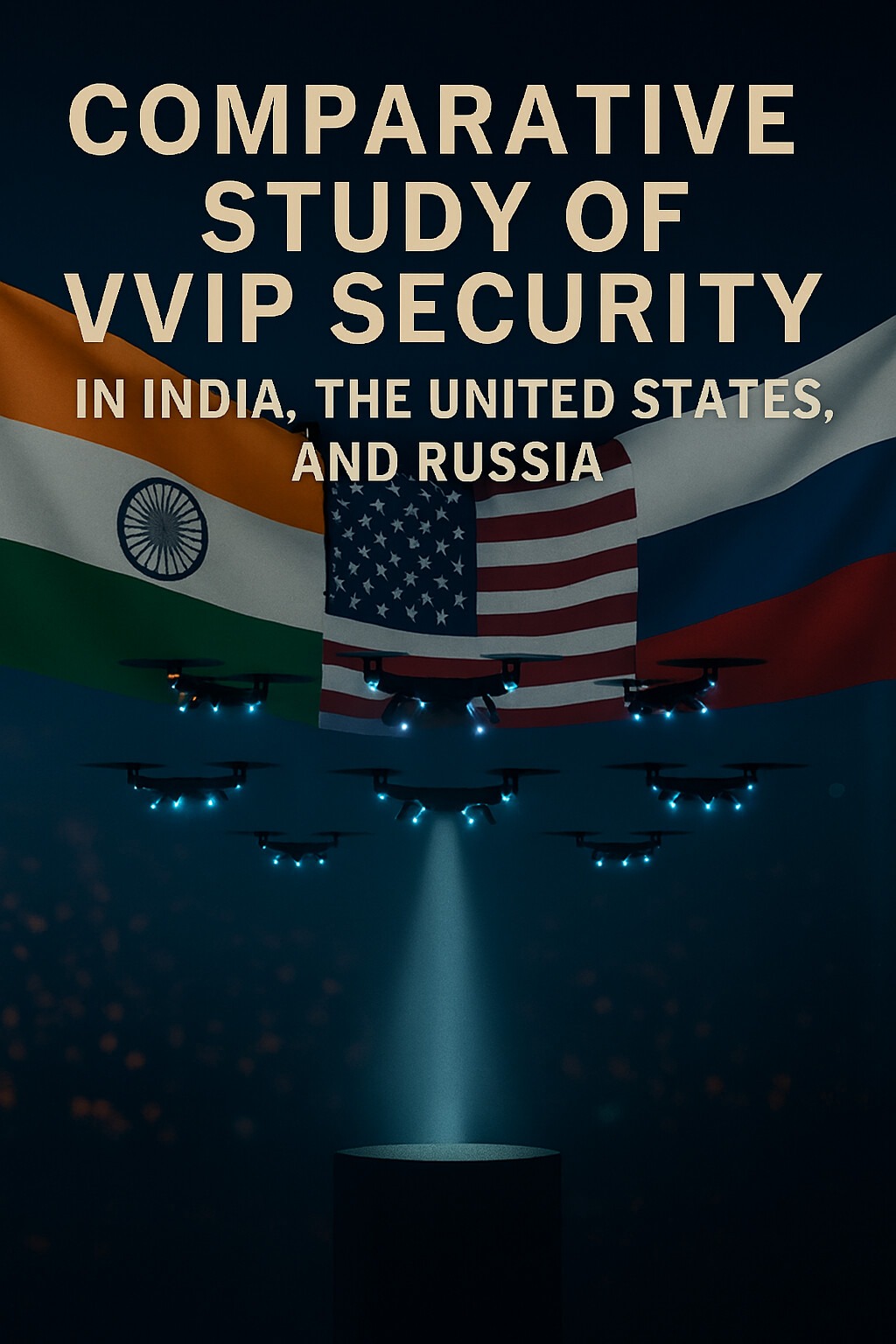
VVIP security systems therefore emerge as sophisticated amalgams of law, intelligence, technology, and political philosophy. Their structure and functioning are shaped by historical trauma, ideological orientation, and evolving threat landscapes. This comparative study examines the VVIP protection frameworks of India, the United States, and Russia, three nations with distinct political systems but shared experiences of assassination attempts, terrorism, and strategic rivalry.
India’s framework reflects a democratic state managing immense scale and diversity. The United States represents a legally codified, technologically driven protection regime that balances security with civil liberties. Russia’s system, deeply influenced by Soviet-era practices, prioritizes regime stability, centralized control, and intelligence dominance. Together, these models reveal how VVIP security serves not only as a protective shield but also as an expression of national character and governance.
VVIP Security in India: Democratic Sovereignty and Layered Protection
India maintains one of the world’s most expansive and multi-layered VVIP security systems, shaped by constitutional values as well as painful lessons from political violence.
Institutional and Legal Framework
VVIP protection in India is governed by the Ministry of Home Affairs (MHA) through standardized protocols:
- Blue Book: Security of the Prime Minister
- Yellow Book: Security of other VVIPs
- Threat-based categories: SPG, Z+, Z, Y+, Y, and X
The cornerstone of India’s VVIP security architecture is the Special Protection Group (SPG).
The Special Protection Group (SPG)
- Constituted in 1985 following the assassination of Prime Minister Indira Gandhi.
- Comprises approximately 3,000 highly trained personnel, drawn from NSG, CRPF, ITBP, and CISF.
- Responsible for proximate security, access control, advance security liaison (ASL), anti-sabotage checks, and coordination with intelligence agencies, particularly the Intelligence Bureau.
A defining feature of the Indian model is absolute unity of command, with Indian agencies retaining primacy even during visits by foreign dignitaries.
Operational Protocols and Lessons
- Multi-ring security arrangements: inner (SPG), middle (PPTs), and outer (CAPFs and state police).
- Z+ protection typically involves 50–55 personnel, armoured vehicles, sanitized routes, and continuous surveillance.
- Major reforms followed:
- Indira Gandhi (1984) – insider threat recognition
- Rajiv Gandhi (1991) – perimeter and crowd management reforms
- Mumbai attacks (2008) – intelligence integration and rapid response emphasis
Contemporary Challenges
- India protects approximately 7 lakh VIPs, placing immense strain on resources.
- Overdependence on manpower persists despite technological advances.
- AI-enabled surveillance, drone detection, and cyber intelligence are expanding but unevenly deployed.
VVIP Security in the United States: Legal Authority, Technology, and Liberty
The United States has institutionalized VVIP protection through a professional, legally mandated, and technologically advanced framework led by the U.S. Secret Service (USSS).
Institutional and Legal Framework
- Established in 1865, initially to counter currency counterfeiting.
- Expanded after President McKinley’s assassination in 1901.
- Governed by Title 18, U.S. Code §3056, mandating protection for:
- Presidents and Vice Presidents
- Former Presidents
- Presidential candidates
- Visiting foreign dignitaries
Operational Capabilities
- Approximately 7,000 personnel.
- Advanced countermeasures include:
- Behavioral threat detection
- Airspace security and no-fly zones
- Armoured presidential limousines
- Magnetometers, CBRN detection, and cyber-security systems
- The Diplomatic Security Service (DSS) supports overseas and foreign dignitary protection.
Historical Inflection Points
- JFK assassination (1963): Motorcade security reforms and armoured vehicles.
- Reagan shooting (1981): Rapid medical evacuation protocols.
- Post-9/11: Expansion of counter-terrorism and cyber-security mandates.
Balancing Security and Civil Liberties
- Protectees may legally decline protection.
- Open political culture, free speech, and widespread firearm ownership complicate protective operations.
- Despite constraints, the U.S. remains a global leader in innovation, training, and doctrine.
VVIP Security in Russia: Centralization, Intelligence Dominance, and Regime Stability
Modern Russia’s VVIP security system is a direct institutional and cultural descendant of the Soviet security apparatus, adapted to the political realities of the Russian Federation.
Institutional Framework
- Managed by the Federal Protective Service (FSO).
- The FSO traces its lineage to the KGB’s Ninth Chief Directorate.
- Responsible for protecting:
- The President of Russia
- Senior state officials
- Kremlin and strategic state facilities
- Estimated strength: 30,000–40,000 personnel.
Operational Doctrine
- Highly centralized command structure.
- Multi-layered physical security, including:
- Secure transport corridors
- Restricted zones around state institutions
- Encrypted communications and signal troops
- Heavy reliance on intelligence-led surveillance, including monitoring of political elites and internal threats.
Historical and Political Context
- Soviet-era purges ingrained institutional paranoia and loyalty enforcement.
- Post-Soviet Russia retained centralized security philosophy under new political structures.
- High-profile incidents reinforced regime-centric security:
- 1990s political instability
- Chechen terrorism
- Ongoing geopolitical tensions
Core Characteristics
- Emphasis on regime continuity over individual liberty.
- Limited transparency and minimal public oversight.
- Protection is inseparable from political control and internal security.
Comparative Analysis: Patterns and Contrasts
Common Ground
- Layered security models.
- Intelligence-driven threat assessments.
- Institutional evolution driven by assassinations and terror attacks.
- Emphasis on unity of command.
Key Differences
|
Aspect |
India |
United States |
Russia |
|
Strategic Orientation |
Emphasis on national sovereignty and protection at scale |
Statutory protection framework balancing security with civil liberties |
Primary focus on regime continuity and executive stability |
|
Command Structure |
Civilian-led federal system with strong central coordination |
Dedicated statutory agency operating under federal law |
Highly centralized executive control |
|
Technological Integration |
Expanding adoption of surveillance, AI, and cyber-security tools |
Global leader in protective technology and innovation |
Intelligence-driven systems with controlled technological deployment |
|
Public Oversight & Transparency |
Moderate oversight through democratic institutions |
High oversight with legal, judicial, and congressional scrutiny |
Minimal public oversight with limited transparency |
Cold War and Post–Cold War Continuities
- Russian FSO retains Soviet operational culture.
- India’s insistence on sovereignty reflects post-colonial experience.
- S. practices influence global protection standards.
Modern Convergence
- Cyber threats, drones, and AI-driven surveillance dominate planning.
- Private security supplements state mechanisms.
- Cultural contexts continue to shape protective doctrines.
Conclusion
VVIP security systems in India, the United States, and Russia encapsulate distinct national philosophies. India’s model balances democratic accountability with operational necessity; the United States combines innovation with constitutional restraint; Russia prioritizes centralized control and regime continuity.
Despite these differences, the fundamentals remain universal: unity of command, intelligence primacy, and adaptability to evolving threats. As hybrid warfare, cyber intrusions, and lone-wolf attacks redefine risk, VVIP security will continue to evolve—not merely as a shield for leaders, but as a barometer of state power itself.
In safeguarding their leaders, nations safeguard their political stability, strategic credibility, and future.