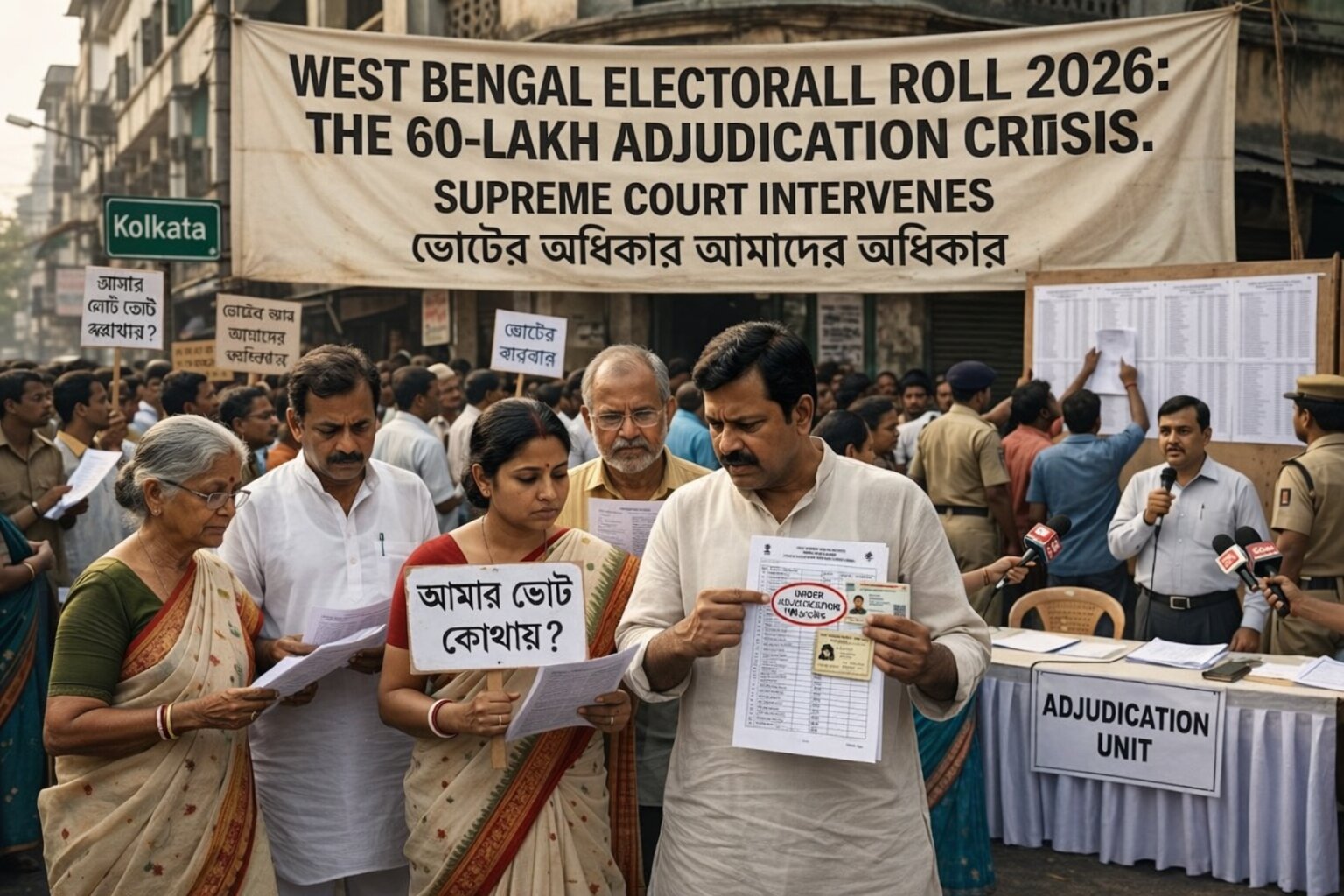
Sir 2026 Electoral Roll Publication And Emerging Concerns
The publication of West Bengal’s Special Intensive Revision (SIR) 2026 electoral roll on 28 February 2026, with 1 January 2026 as the qualifying date, was intended to produce a cleaner and more accurate voter list. Instead, it has opened a wider debate about transparency, administrative discretion, and the need for uniform standards in electoral verification.
The final roll places the number of electors in the State at 6.44 crore (64,452,609). Yet a striking figure stands out: over 60.06 lakh names remain marked “Under Adjudication.” These electors are listed in the roll but their voting rights remain temporarily suspended pending scrutiny by Electoral Registration Officers (EROs) or other competent authorities.
Such a large volume of unresolved cases inevitably raises questions about consistency in the verification process.
The Scale Of The Revision Exercise
According to Press Note No. CEO/PN-05/2026 issued by the Chief Electoral Officer, West Bengal, the SIR exercise involved significant changes to the electoral roll.
The pre-draft roll contained about 7.66 crore electors. After the initial revision, the draft roll published on 16 December 2025 dropped to approximately 7.08 crore, largely due to the removal of around 58.2 lakh entries attributed to deaths, migration, duplication, or non-traceability.
Changes After Draft Roll Publication
Following the publication of the draft roll, the statutory claims and objections process resulted in further changes:
| Type Of Change | Form Used | Number Of Cases | Description |
|---|---|---|---|
| New Voters Added | Form 6 And Form 6A | About 1.82 lakh | Applications for inclusion of new voters |
| Corrections | Form 8 | 6,671 | Administrative corrections in voter data |
| Deletions | Form 7 | Nearly 5.46 lakh | Entries deleted following objections |
Only 6,671 corrections were processed through Form 8. This figure is strikingly low—representing less than 01% of the total electorate—suggesting that the vast majority of data discrepancies resulted in “adjudication” or “deletion” rather than simple administrative correction.
Alongside these changes, however, approximately 60.06 lakh entries were placed under adjudication.
Common Reasons For Adjudication
These cases typically arise due to factors such as:
- discrepancies detected in voter data
- incomplete document verification
- non-appearance during hearings
- legacy records from earlier revision exercises that remain unlinked or inconsistent.
While these names continue to appear in the roll, their status remains uncertain until decisions are recorded in supplementary rolls or adjudication orders.
Divergent Outcomes For Similar Documentation
One of the more contentious aspects of the current debate concerns the varying outcomes experienced by voters presenting similar documentation.
Eligibility proofs such as Aadhaar-linked records, birth certificates, passports, legacy documents predating 1987, or educational certificates are commonly used to establish voter eligibility. Yet anecdotal reports suggest that voters presenting comparable documents have experienced markedly different outcomes — some being included without difficulty, others deleted, and many placed under prolonged adjudication.
Administrative Factors Affecting Verification
These differences often stem from several administrative factors and the specific “logical discrepancies” flagged by the ECI’s automated systems, including:
- Algorithmic “Red Flags”: Many of the initial 36 crore notices were triggered by automated “logical discrepancy” checks in the ERONET database. These include implausible age gaps (e.g., a child listed as only 10–12 years younger than a parent) or abnormal progeny counts (unusually high numbers of children linked to a single head of household).
- Discretionary Assessments: Varying interpretations by Electoral Registration Officers on whether a discrepancy is a clerical error or a sign of “non-genuine” entry.
- Document Hierarchy: Differing views on document validity—for instance, whether a primary school leaving certificate is sufficient or if a Board-issued Admit Card/Certificate is mandatory to override an automated age flag.
- Legacy Data Gaps: The difficulty of reconciling modern digitized records with handwritten “legacy data” from pre-1987 or 1971 records, which often leads to “Under Adjudication” status even when physical documents are provided.
District-Wise Adjudication Patterns
The distribution of adjudication cases across districts has also attracted attention. Reports indicate particularly high numbers in:
- Murshidabad (around 11 lakh cases)
- Malda (around 8.3 lakh cases)
- North 24 Parganas (around 5.9 lakh cases).
While these figures may partly reflect population size and migration patterns, they have nonetheless prompted calls for closer examination of the verification methodology.
Judicial Oversight: Addressing The “Trust Deficit”
In an extraordinary move on February 20, 2026, the Supreme Court of India intervened to resolve what it described as a “trust deficit” between the State Government and the Election Commission. To ensure absolute neutrality, the Court directed the Calcutta High Court to deploy serving and retired judicial officers to take over the quasi-judicial task of verifying claims and objections.
Recognizing the massive scale of the task—with over 80 lakh cases initially flagged—the Apex Court further authorized the requisition of judicial officers from neighbouring Jharkhand and Odisha.
Tasks Assigned To Judicial Officers
These officers are specifically tasked with:
- Adjudicating “Logical Discrepancies”: Resolving complex cases involving age-gap anomalies, parent-progeny linking, and “unmapped” legacy records.
- Standardizing Evidence: Following Court-reiterated guidelines that Aadhaar cards, Class 10 admit cards, and pass certificates must be accepted as valid proof of identity and age.
- Continuous Updates: Invoking its plenary powers under Article 142, the Court ruled that any voter cleared by this judicial process will be added via supplementary rolls and deemed part of the final list right up until the last date of nominations.
The Race Against Time
The race against time is critical: With West Bengal Assembly elections fast approaching, the “Under Adjudication” status is particularly sensitive. Because the Supreme Court has mandated that cleared voters be added via supplementary rolls right up until the last date of nominations, the work of these judicial officers remains the final gateway for over 60 lakh citizens to exercise their franchise.
Verifying Voter Status
For ordinary citizens, the first step is to check their voter status online.
The Election Commission of India’s portals allow electors to verify their position in the roll without requiring login credentials:
- https://electoralsearch.eci.gov.in
- https://voters.eci.gov.in
By selecting “SIR Final Roll 2026” and State Code S25 (West Bengal), voters can determine whether their status is:
- Active
- Deleted
- Under Adjudication
Electors can also download polling-part PDF rolls from the official portal to compare entries within their family, neighbourhood, or booth area. Such comparisons sometimes reveal cases where similar documentation appears to have produced different administrative outcomes.
Steps To Check Voter Status Online
| Step | Action |
|---|---|
| 1 | Visit the official voter search portals. |
| 2 | Select “SIR Final Roll 2026”. |
| 3 | Enter State Code S25 (West Bengal). |
| 4 | Search using voter details. |
| 5 | Check whether the status is Active, Deleted, or Under Adjudication. |
Using The Right To Information
Where doubts persist, the Right to Information Act, 2005 provides a valuable tool for obtaining official records.
Applications filed through https://rtionline.gov.in can seek:
- Certified copies of notices or hearing orders issued in specific cases
- Reasons recorded for adjudication decisions
- Details of documents accepted or rejected in comparable cases
- Anonymised statistics on document-wise acceptance or rejection within a constituency.
The statutory ₹10 application fee and 30-day response period make RTI one of the most accessible mechanisms for clarifying administrative decisions.
RTI Application Overview
| Aspect | Details |
|---|---|
| Law | Right to Information Act, 2005 |
| Application Portal | https://rtionline.gov.in |
| Application Fee | ₹10 |
| Response Time | 30 Days |
| Purpose | Obtaining official records and reasons behind administrative decisions |
Administrative And Judicial Remedies
Electors who believe their names have been wrongly deleted or withheld may pursue several remedies.
Appeals may be filed before the District Election Officer against an order of the Electoral Registration Officer, subject to prescribed timelines. Grievances can also be lodged through the Election Commission’s online grievance portal.
At a broader level, concerns regarding systemic irregularities may be raised through Public Interest Litigation before the Calcutta High Court, where issues relating to electoral roll verification have historically received judicial scrutiny.
Available Remedies For Electors
- Appeal before the District Election Officer.
- Submit grievances through the Election Commission’s online grievance portal.
- Seek records through the Right to Information Act.
- Raise systemic issues through Public Interest Litigation before the Calcutta High Court.
The Need for Consistency
The objective of the Special Intensive Revision is unquestionably legitimate: ensuring that electoral rolls remain accurate, current, and free from duplication. Yet when large numbers of voters remain in adjudicatory limbo and reports emerge of different outcomes for similar documentation, the need for transparent and uniform standards becomes paramount.
Electoral rolls form the foundation of democratic participation. Their credibility depends not only on accuracy but also on the perception of fairness and equal treatment.
As the adjudication process continues and supplementary rolls are issued, ensuring reasoned decisions, consistent criteria, and accessible remedies will be crucial to sustaining public trust in the electoral system.
Key Principles for Electoral Credibility
- Accuracy of electoral rolls
- Uniform standards in adjudication
- Transparency in decision-making
- Equal treatment of voters
- Accessible remedies for affected electors
Window Closing for “Under Adjudication” Voters
As the full bench of the Election Commission of India concludes its visit to West Bengal today, the announcement of Assembly poll dates is imminent. The window for resolving the 60.06 lakh “Under Adjudication” cases is narrowing. Following the Supreme Court’s intervention, over 600 judicial officers from West Bengal, Jharkhand, and Odisha are working urgently to process these claims.
Voters cleared by this judicial review will be added via supplementary rolls right up until the last date of nominations. It is critical for electors to verify their status immediately to ensure their right to vote is restored before the nomination period ends.
Current Status of the Adjudication Process
| Aspect | Details |
|---|---|
| Total Cases Under Adjudication | 60.06 lakh voters |
| Judicial Officers Deployed | 600+ officers |
| States Providing Judicial Officers | West Bengal, Jharkhand, Odisha |
| Final Inclusion Method | Supplementary Electoral Rolls |
| Deadline | Last date of nominations |
Conclusion: The Road to the Polling Booth
The 2026 Special Intensive Revision has highlighted a critical intersection between automated administration and constitutional rights. While the goal of a “clean” roll is essential for electoral integrity, the unprecedented scale of adjudications has placed millions of voters in a state of uncertainty.
With the March 2026 election schedule imminent, the work of the court-appointed judicial officers is now the final safeguard of the democratic process. For the individual citizen, vigilance is the only path forward. Whether through online verification or the Right to Information, ensuring your name is active on the roll is not just a personal task—it is a collective effort to maintain the credibility of West Bengal’s democracy.
Actions for Voters
- Verify your name in the electoral roll immediately.
- Check whether your case is listed under adjudication.
- Monitor supplementary roll updates.
- Use the Right to Information if clarification is required.
- Ensure your voting eligibility is restored before the nomination deadline.