





Introduction
In the Indian criminal justice system, the First Information Report (FIR) plays a very important role. It is the first step that sets the criminal law into motion. An FIR gives information to the police about the commission of a cognizable offence and enables them to start an investigation. Without an FIR, the police cannot usually take action in serious criminal cases. Therefore, understanding the meaning and importance of FIR is essential for every law student and citizen.
Meaning of Fir
The term FIR stands for First Information Report. It is a written document prepared by the police when they receive information about the commission of a cognizable offence for the first time.
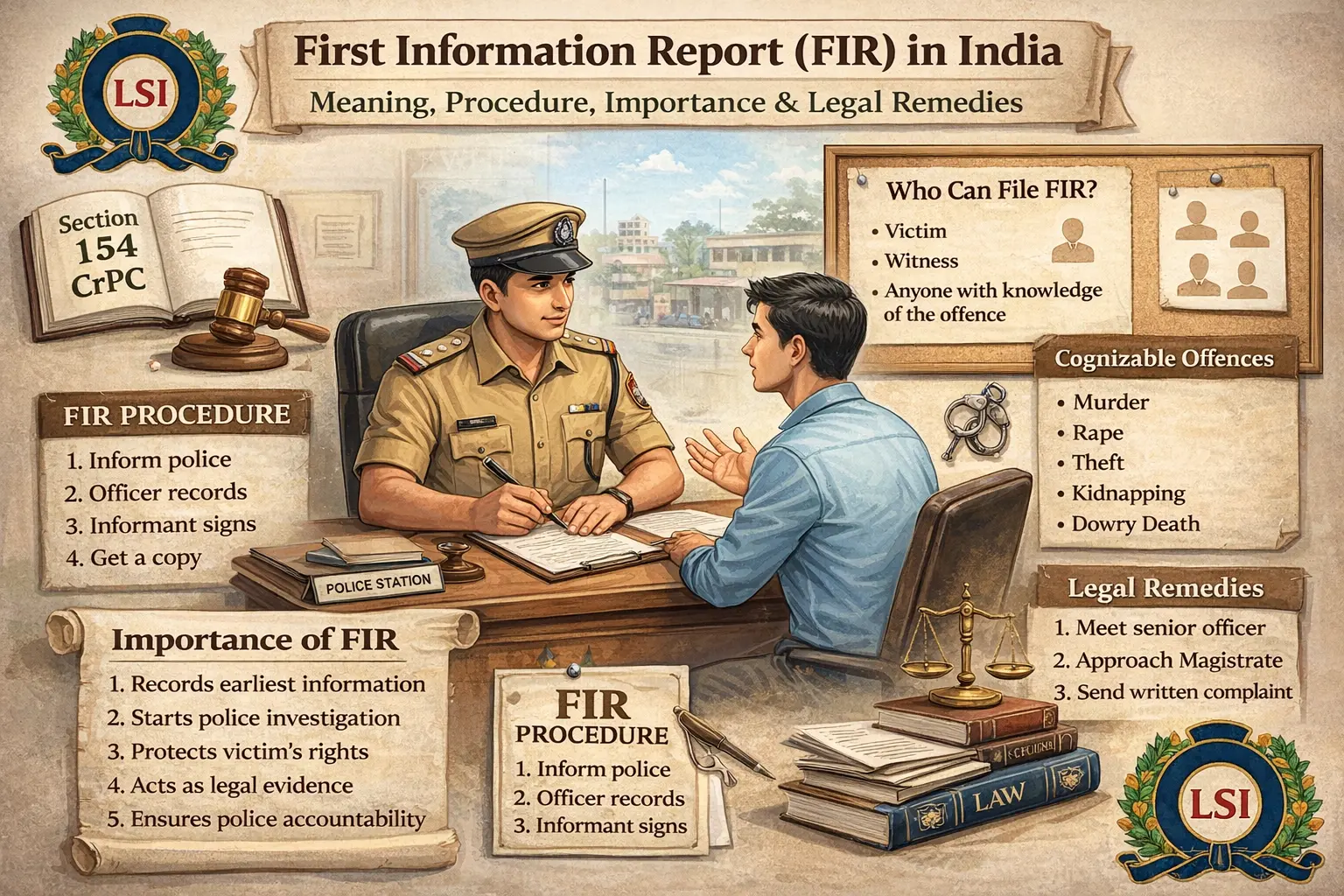
Although the term “FIR” is not specifically defined in the Code of Criminal Procedure, 1973, its procedure is mentioned under Section 154 of the CrPC. The information may be given either orally or in writing by the victim, witness, or any person having knowledge of the offence.
The main purpose of an FIR is to record the earliest information regarding the crime so that the facts are not changed or manipulated later.
Who Can File an Fir
An FIR can be filed by:
- The victim of the offence
- Any witness to the offence
- Any person who has knowledge of the offence.
- A police officer himself (suo motu)
It is important to note that the informant need not be the victim. Even a stranger can file an FIR if they are aware of the commission of a cognizable offence.
Types of Offences for Which Fir Can Be Filed
An FIR is filed mainly in cases of cognizable offences, where the police can arrest the accused without prior permission of the court.
Examples of Cognizable Offences
- Murder
- Rape
- Theft
- Kidnapping
- Dowry death
For non-cognizable offences, the police require permission from a Magistrate before taking action.
Cognizable and Non-Cognizable Offences (Overview)
| Type of Offence | Police Power |
|---|---|
| Cognizable offences | Police can arrest without prior permission of the court |
| Non-cognizable offences | Police require permission from a Magistrate before taking action |
Procedure of Filing an Fir
The procedure for filing an FIR is as follows:
- Information relating to the offence is given to the police officer in charge of the police station.
- If the information is given orally, it must be reduced to writing by the police officer
- The written information must be read over to the informant.
- The informant must sign the FIR after confirming its correctness.
- A copy of the FIR must be given free of cost to the informant.
This procedure ensures transparency and fairness in the criminal justice process.
Importance of FIR
The FIR is important for the following reasons:
| Aspect | Explanation |
|---|---|
| Starting Point of Investigation | FIR is the first step in the criminal investigation. Without it, the police cannot begin the investigation in cognizable cases. |
| Legal Record | It acts as an official record of the incident and helps in preserving the original version of events. |
| Protection of Rights | It protects the rights of both the accused and the victim by preventing false allegations or later manipulation of facts. |
| Judicial Value | FIR is used by courts to corroborate or contradict statements made during trial. |
| Ensures Police Accountability | Once an FIR is registered, the police are legally bound to investigate the matter. |
Relevant Legal Provision: Section 154 of CrPC
Section 154 of the Code of Criminal Procedure, 1973 deals with the information in cognizable cases.
According to Section 154:
- Every information relating to the commission of a cognizable offence shall be recorded by the police.
- The police cannot refuse to register an FIR if the information discloses a cognizable offence.
- In case of refusal, the informant can approach the Superintendent of Police or the Magistrate.
The Supreme Court, in Lalita Kumari v. Government of Uttar Pradesh (2013), held that registration of FIR is mandatory in cases of cognizable offences.
Remedy if Police Refuse to Register FIR
If the police refuse to register an FIR, the following remedies are available:
- Complaint to the Superintendent of Police under Section 154(3) CrPC
- Filing a complaint before a Judicial Magistrate under Section 156(3) CrPC
- Sending written information by post or email.
These remedies ensure that justice is not denied due to police inaction.
Conclusion
The First Information Report is a crucial element of the criminal justice system in India. It not only initiates the process of investigation but also safeguards the interests of both the victim and the accused. Section 154 of the CrPC makes it mandatory for the police to register an FIR in cognizable offences, thereby ensuring access to justice. Hence, an FIR serves as the foundation of criminal proceedings and plays a vital role in maintaining law and order in society.

