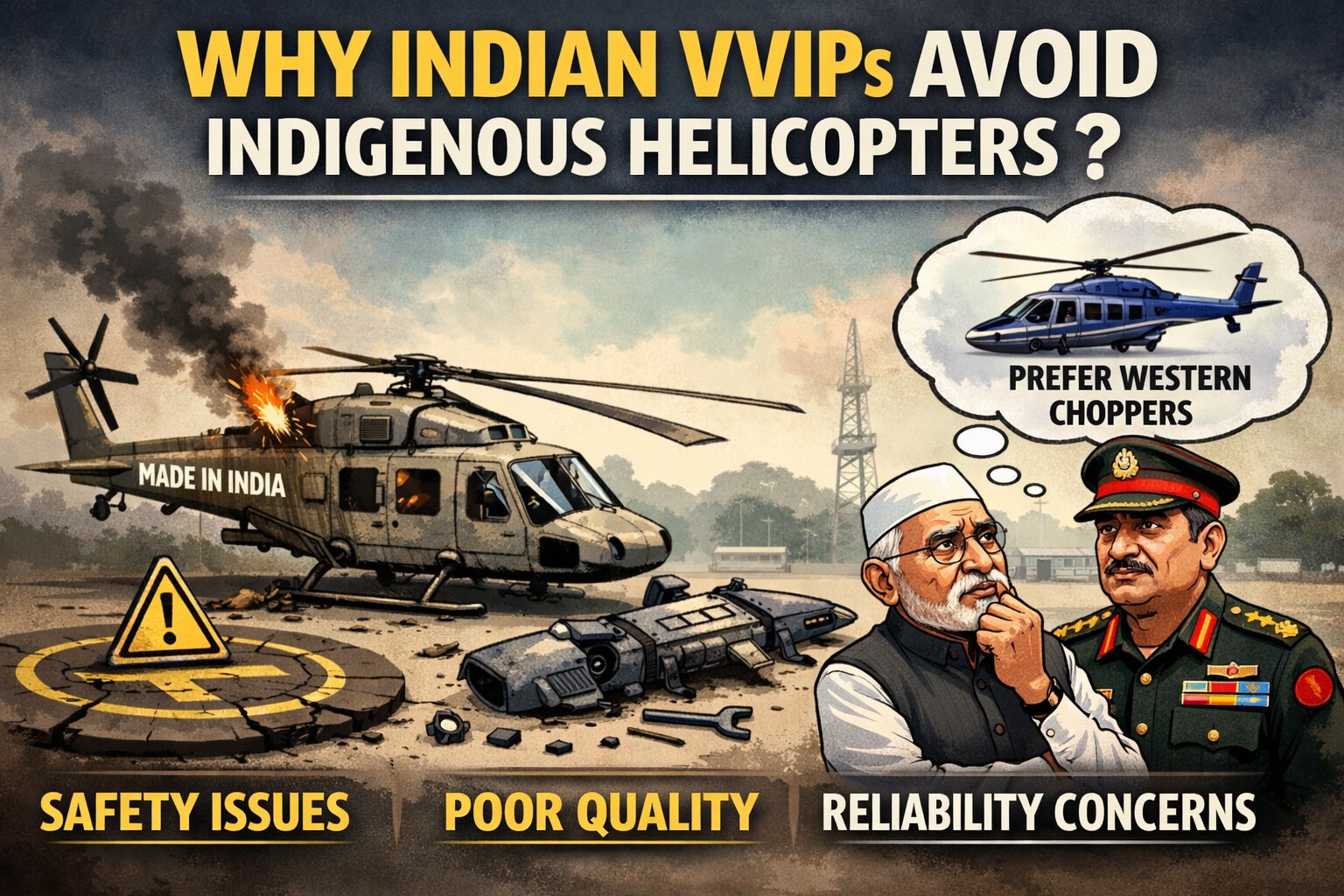
India is one of the few countries in the world with the capability to design and build helicopters entirely within its own borders. Hindustan Aeronautics Limited (HAL), the country’s premier aerospace and defense company, has successfully developed and manufactured several key helicopter models. These include the Advanced Light Helicopter (ALH) Dhruv, the Light Utility Helicopter (LUH), and the Light Combat Helicopter (LCH). These aircraft are actively used by the Indian Army, Air Force, Navy, Coast Guard, and various state-level agencies for operations ranging from transport and surveillance to combat missions.
Despite this significant achievement in indigenous defense production, there is a noticeable gap when it comes to the use of these helicopters for VVIP transport. VVIPs who are at high security risk—rarely fly in Indian-made helicopters during official duties, ceremonial events, or daily travel. Instead, their transport is typically handled by helicopters imported from abroad, mostly from Western countries like France, the United States, or Russia.
This reliance on foreign aircraft isn’t because Indian helicopters are technically inadequate. In fact, models like the Dhruv and LUH have proven their performance, safety, and versatility in tough conditions, including high-altitude operations in the Himalayas and disaster response missions. So, the preference for foreign platforms points to deeper, non-technical issues.
One major factor is perception. There is a long-standing belief in certain circles that foreign-made helicopters are more advanced, reliable, or prestigious. This mindset is rooted in decades of dependence on imported defense equipment and a procurement culture that has historically favored global brands. Security agencies, while focused on safety, often lean toward overly cautious decisions—choosing what they see as “proven” foreign systems to minimize perceived risks.
There are also concerns about liability. In the event of an accident, officials fear greater scrutiny if an indigenous helicopter were involved, even if the incident wasn’t due to any design flaw. The media and political environment can amplify such incidents, turning technical issues into public controversies. As a result, decision-makers often default to foreign models to avoid blame.
Additionally, global image plays a role. Foreign helicopters, especially branded ones like the AW109 or VVIP-configured Chinooks, carry symbolic weight—their use is often seen as a sign of diplomatic alignment or international stature. Choosing them can be as much about political signalling as operational necessity.
Ultimately, the choice of aircraft for VVIP travel reflects more than just technical capability. It reveals underlying attitudes toward domestic innovation, institutional trust, and national self-confidence. Using Indian-made helicopters for top leaders wouldn’t just boost the reputation of homegrown technology—it would send a powerful message about faith in India’s engineering and self-reliance. The real challenge isn’t building the machines; it’s changing the mindset that decides which machines get to carry the nation’s most important leaders.
The Paradox of Indigenous Capability
India’s homegrown helicopter projects, like the ALH Dhruv, aren’t just experimental attempts—they’re battle-tested assets. With over 300,000 flight hours logged, these rotorcrafts have operated across extreme conditions, from the icy Siachen glacier to the tropical Andaman Islands, arid deserts, and coastal regions. They’ve been sold internationally, handled combat duties, rescued stranded personnel in treacherous terrain, and supported disaster relief and supply chains. Their reliability and adaptability are undeniable, proven in countless real-world missions.
Yet, when it comes to transporting India’s highest-profile leaders, these helicopters are often overlooked. Why? The disconnect lies in perception—not technical capability. VVIP travel prioritizes risk avoidance and image over performance metrics. While soldiers, rescuers, and foreign officials trust these machines, decision-makers in elite circles equate safety with international brands, prioritizing brand reputation over demonstrated local expertise. The paradox isn’t in the helicopter’s ability, but in the value placed on its operator’s status.
VVIP Aviation Is a Zero-Failure Domain
In aviation, safety is always the top priority, and in VVIP air transport it becomes an absolute requirement. While a military aircraft mishap is treated as a tragic event that triggers an investigation and is absorbed within the organization, a single incident involving a VVIP can spark a national crisis, undermine political stability and erode international confidence. Consequently, choices in VVIP aviation are driven not just by engineering considerations but by the need to limit political, legal and reputational exposure.
The Psychology of Trust and Imported Reliability
Foreign helicopters—particularly those built in Europe or the United States—are seen as the go‑to choice for many officials because they have been used for decades to transport civilian VVIPs, are linked to world‑leader travel, and enjoy a reputation (often more perception than proven fact) for superior safety. This perception creates a mental shortcut: when a foreign‑made rotorcraft is involved, any mishap can be blamed on outside factors, whereas using a domestically produced helicopter pushes the responsibility inward and turns it into a political issue. As a result, leaders tend to value the image of safety more than the actual statistical safety record.
The Burden of Indigenous Failure
A stark reality guides how we decide: when a foreign‑built helicopter crashes, the story is reduced to “an aviation tragedy,” but when a domestically produced Indian rotorcraft goes down, the narrative shifts to “a systemic failure.” News outlets wouldn’t call it merely an “unfortunate helicopter accident”; instead, they’d headline something like “Home‑grown helicopter falters—scrutiny of ‘Make in India’ intensifies.” This double standard fuels a climate of institutional apprehension.
Legacy of Past Incidents and Narrative Lock-In
The ALH Dhruv helicopter faced challenges during its initial deployment, a common issue for any emerging aircraft worldwide. However, these early incidents attracted excessive media coverage that often-prioritized political discourse over technical details, leading to a distorted public perception. Subtle differences in its design variations, operational roles, and subsequent upgrades were frequently ignored, muddying the narrative. Once a negative image solidified, it proved difficult to shift, as public memory clung to past reports rather than acknowledging the advancements, certifications, and enhancements that followed.
Security Agencies and the Conservatism Bias
Agencies tasked with safeguarding VVIPs, such as the SPG, IAF communication units, and state aviation teams, tend to favour traditional methods due to their risk-averse culture, which stems from systemic challenges. Their incentive structure disincentivizes innovation—offering no recognition for creative solutions while imposing strict penalties if deviations lead to mishaps. As a result, sticking to time-tested approaches becomes the most administratively prudent choice, with imported helicopters gaining preference thanks to their long-standing bureaucratic acceptance and established track records, making them the default “secure” option.
Liability, Accountability, and the Blame Chain
When a VVIP helicopter incident happens, investigations follow: committees are set up, documents are reviewed, and past decisions are re-examined. If the helicopter is imported, blame can be spread across the manufacturer, certification bodies, maintenance teams, or pilot error. But if it’s made in India, the choice to go indigenous comes under extra scrutiny. Officers fear being singled out as “the one who picked the Indian helicopter,” so this unspoken worry often influences defense purchases and deployment, quietly steering decisions away from homegrown options.
Certification vs. Confidence
HAL’s helicopters have received certification from Indian authorities and are approved by military aviation regulators, yet VVIP transport often favours a civilian‑style, internationally recognised certification look, even when the aircraft operate under military rules. Paradoxically, the foreign helicopters used for VVIPs are usually military versions as well, but their overseas origin creates a perception that they possess a higher‑standard certification. In reality, the issue is one of confidence rather than an actual shortfall in certification.
International Optics and Symbolism
When a high-ranking official arrives at a significant international gathering—such as a G20 summit, bilateral meeting, or multilateral conference—the choice of transport carries symbolic weight. Opting for a foreign helicopter subtly signals adherence to “global norms” or “international benchmarks,” while utilizing an Indian-made model might be perceived as more experimental or less prestigious. This contrast is striking: while many countries showcase their domestic aerospace achievements with pride, India, despite possessing the technical expertise, often hesitates, paradoxically prioritizing perceived global alignment over highlighting its own capabilities.
The Comfort and Luxury Argument
VVIP helicopters are more than just a means of transport—they prioritize cabin comfort, low noise, minimal vibration, and high-quality interior finishes. International VVIP helicopters are typically built specifically for executive travel and designed with luxury in mind. In contrast, HAL helicopters were initially developed as multi-purpose aircraft, not exclusively for VVIP use. While their interiors can be upgraded for comfort, they still face a perception gap, as many believe they fall short compared to purpose-built foreign models, even when that’s not entirely true.
Procurement Culture and the Colonial Hangover
India’s procurement system still shows traces of colonial thinking, where imported technology is often seen as better than local options. This belief—that foreign means superior—persists even though India has achieved significant success in developing homegrown solutions over the years. It is sustained by lobbying, consultants, and outdated advice from traditional experts. Nowhere is this mindset more entrenched than in VVIP aviation, a high-profile and elite domain that has been slowest to break free from this legacy.
Media’s Role in Risk Amplification
The Indian media significantly influences aviation discourse by often distorting nuanced issues. Complicated technical matters are reduced to simplistic accounts that assign blame, local setbacks are framed through political lenses, and international incidents are minimized as routine. Those responsible for decision-making recognize this skewed reporting and strategize with these biases in mind.
The Irony: Foreign Leaders Fly Indigenous, Indians Don’t
Many countries use helicopters made in India for various purposes like transportation, general utility tasks, and even for moving VVIPs. It’s a striking irony that while foreign dignitaries travel in Indian-made helicopters, India’s own top leaders often prefer foreign models. This reflects a lack of confidence in domestically produced aircraft, despite their proven use and reliability abroad.
Strategic Consequences of This Reluctance
Reluctance to assign Indian‑made helicopters to top officials undermines faith in the nation’s aerospace sector, confuses investors and collaborators, and dilutes the “self‑reliant India” narrative. If the most senior leaders lack confidence in home‑grown aircraft, how can the broader market be expected to embrace them?
What Would Change the Equation?
The strategy features a VVIP helicopter designed exclusively for high-level use, ensuring it’s purpose-built rather than repurposed utility models. To establish trust gradually, it begins with deployment by Governors and Lieutenant Governors on low-risk, controlled routes, aiming to achieve an unblemished safety record. Institutional backing reinforces this approach, with clear policies prioritizing indigenous aviation and legal safeguards for personnel advocating its adoption. Transparent communication supports the initiative by openly sharing safety data and contextualizing any incidents, fostering public and political confidence in the platform’s reliability.
Leadership and Symbolism
At its core, this is a matter of leadership. When a national leader opts to travel on a locally designed and built helicopter, it reflects trust in the country’s institutions, belief in homegrown innovation, and a commitment to supporting domestic systems. While such a decision entails risks, those inherent challenges are part of the journey toward building a self-reliant nation.
Conclusion
The reason Indian VVIPs rarely use Indian-made helicopters is not rooted in engineering inadequacy. It is rooted in fear of consequences, asymmetry of blame, media narratives, bureaucratic conservatism, and inherited perceptions. India has the machines. What it lacks is institutional courage to normalize their use at the highest level. True confidence in indigenous capability is not expressed in speeches or policy documents—it is expressed in personal choices made at 3,000 feet above ground, with no margin for error. Until that psychological barrier is crossed, Indian helicopters will continue to serve everyone— except the very leadership meant to embody faith in them.