Introduction
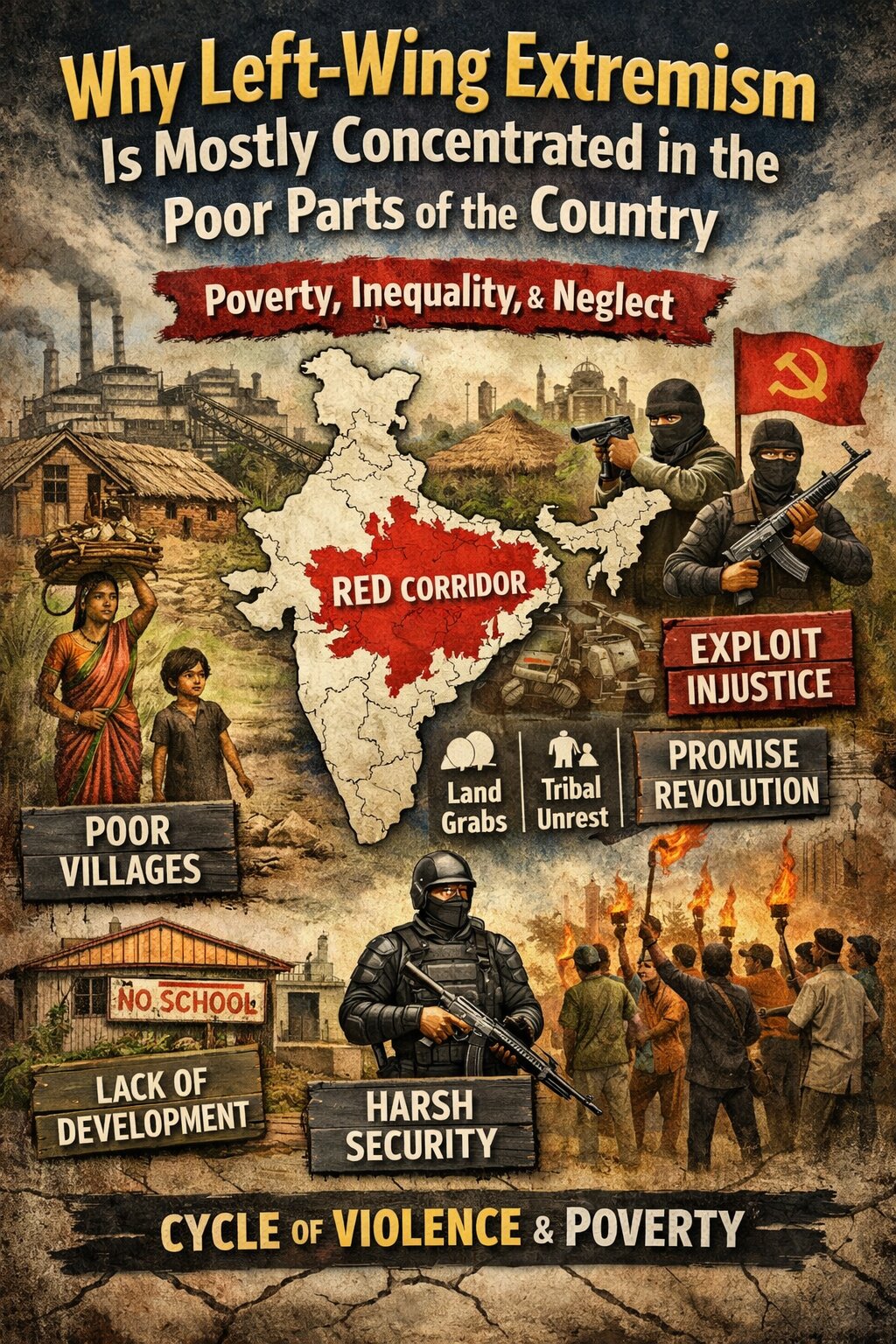
Left-Wing Extremism (LWE) in India is not randomly distributed across the country. Instead, it shows a persistent concentration in regions marked by poverty, underdevelopment, weak governance, and social marginalisation. Districts affected by LWE—often referred to as the “Red Corridor”—are typically those where economic deprivation overlaps with historical injustice and administrative neglect. Understanding why LWE takes deeper root in poorer regions is essential for framing effective security, development, and governance responses.
- Poverty and Economic Deprivation
Poverty is one of the most significant enabling conditions for LWE. In many affected areas, communities struggle with chronic unemployment, low agricultural productivity, lack of industrial opportunities, and minimal access to markets. For generations, people have lived at subsistence levels with little hope of upward mobility.
This economic distress creates resentment against the State and its institutions. LWE groups exploit this frustration by projecting themselves as champions of the poor, promising redistribution of land, fair wages, and resistance against exploitation. Where the State fails to deliver basic economic security, extremist narratives find a receptive audience.
- Unequal Development and Regional Imbalances
Economic growth in India has been uneven. While urban centres and industrial corridors have prospered, large tribal and rural belts—particularly in central and eastern India—have remained outside the mainstream of development. Infrastructure deficits such as poor roads, lack of electricity, inadequate schools, and minimal healthcare facilities reinforce feelings of exclusion.
LWE thrives in these neglected regions by highlighting the contrast between visible prosperity elsewhere and persistent deprivation locally. This sense of being “left behind” strengthens alienation and makes extremist mobilisation easier.
- Land Alienation and Resource Exploitation
Many LWE-affected areas are rich in natural resources like forests, minerals, and water. However, local populations—especially tribal communities—often do not benefit from this wealth. Large development projects, mining operations, and industrial ventures have historically led to land acquisition, displacement, and environmental degradation without adequate compensation or rehabilitation.
Such experiences create deep grievances. LWE groups capitalise on these issues by opposing land acquisition, disrupting mining operations, and portraying themselves as protectors of local rights against corporations and the State.
- Social Marginalisation and Historical Injustice
Poor regions affected by LWE often have high concentrations of Scheduled Tribes and Scheduled Castes. These communities have faced long-standing social discrimination, limited political voice, and weak access to justice. Traditional power structures and exploitative local elites further compound their vulnerability.
Extremist groups frame their ideology around resistance to social oppression and class domination. In areas where people feel humiliated, unheard, or systematically excluded, such ideological messaging resonates more strongly.
- Weak Governance and Administrative Vacuum
A recurring feature of poor, LWE-affected regions is weak State presence. Police stations are understaffed, administrative offices are distant, and grievance redress mechanisms are slow or ineffective. Basic welfare schemes often fail to reach intended beneficiaries due to corruption, lack of awareness, or logistical constraints.
This governance deficit creates a vacuum that LWE groups seek to fill. By running parallel systems—such as informal courts, taxation, and local enforcement—they project an image of authority and control, especially in remote areas where the State is largely absent.
- Low Education and Limited Awareness
Educational indicators in LWE-prone districts are typically poor. Low literacy rates and limited access to quality education reduce critical awareness and restrict employment opportunities. This makes young people particularly vulnerable to recruitment by extremist groups, which offer a sense of purpose, identity, and income—however limited or coercive it may be.
Lack of exposure to alternative viewpoints also allows extremist propaganda to spread with less resistance, especially in isolated communities.
- Security Response Without Development Balance
In several poor regions, the State’s presence has historically been felt more through coercive instruments than through development initiatives. Heavy-handed security operations, when not accompanied by visible governance and welfare measures, can deepen mistrust among local populations.
LWE groups exploit such situations by portraying the State as oppressive and indifferent, further reinforcing their narrative of armed resistance as the only viable option.
Conclusion
The concentration of Left-Wing Extremism in poorer parts of India is not accidental; it is the outcome of a complex interaction between poverty, inequality, marginalisation, weak governance, and historical neglect. While ideology provides the framework for LWE, it is deprivation and exclusion that provide its fuel.
Therefore, addressing LWE cannot rely solely on security measures. Sustainable reduction of extremism requires inclusive development, effective governance, protection of land and resource rights, social justice, and credible State presence in the everyday lives of people. Only when poverty and exclusion are meaningfully addressed will the ground on which LWE thrives begin to shrink.