





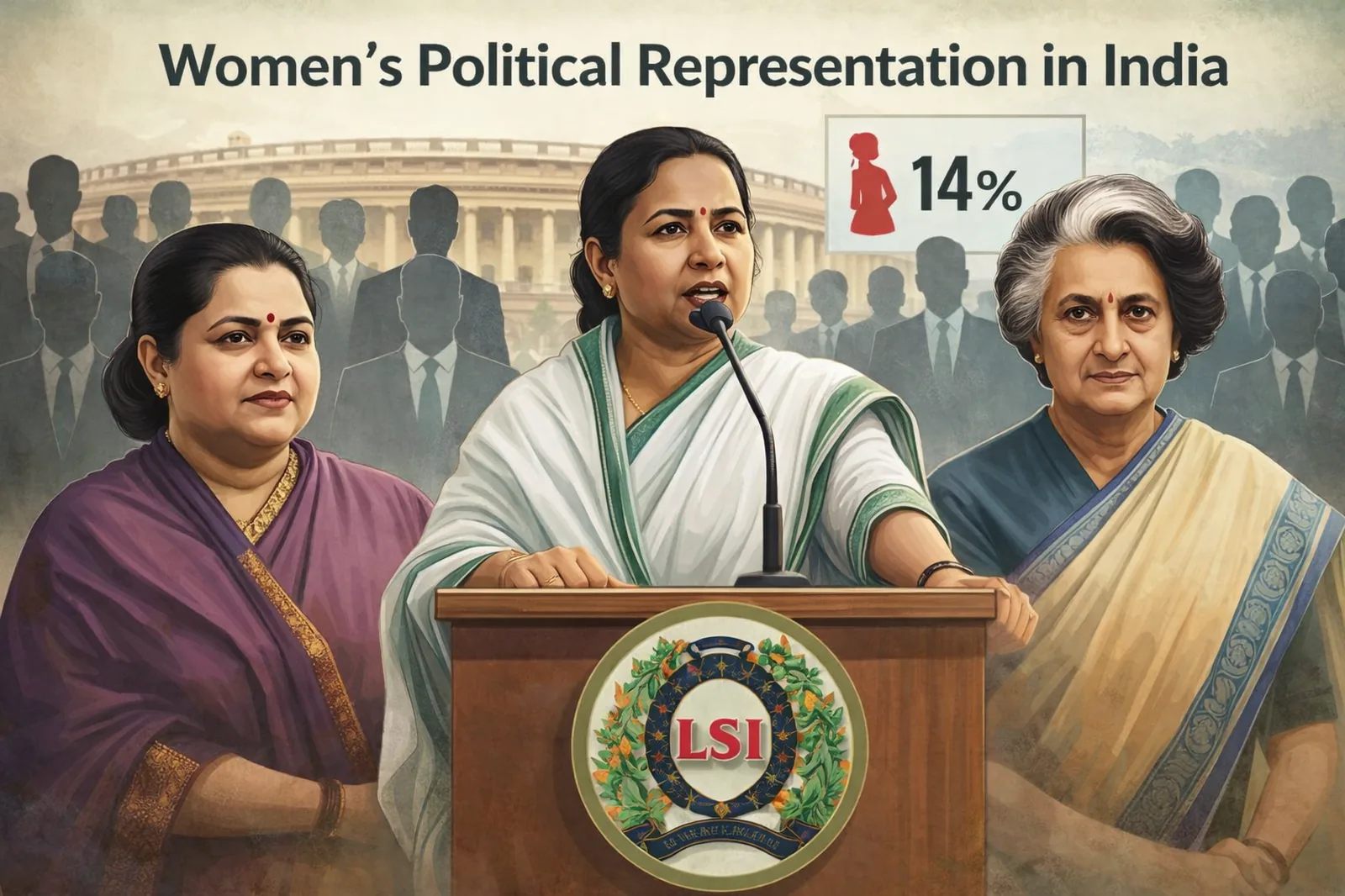
Political representation and participation are fundamental to democracy, yet women remain vastly underrepresented in India’s political institutions. Despite constitutional guarantees of equality and India’s history of women in top political positions—including Prime Ministers, Presidents, and Chief Ministers—the overall picture reveals persistent gender disparities in political power. Understanding the barriers to women’s political participation, the impact of reservation policies, and the pathways to achieving genuine gender parity in governance is crucial for strengthening Indian democracy and ensuring that policies reflect the needs of all citizens.
The Paradox of Indian Women’s Political Representation
India presents a striking paradox in women’s political representation. The country has produced some of the world’s most powerful women political leaders—Indira Gandhi served as Prime Minister for 15 years, Pratibha Patil became President, multiple women have served as Chief Ministers of major states, and Lok Sabha Speakers have been women. This visible leadership at the highest levels creates an impression of gender equality in Indian politics.
However, these individual achievements mask the broader reality of women’s underrepresentation. Women constitute only about 14% of the Lok Sabha (Parliament’s lower house), placing India far behind many developing and developed nations in legislative representation. This percentage, while a historic high, still reflects massive underrepresentation given that women are approximately half the population.
This paradox—high-profile women leaders coexisting with systemic underrepresentation—reflects complex dynamics. Women who reach top positions often do so through family connections, inheriting political capital from fathers, husbands, or other male relatives. While their leadership is significant, it doesn’t necessarily translate to broader opportunities for women without such connections.
The concentration of women’s political leadership in certain families—the Nehru-Gandhi family most prominently, but also regional political dynasties—suggests that political power remains largely hereditary rather than meritocratic. Women’s access to power often depends on male relatives rather than their own political mobilization or party structures actively promoting women.
Historical Context: Women in India’s Freedom Struggle and Early Politics
Women’s participation in India’s independence movement was substantial and visible. Leaders like Sarojini Naidu, Kasturba Gandhi, Kamala Nehru, Aruna Asaf Ali, and countless others played crucial roles in the freedom struggle. Women participated in civil disobedience movements, organized protests, went to jail, and mobilized communities.
This active participation during independence created expectations that free India would embrace women’s political equality. The Constitution guaranteed equal political rights—universal adult suffrage, the right to stand for election, and equality before law. These provisions placed India ahead of many countries in formally recognizing women’s political rights.
However, the translation from constitutional rights to actual participation proved limited. Early Parliaments had minimal women’s representation. The first Lok Sabha elected in 1952 included only 22 women members out of 489 seats—less than 5%. This pattern of extreme underrepresentation persisted for decades.
Some women did achieve prominence in early post-independence politics. Vijaya Lakshmi Pandit became a cabinet minister and UN General Assembly President. Sucheta Kripalani became Chief Minister of Uttar Pradesh. Indira Gandhi’s rise to Prime Minister in 1966 was a watershed moment. However, these individual successes didn’t translate to systematic inclusion of women in political institutions.
The disconnect between women’s active participation in the independence struggle and their subsequent political marginalization reflects a pattern seen in many post-colonial contexts. Revolutionary movements often include women prominently, but post-independence state-building reverts to traditional gender hierarchies. The nationalist movement’s rhetoric of women’s equality was not matched by structural transformation of patriarchal power relations.
Current State of Women’s Representation
National Legislature
As of recent elections, women hold approximately 14% of Lok Sabha seats—about 78 members out of 543. This represents gradual improvement from historical lows but remains far below parity. The 2024 elections saw some increase in women candidates and winners, but the pace of change remains glacial.
The Rajya Sabha (upper house) shows similar patterns, with women holding approximately 11-12% of seats. Nominated members include more women than directly elected ones, suggesting that party leadership includes women when unconstrained by electoral calculations but fails to field them as candidates when electoral competition matters.
Women’s representation varies significantly across political parties. Some parties—particularly regional parties like the Trinamool Congress, Biju Janata Dal, and AIADMK—field more women candidates and have higher percentages of women legislators. National parties like the Congress and BJP have fewer women representatives, though both have had women in leadership roles.
State Legislatures
State assemblies show similar underrepresentation, with most states having fewer than 10% women members. A few states—Bihar, Chhattisgarh, and Madhya Pradesh—have crossed 10%, while others remain below 5%. Larger states tend to have lower representation, while some smaller states show relatively higher percentages.
Chief Ministerial positions have been held by women in multiple states—West Bengal currently has Mamata Banerjee, and historical examples include Jayalalithaa in Tamil Nadu, Mayawati in Uttar Pradesh, Vasundhara Raje in Rajasthan, and others. However, these leaders are exceptions in a predominantly male political landscape.
Women Governors and Lieutenant Governors are more common, though these are appointed rather than elected positions. The symbolic importance of women in constitutional positions contrasts with their limited presence in elected legislatures.
Local Governance
The most dramatic transformation in women’s political participation has occurred at the local governance level. The 73rd and 74th Constitutional Amendments of 1993 mandated 33% reservation for women in Panchayati Raj institutions (village councils) and urban local bodies (municipalities). This single policy change brought over one million women into elected positions.
The impact of local-level reservations has been profound. Women who never imagined participating in public life found themselves elected representatives. Village women who were homebound became decision-makers on local development, resource allocation, and community issues. This grassroots political mobilization represents the most significant expansion of women’s political participation in Indian history.
The Women’s Reservation Bill: Decades of Struggle
The demand for reserved seats for women in Parliament and state legislatures has been one of India’s longest-running political debates. The Women’s Reservation Bill, proposing 33% reservation in the Lok Sabha and state assemblies, was first introduced in 1996 and faced repeated defeats, lapses, and political maneuvering for nearly three decades.
The Arguments For Reservation
Proponents of reservation argue that it is necessary to overcome structural barriers preventing women’s entry into politics. Without deliberate intervention, the slow pace of change means generations will pass before achieving parity. Reservation accelerates representation, bringing diverse women’s voices into legislatures.
Research on local-level reservations demonstrates positive impacts. Reserved seats have changed policy priorities, with women representatives focusing more on water, sanitation, education, and healthcare—issues directly affecting women’s lives. Women’s presence in decision-making bodies has altered deliberative cultures and outcomes.
International experience shows that countries with quota systems or reserved seats achieve higher women’s representation faster than those relying only on voluntary party commitments. The correlation between formal mechanisms ensuring women’s candidacy and actual representation is well-established globally.
Moral and democratic arguments emphasize that legislatures should reflect the populations they represent. When women are half the population but 14% of legislators, democracy is distorted. Ensuring women’s voices in law-making bodies is essential for just governance.
The Arguments Against Reservation
Opponents raise several objections. Some argue that reservation compromises merit, suggesting that positions should be based on capability rather than gender. This argument ignores how patriarchal structures already compromise meritocracy by preventing capable women from accessing opportunities.
Others contend that reservation creates tokenism, with women serving as proxies for male relatives—”sarpanch patis” (husbands of village heads) who control reserved positions. While this phenomenon exists, it reflects implementation challenges rather than invalidating the principle of reservation.
Some parties oppose reservation due to electoral calculations. Reserved seats would require parties to field women candidates in constituencies currently held by male incumbents, creating internal party conflicts. Powerful male politicians resist measures that might displace them.
Concerns about undermining universal franchise suggest that reserved seats could lead to demands for other group-based reservations, fragmenting representation. However, gender is a universal category cutting across all other identities, making it distinct from caste or religious reservations.
The 2023 Breakthrough
After decades of delays, the Women’s Reservation Bill finally passed Parliament in September 2023 with overwhelming support. The legislation reserves 33% of Lok Sabha and state assembly seats for women. However, implementation is deferred until after delimitation (redrawing of constituencies) and census—processes that could take several years.
This delayed implementation has sparked criticism. Supporters who fought for decades fear that postponement represents another delaying tactic. The actual benefit to women may not materialize for years, possibly after the next several elections. Nonetheless, the passage represents a historic victory for women’s political rights advocacy.
The bill also includes sub-reservation for Scheduled Caste and Scheduled Tribe women within the 33%, ensuring that marginalized women benefit from the policy. This intersectional approach recognizes that upper-caste, privileged women have had better political access than women from marginalized communities.
Barriers to Women’s Political Participation
Multiple interconnected barriers limit women’s entry into and success in politics. These barriers operate at individual, institutional, and societal levels, creating a hostile environment for women’s political ambitions.
Social and Cultural Barriers
Patriarchal attitudes about appropriate roles for women fundamentally constrain political participation. Politics is viewed as a male domain—public, combative, and incompatible with femininity. Women who enter politics face accusations of being “unfeminine,” overly ambitious, or neglecting family duties.
Family responsibilities create practical barriers. Politics demands extensive time—campaigning, meeting constituents, attending sessions, traveling. Women bearing primary household and childcare responsibilities struggle to manage political careers. Unlike male politicians whose wives manage households, women politicians rarely have equivalent spousal support.
Mobility restrictions limit women’s political activities. Cultural norms in many communities discourage women’s independent movement, late-night activity, and interaction with unrelated men—all routine aspects of political work. Women’s political participation requires family permission and support, which is often withheld.
Concerns about reputation and honor prevent many women from entering politics. Political life involves public visibility, interaction with diverse people, and sometimes confrontational situations. Families worry about women’s safety and reputation, viewing political involvement as risking family honor.
Political Party Structures
Political parties, despite rhetorical commitments to gender equality, systematically disadvantage women. Party structures are male-dominated, with decision-making concentrated among men. Women’s wings exist in most parties but often lack real power, serving more for mobilizing women voters than promoting women leaders.
Candidate selection processes favor men. Party leadership, predominantly male, selects candidates based on winnability, financial resources, caste calculations, and personal loyalty—criteria that typically favor men. Women are seen as electoral risks, assumed less capable of winning despite evidence contradicting this bias.
The lack of women in party leadership creates a self-perpetuating cycle. Without women in decision-making positions, parties don’t prioritize women’s representation. The few women in leadership often face isolation and limited power to change party culture.
Internal party democracy is limited, making it difficult for women to challenge existing hierarchies. Leadership positions are often hereditary or based on factional control rather than merit or member support. Women without family connections or factional backing struggle to advance.
Financial Barriers
Election campaigns in India are increasingly expensive, requiring substantial financial resources for advertising, travel, rallies, and worker mobilization. Women have less access to wealth, fewer business connections, and limited ability to raise campaign funds compared to men.
The criminalization of politics—with candidates having criminal backgrounds who can mobilize money and muscle power—disadvantages women. Women rarely have access to the illegal or informal networks that fuel political financing. The emphasis on money in politics systematically excludes those without wealth.
Even when parties provide official funding, candidates often need personal resources to supplement party support. Women’s economic subordination, limited property ownership, and lack of independent income restrict their ability to finance political careers.
Violence and Harassment
Women in politics face gender-based violence and harassment designed to intimidate and exclude them. This violence takes multiple forms—sexual harassment, threats, character assassination, physical assault, and online abuse.
During campaigns, women candidates face eve-teasing, molestation, and threats of sexual violence. Their families may be threatened. Opponents use sexist slurs, question their morality, and circulate rumors to damage reputations. Such tactics aim to punish women for transgressing traditional boundaries and deter others from political participation.
Women legislators and officials face harassment within political institutions. Comments about appearance, sexist jokes, speaking over women, and dismissive treatment create hostile work environments. The masculine culture of legislatures makes women feel unwelcome and undervalued.
Online harassment of women politicians has escalated dramatically. Social media platforms enable coordinated abuse campaigns, rape threats, morphed images, and doxxing. The psychological toll of constant harassment affects women politicians’ wellbeing and may drive them from politics.
Media Representation
Media coverage of women politicians focuses disproportionately on appearance, family status, and personal life rather than policy positions and political competence. Headlines emphasize what women wear, their marital status, or family connections rather than their political work.
Women politicians receive less media coverage overall than male counterparts. When covered, framing often emphasizes gender over substance. Senior women leaders may receive attention, but backbenchers and younger women politicians remain invisible.
The media’s tendency to present politics as confrontation and spectacle—emphasizing drama, conflict, and personality clashes—privileges masculine political styles. Women who adopt collaborative, consensus-building approaches may be viewed as less newsworthy, while those adopting aggressive styles face criticism for being “unladylike.”
Impact of Women’s Political Representation
Research and experience demonstrate that women’s political representation matters—not just for justice and equity but for policy outcomes and governance quality.
Policy Priorities and Outcomes
Studies of local governance under reservations show that women representatives prioritize different issues than men. Women invest more in water supply, sanitation, healthcare, and education—infrastructure directly affecting daily life quality. These priorities reflect women’s experiences managing household needs.
Women legislators at state and national levels have championed legislation on domestic violence, sexual assault, property rights, and women’s welfare. The Protection of Women from Domestic Violence Act, enhanced rape laws, and maternity benefit improvements emerged partly from women legislators’ advocacy.
The presence of women in decision-making bodies changes conversations and considerations. Issues affecting women receive attention that might be overlooked in all-male forums. Women’s lived experiences inform policy design, making legislation more responsive to actual needs.
Budget allocations shift when women participate in decisions. Gender-responsive budgeting—analyzing budgets for gender impacts—gains traction when women are present to demand it. Resource allocation becomes more attentive to women’s needs and gender equality goals.
Role Modeling and Social Change
Visible women leaders inspire younger generations. Girls who see women in political authority expand their own aspirations beyond traditional roles. Research shows that in areas with women leaders, girls have higher educational attainment and career ambitions.
Women’s political participation challenges stereotypes about women’s capabilities and appropriate roles. Successfully governing women leaders demonstrate competence, debunking assumptions about women being unsuitable for leadership. This visibility slowly shifts social attitudes.
At the local level, women representatives often become resources for other women in communities. They facilitate access to government services, provide information about rights and programs, and advocate for women facing discrimination or violence. This creates multiplier effects beyond their formal roles.
The empowerment effects on the women themselves are profound. Women who enter politics gain confidence, skills, networks, and public voice. Many describe transformation from hesitant participants to confident leaders. This personal empowerment radiates through families and communities.
Democratic Legitimacy
Representative democracy requires that governing institutions reflect the governed population. Legislatures that are 86% male do not adequately represent a population that is 50% female. Women’s underrepresentation undermines democratic legitimacy and trust.
Diverse perspectives in decision-making lead to better governance outcomes. Homogeneous groups suffer from groupthink and limited creativity. Gender diversity brings different life experiences, knowledge, and approaches to problem-solving, enriching deliberation.
Women’s political participation strengthens accountability. Women voters can better hold women representatives accountable, and women legislators bring accountability to gender-blind or discriminatory policies. This bidirectional accountability strengthens democratic responsiveness.
Strategies for Increasing Women’s Political Participation
Achieving gender parity in political representation requires multifaceted strategies addressing barriers at all levels.
Institutional Reforms
Implementation of Reservations: Swift implementation of the Women’s Reservation Bill is crucial. Delaying implementation perpetuates exclusion. The process should be expedited, with clear timelines and accountability.
Party Reforms: Political parties should voluntarily field at least 33% women candidates even before reservation implementation. Internal party structures should include women in decision-making proportionate to party membership. Candidate selection processes should be transparent and gender-sensitive.
Campaign Finance Reform: Regulating political finance, capping campaign spending, and providing public funding can reduce the advantage of wealthy candidates and level the playing field for women. Specific funding for women candidates could offset their structural disadvantages.
Electoral System Changes: Some argue that proportional representation systems facilitate higher women’s representation than first-past-the-post systems. Party list systems where parties commit to gender balance in lists can ensure representation. India could consider such reforms for certain elections.
Capacity Building and Support
Training Programs: Political leadership training for women—in campaigning, public speaking, policy analysis, and legislative procedures—builds skills and confidence. Organizations providing such training have helped many women enter politics successfully.
Mentorship and Networks: Connecting aspiring women politicians with experienced leaders provides guidance and support. Women’s political networks create solidarity, share strategies, and amplify voices. Such networks buffer against isolation in male-dominated institutions.
Financial Support: Funds specifically for women candidates’ campaigns, either from parties or civil society, can offset financial barriers. Crowdfunding platforms have enabled some women to raise campaign resources from small donors.
Legal Literacy: Educating women about political rights, electoral processes, and legal protections empowers participation. Many women are unaware of their right to stand for election or how to navigate candidacy processes.
Social and Cultural Change
Challenging Gender Stereotypes: Media campaigns, educational curricula, and public discourse challenging assumptions about women’s political capabilities can shift attitudes. Highlighting successful women leaders normalizes women’s political participation.
Engaging Men: Men’s support is crucial for women’s political participation. Programs engaging male family members—educating them about benefits of women’s political participation and encouraging their support—can reduce family-level barriers.
Community Mobilization: Grassroots organizing that encourages women to participate in political processes—from voting to candidacy—builds momentum. Women’s collectives and civil society organizations play vital roles in mobilization.
Celebrating Women Leaders: Recognizing and celebrating women politicians’ achievements—not just at national level but local leaders too—provides visibility and inspiration. Awards, media features, and public acknowledgment validate women’s political contributions.
Addressing Violence
Legal Protections: Strengthening laws against electoral violence, particularly gender-based violence, and ensuring enforcement can protect women candidates and politicians. Fast-track courts for political violence cases could ensure swift justice.
Security Measures: Providing security to women candidates facing threats, monitoring electoral violence, and punishing perpetrators can reduce intimidation. Election commission vigilance on gender-based electoral offenses is essential.
Online Safety: Regulating online platforms to prevent harassment, enabling swift removal of abusive content, and prosecuting cyber harassment can make digital spaces safer for women politicians.
Institutional Responses: Political institutions should have anti-harassment policies, complaint mechanisms, and accountability for creating hostile environments for women members. Zero-tolerance approaches to sexist behavior can change institutional cultures.
International Comparisons and Lessons
India’s women’s political representation lags behind many countries, though it exceeds some others. Understanding international patterns provides lessons for advancing representation.
Rwanda leads globally with 61% women in parliament, achieved through constitutional quotas and deliberate post-genocide reconstruction prioritizing inclusion. Nordic countries maintain 40-45% representation through voluntary party quotas and gender-equality cultures. Latin American countries have significantly increased representation through legislative quotas and enforcement mechanisms.
Successful quota systems share characteristics: clear legal mandates, enforcement mechanisms penalizing non-compliance, placement mandates ensuring women get winnable positions rather than token candidacies, and political culture supportive of gender equality.
Voluntary party quotas work when parties genuinely commit and when there’s political accountability for compliance. Countries where parties adopt quotas but fail to implement them show limited gains. The key is making commitments meaningful through monitoring and consequences.
Proportional representation systems generally facilitate higher women’s representation than majoritarian systems. Party list systems where parties commit to gender balance enable rapid increases. India’s first-past-the-post system makes change more difficult, suggesting value in considering electoral system reforms.
Cultural factors matter but aren’t deterministic. Conservative societies with religious patriarchy have achieved high representation through legal mandates, while liberal democracies sometimes lag. Political will and institutional design can overcome cultural barriers, while cultural progressivism without institutional mechanisms may not translate to representation.
The Road Ahead
The passage of the Women’s Reservation Bill marks a historic milestone, yet implementation challenges and broader representation goals remain. Several priorities should guide efforts to achieve meaningful gender parity in Indian politics.
Swift Implementation: Pressure for rapid implementation of reservations is essential. Civil society monitoring, media attention, and political mobilization can prevent indefinite delays. Clear timelines with accountability mechanisms should be established.
Beyond Numbers: Representation is not just about numerical presence but substantive participation. Ensuring reserved seats translate to genuine empowerment—not proxy representation by male relatives—requires support systems, capacity building, and monitoring.
Intersectional Inclusion: Ensuring diverse women—across caste, class, religion, and region—benefit from increased representation requires attention to intersectionality. Upper-caste, urban, educated women have better access; policies must actively include marginalized women.
Sustained Mobilization: Political change requires ongoing pressure from women’s movements, civil society, and ordinary citizens demanding accountability. The struggle doesn’t end with legal victories but continues through implementation and cultural transformation.
Youth Engagement: Young women entering politics bring fresh perspectives and energy. Encouraging youth political participation, providing pathways for young women leaders, and challenging generational entrenchment can invigorate political renewal.
Conclusion
Women’s political representation in India remains profoundly inadequate despite constitutional guarantees of equality and individual examples of women in highest offices. The 14% representation in national legislature is a democratic deficit requiring urgent attention. Political power concentrated overwhelmingly in men’s hands produces policies insensitive to half the population’s needs and experiences.
The struggle for women’s political representation has been long and difficult, marked by resistance from entrenched interests, cultural barriers, and structural obstacles. Yet progress has occurred—from single-digit representation to approaching 15%, from complete exclusion from local governance to one million women in panchayats, from no legal commitment to reservations to constitutional amendment mandating 33% representation.
The Women’s Reservation Bill represents a watershed moment, though its delayed implementation tempers celebration. When implemented, it will transform India’s political landscape, bringing unprecedented numbers of women into legislatures. This transformation carries potential for policy change, cultural shifts, and democratic deepening.
However, numbers alone don’t guarantee substantive empowerment. The quality of representation matters—ensuring women legislators have genuine voice, resources, and power to shape agendas. This requires addressing violence and harassment, changing institutional cultures, building women’s political capacities, and holding parties accountable for meaningful inclusion.
Ultimately, achieving gender parity in political representation is about realizing democracy’s promise. Democracy claims to govern by and for the people—all people, not just half. Until women participate equally in political power, Indian democracy remains incomplete. The path forward requires sustained commitment from all stakeholders—political parties reforming practices, civil society maintaining pressure, institutions creating enabling environments, and society transforming attitudes about women’s rightful place in public life.
The goal is not symbolic representation but genuine shared power. Every woman who enters politics, challenges barriers, and persists despite obstacles moves India closer to this goal. Every policy ensuring women’s political rights strengthens democratic foundations. The journey toward political gender parity is not just about women’s rights but about building a more just, representative, and effective democracy for all Indians.

