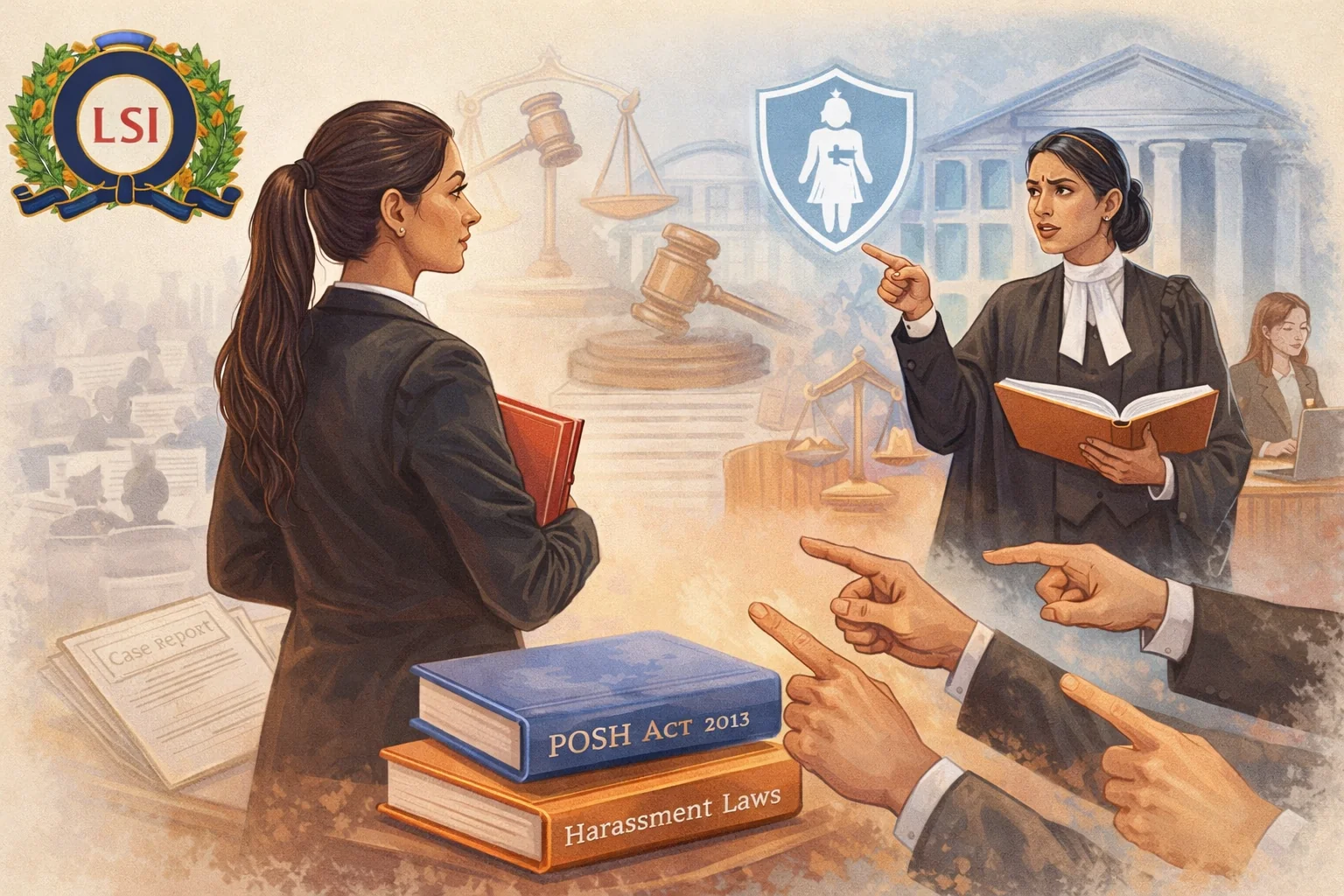
Introduction: Progress with Persistent Shadows
Women have transformed India’s legal profession in remarkable ways. Today, they argue landmark cases, head law firms, teach in universities, and sit on the Bench. Courtrooms that once echoed almost entirely with male voices now reflect a more balanced representation. Yet behind this visible progress lies a quieter, more troubling reality. Many women lawyers continue to navigate unsafe work environments, subtle and overt harassment, professional retaliation, and structural barriers that rarely make it into judgments or annual reports.
This article explores the legal protections available to women lawyers in India, examines how these laws function in real life, highlights documented incidents as case studies, and briefly looks at the experiences of foreign women lawyers working with or in India. It also offers practical, ground-level solutions for institutions and individuals alike.
“The law provides strong words on paper, but courts and chambers must build matching muscle on the ground — confidentiality, impartial inquiry and protection from retaliation.”
— Adv. Tarun Choudhury
The Legal Framework: What the Law Promises
The POSH Act, 2013
The Sexual Harassment of Women at Workplace (Prevention, Prohibition and Redressal) Act, 2013 — commonly known as the POSH Act — is the backbone of workplace protection for women in India. It mandates that every workplace must have an Internal Complaints Committee (ICC) to receive and investigate complaints, conduct inquiries, and recommend action.
On paper, POSH is progressive and victim-centric. It recognises not just physical harassment but also verbal, emotional and digital misconduct. For women lawyers, however, the challenge is that the Act was designed primarily with conventional employer–employee workplaces in mind — not the fragmented, informal and highly individualistic structure of the legal profession.
Advocates Act, 1961 and Bar Council Rules
The Advocates Act, along with the disciplinary powers of State Bar Councils and the Bar Council of India (BCI), regulates professional conduct in the legal profession. Under Section 35, misconduct by advocates can attract disciplinary action including suspension or disbarment.
Over the years, courts and the BCI have issued various guidelines suggesting that sexual harassment complaints involving advocates may be addressed under the Advocates Act, sometimes in addition to POSH. Bar associations have also been advised to comply with POSH norms by creating complaint mechanisms.
Judicial Uncertainty (2024–2025)
Recent years have seen conflicting judicial views on a crucial question: Can a woman advocate directly invoke the POSH Act, or must she approach the Bar Council under the Advocates Act? Several High Courts have grappled with this issue, leaving the law unsettled. In practice, this ambiguity often results in delays, jurisdictional confusion, and procedural dead ends for complainants.
How These Laws Work — And Where They Collapse
The Coverage Gap
Many women advocates are independent professionals, not salaried employees. They work from shared chambers, rotating courtrooms and informal mentorship arrangements. This makes it difficult to identify who the “employer” is — a key requirement under POSH. As a result, some women find themselves legally protected in theory but procedurally stranded in reality.
Power Without Accountability
The legal profession is built on hierarchy: senior advocates control briefs, reputations, referrals and visibility. For junior women lawyers, reporting harassment can feel like professional suicide. The fear is not just of the harasser, but of being quietly excluded from work, networks and opportunities.
- Fear of losing briefs and clients
- Risk of professional isolation
- Loss of mentorship and references
Studies and investigative journalism consistently show that many women choose silence, informal settlements or resignation over formal complaints — not because the harm is small, but because the cost of speaking is too high.
Institutional Weakness
In many court complexes and bar associations, complaint committees either do not exist, are poorly constituted, or lack independence. Even where they exist, complaints often move slowly, confidentiality is breached, and retaliation goes unchecked. The system meant to protect often becomes another source of anxiety.
| Problem Area | Common Reality |
|---|---|
| Complaint Committees | Absent or inactive in many courts |
| Inquiry Process | Slow and procedurally unclear |
| Confidentiality | Frequently breached |
| Retaliation | Rarely monitored or punished |
Case Studies: When Reality Breaks Through the Silence
Case Study A: Woman Lawyer vs Police (Supreme Court, 2025)
In 2025, a practising woman lawyer from Gurugram approached the Supreme Court alleging sexual assault and harassment by police officials. The case gained national attention and highlighted how women lawyers can face threats not only within the profession but also from state authorities.
- Lesson: When the accused are powerful state actors, women lawyers face a double battle — personal trauma and institutional inertia. Without swift judicial intervention, even legal professionals struggle to access justice.
Case Study B: Conviction for Harassment of a Woman Judicial Officer (Delhi High Court, 2025)
In a rare but significant ruling, the Delhi High Court upheld the conviction of a lawyer for outraging the modesty of a woman judicial officer. The court treated the misconduct as both a criminal offence and a professional disgrace.
- Lesson: The judiciary can act decisively when it chooses to. But such firm outcomes remain exceptions rather than the norm.
Case Study C: District Courts in West Bengal (2025 Investigative Report)
An investigative series documented widespread sexual harassment faced by women lawyers across district courts in West Bengal. Court corridors, chambers and post-hearing interactions emerged as common sites of abuse, while institutional responses were largely indifferent.
- Lesson: The problem is not confined to elite metropolitan courts. Grassroots court environments often remain the most unsafe and least regulated.
Foreign Women Lawyers and India: A Different Yet Similar Reality
Regulatory Landscape
Foreign lawyers are not permitted to practise Indian law or appear in Indian courts. They may advise on foreign or international law and participate in international arbitration under restricted BCI rules. These regulations shape the experience of foreign women lawyers working in India.
Safety and Workplace Experience
Foreign women lawyers often work under formal contracts with international firms, which brings stronger HR frameworks, reporting channels and global compliance standards. This institutional structure offers relatively better protection than what many Indian women lawyers receive.
However, challenges remain — cultural barriers, visa dependence, lack of access to Indian regulatory remedies, and limited local support systems can make redress difficult when harassment occurs.
Comparative Overview
| Aspect | Indian Women Lawyers | Foreign Women Lawyers |
|---|---|---|
| Regulatory Access | Full access to Indian legal remedies | Limited by visa status and BCI restrictions |
| Workplace Structure | Often informal or poorly regulated | Formal contracts and HR systems |
| Protection Mechanisms | Weak or inconsistently enforced | Stronger global compliance frameworks |
| Common Challenges | Harassment, bias, institutional silence | Cultural barriers, isolation, limited remedies |
Practical Solutions: What Actually Works
For Courts and Bar Associations
- Independent complaint mechanisms: Every court complex must have a transparent, impartial and accessible committee with real disciplinary powers.
- Mandatory training: Regular sensitisation programmes for judges, advocates, clerks and staff.
- Safe infrastructure: Proper lighting, CCTV in public areas, secure travel facilities and safe waiting spaces.
- Zero-retaliation rules: Fast interim protection for complainants and strict penalties for professional victimisation.
For Law Firms and International Firms
- Robust HR systems: Multiple reporting channels, external investigators, and written anti-harassment policies.
- Structured mentoring: Reduce informal power dependencies and create accountable professional relationships.
For Individual Women Lawyers
- Document everything: Preserve messages, dates, witnesses and meeting records.
- Use multiple remedies: ICC, Bar Council, FIR — wherever applicable.
- Seek collective strength: Women lawyer networks, NGOs and legal aid clinics offer emotional and strategic support.
Summary Table: Practical Solutions
| Stakeholder | Key Measures |
|---|---|
| Courts and Bar Associations | Independent complaint mechanisms, mandatory training, safe infrastructure, zero-retaliation rules |
| Law Firms and International Firms | Robust HR systems, structured mentoring |
| Individual Women Lawyers | Document everything, use multiple remedies, seek collective strength |
Final Reflection: From Legal Promise to Living Reality
The legal profession should be a sanctuary of rights, not a terrain of silent suffering. India has no shortage of laws — the POSH Act, the Advocates Act and BCI guidelines together form a strong legal scaffold. What remains missing is consistent enforcement, institutional courage and cultural reform.
When bar associations protect reputations over victims, when courts delay instead of defend, and when silence becomes safer than justice, the profession loses its moral authority. True reform will come not merely from new laws, but from building workplaces where dignity is protected as fiercely as precedent.
Only then can the law stop being just a shield on paper — and become real protection in practice.
“When a junior woman lawyer fears for her practice if she speaks up, we have failed as a profession. The remedy is institutional: functioning complaint mechanisms, training, accountability and cultural change.”
— Adv. Tarun Choudhury