





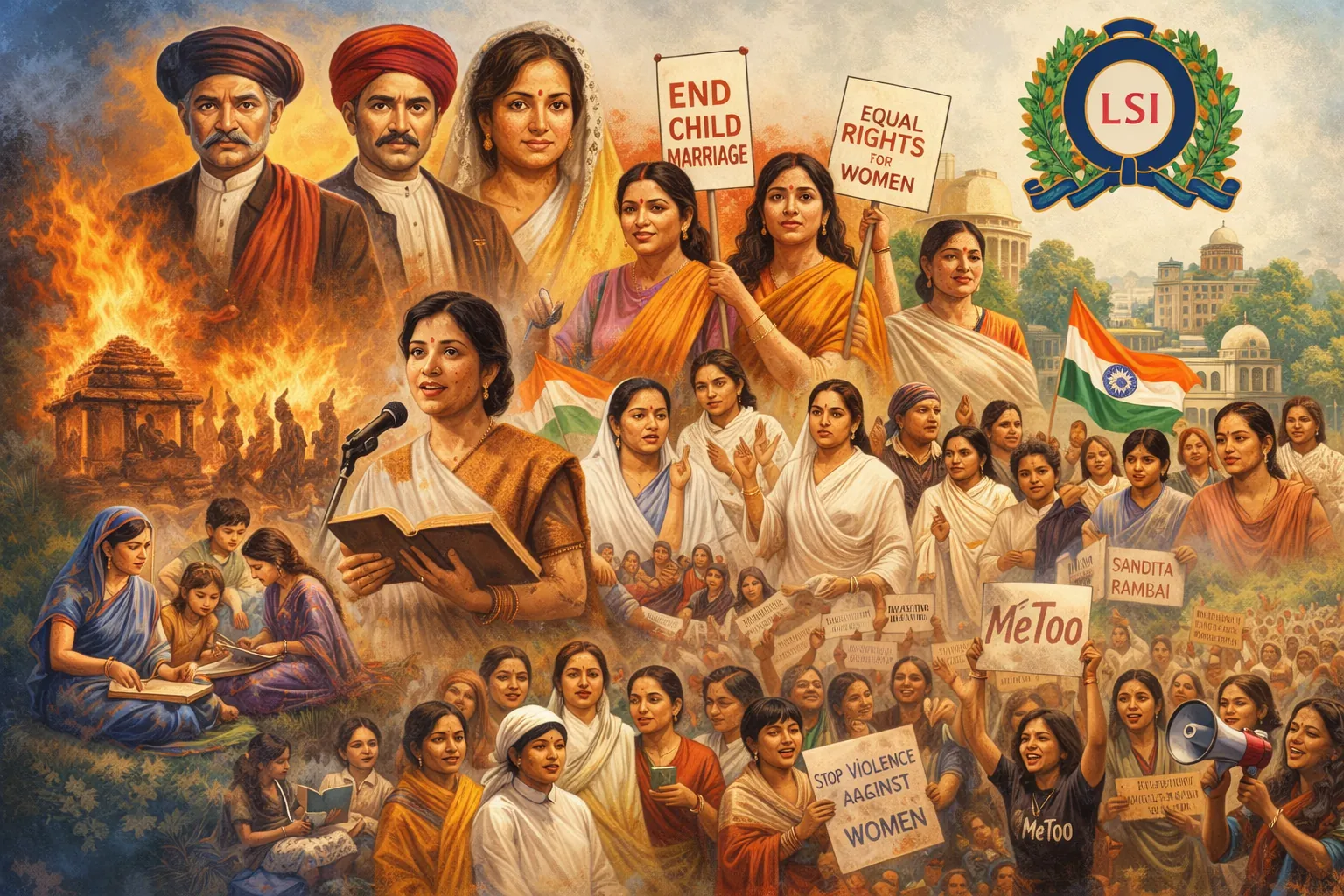
The story of women’s rights in India is inseparable from the story of women’s movements—the collective struggles, organizations, campaigns, and mobilizations through which women and their allies have challenged oppression, demanded rights, and reshaped society. From 19th-century reform movements addressing sati and child marriage to contemporary campaigns against sexual violence and for reproductive rights, women’s organizing has been the engine driving progress. Understanding this history—its victories and setbacks, its ideological debates and strategic choices, its heroes and everyday activists—is essential for comprehending how change happens and for charting the path forward in the ongoing struggle for gender equality.
Early Reform Movements: Colonial Context and Social Reform (1800s-1947)
The origins of organized advocacy for women’s rights in India emerged during the colonial period, shaped by the encounter between indigenous traditions, colonial rule, and reformist impulses.
The Social Reform Movement
The 19th-century social reform movement addressed various practices affecting women, driven initially by male reformers influenced by Western education and Enlightenment ideas, though women soon became active participants.
Raja Ram Mohan Roy led efforts against sati (widow immolation), culminating in its prohibition in 1829. While his intervention was paternalistic and his motivations complex—combining humanitarian concerns with desire to present Indian society as civilized to British rulers—the campaign against sati marked an early challenge to practices harmful to women.
Ishwar Chandra Vidyasagar championed widow remarriage, challenging the stigma and restrictions on widows. The Hindu Widows’ Remarriage Act of 1856 legalized widow remarriage, though social acceptance lagged far behind legal permission. Vidyasagar also advocated for women’s education, establishing schools for girls.
Jyotirao Phule and Savitribai Phule took more radical approaches, connecting women’s oppression with caste hierarchy. Savitribai, India’s first female teacher, opened schools for girls from lower castes, facing violent opposition from upper-caste communities. The Phules’ work linked gender justice with caste annihilation, prefiguring intersectional approaches.
Women’s Own Voices Emerge
By the late 19th century, women themselves began articulating demands and organizing collectively. Pandita Ramabai, a Sanskrit scholar and social reformer, established homes for widows and advocated for their education and economic independence. Her writings challenged patriarchal interpretations of religious texts and colonial attitudes toward Indian women.
Women’s organizations began forming—the Ladies Social Conference (1904), the All-India Women’s Conference (AIWC) founded in 1927, and others. These organizations initially focused on social reform—education, child marriage, purdah—but gradually expanded to political issues.
The Nationalist Movement and Women’s Participation
The independence struggle mobilized women massively. Sarojini Naidu, Kasturba Gandhi, Kamala Nehru, Aruna Asaf Ali, Sucheta Kripalani, Vijaya Lakshmi Pandit, and countless others participated in civil disobedience, organized protests, went to prison, and provided leadership.
Women’s participation challenged gender norms—they entered public spaces, defied colonial authority, and demonstrated capabilities contradicting stereotypes about female frailty. The nationalist movement created space for women’s political engagement that would shape post-independence organizing.
However, the relationship between nationalism and feminism was complex. Nationalist rhetoric sometimes deployed women symbolically—as mothers of the nation or repositories of tradition—rather than recognizing them as autonomous political actors. Gender issues were sometimes subordinated to nationalist goals, with women’s demands deferred until after independence.
Gains and Limitations
The reform period achieved significant changes—legal prohibitions on sati and child marriage, expansion of women’s education, widow remarriage legalization, and women’s political mobilization. These changes created foundations for further progress.
However, reforms were limited in scope and impact. They primarily affected urban, upper-caste communities while leaving rural and lower-caste women largely untouched. Reformers often operated within patriarchal frameworks, seeking to “improve” women’s conditions rather than fundamentally challenging gender hierarchy. The focus on specific practices like sati sometimes diverted attention from broader structural inequalities.
Post-Independence: Constitutional Rights and Organizational Growth (1947-1970s)
Independence brought constitutional guarantees of equality but limited immediate transformation of women’s lives, prompting new forms of organizing.
Constitutional Foundations
The Indian Constitution enshrined gender equality—prohibiting discrimination, guaranteeing equal rights, and enabling affirmative action for women. These provisions, championed by women constitution-makers like Hansa Mehta and Dakshayani Velayudhan, created legal frameworks for advancing women’s rights.
However, the gap between constitutional promises and lived realities was vast. Laws existed without enforcement. Social norms contradicted legal rights. Economic and political power remained concentrated in male hands.
The Quiet Period
The first two decades post-independence saw relatively limited women’s movement activity. Attention focused on nation-building, economic development, and political consolidation. Existing women’s organizations like AIWC continued work on social welfare and women’s issues but with less mobilizational energy than the independence era.
The National Federation of Indian Women (NFIW), affiliated with the Communist Party, organized working-class women around labor issues. These efforts connected women’s rights with class struggle, though sometimes subordinating gender to class analysis.
The 1970s: Resurgence and Radicalization
The 1970s witnessed a resurgence of feminist activism globally and in India, sparked by multiple factors—rising education creating conscious women, Emergency period restrictions provoking resistance, and international women’s movements inspiring organizing.
The Towards Equality report (1974), commissioned by the government to assess women’s status, documented deteriorating conditions—declining sex ratios, falling labor force participation, persistent violence. The report’s findings galvanized activism by providing empirical evidence of women’s marginalization.
Autonomous women’s groups emerged independent of political parties, prioritizing gender over other political alignments. Groups like Stree Sangharsh in Delhi, the Progressive Organization of Women in Hyderabad, and others organized around violence against women, dowry, rape, and economic exploitation.
The Mathura rape case (1978)—where the Supreme Court acquitted policemen who raped a young tribal girl, blaming her for “consent”—sparked nationwide protests. Women’s groups organized demonstrations, sit-ins, and campaigns demanding legal reform. This mobilization led to amendments in rape laws, expanding the definition and shifting evidentiary burdens in certain contexts.
The Contemporary Movement: Diversification and Debates (1980s-Present)
From the 1980s onward, the women’s movement grew, diversified, and grappled with internal debates while achieving significant victories.
Anti-Dowry and Anti-Violence Campaigns
Dowry deaths—murders of women by husbands and in-laws over dowry demands—became a major focus. Cases like that of Tarvinder Kaur (1979), burned to death by her in-laws, sparked outrage. Women’s groups organized protests, coined slogans like “Dahej ki aag mein bahu jali” (the bride burns in dowry’s fire), and demanded legal action.
Campaigns led to the Dowry Prohibition Act amendments and legal recognition of dowry death as a specific crime. However, implementation remained weak, and dowry practices persisted, demonstrating limits of legal reform without social transformation.
Campaigns against other forms of violence—rape, sexual harassment, domestic violence—intensified. The Bhanwari Devi case (1992), where a Rajasthani woman working on social development was gang-raped for preventing child marriage, led to landmark Supreme Court guidelines on workplace sexual harassment (Vishaka judgment, 1997).
Sati and Communal Tensions
The Roop Kanwar case (1987), where an 18-year-old woman was burned on her husband’s funeral pyre in Rajasthan, reignited debates about sati. Women’s groups condemned the incident and subsequent glorification, demanding action against perpetrators.
However, the case revealed tensions. Hindu right-wing groups defended sati as religious practice and women’s choice, accusing feminists of cultural imperialism. The episode highlighted how women’s rights issues intersect with religious politics and communal identities, complicating straightforward advocacy.
Economic Liberalization and Women Workers
The 1991 economic liberalization prompted organizing around its gendered impacts. The National Alliance of People’s Movements and various women’s organizations highlighted how structural adjustment, privatization, and globalization affected women—through job losses, reduced subsidies, declining public services, and exploitative conditions in export industries.
The Self-Employed Women’s Association (SEWA), founded by Ela Bhatt in 1972, organized informal sector women workers—street vendors, home-based workers, agricultural laborers. SEWA provided model for organizing marginalized women around economic rights, combining union organizing with service provision.
Reproductive Rights and Health
The women’s health movement challenged coercive family planning programs, unsafe contraceptive testing, and neglect of women’s broader health needs. Organizations like Saheli in Delhi, Stree Arogya Shodh in Maharashtra, and others documented forced sterilizations, inadequate maternal care, and health system failures.
Campaigns for reproductive rights emphasized women’s autonomy in reproductive decisions, safe abortion access, and comprehensive reproductive healthcare beyond population control. This work challenged both state population policies and conservative opposition to reproductive freedoms.
Legal Activism and Public Interest Litigation
Feminist lawyers and legal activists used courts strategically to advance women’s rights. Public Interest Litigations on custodial rape, sexual harassment, domestic violence, and other issues expanded legal protections and established precedents.
Organizations like Majlis in Mumbai and Lawyers Collective Women’s Rights Initiative provided legal aid to women survivors of violence while engaging in law reform advocacy. This legal activism secured important victories—the Domestic Violence Act (2005), Sexual Harassment Act (2013), and various judicial pronouncements strengthening women’s rights.
The 2012 Delhi Gang Rape and Mass Mobilization
The brutal gang rape and murder of Jyoti Singh (popularly known as Nirbhaya) in December 2012 sparked unprecedented protests. Thousands, particularly young people, took to streets demanding safety, justice, and systemic change. The spontaneous, sustained mobilization reflected accumulated frustration with violence and impunity.
The protests led to the Justice Verma Committee recommendations and subsequent legal amendments strengthening sexual violence laws—expanded rape definitions, increased penalties, new offenses. Fast-track courts were established, though their effectiveness has been limited by broader systemic problems.
The Nirbhaya protests represented a watershed—demonstrating public anger at violence against women, bringing feminist concerns into mainstream consciousness, and showing potential for mass mobilization around gender justice.
#MeToo Movement
The #MeToo movement, which went global in 2017, reached India in 2018. Women across sectors—media, entertainment, academia, arts, corporate—shared experiences of workplace sexual harassment. Prominent men faced public accusations, some lost positions, and conversations about workplace cultures intensified.
#MeToo demonstrated social media’s power for collective voice and accountability outside formal legal systems. However, it also revealed class and caste dimensions—most public allegations came from relatively privileged women in white-collar professions, while working-class and Dalit women’s harassment often remained invisible.
Backlash emerged—concerns about false accusations, due process, and men’s reputations. Some cases resulted in defamation suits against accusers. The movement’s impact on institutional practices and cultures remains contested.
Ideological Currents and Internal Debates
The women’s movement has never been monolithic, encompassing diverse ideological perspectives and experiencing significant internal debates.
Liberal vs. Radical Feminism
Liberal feminists emphasize equality within existing systems—equal access to education, employment, political participation, and legal rights. They pursue reform through legislation, policy changes, and institutional integration.
Radical feminists argue that patriarchy is fundamental, requiring revolutionary transformation rather than reform. They emphasize consciousness-raising, challenging male violence and control over women’s bodies and lives, and creating women-centered alternatives to patriarchal institutions.
These different orientations lead to strategic differences—whether to work within existing institutions or build alternatives, whether legal reform is sufficient or cultural revolution necessary, and whether men can be genuine allies or inherently benefit from patriarchal privilege.
Autonomous vs. Mainstream Organizations
Autonomous women’s groups, independent from political parties and male-dominated organizations, emerged in the 1970s believing that women’s issues needed independent organizing free from subordination to other political goals.
Mainstream women’s organizations affiliated with political parties—Congress, Left parties, BJP—integrate women’s issues within broader political programs. They access resources and political power through party connections but risk subordinating gender to party priorities.
Debates about autonomy continue—whether autonomous organizing maintains focus on gender issues or risks marginalization, whether mainstream affiliation provides influence or compromises independence.
Class and Caste: Intersectionality Debates
Dalit feminists have challenged mainstream feminism for centering upper-caste women’s experiences while ignoring caste oppression. They articulate distinct forms of gender oppression faced by Dalit women—caste-based sexual violence, economic exploitation in degrading work, and discrimination from both upper-caste women and Dalit men.
Organizations like the National Federation of Dalit Women and individual activists like Ruth Manorama have demanded that women’s movements address caste, class, and religion alongside gender. These interventions have pushed movements toward intersectional analyses recognizing multiple, overlapping oppressions.
Working-class feminists similarly challenge middle-class feminist agendas that prioritize professional women’s concerns—workplace harassment in corporate offices—while neglecting issues affecting poor women—agricultural labor exploitation, domestic worker rights, food security.
Secularism and Communalism
The relationship between feminism and religious identity has been contentious. Muslim feminists have challenged both patriarchal interpretations of Islamic law and Hindu nationalist instrumentalization of Muslim women’s issues to attack Muslim communities.
Organizations like Bharatiya Muslim Mahila Andolan work for Muslim women’s rights within Islamic frameworks, challenging regressive practices while resisting external interference. The Shah Bano case (1985-86), involving Muslim women’s maintenance rights, revealed tensions between women’s rights, religious personal laws, and communal politics.
Debates continue about Uniform Civil Code—whether it would ensure women’s equality or impose majoritarian norms, whether reform should come through UCC or progressive interpretation of personal laws, and whose voices should be centered in these discussions.
Globalization and Transnational Feminism
Indian feminism engages with global women’s movements, international human rights frameworks, and transnational advocacy networks. CEDAW (Convention on Elimination of All Forms of Discrimination Against Women) ratification, Beijing Platform participation, and engagement with UN processes connect Indian activism to global movements.
However, debates exist about Western feminism’s influence—whether international frameworks empower or impose alien concepts, whether funding from international donors shapes agendas, and whether global feminism respects cultural differences or imposes universalist assumptions.
The Digital Divide in Activism
Contemporary movements increasingly use social media and digital tools for organizing, awareness, and mobilization. Digital activism enables rapid communication, broad reach, and documentation.
However, digital divides mean privileged women dominate online feminist spaces while poor, rural, and less educated women remain excluded. Questions arise about whether digital activism substitutes for grassroots organizing, whether it builds sustainable movements, and how to bridge online-offline gaps.
Achievements and Limitations
The women’s movement has achieved remarkable victories while facing persistent limitations and challenges.
Legislative and Legal Victories
Movements have secured significant legal changes—Domestic Violence Act, Sexual Harassment Act, amendments to rape laws, property rights reforms, and various Supreme Court judgments. These provide frameworks for protection and recourse, even if implementation remains inadequate.
Legal activism has expanded rights interpretation—reproductive autonomy, privacy rights, and non-discrimination principles have been judicially recognized. These jurisprudential developments create precedents for future claims.
Policy Changes
Advocacy has influenced policies—panchayat reservations for women, midday meal schemes supporting girls’ education, conditional cash transfers for girls, and various welfare programs. Gender budgeting and women’s development departments in government reflect movement pressure.
Cultural Shifts
Perhaps most importantly, movements have shifted consciousness. Public discourse about violence, rights, equality, and autonomy differs dramatically from decades ago. Behaviors once normalized—domestic violence, workplace harassment, child marriage—face social questioning and opposition.
Younger generations, particularly urban youth, hold more egalitarian attitudes than previous generations, partly due to sustained movement advocacy, awareness campaigns, and cultural interventions. While gaps between attitudes and behaviors persist, ideological shifts create potential for further change.
Limitations and Challenges
Despite achievements, movements face significant limitations. Legal reforms remain inadequately implemented—laws exist but justice is inaccessible, perpetrators unpunished, survivors unsupported. The gap between rights and realities remains vast.
Movement reach is limited—urban, educated, upper-caste women dominate activism while poor, rural, Dalit, Adivasi, and Muslim women are underrepresented in leadership and have their issues marginalized. Creating genuinely inclusive movements remains challenging.
Organizational sustainability is difficult—many groups operate with minimal resources, burnout is common, and maintaining momentum between crisis moments challenging. Institutionalization can bureaucratize movements while avoiding it leaves them precarious.
Backlash against women’s advancement is real—conservative forces mobilize around “tradition” and “family values” to oppose change. Each gain provokes resistance, requiring constant defense alongside pushing for further progress.
Intersecting oppressions complicate organizing—addressing gender requires confronting caste, class, religion, and other hierarchies, yet movements struggle to hold these analyses simultaneously without fragmenting or prioritizing one dimension over others.
The Future of Women’s Movements
The future of women’s organizing faces both opportunities and challenges requiring strategic thinking and adaptation.
Building Inclusive Movements
Creating movements that genuinely center marginalized women—Dalit, Adivasi, Muslim, disabled, LGBTQ+, poor—requires more than rhetorical commitment. It demands leadership opportunities, resource allocation, agenda-setting power, and sustained engagement with intersecting oppressions.
Coalition-building across different struggles—labor, caste annihilation, religious minority rights, environmental justice—can create powerful alliances while respecting different movements’ specificities.
Bridging Generations
Intergenerational collaboration between veteran activists with experience and institutional memory and younger feminists bringing energy, digital savvy, and fresh perspectives can strengthen movements. Avoiding both elitism dismissing youth and ageism discarding experience requires mutual respect and dialogue.
Digital and Grassroots Integration
Leveraging digital tools for organizing, awareness, and mobilization while ensuring grassroots connection, sustained offline organizing, and inclusion of digitally excluded women requires creative strategies. Technology should augment rather than substitute for face-to-face organizing.
Sustaining Momentum
Building institutions and structures that outlast particular campaigns or charismatic leaders creates sustainability. However, institutionalization must avoid bureaucratization that dampens radical potential. Balancing sustainability with dynamism remains an ongoing challenge.
Theoretical Development
Developing Indian feminist theory grounded in local contexts while engaging with global feminisms can provide analytical frameworks for understanding and challenging oppression. Theory emerging from struggles, tested in practice, and refined through reflection strengthens movements.
State Engagement vs. Autonomy
Navigating relationships with states—engaging to influence policy while maintaining independence to criticize—requires strategic sophistication. Movements need state action on legislation, resources, and enforcement but must avoid co-optation or dependence that constrains radical critique.
Conclusion: The Unfinished Revolution
The women’s movement in India represents an ongoing, unfinished revolution. Over two centuries, women and allies have challenged practices killing women, denied their education, married them as children, confined them to domestic spheres, controlled their bodies, and subordinated them systematically. Through organizing, advocacy, litigation, and cultural intervention, movements have achieved remarkable transformations.
Yet the revolution remains incomplete. Millions of women still face violence, economic marginalization, political exclusion, and social subordination. Legal rights exist but implementation lags. Consciousness has shifted but behaviors haven’t fully followed. Progress for some coexists with continued oppression for many.
The history of women’s movements teaches crucial lessons. Change is possible—comparing women’s status today with a century ago demonstrates dramatic transformation. Change requires struggle—nothing was given freely but won through sustained organizing and resistance. Change is uneven—legal reforms outpace social transformation, urban areas advance faster than rural, privileged women benefit more than marginalized.
The future depends on whether movements can build on achievements while addressing failures, whether they can become genuinely inclusive while maintaining focus, whether they can sustain momentum between crisis mobilizations, and whether they can navigate complex political terrains without compromising principles.
Every woman who speaks out, every organization formed, every campaign waged, every law passed, every perpetrator held accountable, and every social norm challenged contributes to the ongoing revolution. The journey from colonial-era social reform to contemporary intersectional feminism shows how far the movement has traveled. The persistence of gender inequality shows how far it must still go.
The women’s movement is not background to women’s rights but the engine driving progress. Understanding this history—honoring those who struggled before us, learning from victories and defeats, recognizing ongoing challenges—equips current and future activists for the continued struggle toward the still-distant goal of full gender equality in India.

