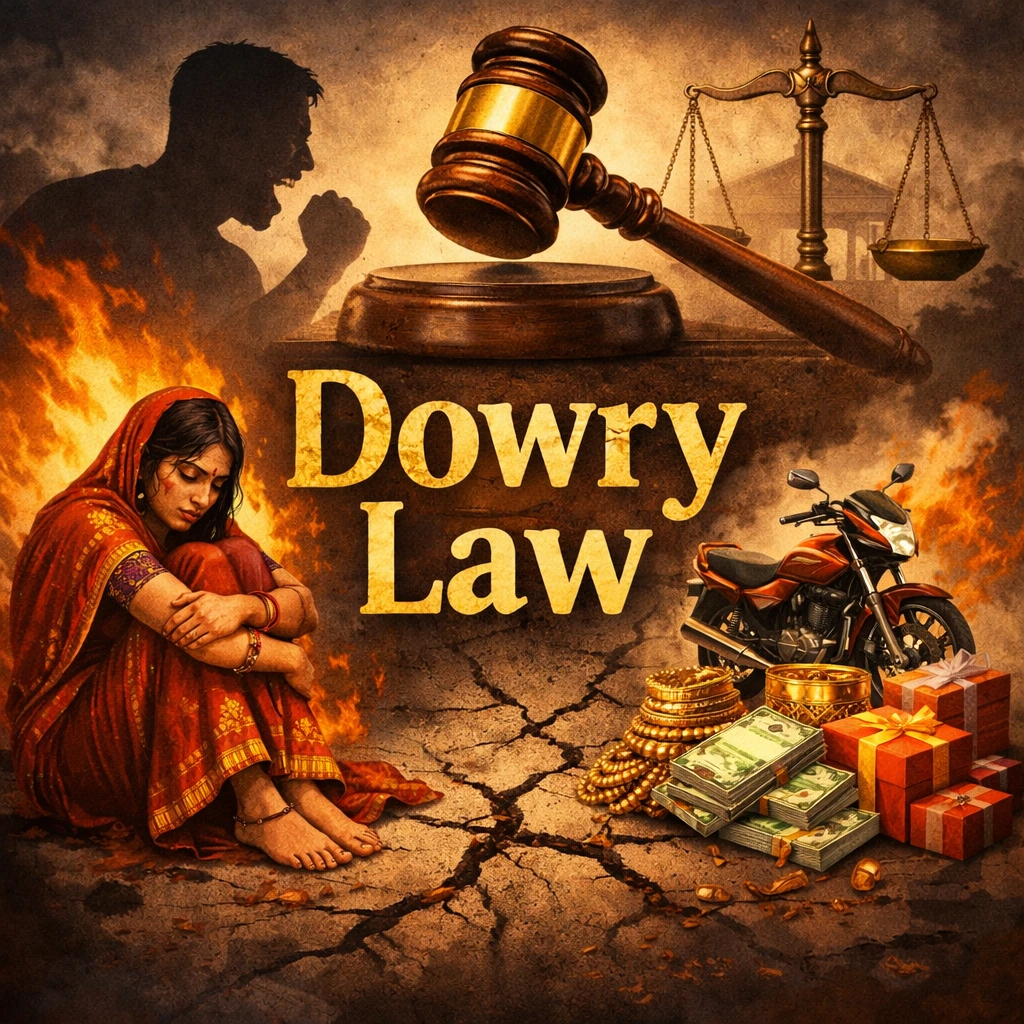
I. Introduction: Dowry as a Continuing National Crime
Despite decades of legislation, judicial warnings, and public discourse, dowry remains one of India’s most lethal social crimes. What often begins as “expectations” or “customary gifts” frequently ends in coercion, cruelty, and death. The Supreme Court’s judgment in State of Uttar Pradesh v. Ajmal Beg & Jamila Beg (December 2025) confronts this reality head-on.
This decision is particularly significant because it:
- Reasserts the strict application of dowry death law
- Corrects a flawed High Court acquittal
- Recognises the dangerous spread of dowry into Muslim marriages, eroding the institution of Mehr
- Frames dowry violence as a constitutional violation, not merely a family dispute
The ruling is not just corrective—it is norm-setting.
II. Facts Revisited: The Anatomy of a Dowry Death
Nasrin, a 20-year-old woman, entered marriage with Ajmal Beg expecting dignity, security, and companionship. Instead, she was met with escalating dowry demands:
- A coloured television
- A motorcycle
- ₹15,000 in cash
When her family failed to meet these demands, Nasrin was subjected to sustained cruelty. Ultimately, she was burnt alive inside her matrimonial home.
The pattern was unmistakable:
- Demands linked directly to marriage
- Harassment continuing “soon before death”
- Death under unnatural circumstances within seven years of marriage
III. Trial Court vs. High Court: A Study in Judicial Contrast
| Trial Court | Allahabad High Court |
|---|---|
| Applied Section 304B IPC (Dowry Death) Applied Section 498A IPC (Cruelty) Invoked Section 113B, Evidence Act (Presumption of Dowry Death) Recognised circumstantial proof in domestic crimes | Ignored statutory presumptions Discarded consistent witness testimony Applied an unrealistically high standard of proof |
This approach effectively neutralised the purpose of dowry death legislation, prompting Supreme Court intervention.
IV. Supreme Court’s Intervention: Restoring Legal Balance
The Supreme Court restored the conviction, emphasizing that dowry death law exists precisely because ordinary criminal standards fail to capture domestic violence dynamics.
The Court reaffirmed that:
- Once foundational facts are established, presumptions are mandatory, not optional
- Appellate courts must not substitute conjecture for evidence
- Social realities must inform judicial appreciation of facts
V. Dowry vs. Mehr: A Crucial and Courageous Judicial Recognition
One of the most valuable contributions of this judgment is its explicit discussion on Mehr.
Mehr: Its Original Purpose
In Islamic law:
- Mehr is mandatory
- It belongs exclusively to the bride
- It functions as economic security and dignity assurance
Dowry’s Corrosive Impact
The Court observed that dowry has:
- Entered Muslim marriages under social pressure
- Reduced Mehr to a symbolic or nominal formality
- Shifted marriage dynamics from bride-centric protection to groom-centric extraction
This observation is jurisprudentially significant because it:
- Rejects the myth that dowry is religion-specific
- Exposes dowry as a pan-Indian social pathology
- Reinforces women’s rights across personal law boundaries
VI. Dowry Death as a Constitutional Crime
The Court went beyond the IPC and located dowry death within constitutional morality.
Dowry deaths violate:
- Article 14 – Equality before law
- Article 15(3) – Protection of women
- Article 21 – Right to life with dignity
This aligns with earlier rulings where the Court has held that private violence can amount to constitutional infringement when systemic and tolerated.
VII. Landmark Judgments That Strengthen This Verdict
- Kans Raj v. State of Punjab (2000)
Dowry cruelty must be viewed as a continuing offence, not isolated acts. - Satvir Singh v. State of Punjab (2001)
“Soon before death” means a live and proximate link, not immediate timing. - Kaliyaperumal v. State of Tamil Nadu (2004)
Presumption under Section 113B is compulsory once conditions are met. - Rajinder Singh v. State of Punjab (2015)
Dowry deaths undermine the social justice framework of criminal law. - Vikas v. State of Rajasthan (2014)
Courts must apply context-sensitive standards in domestic crime cases.
Together, these judgments form the doctrinal backbone of the Ajmal Beg ruling.
VIII. Addressing the “Misuse” Debate—Without Dilution
The Supreme Court implicitly responded to concerns about misuse of Section 498A by drawing a clear line:
- Safeguards cannot become shields for perpetrators
- Misuse concerns cannot justify systemic under-enforcement
- Each case must be decided on evidence, not assumptions
This balanced approach aligns with Social Action Forum for Manav Adhikar v. Union of India (2018), which cautioned against both misuse and dilution.
IX. Directions and the Larger Social Message
While restoring conviction, the Court issued broader guidance:
- Dowry violence must be addressed across communities
- Investigators must treat dowry deaths as serious homicide-equivalent crimes
- Courts must resist cultural normalization of coercive gift-giving
The judgment reinforces that custom cannot override criminal law.
X. Why This Case Will Shape Future Dowry Jurisprudence
For Criminal Law
It strengthens appellate scrutiny standards in dowry death acquittals.
For Personal Law Discourse
It opens the door for deeper conversations on how social practices distort religious safeguards for women.
For Society
It challenges families to confront dowry not as “tradition” but as structured violence.
For Legal Scholarship
It is a landmark reference on the intersection of gender justice, personal law, and constitutional values.
XI. Conclusion: Dowry Has No Religious or Cultural Refuge
State of Uttar Pradesh v. Ajmal Beg & Jamila Beg is not merely about correcting a judicial error—it is about reaffirming a civilizational commitment.
The Supreme Court made it clear:
- Dowry is not culture; it is coercion
- Dowry deaths are not accidents; they are crimes
- Mehr was meant to protect women, not be overshadowed by greed
By restoring the conviction, the Court reaffirmed that the law stands with the victim, not with distorted customs.
In a society still struggling to eradicate dowry, this judgment serves as a constitutional reminder that justice will not bow to tradition—and dignity will not be sacrificed at the altar of marriage.