





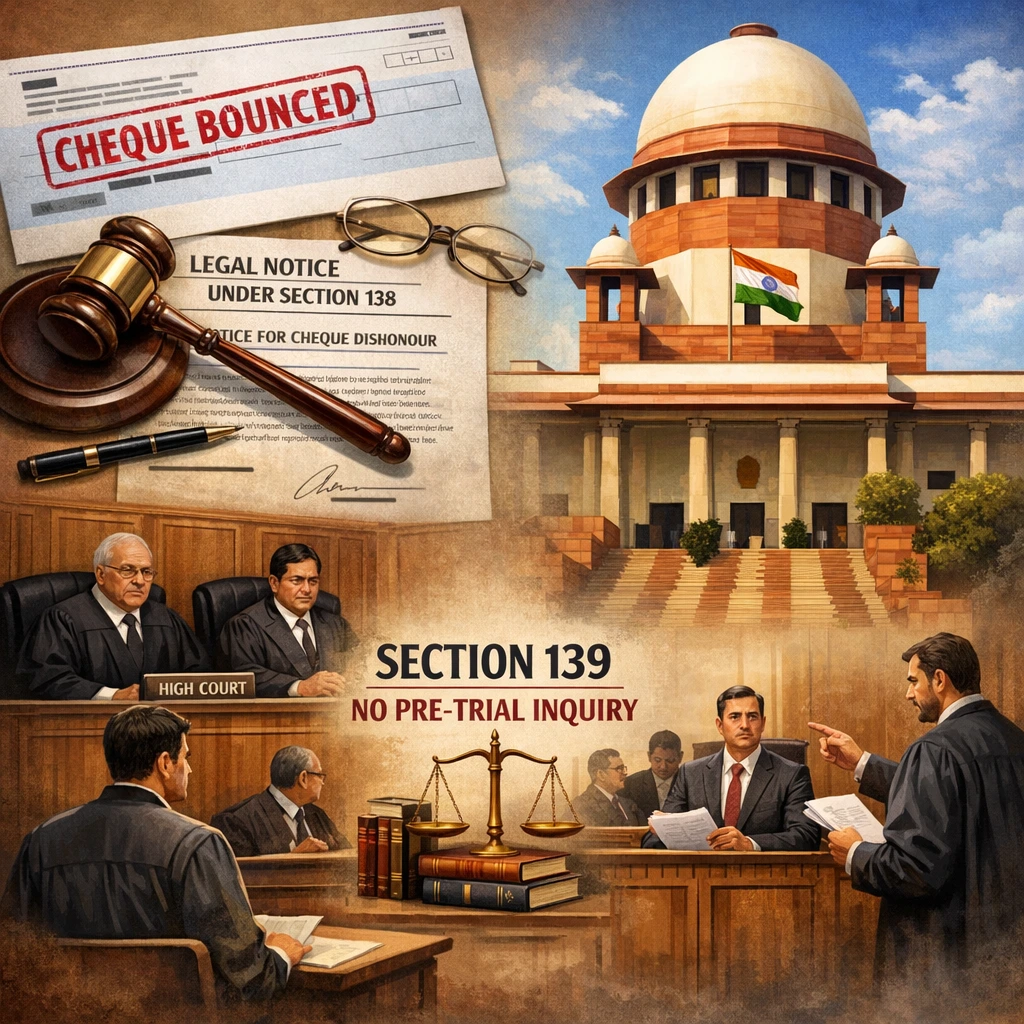
Supreme Court Clarifies Cheque Dishonour Law
The Supreme Court of India has delivered an important and clarificatory judgment in Sri Om Sales v. Abhay Kumar, decisively settling a recurring controversy in cheque dishonour litigation. The Court has held that High Courts cannot quash proceedings under Section 138 of the Negotiable Instruments Act, 1881, by undertaking a pre-trial inquiry into disputed facts, merely because the accused questions the existence of debt or liability.
At a time when cheque bounce cases form a substantial part of criminal dockets across the country, this ruling restores procedural discipline and reinforces the statutory framework enacted by Parliament to protect commercial credibility.
The Background: When Quashing Became a Mini-Trial
The dispute arose from a cheque issued by the accused which was dishonoured on presentation. The complainant initiated proceedings under Section 138 of the Negotiable Instruments Act. After the Magistrate took cognizance and summoned the accused, the matter was taken to the High Court under Section 482 of the Code of Criminal Procedure, invoking the Court’s inherent powers to quash proceedings.
The High Court, while quashing the complaint, examined disputed factual questions—particularly whether the cheque was issued in discharge of a legally enforceable debt. In doing so, it effectively conducted a pre-trial assessment of evidence, concluding that no offence was made out.
It was this approach that came under scrutiny before the Supreme Court.
The Supreme Court’s Core Holding
The Supreme Court categorically disapproved of such pre-trial factual adjudication. It held that:
- Once the foundational ingredients of Section 138 are disclosed, the criminal process must ordinarily proceed.
- Disputed questions of fact cannot be resolved at the quashing stage, as that function belongs exclusively to the trial court.
- High Courts must resist the temptation to conduct a “mini-trial” under the guise of exercising inherent powers.
The judgment makes it clear that Section 482 CrPC is a shield against abuse of process, not a substitute for trial.
Section 139 Presumption: The Heart of the Judgment
A central pillar of the ruling is the reaffirmation of Section 139 of the Negotiable Instruments Act, which creates a statutory presumption that a cheque was issued for the discharge of a legally enforceable debt or liability.
The Court emphasised that:
- This presumption operates in favour of the complainant once issuance and dishonour of the cheque are shown.
- The burden then shifts to the accused to rebut this presumption.
- Rebuttal is a matter of evidence, not mere argument, and must occur during trial.
By attempting to decide the existence of debt at the threshold, the High Court had effectively neutralised the statutory presumption—an approach the Supreme Court found legally impermissible.
Limits of High Court Powers Under Section 482 CrPC
The judgment draws a clear constitutional and procedural boundary around the inherent powers of High Courts:
- Section 482 is meant to prevent manifest injustice or abuse of process.
- It does not authorise factual adjudication, credibility assessment, or evaluation of rival versions.
- If complaints disclose the basic ingredients of an offence, criminal law must take its normal course.
This clarification is significant because cheque dishonour cases often involve contested commercial narratives, which cannot be fairly resolved without evidence and cross-examination.
Practical Impact of the Judgment
1. Greater Security for Complainants
The ruling strengthens the hands of cheque holders—particularly small businesses, traders, and professionals—by ensuring that valid complaints are not prematurely dismissed on contested factual grounds.
2. Discouragement of Dilatory Tactics
Accused persons can no longer rely on early quashing petitions as a shortcut to avoid trial. Mere denial of liability will not suffice; evidence must speak.
3. Uniformity Across High Courts
By clearly disapproving pre-trial inquiries, the Supreme Court has reduced scope for inconsistent quashing orders, promoting greater doctrinal consistency nationwide.
4. Reinforcement of Trial Court Authority
The judgment restores the central role of Magistrates in cheque dishonour cases, ensuring that factual disputes are resolved where the law intends—in trial, not in chambers.
5. Strengthening Commercial Trust
At a systemic level, the decision reinforces confidence in cheque-based transactions by preserving the deterrent effect of Section 138.
Why This Judgment Matters
Cheque dishonour law was enacted to instil financial discipline and transactional certainty. Over-expansion of quashing jurisdiction threatened to dilute this objective by converting criminal proceedings into preliminary civil adjudications.
In Sri Om Sales v. Abhay Kumar, the Supreme Court has decisively corrected that drift. The message is unambiguous:
criminal trials cannot be replaced by judicial speculation at the threshold.
Conclusion
This judgment stands as a reaffirmation of legislative intent, statutory presumptions, and procedural fairness. By curbing pre-trial interference and restoring respect for the trial process, the Supreme Court has ensured that cheque dishonour jurisprudence remains both effective and principled.
For litigants and lawyers alike, Sri Om Sales v. Abhay Kumar will serve as a leading authority against premature quashing and as a reminder that facts must be tested in evidence, not assumed in advance.
