





Introduction
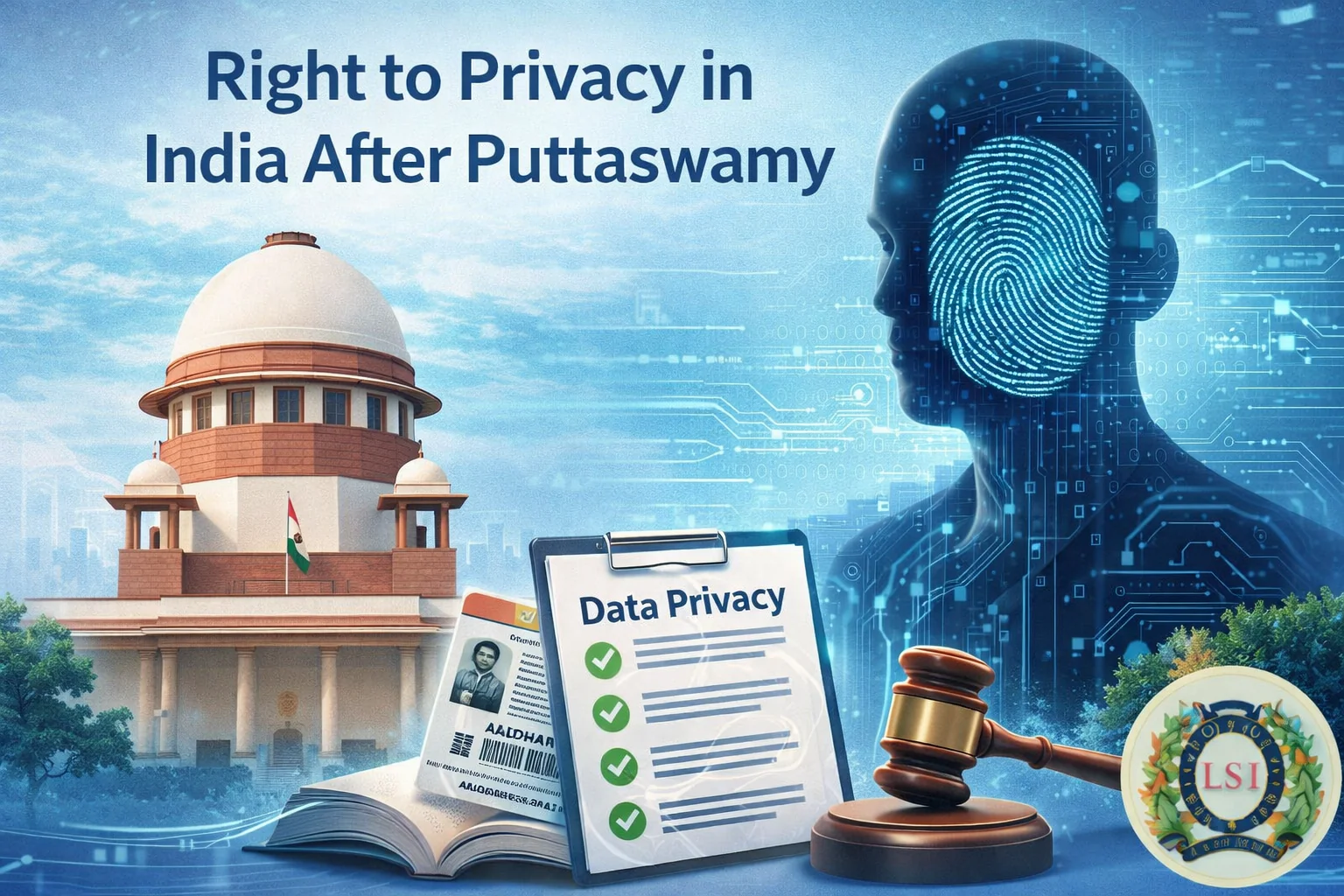
The right to privacy has emerged as a cornerstone of constitutional jurisprudence in India following the landmark judgment in Justice K.S. Puttaswamy (Retd.) v. Union of India (2017). In this historic decision, the Supreme Court unanimously recognised privacy as a fundamental right inherent in Article 21 and other freedoms guaranteed under Part III of the Constitution. The judgment overruled earlier precedents and redefined the relationship between the individual and the State in an era of rapid technological advancement. This paper examines the scope, impact, and evolving contours of the right to privacy in India after the Puttaswamy judgment.
Legal Framework and Provisions
The legal framework governing the right to privacy in India was significantly strengthened after the Supreme Court’s decision in Justice K.S. Puttaswamy (Retd.) v. Union of India (2017), which recognised privacy as a fundamental right under Articles 14, 19, and 21 of the Constitution. The Court laid down the principles of legality, necessity, and proportionality for any State interference with privacy. Post-Puttaswamy, statutory safeguards have evolved through provisions under the Information Technology Act, 2000, and the enactment of the Digital Personal Data Protection Act, 2023, which regulates data collection, processing, and consent.
Core Principles Governing State Interference
- Legality: Any infringement of privacy must have a valid legal basis.
- Necessity: The interference must be necessary to achieve a legitimate State aim.
- Proportionality: The extent of interference must be proportionate to the objective sought to be achieved.
Acts
After the Puttaswamy judgment, several legislative enactments became central to the protection of the right to privacy in India. The Information Technology Act, 2000, particularly Sections 43A and 72A, provides civil and criminal liability for misuse of personal data and breach of confidentiality. The Aadhaar (Targeted Delivery of Financial and Other Subsidies, Benefits and Services) Act, 2016 was read subject to privacy safeguards by the Supreme Court. Most significantly, the Digital Personal Data Protection Act, 2023 establishes a comprehensive data protection regime, recognising consent, purpose limitation, and data minimisation, thereby operationalising the constitutional right to privacy.
Key Legislations and Their Role
| Legislation | Relevant Provisions | Privacy Protection Mechanism |
|---|---|---|
| Information Technology Act, 2000 | Sections 43A, 72A | Liability for data misuse and breach of confidentiality |
| Aadhaar Act, 2016 | Subject to judicial interpretation | Use of Aadhaar data with privacy safeguards |
| Digital Personal Data Protection Act, 2023 | Consent, purpose limitation, data minimisation | Comprehensive data protection and regulatory framework |
Punishments
Post the Puttaswamy judgment, violations of the right to privacy attract statutory penalties under various laws. The Information Technology Act, 2000 prescribes punishment under Section 72 for breach of confidentiality, with imprisonment up to two years or fine up to one lakh rupees, or both, while Section 72A provides imprisonment up to three years or fine up to five lakh rupees for unlawful disclosure of personal information. The Digital Personal Data Protection Act, 2023 introduces stringent civil penalties, allowing fines up to ₹250 crore for serious data breaches, non-consensual processing, or failure to safeguard personal data, thereby strengthening enforcement of privacy rights.
Summary of Punishments Under Privacy Laws
- Section 72, Information Technology Act, 2000: Imprisonment up to two years, or fine up to one lakh rupees, or both.
- Section 72A, Information Technology Act, 2000: Imprisonment up to three years, or fine up to five lakh rupees, or both.
- Digital Personal Data Protection Act, 2023: Civil penalties up to ₹250 crore for serious data protection violations.
Cases
Navtej Singh Johar vs Union of India (2018)
Facts
Section 377 of the Indian Penal Code (IPC) (a colonial-era law) criminalised “carnal intercourse against the order of nature.” This law was used to penalise consensual same-sex sexual acts as a criminal offence. Petitioners — Navtej Singh Johar and others (LGBTQ+ individuals) — filed a writ petition in the Supreme Court of India challenging Section 377, claiming it violated their fundamental rights to equality, dignity, privacy and freedom.
Issues
The Supreme Court considered the following core questions:
- Whether Section 377 IPC, insofar as it criminalises consensual sexual acts between adults of the same sex, violates fundamental rights under the Indian Constitution — particularly Articles 14 (equality), 15 (non-discrimination), 19 (freedom of expression) and 21 (life & personal liberty)?
- Whether the earlier Supreme Court decision in Suresh Kumar Koushal v. Naz Foundation (which had upheld Section 377) was correct?
Judgment
On 6 September 2018, a five-judge Constitution Bench of the Supreme Court delivered a unanimous judgment. Portions of Section 377 that criminalised consensual sexual activity between adults of the same sex were declared unconstitutional. The Court held that Section 377, in this respect, violated Articles 14, 15, 19 & 21 of the Constitution because it discriminated based on sexual orientation and invaded privacy and dignity.
The decision overruled the 2013 Suresh Kumar Koushal judgment. The Court emphasised constitutional morality and stated that sexual orientation is an essential part of personal identity deserving protection. Section 377 remained valid only for non-consensual sexual acts, acts involving minors, and bestiality.
Joseph Shine vs Union of India (2018)
Facts
In December 2017, a Public Interest Litigation (PIL) was filed by Joseph Shine challenging the constitutional validity of Section 497 of the Indian Penal Code, 1860 (offence of adultery) read with Section 198(2) of the Code of Criminal Procedure, 1973.
Section 497 criminalised adultery by punishing only the man who had sexual intercourse with a married woman without the consent of her husband. The provision treated the woman as neither an offender nor a victim and barred her from filing a complaint.
A three-judge bench headed by CJI Dipak Misra referred the matter to a five-judge Constitution Bench, observing that the provision appeared archaic and discriminatory.
Issue
Whether Section 497 IPC, read with Section 198(2) CrPC, was unconstitutional for violating Article 14 (Right to Equality), Article 15 (Prohibition of Discrimination), and Article 21 (Right to Life, Personal Liberty, Privacy and Dignity) of the Constitution of India.
Judgment
The Supreme Court unanimously struck down Section 497 IPC as unconstitutional. Section 198(2) CrPC was also held unconstitutional to the extent it applied to adultery.
The Court held that Section 497 was arbitrary, patriarchal and discriminatory, as it treated women as the property of their husbands. The provision violated Article 14 by denying substantive equality to women, contravened Article 15 as it was based on gender stereotypes, and violated Article 21 by infringing upon dignity, privacy, sexual autonomy and personal liberty.
The Court reaffirmed that sexual privacy and autonomy are natural rights protected under the Constitution. Adultery was decriminalised, but it continues to remain a civil wrong and a ground for divorce. The State cannot intrude into the private realm of marriage through criminal law.
Key Judicial Opinions
- Justice Dipak Misra (for himself & Justice Khanwilkar): Criminalising adultery amounts to unwarranted intrusion into matrimonial privacy and violates dignity and liberty under Article 21.
- Justice D.Y. Chandrachud: Emphasised sexual autonomy, dignity and privacy, relying on Navtej Singh Johar and K.S. Puttaswamy, and rejected patriarchal control over women’s sexuality.
- Justice Indu Malhotra: Held that adultery should remain a civil wrong and criminal sanction failed the three-fold test of privacy under Puttaswamy.
Conclusion
The judgment marked a constitutional shift from morality-based criminal law to autonomy-based rights, reinforcing gender equality, dignity and privacy within marriage.
Anuradha Bhasin vs Union of India (2020)
Facts
After 4 August 2019, the Government of India suspended mobile phone networks, internet services and landline connectivity across Jammu & Kashmir following the abrogation of Article 370. The communications blackout severely affected journalists, media, businesses and the public.
Anuradha Bhasin (Executive Editor of Kashmir Times) and others filed a writ petition under Article 32 challenging the indefinite internet shutdown and the non-publication of government orders imposing communication restrictions.
Issues
The Supreme Court examined:
- Whether restrictions on internet access affect fundamental rights under Article 19.
- Whether an indefinite suspension of internet services is lawful.
- Whether government orders restricting communications must be published.
- The scope of power under the Telecom Suspension Rules (2017) and Section 144 Cr.P.C.
Judgment
On 10 January 2020, the Supreme Court held that internet shutdowns affect fundamental rights under Article 19, and any restriction must satisfy constitutional safeguards. Indefinite suspension of internet services was held impermissible.
The Court mandated publication of all orders restricting communications and affirmed that such orders are subject to judicial review. Section 144 Cr.P.C. cannot be misused to suppress dissent and must be imposed based on objective material.
K.S. Puttaswamy vs Union of India (2017)
Facts
The case challenged the constitutional validity of the Aadhaar (Targeted Delivery of Financial and Other Subsidies, Benefits and Services) Act, 2016 and the Aadhaar biometric ID system.
Petitioners argued that Aadhaar’s collection, storage and use of demographic and biometric data violated the right to privacy and personal liberty, and that mandatory Aadhaar linking enabled surveillance and exclusion.
Issues
- Whether Aadhaar violated the fundamental right to privacy.
- Whether the Aadhaar Act as a Money Bill was valid.
- Whether Aadhaar could be made mandatory for services.
- Whether private entities could use Aadhaar authentication.
Judgment
The Supreme Court upheld the constitutional validity of the Aadhaar Act, holding that it served a legitimate state aim of welfare delivery. Aadhaar was held not to inherently violate privacy if safeguards of legality and proportionality are followed.
Private entities were barred from insisting on Aadhaar authentication. Aadhaar could not be made mandatory for bank accounts or mobile connections, but linking with PAN and welfare benefits funded from the Consolidated Fund of India was permitted with safeguards.
Impact on Society
The recognition of the right to privacy as a fundamental right after the Puttaswamy judgment has had a profound impact on Indian society. It strengthened individual autonomy, dignity, and personal choice in matters relating to data, bodily integrity, and personal relationships.
The judgment increased public awareness about data protection, surveillance, and misuse of personal information by both the State and private entities. It empowered citizens to challenge arbitrary state actions, such as excessive data collection and unlawful monitoring.
Additionally, it influenced policy-making, leading to stronger data protection laws and fostering a culture of accountability, transparency, and respect for civil liberties.
Key Societal Impacts of the Puttaswamy Judgment
| Area | Impact |
|---|---|
| Individual Autonomy | Strengthened control over personal data, bodily integrity, and personal relationships |
| Public Awareness | Increased understanding of data protection, surveillance, and privacy rights |
| State Accountability | Enabled challenges against excessive data collection and unlawful monitoring |
| Policy Development | Encouraged stronger data protection laws and rights-based governance |
| Civil Liberties | Promoted transparency, accountability, and respect for constitutional freedoms |
Conclusion
The Justice K.S. Puttaswamy v. Union of India judgment marks a transformative moment in Indian constitutional jurisprudence by affirming the right to privacy as a fundamental right intrinsic to life and personal liberty.
It reshaped the relationship between the State and individuals by imposing constitutional limits on surveillance and data collection. The decision laid the foundation for robust data protection frameworks and progressive judicial interpretations safeguarding dignity, autonomy, and freedom of choice.
While legislative and institutional challenges remain, the post-Puttaswamy era signifies a decisive shift towards rights-based governance, reinforcing democratic values and strengthening constitutional protection for individuals in an increasingly digital society.
Reference
- Source: Indian Kanoon – https://share.google/ECapvWDuJ9gNVlNy0
- Source: Indian Kanoon – https://share.google/SirxxRlGN8URH5izL
- Source: Indian Kanoon – https://share.google/BgYDAJT9u0AiUqXwK
- Justice K.S. Puttaswamy (Retd) vs Union Of India on 26 September, 2018 – https://share.google/MkSwpCbdtJksuvWYR
Written By: Kherin Trufina.A

