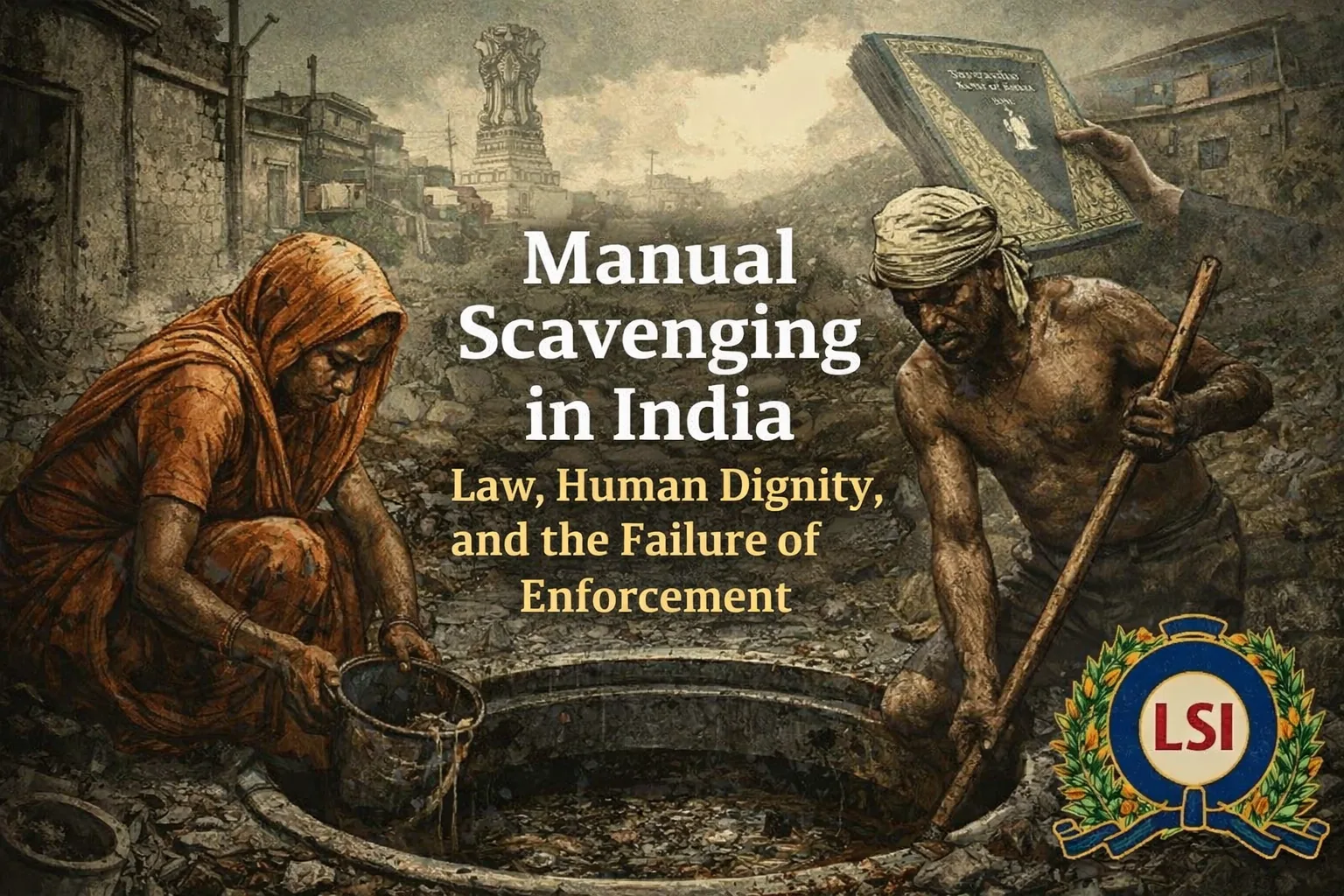
Manual scavenging is a hazardous practice that involves the removal of human waste in unhygienic environments without protective equipment. It is a violation of human rights, as it is detrimental to human health. While the country is advancing toward digitalization, such inhuman practices are still prevalent in India.
The Constitution of India emphasizes liberty, equality, fraternity, and dignity, yet practices such as manual scavenging have not been entirely eradicated in the country.
These practices are predominantly carried out by socially and economically marginalized communities, suggesting that casteism plays an important role in such circumstances.
Since society is particularly conservative and rigid in remote regions of the country, these practices are highly prevalent there.
It demonstrates that constitutional principles such as equality, fraternity, dignity, and liberty remain largely illusory.
Poor Implementation Of Statutes And Schemes
Legislative And Judicial Interventions
The government first enacted a statute prohibiting manual scavenging in 1993.
A decade later, the ‘Safai Karamchari Andolan’ gained nationwide popularity.
In 2013, the government enacted another statute to ban the practice of manual scavenging and to provide rehabilitation to workers.
The Supreme Court in 2014 also directed the government to pay compensation to the victims.
Socio-Economic Realities
Generally, women from weaker sections were engaged in such practices.
A large section of them were forced to do manual scavenging due to poverty and unemployment issues.
Most of them earn below the minimum wage.
The most alarming situation is that metropolitan cities have not yet eliminated this practice.
Data And Compliance Failures
The National Law School of India, Bengaluru conducted a survey in 2025, which identified 7,800 persons as manual scavengers in the State of Karnataka1.
In 2014, the Supreme Court also directed the state governments to implement the statutes related to the prohibition of manual scavenging, but most of the states failed to comply with the directions of the Court.
This reflects mismanagement and poor implementation of the government schemes, which forced people to adopt manual scavenging as a means of livelihood.
Such administrative failure resulted in a large number of sewer deaths.
Summary Of Key Issues
Aspect
Observation
Legislation
Statutes enacted in 1993 and 2013 to prohibit manual scavenging
Judicial Directions
Supreme Court directions in 2014 for compensation and implementation
Economic Conditions
Poverty, unemployment, and earnings below minimum wage
Implementation
Failure of states to comply with statutory and judicial mandates
Measures Adopted For Its Prevention
Statutory Measures
The Government of India introduced various statutes, such as the Employment of Manual Scavengers and Construction of Dry Latrines (Prohibition) Act, 1993.
Two decades later, the Parliament enacted ‘The Prohibition of Employment as Manual Scavengers and Their Rehabilitation Act 2013’.
Civil Society Movements
Human rights activists and NGOs organized several campaigns and movements to prohibit manual scavenging.
The ‘Safai Karamchari Andolan’, which started in 1993, gradually gained widespread popularity among the masses.
The ‘Maila Mukta yatra’, which started in 2012, was a two-month yatra that crossed eighteen states and gathered huge support from the Dalit community2.
Government Schemes
The government introduced schemes such as ‘NAMASTE’, which ensured the creation of 4,800 urban bodies to provide better mechanized equipment and ensure the availability of skilled workers to perform sanitation tasks3.
The ‘Swachh Bharat Mission’ was launched to identify the insanitary latrines and convert them into sanitary latrines for better working conditions4.
Current Status Of Manual Scavenging
The Central Government informed the Parliament that 732 districts in the country have eradicated the practice of manual scavenging5. The government also provided additional information on 377 sewer-cleaning deaths between 2019 and 20236. The government identified 58,098 individuals as manual scavengers, with Uttar Pradesh accounting for the most6. The government implemented the ‘NAMASTE’ scheme to eradicate the practice across the country3.
In 2024, government data showed that no deaths from manual scavenging were reported in the last five years, but a few people died in accidents while cleaning septic tanks. On 18th December 2024, the government informed the Rajya Sabha that a total number of 419 deaths were reported from septic cleaning operations between 2019 and 20243.
However, the government distinguished between manual scavengers and hazardous cleaners in the Parliament, yet NGOs and human rights activists rejected such claims and urged the government to treat hazardous practitioners as manual scavengers7. NGOs and human rights activists argued that such claims were baseless, as most of the deaths occurred while cleaning the septic tanks and railway bridges. They further argued that cleaning septic tanks and railway bridges was riskier than cleaning open drains and pits.
Key Government Data At A Glance
Category
Details
Districts Declared Manual Scavenging-Free
732 Districts
Identified Manual Scavengers
58,098 Individuals
Highest Number Of Manual Scavengers
Uttar Pradesh
Sewer And Septic Cleaning Deaths (2019–2023)
377 Deaths
Septic Cleaning Deaths Reported (2019–2024)
419 Deaths
Challenges Faced By India
Illiteracy — India is a country where the literacy rate is moderate; due to the high amount of illiteracy, this inhuman practice is still in existence.
Unemployment — Besides illiteracy, the country has a high unemployment rate, especially in remote areas. This high level of unemployment in rural sectors has forced people to choose such occupations for their livelihood. They moved to urban areas in search of better employment, but due to the lack of diversity in the field of employment, many of them engage in these activities to earn a livelihood.
Poverty — Poverty is another major cause for which people resort to manual scavenging as an option for their livelihood. A large group of people are still below the poverty line, which has eventually forced them to adopt manual scavenging as a means of livelihood.
Insanitary Latrines — The Ministry of Housing and Urban Affairs stated that the main reason for the existence of manual scavenging is the presence of insanitary latrines. The ‘Swachh Bharat Mission’ Scheme was launched to identify insanitary latrines and convert them into sanitary latrines to eradicate manual scavenging4.
Conclusion
Though manual scavenging was banned three decades ago, a large number of deaths were still reported. Various activists also claimed that there was significant underreporting in the number of deaths. This highlights mismanagement and administrative failure in implementing the schemes. India is a developing nation adopting modern sanitation techniques, but progress is too slow. Such practices are detrimental to human health and an affront to human dignity. End Notes:
National Law School of India University, State-Wide Survey on Identifying Manual Scavengers in Karnataka by Centre for the Study of Social Inclusion, NLSIU (2025), https://www.nls.ac.in/news-events/state-wide-survey-on-identifying-manual-scavengers-in-karnataka-by-centre-for-the-study-of-social-inclusion-nlsiu
International Dalit Solidarity Network, Manual Scavenging, IDSN, https://idsn.org/key-issues/manual-scavenging
Rajya Sabha, Unstarred Question No. 2695, Deaths Due to Sewer and Septic Tanks Cleaning, Ministry of Social Justice and Environment, Government of India (2023), https://sansad.in/getFile/annex/266/AU2695_sBufmr.pdf?source=pqars
Rajya Sabha, Unstarred Question No. 1581: Eradication of Manual Scavenging, Government of India (December 18, 2024), https://sansad.in/getFile/annex/251/AU1581.pdf?source=pqars
Press Information Bureau, Government Measures to Eliminate Manual Scavenging, Government of India (December 18, 2024), https://www.pib.gov.in/PressReleasePage.aspx?PRID=2042007®=3&lang=2
Rajya Sabha, Unstarred Question No. 1096: Identification of Manual Scavengers, Ministry of Social Justice and Empowerment, Government of India (2023), https://sansad.in/getFile/annex/265/AU1096_V1fqD9.pdf?source=pqars
Lok Sabha, Unstarred Question No. 488: Hazardous Cleaning and Sewer Deaths, Ministry of Social Justice and Empowerment, Government of India (2023), https://sansad.in/getFile/loksabhaquestions/annex/1715/AU488.pdf?source=pqals
Award-Winning Article Written By: Mr.Chaudhury Shakib Ahamed, Final Year Law Student Ballb(Hons) Bengal Law College University Name -The University Of Burdwan
🎖️ Recognition · Legal Author 📚
1 Published Articles
I am a final year law student of Bengal Law College under The University of Burdwan.
I have a keen interest on human rights, constitutional law, administrative law, contract law, company law,law of taxation, intellectual property law, international law.Besides this I am also a poet and a story writer. I belong from a tier 3 law college, but still I love to present my innovative legal ideas infront of the world.