





Introduction
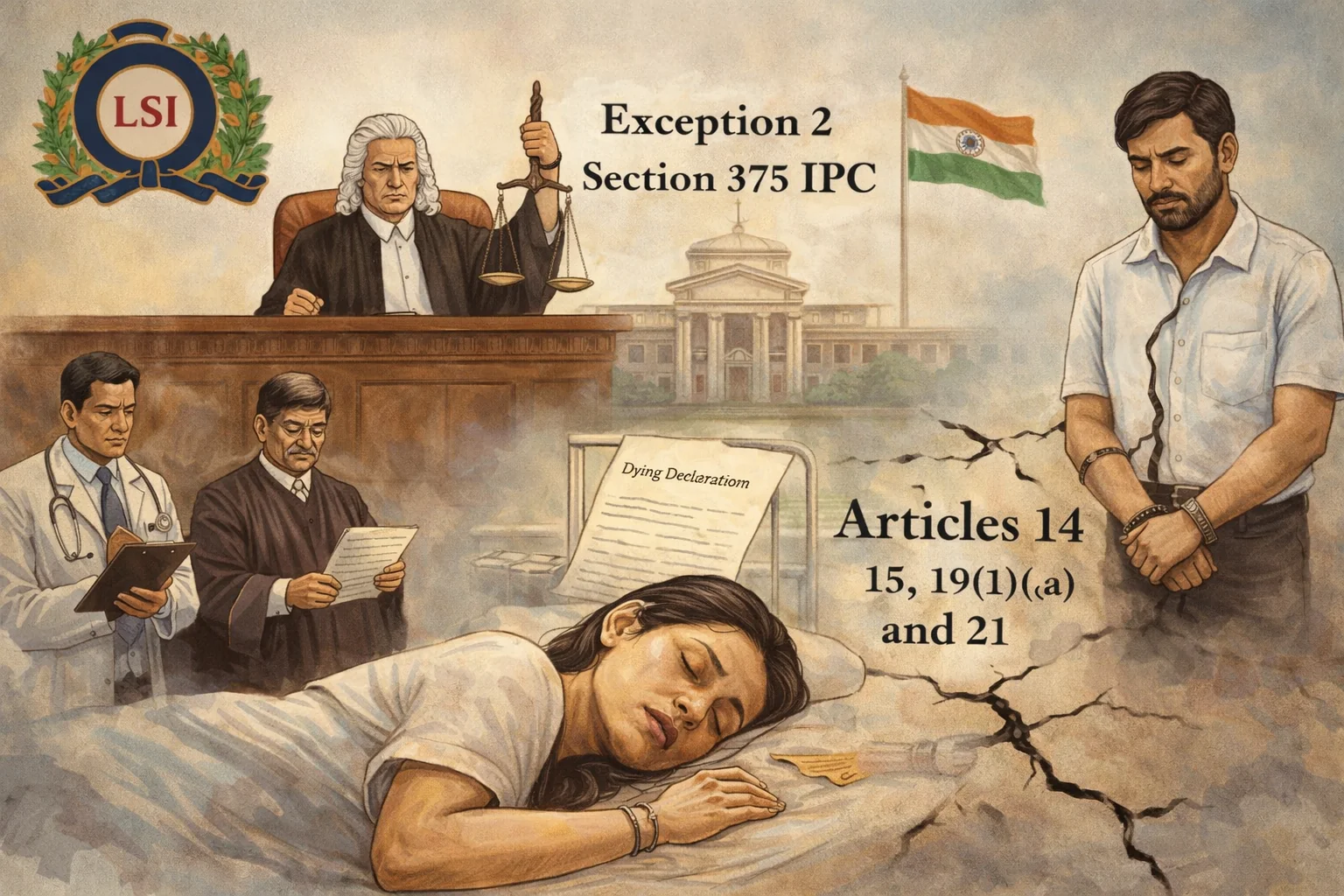
The case of Gorakhnth Sharma v. State of Chhattisgarh (2025) has sparked a widespread debate within the Indian legal and feminist landscape, both for being a brutal factual matrix and for the very uncomfortable truth it presents of the continuing marital rape exception in Indian criminal law. The High Court’s acquittal of the accused on rape charges despite compelling evidence, including the victim’s dying declaration, medical testimony, and the devastating consequences of the victim’s death, bespeaks how the law continues to safeguard husbands from accountability for sexual violence against their wives.
This comment critically examines the facts of the judgement, the reasoning, and its implications. It argues that the court may have been legally constrained by Exception 2 of Section 375 of the Indian Penal Code (IPC), the ruling shows deep contrasts with the statutory provisions that guarantee life with dignity, equality, and liberty with Articles 14, 15, 19(1)(a), and 21 of the Indian Constitution. Referencing comparative jurisprudence and feminist legal scholarship, the article points towards the imperative legislative reform to end the marital rape exception and reclaim women’s autonomy and constitutional status in marriage.
Case Facts and Procedural Background
The appellant, Gorakhnth Sharma, was accused of committing repeated sexual assaults, including acts which fall under ‘unnatural sex’ under Section 377 of IPC, on his wife against her will. The act resulted in her unfortunate death on December 11, 2017. More importantly, before succumbing to her injuries, the victim gave a dying declaration before the magistrate in which she inculpated her husband.
Based on this declaration, and with support of substantiating medical evidence documenting severe injuries resulting from sexual violence, the husband was charged under:
- Section 376 of IPC for Rape
- Section 377 of IPC for Unnatural Offences
- Section 304 of IPC for Culpable Homicide not Amounting to Murder
In the Trial Court, the husband was convicted and sentenced to 10 years of rigorous imprisonment under each of the above provisions. However, on appeal, the High Court of Chhattisgarh overturned the rape conviction, pointing out Exception 2 of Section 375 of IPC, which exempts marital rape where the wife is above 15 years of age, and excluded the prosecution for rape within marriage. The court, acknowledging the gravity of the case, justified its actions as being constrained by the statute. It thereby confined its conclusions to Sections 377 and 304.
Comparison of Trial Court and High Court Outcomes
| Aspect | Trial Court | High Court |
|---|---|---|
| Section 376 (Rape) | Conviction | Acquittal due to Exception 2 |
| Section 377 (Unnatural Offences) | Conviction | Conviction upheld |
| Section 304 (Culpable Homicide) | Conviction | Conviction upheld |
Legal Reasoning and Application
Exception 2 to Section 375: Marital Rape Immunity
The High Court’s main arguments stood on the point of Exception 2 to Section 375 of IPC, which reads:
“Sexual intercourse or sexual acts by a man with his own wife, the wife not being under fifteen years of age, is not rape.”
This is a hangover from colonial morality borrowed from Victorian-era English law. It has been criticised as being out of line with modern human rights norms. Nevertheless, the High Court, under the binding statute, was forced to acquit Sharma of rape. The effect of the ruling was to reaffirm the proposition that the marital relationship is an automatic shield in statute against rape charges, irrespective of consent, force, or injury.
The court did consider, though, liability under Section 377 IPC, which penalizes “carnal intercourse against the order of nature,” and under Section 304 IPC, as the victim had died. The court, though, was unequivocal that so long as Exception 2 continues to operate, no rape conviction can hold where the accused person is the husband of the victim.
The Dying Declaration
One of the key pieces of evidence was the dying declaration of the victim. Under Section 32(1) of the Indian Evidence Act, the Indian law makes dying declarations permissible, recognising them as an exception to the Hearsay Rule and recognizing them as reliable where the declarant is under a sense of impending death. Courts have upheld the evidentiary weight of dying declarations as in Prabhash Sharma & Anr. vs State on 1 June, 2012.
In this case, the statement was consistent and unambiguous in incriminating the husband. But the High Court held that although the statement was adequate for offences under Sections 377 and 304, it was insufficient to overcome the express statutory immunity of husbands under Section 375. Statutory impediments thereby checked the full impact of the declaration, not by the weakness of evidence.
Critique of the Judgement
a. Constitutional Incompatibility
Prima Facie, the High Court’s judgment illustrates a direct conflict between the statutory law and constitutional principles. Articles 14, 15, 19(1)(a), and 21 of the Constitution guarantee equality before the law, non-discrimination, freedom of expression, and the right to live with dignity. The marital rape exception, however, denies married women the same legal protection as unmarried women when it comes to sexual offences against them conducted by their husbands.
The Supreme Court in Suchita Srivastava v. Chandigarh Administration (2009) emphasized that reproductive and bodily autonomy are integral to Article 21. Likewise, in Joseph Shine v. Union of India (2018), striking down adultery laws, the Court rejected the idea of women as property within marriage. Yet, Exception 2 perpetuates precisely this archaic view: that marriage extinguishes a woman’s capacity to withhold consent.
The Gorakhnth Sharma decision, by adhering to the letter of Exception 2, makes this constitutional inconsistency a fait accompli. The decision goes against not only the rights of the victim, but also the constitutional guarantee that marriage does not lower women to second-class citizenship.
b. Right to Dignity and Autonomy
The ruling also runs counter to the Supreme Court’s historic upholding of privacy and autonomy in K.S. Puttaswamy v. Union of India (2017). If privacy encompasses bodily integrity and sexual autonomy, it necessarily extends to marriage. By protecting marital rape, the law essentially suspends these rights within the conjugal home.
This leads to egregious implications: the home of marriage, nominally a site of intimacy and protection, is a space where violence is abetted and legal accountability put into abeyance. The victim here not only suffered assault but perished from it, though her call for justice was cut short by statutory immunity.
c. International Human Rights Standard
India is a signatory to international instruments, including the Convention on the Elimination of All Forms of Discrimination Against Women (CEDAW) and the International Covenant on Civil and Political Rights (ICCPR). Both instruments mandate protection against gender-based violence. The UN Committee on the Elimination of Discrimination Against Women has repeatedly urged India to criminalize marital rape.
Comparatively, jurisdictions like the United Kingdom (R v. R [1991] 1 AC 599), Canada, South Africa, and most of Europe have abolished the marital rape immunity, recognizing its incompatibility with modern human rights norms. By contrast, India’s retention of the exception places it alongside a shrinking list of countries clinging to outdated doctrines.
d. Legislative Inertia
It is important to acknowledge that the High Court’s hands were tied by legislative inaction. The judiciary cannot rewrite statutory provisions, however unjust. Yet, as the Justice Verma Committee Report (2013), the Law Commission of India (172nd Report, 2000; 243rd Report, 2012) and multiple parliamentary debates have noted, the marital rape exemption has no place in a constitutional democracy.
The present case illustrates the cost of this inertia: a woman’s death, her dying declaration disregarded, and her husband shielded from accountability for rape.
Broader Social and Legal Implications
Impact on Married Women’s Safety
The ruling perpetuates a culture of exemption within marriage. NCRB data points out that domestic violence is among the most common violence against women. When rape is not criminalized, women face a doubly hostile environment: violence at home coupled with denial of legal recourse.
- The message is clear: a husband may assault his wife with impunity.
- Even death may not suffice to pierce the statutory shield.
- This undermines faith in the justice system itself.
Reinforcement of Patriarchal Stereotypes
The judgment reinforces patriarchal notions of conjugal rights, where everything in a marriage is assumed to automatically be coated with consent. This idea, heavily inspired by Sir Matthew Hale’s 17th-century declaration that “a husband cannot be guilty of rape committed by him on his lawfully wedded wife,” has been repudiated in modern jurisprudence. Yet in India, it stays, justifying violence under the guise of marital obligation.
A Precedent with Troubling Consequences
The Gorakhnth Sharma case risks setting a precedent where even extreme cases of violence culminating in death cannot lead to rape convictions if the accused is the husband. This not only diminishes the seriousness of the offence but also trivializes the lived experiences of countless married women subjected to sexual violence.
Comparative Perspectives
A comparative lens highlights India’s isolation.
| Country | Legal Position |
|---|---|
| United Kingdom | In R v. R (1991), the House of Lords abolished the marital rape immunity, holding that it was “anachronistic and offensive to modern values.” |
| Canada | In 1983, amendments to the Criminal Code abolished the exemption, affirming that consent must be present in all sexual relationships. |
| South Africa | Post-apartheid constitutional reforms explicitly criminalized marital rape as part of broader gender justice measures. |
| Nepal | In Forum for Women, Law and Development v. His Majesty’s Government (2002), the Supreme Court of Nepal struck down marital rape immunity as unconstitutional. |
India’s refusal to follow these trends, despite its constitutional guarantees and international obligations, positions it as an outlier and undermines its global credibility on women’s rights.
Reform Pathways
| Pathway | Description |
|---|---|
| Legislative Reform | Parliamentary repeal of Exception 2 to Section 375 IPC. |
| Judicial Review | Constitutional challenge before the Supreme Court. |
| Social Reform | Public awareness, education, and survivor support. |
1) Legislative Repeal of Exception 2
The most immediate action is the revocation of Exception 2 to Section 375 IPC. This involves parliamentary will, which has been lacking until now out of political sensitivity to marital privacy and apprehensions of abuse. However, as women’s rights activists contend, the possibility of abuse cannot be permitted to override the systemic denial of justice.
- Requires direct legislative action.
- Faces political resistance.
- Essential for restoring equal legal protection.
2) Judicial Intervention through Constitutional Challenge
Lacking legislative change, constitutional litigation can yield relief. Challenge petitions filed against Exception 2 are under consideration before the Supreme Court (e.g., RIT Foundation v. Union of India). The Court has been willing, in cases such as Navtej Singh Johar v. Union of India (2018), to invalidate discriminatory provisions. The same method could make Exception 2 unconstitutional for being violative of Articles 14, 15, and 21.
- Uses constitutional remedies.
- Relies on judicial interpretation.
- Based on equality and fundamental rights.
3) Social Awareness and Advocacy
Aside from law, reform necessitates the de-stigmatising of marital rape. There has to be public awareness campaigns, education reforms, and mechanisms of support for survivors. The Sharma case, in its sadness, presents an opportunity for fresh campaigning.
- Public education initiatives.
- Support systems for survivors.
- Cultural change in perceptions of marriage.
Conclusion
The decision in Gorakhnth Sharma v. State of Chhattisgarh (2025) lays bare the stark injustice perpetuated by India’s marital rape exemption. Bound by the statutory text, the High Court acquitted a man whose sexual assaults led to his wife’s death. While legally correct within the IPC’s framework, the outcome is morally and constitutionally indefensible.
This case underscores the urgent need for reform: the repeal of Exception 2 to Section 375 IPC, recognition of consent as central to all sexual relations, and the alignment of Indian law with constitutional guarantees and global human rights standards. Until such reform occurs, marriage will remain a site where women’s autonomy is suspended, their dignity disregarded, and their rights denied.
The Gorakhnth Sharma judgment should not be seen as an isolated tragedy, but as a clarion call for systemic change. Only when the law affirms that marriage does not extinguish consent can India truly claim to uphold the constitutional promise of equality, dignity, and liberty for all women.

