





Introduction
Patent law in India provides inventors with exclusive rights to their inventions for a limited period of time, fostering innovation and technological advancement. However, not every invention qualifies for a patent. The Indian Patents Act, 1970, delineates strict criteria that an invention must meet to be patentable. This assignment aims to provide an in-depth understanding of the patentability criteria under Indian Patent Law, highlighting the statutory requirements, key legal principles, and judicial interpretations that determine whether an invention can be granted a patent in India.
Legal Framework
The Indian patent system is governed predominantly by the Patents Act, 1970, along with the Patents Rules, 2003. The act has been amended over time to meet international standards, including those mandated by the Agreement on Trade-Related Aspects of Intellectual Property Rights (TRIPS). The Act defines an invention under Section 2(1)(j) and sets out what inventions are eligible for patents, as well as exclusions under Sections 3 and 4. These form the foundation for understanding patentability in India.
Core Patentability Criteria
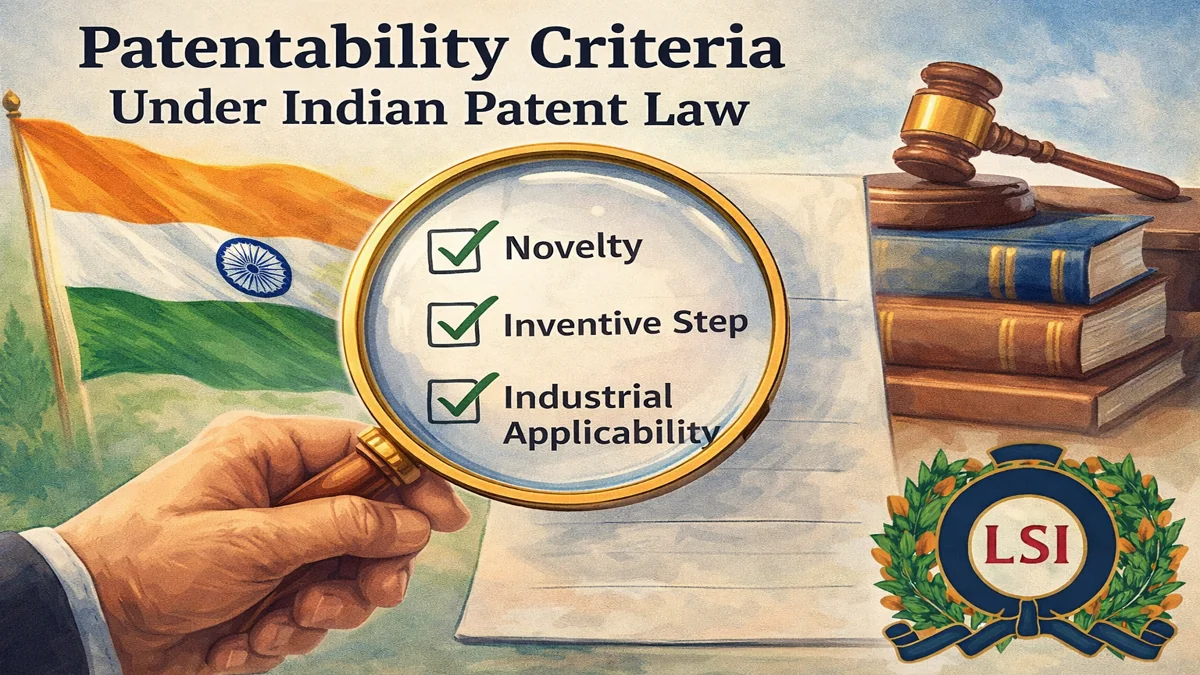
For an invention to be granted a patent in India, it must meet the three fundamental criteria of:
- Novelty (Newness)
- Inventive Step (Non-Obviousness)
- Industrial Applicability (Utility)
Novelty (Newness)
Novelty means that the invention must be new and not disclosed to the public anywhere in the world before the date of filing. This ensures the patent system rewards original inventions and prevents monopolies on existing knowledge.
| Aspect | Details |
|---|---|
| Statutory Provision | Section 2(1)(j) defines an invention that is novel and not anticipated by prior art anywhere in the world. |
| Prior Art | This includes all publicly available information such as publications, patents, presentations, and use in any territory. |
| Implications | If the invention has been published, patented, or commonly used anywhere before the filing date, it is not novel and cannot be patented. |
| Example | A new mechanical device that has not been described in any publication or patent anywhere qualifies as novel. |
Inventive Step (Non-Obviousness)
The inventive step requires that the invention should not be obvious to a person skilled in the relevant technical field. It must involve a technical advancement or economic significance that is not evident from existing knowledge or prior art.
| Aspect | Details |
|---|---|
| Legal Interpretation | The invention must reflect innovation, creativity, or technical progress rather than trivial or routine advancements. |
| Test | The patent office and courts evaluate whether the invention could have been easily deduced by an expert in the field. |
| Case Law | Indian courts have emphasized that the inventive step should show a considerable improvement and cannot be a mere workshop improvement. |
| Practical Example | A modified chemical process that increases yield significantly beyond known methods may fulfill this criterion. |
Industrial Applicability (Utility)
The invention must be capable of being made or used in an industry. The utility must be specific, credible, and substantial, indicating that the invention can solve a practical problem.
| Aspect | Details |
|---|---|
| Section 2(1)(j) | The invention must be useful and applicable in some form of industry, including agriculture. |
| Scope | It covers manufacturing, technology, pharmaceuticals, and other commercial uses. |
| Non-Patentability | Abstract ideas or inventions without tangible utility fail this criterion. |
| Example | A novel pharmaceutical compound effective for treatment meets industrial applicability. |
Exclusions From Patentability
The Indian Patents Act restricts patentability for several categories regardless of meeting the above criteria. Section 3 and 4 list inventions that cannot be patented:
Categories of Non-Patentable Inventions
- Frivolous Or Non-Technical Inventions: Inventions lacking utility or those contrary to natural laws.
- Mathematical Methods And Business Methods: Abstract ideas, formulas, or financial schemes.
- Medical And Surgical Procedures: Methods of treatment, diagnostics, and surgeries to safeguard public health.
- Traditional Knowledge And Biodiversity: Protection against patents on indigenous knowledge or bio-resources without approval.
- Software “Per Se”: Computer programs alone are excluded; however, software with technical effects can be patented.
- Plants And Animals: Except microorganisms, biological entities are excluded.
- Miscellaneous: Others including literature and artistic works, scientific theories, and mere discoveries.
Supporting Legal Provisions
In addition to the basic criteria, the patent application must comply with other legal requirements:
| Legal Requirement | Description |
|---|---|
| Sufficient Disclosure | As per Section 10 of the Patents Act, the invention must be described in sufficient detail in the patent specification to enable a person skilled in the art to replicate it. |
| Claim Clarity | Claims defining the scope of protection must be clear and supported by the description. |
| Priority Rights | Provisions for claiming priority in case of international filings safeguard the novelty of the invention. |
| Formalities | Filing fees, declarations, and timely submission of complete specifications and examination requests. |
Judicial Interpretation And Important Cases
Indian courts have played a significant role in shaping patentability criteria:
- Novartis Case: The Supreme Court denied a patent for a cancer drug reformulation, emphasizing genuine innovation over minor modifications.
- Roche Vs Cipla: Affirmed the need for novelty and inventive step in pharmaceuticals.
- CRDI Vs Union Of India: Affirmed exclusions under Section 3 and 4 regarding traditional knowledge.
These cases underline the balance between protecting innovation and preventing unwarranted patent monopolies.
Practical Challenges And Considerations
- Patent Examination: Indian Patent Office conducts first examination reports (FER) scrutinizing novelty and inventive step.
- Opposition Proceedings: Patents may face opposition based on failure to satisfy patentability criteria.
- Global Vs Local Standards: India’s patent laws harmonize with international standards while addressing public interest concerns.
Conclusion
Patentability under Indian Patent Law is a strict process designed to foster genuine innovation industrial applicability is fundamental. However, judicial scrutiny and statutory exclusions ensure patents are not granted for trivial, obvious, or non-technical inventions. Inventors need to understand these criteria thoroughly to navigate the patent system effectively and safeguard their intellectual property with confidence.
