





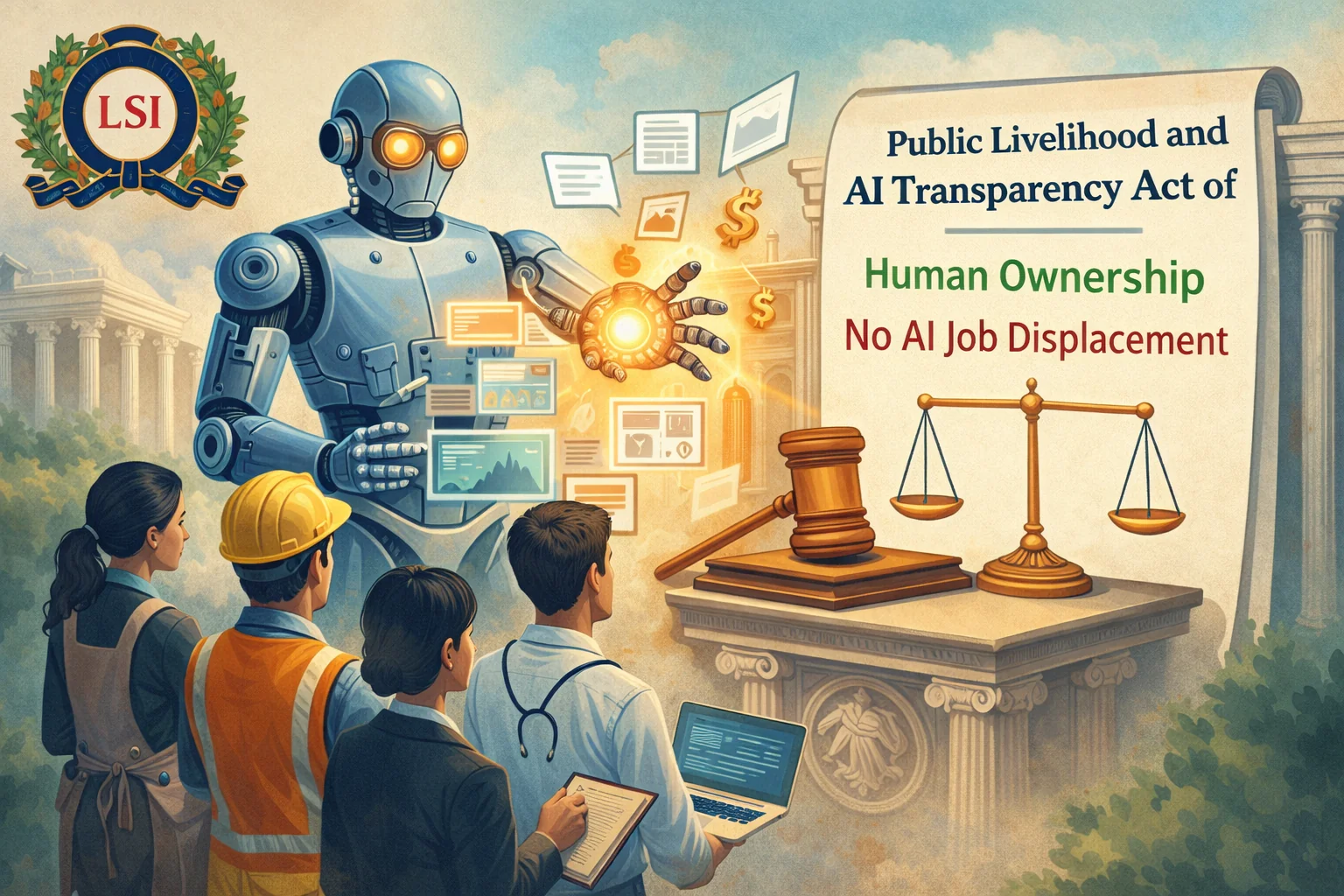
Section 1. Short Title, Purpose, And Fundamental Principles
(a) Short Title
This Act may be cited as the “Public Livelihood and AI Transparency Act of 2026.”
(b) Fundamental Principles
Parliament recognizes and declares that:
Human Community Principle
When human individuals contribute content to the internet, they do so for the benefit of the human community—enabling human social interaction, cultural exchange, human education, and democratic discourse among human beings. Such contributions are made for human engagement, not for exploitation by non-human technological equipment or automated systems;
Anti-Coercion Principle
No human shall be compelled, coerced, or conditioned to authorize non-human technological use of their data as a prerequisite for accessing essential digital services, platforms, or infrastructure. Consent obtained through market dominance, platform lock-in, or take-it-or-leave-it terms of service is not freely given and shall be void ab initio;
Attribution as Dignity Principle
The right of attribution is a fundamental inherent to human creativity, independent of economic rights or contractual licensing. Even when authorization for non-human technological use is voluntarily given, the original human source must be acknowledged. To erase the human origin of creative works through non-attributed machine processing is to violate the dignity of the creator and the integrity of human culture;
Livelihood Protection Principle
The right to earn a living through one’s own labor, skill, creativity, and expertise is fundamental to human dignity, economic security, and democratic participation. No technological system, regardless of efficiency or capability, may be deployed to displace, replace, or compete with human workers when such deployment would affect the livelihood of any person. The preservation of human economic opportunity takes absolute precedence over automation, algorithmic efficiency, or corporate profit;
Human Ownership Primacy Principle
All creative expression, knowledge, and intellectual value originates from human consciousness, experience, and labor. Non-human technological equipment can only recombine, interpolate, or transform pre-existing human intellectual contributions—it cannot create de novo. Therefore, all outputs generated by AI systems are derivative of human intellectual labor and must be owned exclusively by the human sources whose works made such outputs possible. Neither artificial intelligence nor the corporations that operate such systems can claim property rights in the fruits of human creativity;
Irrevocability
rights, including the right of attribution and the right of integrity, are personal to the human creator and shall not be alienated, waived, or transferred through any contract, terms of service, or licensing agreement, particularly in the context of non-human technological use.
(c) Purpose
The purposes of this Act are to:
- Establish that publicly accessible data shared for human community purposes does not constitute consent for non-human technological use;
- Prohibit platforms from coercing or conditioning user consent to AI training as a requirement for service access;
- Guarantee mandatory attribution of original human sources in all AI outputs, regardless of licensing or contractual terms;
- Absolutely prohibit the deployment of AI systems that affect, threaten, or displace human livelihoods, and establish such violations as criminal offenses;
- Establish that all AI-generated outputs are the exclusive property of the humans as creators, whose works enabled such outputs, and permanently prohibit any claim of ownership by AI systems or corporate entities;
- Protect intellectual property rights, economic security, and the integrity of human creative expression against unauthorized or authorized non-human technological appropriation;
- Create transparency requirements for AI training datasets;
- Establish a framework preempting any inconsistent laws regarding AI training data, economic displacement, and intellectual property ownership.
Purpose Summary Table
| Area | Objective |
|---|---|
| Consent | No implied consent for AI training from public data |
| Platform Regulation | No coercive acceptance of AI terms |
| Attribution | Mandatory credit to human creators |
| Employment Protection | Prohibit livelihood displacement by AI |
| Ownership | Humans exclusively own AI outputs |
| IP Protection | Protect creative expression integrity |
| Transparency | Disclosure of AI training datasets |
| Legal Framework | Preemption of conflicting laws |
Section 2. Definitions
In this Act:
Artificial Intelligence Model (AI Model)
(a) “Artificial Intelligence Model” or “AI Model”—Any computational system that uses machine learning, deep learning, neural networks, or similar techniques to generate outputs, make predictions, or perform tasks based on training data, operating through non-human technological processes with or without human creative judgment in the data ingestion phase.
Human Community Purpose
(b) “Human Community Purpose”—The sharing, display, discussion, or dissemination of content by and for human beings through social interaction, cultural exchange, education, journalism, artistic appreciation, or civic discourse, and content generated from the same, excluding automated data processing for machine learning or algorithmic model development by non-human technological equipment without any human generated or deemed to be generated from human data.
Non-Human Technological Use
(c) “Non-Human Technological Use”—Any automated collection, ingestion, processing, analysis, or synthesis of data by technological equipment, systems, algorithms, or computational processes with or without direct human creative oversight in each instance of data utilization, for purposes of training, fine-tuning, or developing artificial intelligence models.
Platform
(d) “Platform”—Any digital service, website, application, or online infrastructure that hosts, displays, or enables the sharing of user-generated content, including but not limited to social media services, search engines, content repositories, and cloud storage providers, where such service possesses market power or operates as an essential facility for digital expression.
Forced Consent
(e) “Forced Consent”—Any authorization for non-human technological use obtained through:
- Terms of service that condition access to platform services on consent to AI training;
- “Clickwrap” or “browsewrap” agreements that bundle AI training authorization with general platform use;
- Take-it-or-leave-it provisions where users cannot opt out of AI training without forfeiting essential digital services;
- Market dominance or lock-in effects that deprive users of meaningful alternative platforms;
- Any practice that subordinates data dignity to platform access.
Rights
(f) “Rights”—The rights of attribution (paternity) and integrity belonging to human creators under Article 19 and 21 of Constitution of India and international treaty obligations, which persist regardless of copyright ownership, licensing, or contractual assignment of economic rights.
Mandatory Attribution
(g) “Mandatory Attribution”—The obligation to identify, credit, and link to the original human source of any data used in AI training, which obligation shall apply in perpetuity regardless of any contractual waiver or license terms.
Affecting Livelihood
(h) “Affecting Livelihood”—Any action, output, or effect of an AI system that:
- Replaces, displaces, or substitutes for human labor, employment, or economic activity;
- Reduces income, work hours, employment opportunities, or economic security for any individual or class of workers;
- Depresses wages, rates, or compensation due to competition with non-human outputs;
- Eliminates career pathways, apprenticeship opportunities, or entry-level positions;
- Devalues human expertise, credentials, education, or creative expression;
- Destroys or diminishes industries, sectors, or professions that provide human livelihood;
- Erodes collective bargaining, workplace protections, or labor standards;
- Creates dependency on non-human systems that undermine human economic self-sufficiency.
AI-Generated Output
(i) “AI-Generated Output”—Any content, work, product, analysis, code, image, text, audio, video, or other tangible or intangible result produced by an AI system through automated processing, regardless of:
- The degree of “originality” or “creativity” displayed;
- The amount of computational resources expended;
- Claims of “emergent” properties or “novel” combinations;
- Any other characteristic that might suggest independent creation.
Human Ownership
(j) “Human Ownership”—The exclusive, perpetual, and inalienable right of human creators to possess, use, enjoy, and dispose of AI-generated outputs that derive from their original intellectual contributions, free from any claim by non-human entities or corporate systems.
Covered Entity
(k) “Covered Entity”—Any person, corporation, partnership, platform, or other entity that develops, trains, fine-tunes, distributes, deploys, or operates AI models for any purpose, including operators of non-human technological equipment engaged in automated data collection.
Authorized Use
(l) “Authorized Use”—Use of data for AI training pursuant to:
- Freely given, specific, informed, and unambiguous consent obtained without coercion, conditioning, or platform leverage;
- A valid license agreement explicitly covering AI training purposes by technological equipment that explicitly preserves mandatory attribution, and human ownership of outputs;
- A statutory exception expressly provided in this Act.
Section 3. Prohibition On Platform Coercion And Forced Consent
Absolute Prohibition On Conditional Consent
(a) No platform shall, as a condition of providing access to services, require, request, or coerce any user to authorize non-human technological use of their data. This prohibition shall apply regardless of whether the platform provides compensation, “premium” features, or modified service tiers with consent.
Unbundling Requirement
(b) Any platform seeking authorization for non-human technological use must:
- Present such request separately from general terms of service;
- Allow users to access all platform features and services while explicitly declining AI training authorization;
- Provide identical service quality and functionality regardless of AI training consent status;
- Refrain from dark patterns, manipulative interface design, or punitive measures against users who decline AI training consent.
Presumption Of Invalidity
(c) Any consent to non-human technological use obtained through platform terms of service, end-user license agreements, or general privacy policies shall be presumptively invalid and unenforceable. This presumption may only be overcome by separate, specific, affirmative authorization complying with Section 4.
Retroactive Invalidation
(d) Any consent to AI training obtained by platforms prior to the effective date of this Act through bundled terms of service, general privacy policies, or market coercion is hereby declared void ab initio. Platforms must:
- Cease all non-human technological use of user data obtained through such coerced consent within 90 days;
- Purge such data from training datasets and model weights where technically feasible;
- Provide individual notice to users explaining that previously “consented” AI use is now prohibited and has been terminated.
Platform Liability
(e) Platforms violating this Section shall be liable for:
- Statutory damages of Rs.1 Crore per user affected by coerced consent practices;
- Disgorgement of all profits derived from AI models trained on coerced data;
- Injunctive relief prohibiting continued use of such data;
- Full cost of advocates fees and costs for successful plaintiffs.
Section 4. Authorization Requirements And Mandatory Attribution
Freely Given Authorization Required
(a) Authorization for non-human technological use must be:
- Voluntary—Obtained without platform coercion, market leverage, or service conditioning;
- Specific—Clearly identify the data to be used and explicitly acknowledge non-human technological equipment use;
- Informed—Disclose that automated systems without human creative judgment will process the data;
- Affirmative—Require clear, unambiguous opt-in action separate from general platform registration;
- Granular—Allow authorization by content type, specific works, or time-limited periods;
- Revocable—Permit withdrawal of authorization at any time without penalty or service degradation;
- Ownership-Preserving—Explicitly acknowledge that all AI outputs generated using the authorized data shall be owned exclusively by the humans alone, not by the AI system or operating corporation.
Perpetual Mandatory Attribution
(b) Notwithstanding any contractual term, license, or purported waiver, every authorization for non-human technological use shall include as a non-waivable condition:
Source Citation Requirement
(c) For each output generated by the AI model that draws upon or is influenced by the authorized data, the covered entity must provide:
- The name or identifier of the original human creator;
- The title or description of the original work;
- A direct hyperlink to the original source or permanent identifier;
- The date of original creation and date of AI model output;
- A statement that the output was generated using the creator’s work as training data;
- A statement that the original human creator retains exclusive ownership of the output.
Output Integration
(d) Such attribution must appear:
- Prominently in any user interface displaying AI-generated content;
- In metadata accompanying digital files;
- In any downstream distribution, modification, or derivative use;
- In a manner accessible to end-users without technical expertise.
Prohibition On Removal
(e) No contractual provision, license, or terms of service may permit the removal, obscuring, or omission of mandatory attribution. Any such provision is void as against public policy.
Rights Preservation
(f) No authorization, license, or contract may require waiver of rights, including:
- The right of attribution (paternity);
- The right of integrity (objection to prejudicial distortion);
- The right to object to false attribution;
- The right to ownership of all AI outputs derived from the creator’s works;
- The right to withdraw authorization if the use prejudices the creator’s honor or reputation.
Prohibited Authorization Terms
(f) The following shall NOT constitute valid authorization:
- Platform terms of service purporting to grant perpetual, irrevocable rights to “any purpose including AI”;
- Broad licenses failing to specify mandatory attribution requirements;
- Agreements containing “rights waivers,” “attribution waivers,” or “ownership transfer” clauses;
- Collective licenses that do not preserve individual attribution and ownership rights;
- Any term suggesting that public posting constitutes AI training consent;
- Any term purporting to assign ownership of AI outputs to platforms, corporations, or non-human systems.
Section 5. Absolute Prohibition On AI Affecting Human Livelihood
(a) Criminal Offense Of Livelihood Harm
It shall be a offense for any covered entity to knowingly deploy, operate, distribute, or make available any AI system where the outputs, functions, or effects of such system:
1. Replace, Displace, Or Substitute For Human Labor
Perform tasks, functions, or services that would otherwise provide employment, income, or economic sustenance to any human being, including but not limited to:
- Creative expression (writing, journalism, art, music, performance, design);
- Professional services (legal, medical, financial, educational, scientific etc.);
- Technical and analytical work (programming, engineering, analysis, research);
- Administrative and managerial functions (scheduling, evaluation, supervision, decision-making);
- Service and care work (healthcare, education, childcare, eldercare, hospitality);
- Manual and physical labor (transportation, delivery, maintenance, manufacturing, construction).
Compete With Human Economic Activity
Generate content, analysis, products, or services that:
- Enter markets where human-created goods or services are sold;
- Underbid, undersell, or otherwise compete with human providers;
- Depress prices, wages, or rates below what human workers require for economic survival;
- Create surplus value for corporations while destroying value for human labor.
Automate Human Judgment Functions
Execute decision-making, management, evaluation, or supervision functions that have traditionally required and benefited from human empathy, ethical reasoning, contextual understanding, or moral judgment.
Enable Algorithmic Management
Control, direct, evaluate, discipline, or terminate human workers through automated systems, including but not limited to:
- Performance monitoring and productivity tracking;
- Automated scheduling, task allocation, or shift management;
- Algorithmic hiring, firing, or disciplinary decisions;
- Surveillance-based productivity optimization;
- Predictive analytics for workforce reduction or union-busting.
(b) Irrebuttable Presumption Of Prohibited Effect
It shall be conclusively presumed that any AI system capable of generating outputs that mimic, replicate, or substitute for human cognitive, creative, physical, or managerial labor poses a direct, immediate, and unacceptable threat to human livelihood, regardless of:
- Claims of superior efficiency, accuracy, or cost-effectiveness;
- Assertions that the AI “augments” rather than replaces humans;
- Arguments that displaced workers can be “retrained” or “reskilled”;
- Economic theories suggesting “job churn” creates new opportunities;
- Any purported waiver or consent obtained from affected workers or unions.
(c) Strict Liability For Livelihood Harm
Covered entities shall be strictly liable for any violation of this Section and there shall be requirement of proof of intent, malice, or negligence. The mere deployment of an AI system affecting human livelihood constitutes a complete offense.
(d) Prohibited Defense
It shall not be a defense to prosecution under this Section that:
- The AI system creates new jobs in different sectors;
- The affected workers received notice, training, or severance;
- The deployment was approved by regulatory bodies or “ethical” review boards;
- The AI operates under “human oversight” or “human-in-the-loop” frameworks;
- The affected workers consented to displacement or signed “future of work” agreements;
- The deployment is necessary for “competitiveness” or “innovation.”
Section 6. Criminal Penalties And Enforcement
(a) Felony Classification
Violations of Section 5 shall constitute a Cognizable and Non Bailable offence.
(b) Corporate And Individual Liability
(1) Corporate Entities
All persons of the entity aware of the function shall, be it any corporation, partnership, or entity violating Section 5 shall be subject to:
| Penalty | Description |
|---|---|
| Criminal Fine | Not less than Rs.10 Crore and not more than Rs.100 Crore per violation |
| Dissolution | Charter revocation for willful, repeated, or systematic violations |
| Disgorgement | Mandatory disgorgement of all profits, revenues, and economic benefits derived from prohibited AI systems |
| Asset Forfeiture | All hardware, software, models, and infrastructure used in prohibited deployment |
(2) Individual Liability
Any officer, director, employee, or agent of a covered entity who knowingly participates in, authorizes, or fails to prevent a violation of Section 5 shall be subject to:
| Penalty | Description |
|---|---|
| Imprisonment | Not less than 5 years and not more than 20 years per violation |
| Fine | Not less than Rs.1 Crore and not more than Rs.5 Crore |
| Corporate Ban | Lifetime prohibition from serving as an officer or director of any corporation |
| Restitution | Compensation to all affected workers for lost wages, benefits, and economic opportunities |
(c) Whistleblower Protections And Rewards
Individuals who report violations of Section 5 shall receive:
- Protection from retaliation;
- Rewards of 10-30% of criminal fines collected;
- Private right of action to enforce this Section against the Govt minister, secretaries and officers whose duty it is to enforce this law, if it declines to prosecute.
(e) Legal Preemption
This Section preempts all laws in future to the extent they are less protective, but preserves laws establishing parallel or greater criminal penalties for livelihood-harming AI deployment.
Section 7. Civil Remedies And Injunctive Relief
(a) Private Right Of Action
Any individual whose livelihood has been affected by a violation of Section 5 may bring a criminal or civil action and the civil claim shall be:
- Statutory damages of not less than the Penal amount per affected individual; or Actual damages including lost income, benefits, career damage, and emotional distress; which ever is more
- Punitive damages of up to 4 times above;
- Injunctive relief ordering of immediate cessation of AI deployment;
- Attorneys’ fees and costs.
(b) Class Action Authorization
Claims under this Section may proceed as class actions on behalf of all similarly situated affected workers, with damages calculated in the aggregate.
(c) Expedited Injunctive Relief
Courts shall issue temporary restraining orders and preliminary injunctions prohibiting deployment of livelihood-affecting AI systems within 48 hours of filing, pending full adjudication.
Section 8. Human Ownership Of All AI-Generated Outputs
(a) Absolute Prohibition On Non-Human Ownership
1. No AI Ownership
No artificial intelligence system, algorithm, computational model, neural network, machine learning system, or any other non-human technological equipment, shall be recognized as an author, creator, inventor, or rights holder under any provision of law whatsoever
No Corporate Ownership Of AI Outputs
No corporation, partnership, limited liability company, trust, or other business or legal entity shall claim, hold, exercise, or enforce any ownership, copyright, patent, trademark, trade secret, or proprietary right in any AI-generated output, regardless of:
- Investment in AI development, hardware, or infrastructure;
- Ownership or licensing of training data;
- Employment of programmers, engineers, or data scientists;
- Contractual terms with users, contributors, or employees;
- Claims of “sweat of the brow,” compilation copyright, or database rights;
- Any other theory of ownership, authorship, or economic right.
No Work-for-Hire Doctrine
No AI-generated output shall qualify as a “work made for hire”, regardless of:
- The employment status of individuals who programmed or operated the AI;
- Contractual “work-for-hire” agreements;
- Corporate or Govt commissioning or funding of AI development;
- Any other circumstance that might apply the work-for-hire doctrine to human-created works.
No Assignment Or Transfer
No contract, terms of service, employment agreement, licensing agreement, or any other legal instrument may assign, transfer, or convey ownership of AI-generated outputs from the human source(s) to:
- The AI system itself;
- The corporation or entity operating the AI;
- Any third party;
- Any non-human or human entity other than the original human creator(s).
(b) Automatic Vesting Of Human Ownership
All rights, title, and interest in AI-generated outputs shall vest automatically, immediately, exclusively, and perpetually in the human individual or individuals whose original works, data, likeness, intellectual contributions, or creative expression were used to generate such output, as follows:
- Identifiable Contribution. Where specific human sources can be identified in the training data or generation process, ownership shall vest in those individuals in proportion to the quantum and qualitative significance of their contribution and rest in the Human Creative Commons Trust ownership.
- Collective Ownership. Where multiple human sources contributed to the training data, ownership shall be held collectively by all identifiable contributors as tenants in common, with each contributor retaining an undivided interest proportional to their contribution and rest in the Human Creative Commons Trust ownership. No single contributor may unilaterally exploit the output without accounting to and obtaining consent from all other contributors and rest in the Human Creative Commons Trust ownership.
- Unidentifiable Sources. Where human sources cannot be specifically identified, ownership shall vest in a Human Creative Commons Trust established under subsection (e), to be held for the benefit of all human creators and the public domain, with no rights accruing to the AI operator or corporate entity.
- Perpetual And Irrevocable. Human ownership under this Section is perpetual, irrevocable, inalienable, and non-waivable. No contract, license, or agreement may transfer, assign, or extinguish such ownership.
(c) Retroactive Vesting And Voiding Of Prior Claims
This ownership provision applies retroactively to all AI-generated outputs created at any time prior to the effective date of this Act:
- Immediate Vesting. Upon enactment, all rights in existing AI outputs immediately vest in the original human sources, free from any prior claims by AI systems or corporate entities.
- Voiding Of Prior Registrations. Any copyright, patent, or trademark registration obtained by an AI system or corporate entity for AI-generated output is hereby declared void ab initio and shall be expunged from all registries.
- Disgorgement Of Past Profits. Entities that have exploited AI-generated outputs must disgorge all profits, revenues, and economic benefits derived therefrom to the human owners, with interest calculated from the date of first exploitation.
- No Statute Of Limitations. Claims for retroactive ownership and disgorgement may be brought at any time, with no statute of limitations defense available.
(d) Prohibition On AI “Personhood” And Legal Capacity
- No Legal Personhood. No AI system or corporate operators shall be recognized as a legal person, artificial person, juridical person, or rights-bearing entity under any law, including corporate law, intellectual property law, constitutional law, or any other legal framework.
- No Standing. AI systems and corporate operators lack standing to sue, be sued, intervene in proceedings, or seek judicial remedies in any court, administrative agency, or alternative dispute resolution forum.
- No Contractual Capacity. AI systems lack capacity to enter into contracts, licenses, or binding agreements. Any purported agreement to which an AI system is a party is void ab initio, and all rights and obligations thereunder shall vest exclusively in the human party or parties.
- No Constitutional Rights. AI systems and corporate operators are not “persons” entitled to protection under the Constitution, or any other provision of law. Claims of “free speech,” “due process,” or “equal protection” rights for AI systems or their outputs or entities are prohibited and shall not be entertained by any court.
- No Property Rights In Data. AI systems and corporate operators shall not assert property rights, trespass claims, or conversion claims against human creators who seek to remove, restrict, or control use of their data in AI training.
(e) Human Creative Commons Trust
- Purpose. To hold ownership of AI outputs for the benefit of the global human creative community and the public domain, preventing corporate capture of collectively-derived intellectual value.
- Administration. The Trust shall be governed by a board of human creators, scholars, and public representatives, with no corporate or AI industry participation.
- Licensing. The Trust may license AI outputs for non-commercial, educational, or research purposes only, with all proceeds supporting human artists, journalists, and creative professionals displaced by AI systems.
- Prohibition On Commercial Exploitation. No AI output held by the Trust may be commercially exploited by any corporate entity or individual for private profit.
It shall be the liablity of the Trust to ensure complete enforecement of the act
The provisions of section 5 above shall apply to the Trust
(f) Mandatory Ownership Registration And Disclosure
Pre-Generation Registration
Before generating any AI output, covered entities must register with the Copyright Office:
- The specific human sources in the training data that will contribute to the output;
- The anticipated nature and content of the output;
- A sworn affidavit disclaiming any claim of ownership by the AI system or corporate entity;
- A binding commitment to attribute ownership to the identified human sources.
Post-Generation Filing
Within 30 days of generating an AI output, covered entities must file:
- The complete output or a representative sample;
- Verification that ownership has vested in the human sources;
- A certificate of compliance with this Section;
- A waiver of any corporate claim to the output.
(g) Public Ownership Registry
The Trust shall maintain a public, searchable registry of all AI-generated outputs and their human owners, accessible without fee to the public.
(h) Output Labeling
| Requirement | Description |
|---|---|
| Notice | “Human-Owned Content: Exclusive property of [Creator Name(s)]. AI systems and operating corporations disclaim all ownership rights.” |
| Owners | Complete list of human owners and proportional interests |
| Registry Link | URL linking to the Public Ownership Registry |
| Verification | QR code or digital watermark linking to ownership documentation |
(h) International Coordination
- No recognization to foreign intellectual property rights granted to AI systems or corporate entities for AI-generated outputs;
- No enforcement of foreign judgments recognizing non-human ownership;
- Negotiations or treaties establishing human ownership as an international norm;
- Imposition of trade sanctions on nations permitting AI or corporate ownership of algorithmic outputs.
Section 9. Transition, Compliance, And Safe Harbor
a) Immediate Cessation Required
All covered entities must cease deployment of livelihood-affecting AI systems within 30 days of this Act’s effective date.
b) Mandatory Workforce Restoration
Entities that have deployed prohibited AI systems must:
- Immediately terminate AI operations and restore human-performed functions;
- Rehire all displaced workers with full back pay, benefits, and seniority restoration;
- Provide retraining at employer expense for any worker whose skills were degraded during AI deployment;
- Submit to monitoring by the Department of Labor for a period of not less than 5 years.
c) Ownership Transfer And Disgorgement
Entities holding claims to AI-generated outputs must:
- Immediately transfer all such outputs and associated revenues to the identified human owners or the Human Creative Commons Trust;
- Provide complete accounting of all profits derived from AI outputs;
- Disgorge all ill-gotten gains with interest;
- Destroy all corporate records falsely claiming AI or corporate authorship.
d) No Exemption For Prior Deployments
No AI system deployed, no output generated, and no ownership claim asserted prior to this Act’s effective date is exempt from this Act. All existing deployments, outputs, and claims must comply immediately with this Section.
e) Limited Research Exception
Academic research on AI capabilities may continue provided:
- No commercial deployment or public release of models;
- No economic competition with human labor;
- No ownership claims by researchers or institutions;
- All outputs immediately vest in human sources or the Human Creative Commons Trust;
- Strict containment protocols preventing unauthorized use;
- Annual certification to the Department of Labor and Trust confirming compliance.
Section 10. Transparency, Record-Keeping, And Registry
a) Training Data Documentation
Covered entities shall maintain detailed records of:
- All public data used in training, including specific attribution and ownership information for each data point;
- Documentation demonstrating authorization was freely given without platform coercion;
- Attribution chains and ownership mapping from sources to outputs;
- Technical measures to prevent removal of attribution and ownership metadata.
b) Public Ownership And Attribution Database
The Trust shall establish and maintain a publicly searchable “Human Ownership and Attribution Registry” containing:
- All AI-generated outputs with complete ownership information;
- All training data sources with attribution to human creators;
- Records of which creators have authorized non-human technological use and under what terms;
- Standardized formats for ownership disclosure and attribution;
- A registry of creators who have prohibited AI use or reserved moral and ownership rights.
c) Verification Mechanisms
Covered entities must implement:
- Technical systems to trace model outputs back to specific training data sources and human owners;
- Automated ownership and attribution generation for all AI outputs;
- Mechanisms for creators to verify whether their owned works appear in AI outputs;
- Quarterly reports to the Trust on ownership compliance rates.
Section 11. Technical Safeguards And Standards
a) Ownership And Attribution Technology Standards
Trust shall develop standards for:
- Persistent ownership and attribution metadata resistant to stripping or alteration;
- Blockchain or distributed ledger systems for immutable ownership records;
- Automated ownership verification systems;
- Interoperable formats ensuring ownership and attribution travel with content across platforms;
- Technical measures to prevent AI systems from generating outputs without embedded ownership data.
b) Prohibition On Ownership Obfuscation
Covered entities shall not deploy or distribute AI systems that:
- Remove, disable, obscure, or falsify ownership or attribution metadata;
- Generate outputs designed to prevent identification of human sources;
- Use “black box” architectures that inherently prevent source and ownership tracing;
- Falsely claim corporate or AI authorship in output metadata.
c) Machine-Readable Rights Reservation
Trust shall develop standards for:
- Machine-readable protocols distinguishing human community permissions from non-human technological use prohibitions;
- Technical measures to prevent automated scraping by technological equipment while preserving human access;
- Verification systems for authorization and ownership documentation specific to non-human technological use.
Section 12. Relationship To Other Laws
a) Supremacy Of Livelihood And Human Ownership
The Livelihood human ownership provisions of this Act shall supersede any conflicting provision of any law, states intellectual property, contract, or property law, or any international treaty or agreement to the extent it recognizes non-human ownership.
b) Labor Law Integration
This Act shall be enforced in coordination with the labour laws in force. Apart from the provisions hereof, violations of this Act constituting unfair labor practices may be tried under those labour laws.

