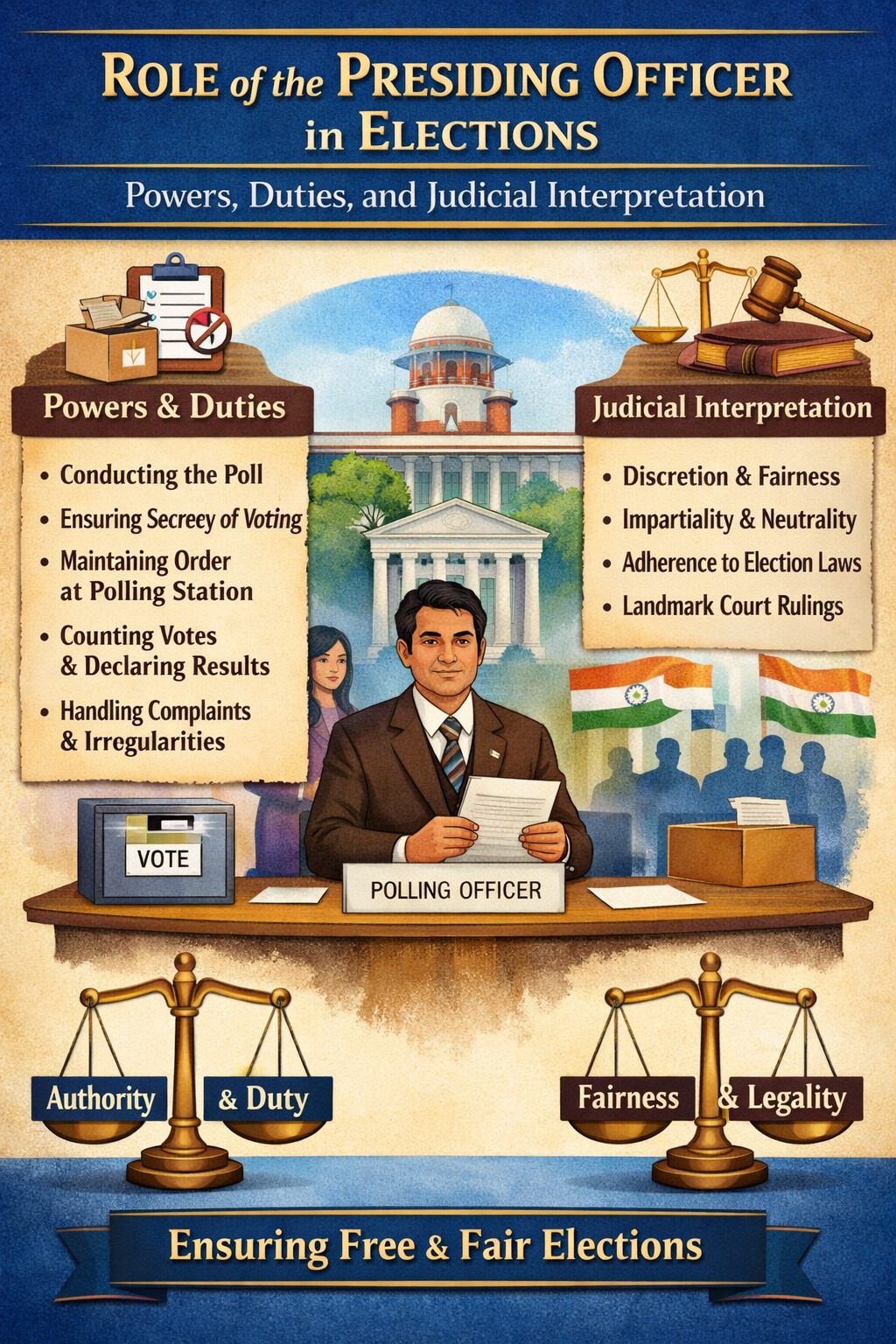
Free and fair elections form the cornerstone of a democratic polity. In India, the constitutional mandate under Article 324 of the Constitution entrusts the superintendence, direction, and control of elections to the Election Commission of India (ECI). At the grassroots level, this mandate is operationalised through election officials, among whom the Presiding Officer (PO) occupies a pivotal position. The Presiding Officer is the highest authority at a polling station and is responsible for ensuring that the polling process is conducted strictly in accordance with law, rules, and ECI instructions.
Statutory Framework Governing the Presiding Officer
The role, appointment, and powers of the Presiding Officer in the conduct of elections are principally governed by a combination of statutory provisions, delegated legislation, and executive instructions.
At the statutory level, the Representation of the People Act, 1951, particularly Sections 26 to 28A, provides the legal framework for the appointment of Presiding Officers and polling personnel, their duties, and their deemed deputation to the Election Commission of India, thereby placing them under the Commission’s superintendence, control, and disciplinary authority during the election period. These provisions ensure institutional independence and uniformity in poll administration.
Operational and procedural aspects are elaborated under the Conduct of Elections Rules, 1961, notably Rule 39 (procedure for voting by ballot paper/maintenance of secrecy of voting by electors), Rule 48 (procedure on adjournment of poll), and Rules 49A–49X and allied provisions governing voting by EVMs and VVPATs, including sealing, custody, secrecy of voting, and maintenance of order. These Rules confer statutory authority upon the Presiding Officer to regulate proceedings within the polling station.
Supplementing the Act and Rules, the Handbook for Presiding Officers issued by the Election Commission of India serves as an authoritative practical guide, containing step-by-step instructions, checklists, and clarifications to ensure uniform application of the law and compliance with the Commission’s directions under Article 324 of the Constitution.
With respect to electoral offences, cognizance is taken under the penal provisions of the Representation of the People Act, 1951 (as amended), while general criminal liability for related acts—such as obstruction, impersonation, or disorder—may also arise under the Bharatiya Nyaya Sanhita, 2023.
However, the Presiding Officer’s authority in this regard is limited to maintaining order at the polling station and requisitioning police assistance as provided under the Act and the Conduct of Elections Rules. Importantly, no independent magisterial powers are conferred on Presiding Officers under the Bharatiya Nagarik Suraksha Sanhita, 2023, and any coercive criminal process must be exercised by competent magistrates or law-enforcement authorities.
Appointment
Presiding Officers are appointed by the Returning Officer under Section 26 of the Representation of the People Act, 1951, and discharge their functions in accordance with the Conduct of Elections Rules, 1961, free from political influence.
- Core Functions and Responsibilities of the Presiding Officer
(a) Overall Control of the Polling Station: The Presiding Officer is the chief authority within the polling station, exercising overall supervision and control over all polling personnel, including Polling Officers. He or she is responsible for the orderly opening and closing of the poll, ensuring the secrecy of voting, and preventing electoral malpractices such as impersonation, booth capturing, and undue influence.
In practice, if unauthorized persons enter the polling station or canvassing takes place within the prohibited 100-metre radius, the Presiding Officer is empowered to direct their immediate removal and restore order, including by seeking police assistance where necessary.
(b) Verification of Voters and Issue of Ballot / Activation of EVM
The Presiding Officer plays a pivotal role in ensuring the integrity of the voting process by verifying the proper identification of voters (primarily through the Electors Photo Identity Card (EPIC) or other prescribed alternative documents, as per the marked copy of the electoral roll and Rule 49H of the Conduct of Elections Rules, 1961), ensuring application of indelible ink on the left forefinger (after inspection to confirm no prior mark exists, in line with Rule 49K safeguards against personation – typically handled by the Second Polling Officer but under the Presiding Officer’s overall supervision), and activating the EVM by pressing the ‘Ballot’ button on the Control Unit to enable the voter to cast their vote on the Ballot Unit (with the Presiding Officer or designated Polling Officer in charge of the Control Unit).
The Presiding Officer must be fully satisfied that all statutory requirements— including identity verification, indelible ink marking, entries in the Register of Voters (Form 17A), and no challenges or irregularities—are met before permitting any voter to proceed to vote, thereby safeguarding against impersonation and upholding free and fair elections as outlined in the Representation of the People Act, 1951, Conduct of Elections Rules, 1961, and the ECI’s Handbook for Presiding Officers.
(c) Maintenance of Secrecy of Voting
Rule 49M of the Conduct of Elections Rules, 1961, mandates strict maintenance of secrecy of voting, requiring every elector permitted to vote to observe the prescribed procedure to ensure secrecy within the polling station. The Presiding Officer plays a key role in enforcing this by preventing any voter from disclosing their vote, prohibiting photography or videography inside the polling station, and safeguarding the voting compartment from any interference or observation that could compromise secrecy.
In the landmark case of A.C. Jose v. Sivan Pillai, (1984) 2 SCC 656, the Supreme Court underscored the fundamental importance of secrecy in the electoral process, emphasizing that it must be preserved at all costs to uphold the integrity and fairness of elections, as it forms an essential safeguard for free and genuine expression of voter choice.
(d) Power to Adjourn or Stop Poll: Under Section 57 and Section 58 of the Representation of the People Act, 1951, the Presiding Officer may stop or adjourn the poll in cases of:
- Natural calamity
- Riot or violence
- Destruction or tampering of EVMs
- Booth capturing
As for example, if a polling station is stormed by miscreants and voting is disrupted, the Presiding Officer may adjourn the poll and report the matter to the Returning Officer for a fresh poll.
(e) Handling of Challenged and Tendered Votes
The Presiding Officer adjudicates:
- Challenged votes: when a polling agent challenges a voter’s identity under Section 49J of the Conduct of Election Rules, 1961.
- Tendered votes: when a voter claims that someone has already voted in their name under Section 49P of the Conduct of Election Rules, 1961.
This quasi-judicial function must be exercised carefully and impartially.
(f) Maintenance of Election Records: The Presiding Officer bears the crucial responsibility for the proper maintenance, preparation, and sealing of key election records at the close of poll to ensure transparency and evidentiary value in case of disputes. This includes meticulously filling and certifying the Presiding Officer’s Diary (recording all significant events, incidents, and observations during polling), maintaining and sealing the Register of Voters in Form 17A (detailing voter verification details), preparing the Ballot Paper Account or EVM Account in Form 17C (accounting for votes polled, unused EVMs, tendered votes, etc.), and securely packing and sealing various election materials—such as used and unused forms, declarations, challenged vote lists, visitor sheets, and other documents—into designated envelopes or packets with paper seals, strip seals, and address tags as per ECI guidelines.
These sealed records and materials are then handed over to the Returning Officer and frequently serve as vital, contemporaneous evidence in election petitions under the Representation of the People Act, 1951, helping courts ascertain the fairness and regularity of the polling process.
Case Law
Ram Sewak Yadav v. Hussain Kamil Kidwai, AIR 1964 SC 1249: The Supreme Court held that election records maintained by polling officials are vital and can be inspected by courts under strict conditions.
- Powers to Maintain Law and Order
Under Section 28A of the Representation of the People Act, 1951, the Presiding Officer (along with Returning Officer, polling officers, and designated police) is deemed to be on deputation to the Election Commission of India from the date of election notification until result declaration. This places them under the ECI’s superintendence, direction, and discipline, shielding them from external interference.
Additionally, under Section 131 of the RP Act, 1951, the Presiding Officer may direct police to arrest persons for disorderly conduct or misconduct near/at polling stations that interferes with the poll.
- Role in Preventing Electoral Malpractices
Chapter III of the Representation of the People Act, 1951 (Sections 125–136) deals with electoral offences.
The Presiding Officer plays a preventive role against:
- Impersonation
- Multiple voting
- Booth capturing
- Intimidation of voters
Mohinder Singh Gill v. Chief Election Commissioner, (1978) 1 SCC 405: The Supreme Court described the Election Commission as the super-authority overseeing the entire electoral process, with Returning Officers as the kingpin and Presiding Officers as the minions in the polling stations. All these officials operate as part of the machinery under the ECI’s superintendence to ensure free and fair elections and to preserve the purity of the electoral process.
This case is a landmark for affirming the ECI’s broad authority under Article 324 to protect electoral integrity, even in extraordinary situations involving violence, irregularities, or threats to fairness.
Accountability and Legal Protection
Accountability
A Presiding Officer may be held accountable for:
- Wilful dereliction of duty
- Bias or partisanship
- Manipulation of records
Such acts may lead to:
- Departmental action
- Criminal prosecution
- Adverse inference in election petitions
Legal Protection
Acts done in good faith are protected under Section 146C of the Representation of the People Act, 1951.
No suit, prosecution or other legal proceeding shall lie against the Election Commission or any person acting under the direction of the Commission in respect of anything which is in good faith done or intended to be done in pursuance of the provisions of this Act or of any other law relating to elections.
This is the standard “good faith” protection clause commonly found in many Indian statutes, shielding election officials and the Election Commission from liability when they act bona fide (in good faith) under the Act.
Judicial View on the Role of Presiding Officers
Courts have consistently held that:
- Presiding Officers are neutral arbiters
- Minor procedural lapses do not vitiate elections unless they materially affect the result
- Substantial compliance with election law is sufficient
Case Law
Jagan Nath v. Jaswant Singh, AIR 1954 SC 210: The Supreme Court held that elections should not be lightly set aside and that the burden lies on the challenger to prove material irregularity.
Conclusion
The Presiding Officer is the linchpin of the electoral process at the polling station level. Acting as the eyes and ears of the Election Commission, the Presiding Officer ensures that constitutional ideals of free, fair, and transparent elections are translated into reality. Judicial precedents reinforce the significance of this role while balancing it with accountability and legal safeguards. In a democracy as vast and complex as India’s, the integrity and impartiality of Presiding Officers remain indispensable to the legitimacy of electoral outcomes.