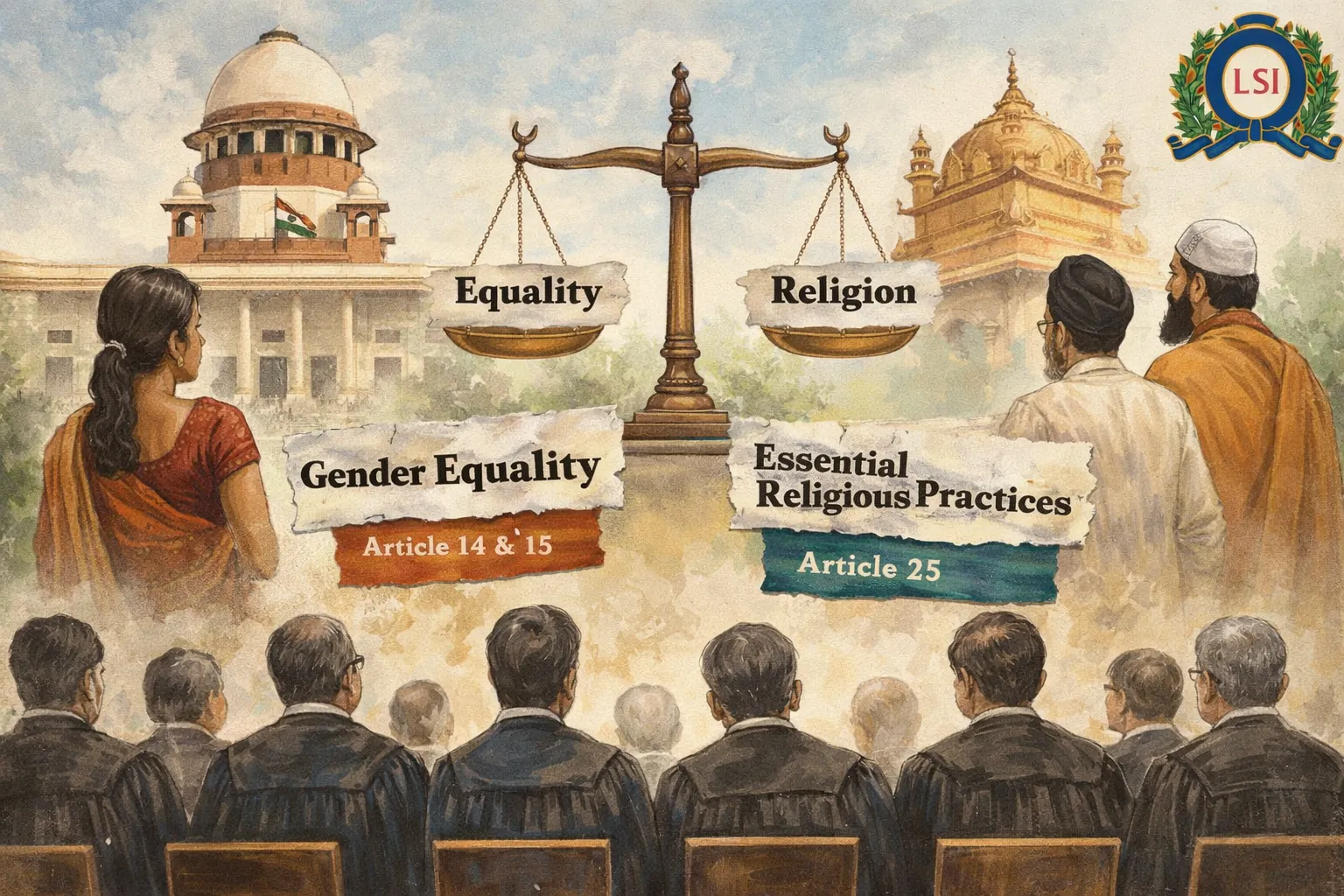
A Constitutional Crossroads: Faith, Equality and the Limits of Judicial Review
India’s constitutional law jurisprudence is once again at a historic inflection point. The Supreme Court’s nine-judge Constitution Bench is not merely reconsidering Sabarimala — it is re-examining the very architecture of religious freedom in the Indian Constitution.
The reference moves far beyond the question:
Can women enter the Sabarimala temple?
Instead, the Court now asks:
How should courts decide what religion itself protects?
Case Details
| Particular | Information |
|---|---|
| Case name | Kantaru Rajeevaru v. Indian Young Lawyers Association (Review Reference in the Sabarimala matter) |
| Connected original judgment | Indian Young Lawyers Association v. State of Kerala |
| Bench strength | Nine-Judge Constitution Bench of the Supreme Court of India |
| Reference order date | 14 November 2019 |
| Review orders continuing reference | 2020–2023 procedural listings; matter still pending for final constitutional adjudication |
Background — From Sabarimala to a Pan-India Religious Rights Question
In 2018, the Supreme Court in Indian Young Lawyers Association v. State of Kerala (5-judge bench) held that the exclusion of women aged 10–50 from the Sabarimala Temple violated constitutional guarantees of equality and dignity.
The judgment relied heavily on:
- Article 14 — Equality before law
- Article 15 — Non-discrimination
- Article 25 — Freedom of religion
However, intense legal, theological and social debate followed. Review petitions raised a deeper issue:
Should courts decide what constitutes an essential religious practice?
Recognising that similar disputes exist across religions —
- Mosques
- Temples
- Dargahs
- Parsi fire temples
- Other denominational institutions
The Court referred the matter to a nine-judge bench in 2019.
The Constitutional Questions Before the 9-Judge Bench
The Court framed issues that go to the heart of Indian secularism.
A. Essential Religious Practices Doctrine (ERP)
For decades, courts have tested religious practices by asking:
Is the practice essential to the religion?
Now the Court must reconsider:
- Should judges interpret theology?
- Who defines religion — believers or the Constitution?
- Can constitutional morality override denominational autonomy?
This could redefine precedents dating back to Shirur Mutt (1954).
B. Gender Equality vs Religious Freedom
The core tension:
| Equality Model | Religious Autonomy Model |
|---|---|
| Constitution transforms society | Constitution protects diversity |
| State reforms religion | State stays neutral |
| Individual rights prevail | Community rights prevail |
The Court must decide whether faith-based exclusion automatically becomes unconstitutional discrimination.
C. Interplay of Articles 14, 15 and 25
The most complex doctrinal question:
Are religious rights subject to equality — or are they independent freedoms?
Possible interpretations:
| Model | Meaning |
|---|---|
| Equality-First Model | Article 25 subject to Article 14 — Any exclusion = unconstitutional |
| Group-Rights Model | Denominations protected under Article 26 — Autonomy of religious communities preserved |
| Harmonisation Model | Courts intervene only when practice violates dignity in a civil sense |
This case will determine India’s future model of secularism.
Why This Case Is Historically Significant
This reference is considered among the most consequential constitutional cases since:
- Basic Structure doctrine
- Privacy judgment
- Decriminalisation of homosexuality
Because the Court will decide:
- Can courts reform religion?
- Are constitutional rights purely individual?
- What is the role of constitutional morality?
- Where does pluralism end and discrimination begin?
Potential Impact Across Religions
The ruling will not remain confined to Sabarimala.
It will influence disputes involving:
- Entry restrictions in temples
- Denominational control over rituals
- Mosque entry issues
- Parsi fire temple access rules
- Women’s participation in religious ceremonies
In short, the judgment will determine the constitutional limits of faith-based exclusion in India.
The Larger Jurisprudential Question
At stake is a philosophical question:
Is the Constitution a social reformer or a neutral referee?
The nine-judge bench must decide whether India follows:
| Approach | Meaning |
|---|---|
| Transformative constitutionalism | Rights reshape tradition |
| Pluralistic constitutionalism | Tradition coexists with rights |
Conclusion
The Sabarimala reference is no longer a temple entry dispute — it is a foundational inquiry into the relationship between faith and the Constitution.
Whatever the Court decides will redefine:
- Religious autonomy
- Anti-discrimination law
- Judicial power in matters of belief
For constitutional lawyers, this case may become the new cornerstone precedent governing Articles 14, 15, 25 and 26 for decades to come.
The judgment will not just decide who may enter a temple — it will decide how India understands freedom itself.