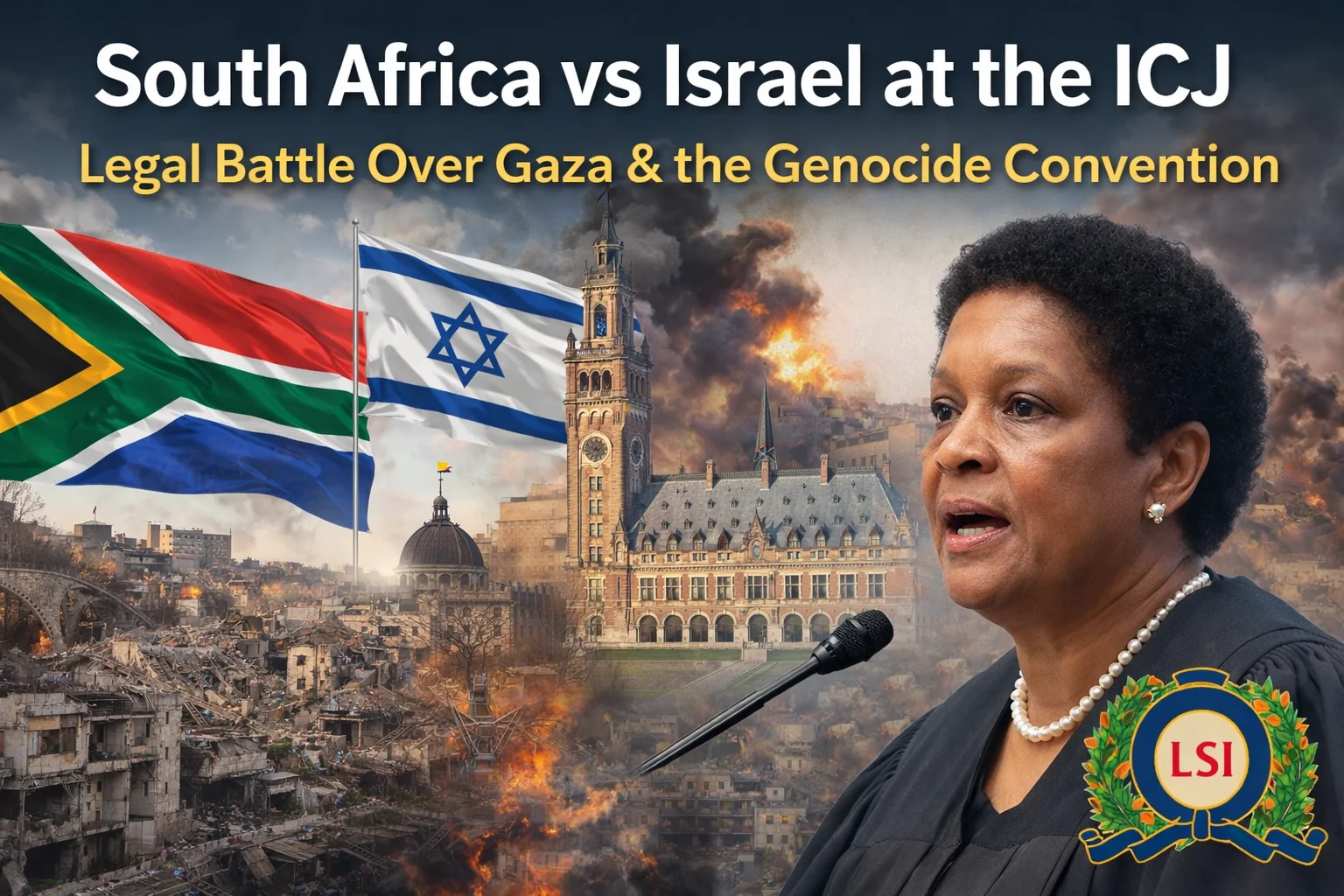
A Legal and Historical Perspective on Accountability, Human Rights, and the Gaza Conflict
The ongoing war in Gaza and the landmark case brought by South Africa against Israel before the International Court of Justice (ICJ) have generated intense legal, political, and moral debate across the world. At a recent lecture at Notre Dame Law School, Justice Leona Theron of the South African Constitutional Court provided a detailed and nuanced explanation of the case, its historical context, the legal arguments presented by both sides, and the broader significance of international law in addressing alleged human rights violations. Her address offered valuable insights into how international legal mechanisms function, their limitations, and their potential to shape global accountability.
Notre Dame’s Approach: Dialogue over Division
Introducing the session, Professor Alford highlighted how Notre Dame Law School has chosen dialogue rather than disruption in engaging with the Israel-Gaza conflict. Unlike some U.S. universities where protests led to class disruptions and polarized confrontations, Notre Dame has fostered structured, respectful discussions on contentious issues such as antisemitism, free speech, international law, and the ICJ proceedings.
This intellectual environment set the stage for Justice Theron’s lecture, which was framed not as advocacy but as legal analysis grounded in South Africa’s history and international jurisprudence.
The Gaza War and the Road to The Hague
Justice Theron began by situating the ICJ case within the broader context of the October 7, 2023 Hamas attacks and Israel’s subsequent military response. She acknowledged the brutality of the Hamas assault, which resulted in over 1,200 deaths and the abduction of approximately 240 hostages. These events, she noted, fundamentally altered the dynamics of the Israeli-Palestinian conflict.
Israel’s military campaign in Gaza, launched with the stated objective of dismantling Hamas, has led to widespread civilian casualties, massive destruction of infrastructure, and large-scale displacement of Gaza’s population. Hospitals, schools, and refugee camps have been affected, while humanitarian conditions have deteriorated sharply, with reports of severe shortages of food, water, and medical supplies.
Against this backdrop, South Africa filed an application at the ICJ on December 29, 2023, alleging that Israel’s conduct in Gaza violated obligations under the Genocide Convention.
Why South Africa? The Weight of History
A central theme of Justice Theron’s address was South Africa’s moral and legal perspective, shaped by its own apartheid past. She explained how apartheid—recognized internationally as a crime against humanity—systematically oppressed Black South Africans through racially discriminatory laws enforced by the judiciary itself.
South Africa’s transition to democracy was made possible in part through international pressure, sanctions, and solidarity movements. This history, Justice Theron suggested, informs South Africa’s contemporary foreign policy and its willingness to invoke international law when mass atrocities are alleged.
She also highlighted the historical alignment between South Africa’s liberation movement (the African National Congress) and the Palestinian cause, contrasting with the apartheid-era government’s diplomatic ties with Israel. This legacy partly explains why South Africa felt compelled to bring the case before the ICJ.
South Africa’s Legal Case: Genocide Convention as the Foundation
South Africa grounded its application in Article 9 of the Genocide Convention, which allows disputes regarding interpretation, application, or fulfillment of the Convention to be brought before the ICJ.
Prima Facie Jurisdiction: South Africa’s Arguments
- Both South Africa and Israel are parties to the Genocide Convention.
- There exists a genuine legal dispute regarding Israel’s compliance.
- Certain acts in Gaza could fall within the scope of genocide as defined under international law.
South Africa relied on a range of evidence, including statements by Israeli officials, media reports, and UN findings, to argue that there was a plausible risk of genocidal intent. Justice Theron emphasized that proving genocide requires demonstrating both prohibited acts and specific intent to destroy, in whole or in part, a protected group.
Israel’s Defense: War, Not Genocide
- The military campaign in Gaza is an act of self-defense against a terrorist organization.
- The Genocide Convention was not designed to regulate the conduct of war.
- South Africa ignored Hamas’s role in initiating the conflict on October 7.
- Any civilian harm was incidental to legitimate military operations.
Israel also contended that South Africa failed to engage in diplomatic dialogue before approaching the ICJ and urged the court to dismiss the case outright.
ICJ’s Provisional Measures: A Middle Path
On January 26, 2024, the ICJ issued provisional measures but stopped short of ordering an immediate ceasefire. Instead, it directed Israel to:
| Order | Requirement |
|---|---|
| 1 | Prevent acts of genocide and public incitement. |
| 2 | Allow humanitarian aid into Gaza. |
| 3 | Preserve evidence related to alleged violations. |
| 4 | Report back to the court within one month on compliance. |
The court found that some of South Africa’s allegations were plausible enough to warrant interim measures, emphasizing that its ruling did not constitute a final judgment on genocide.
Justice Theron explained that the ICJ’s restraint was largely due to jurisdictional limits—most notably, the fact that Hamas is not a state and therefore not subject to ICJ orders.
The Challenge of Asymmetrical Litigation
A major point of discussion in the Q&A session was the asymmetry of the case: South Africa could bring the claim under the erga omnes nature of the Genocide Convention, yet Hamas, a key actor in the conflict, was not before the court.
This raised questions about fairness, effectiveness, and the ability of international law to fully address complex conflicts involving non-state actors. Justice Theron acknowledged these limitations but maintained that the case still served an important role in reinforcing international legal norms.
International Law as a Tool for Justice
In her concluding remarks, Justice Theron emphasized that international law—despite its constraints—remains a crucial mechanism for accountability, conflict resolution, and human rights protection. She argued that legal action, even when imperfect, is preferable to silence in the face of potential atrocities.
“Injustice anywhere is a threat to justice everywhere.”
This quote, attributed to Martin Luther King Jr., underscored the universal responsibility to confront wrongdoing through lawful means.
Conclusion: A Seminal Moment for International Justice
Justice Leona Theron’s lecture offered more than a legal briefing—it provided a profound reflection on the role of law in a divided world. The South Africa v. Israel case at the ICJ represents a defining moment for the Genocide Convention and international humanitarian law.
Whether one agrees with South Africa’s position or not, the case has reinforced the idea that even powerful states can be called to account before international courts, and that smaller nations can use legal institutions to challenge global injustice.
As the ICJ proceedings continue, this case will likely shape the future of international law, state responsibility, and the global response to mass violence.