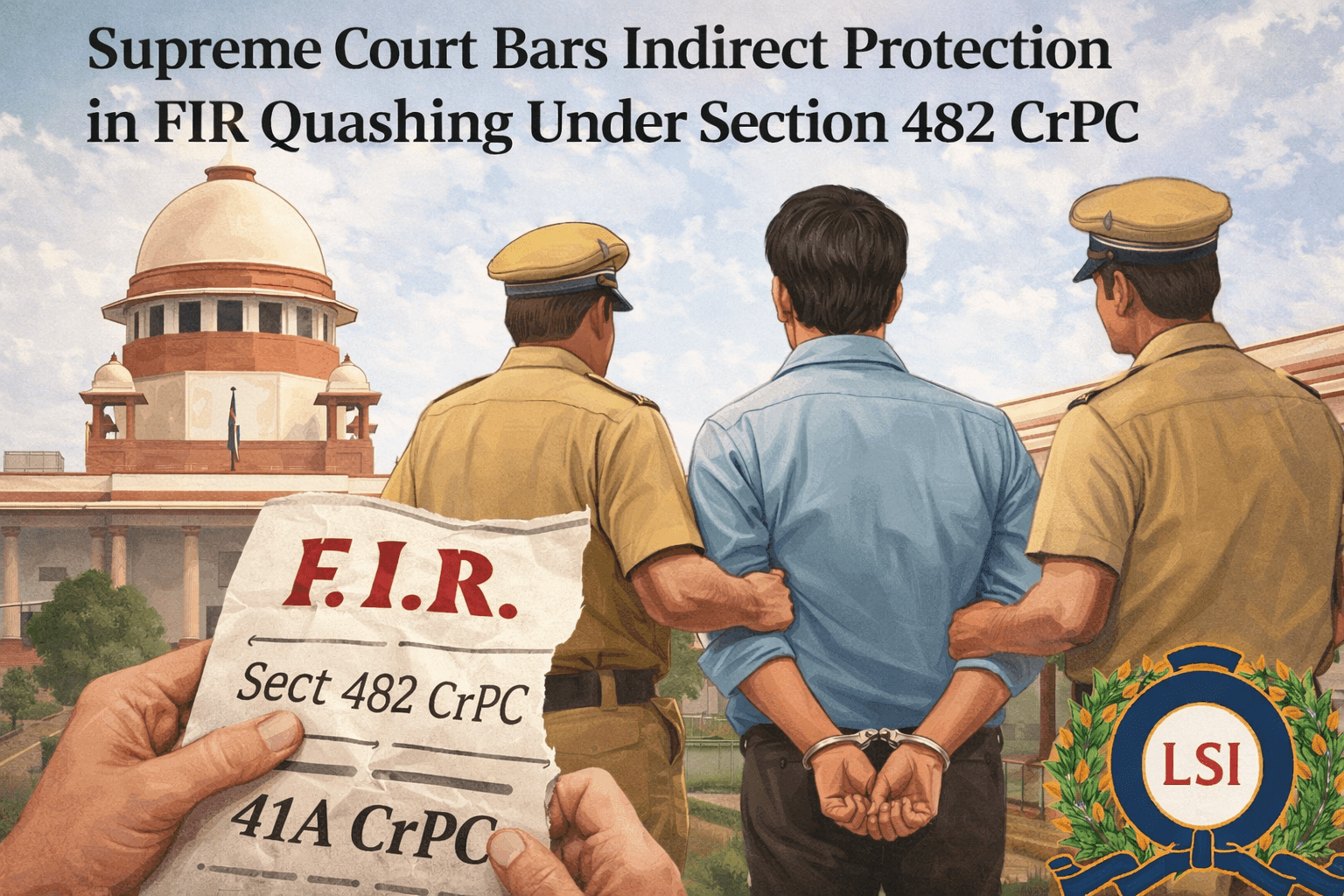
Supreme Court Ruling On Indirect Protection Under Section 482 CrPC
On 19 January 2026 the Supreme Court of India delivered a short but important ruling restraining High Courts from providing what the Court called “indirect protection” to accused persons in petitions filed under Section 482 CrPC for quashing FIRs. The decision arises from an appeal against an order of the Telangana High Court and is reported as Practical Solutions Inc. (Through Authorized Representative) v. State of Telangana & Ors..
What Happened (Facts In Brief)
Accused persons filed a petition in the Telangana High Court seeking quashing of an FIR registered against them under provisions of the Bharatiya Nyaya Sanhita (the judgment refers to offences charged under BNSS equivalents).
Instead of issuing notice and conducting fuller consideration, the High Court disposed the petition at the admission stage and — without notice to the State or the defacto complainant — directed the investigating officer to deal with the accused under the procedure in Section 35(3) BNSS (the BNSS provision corresponding to Section 41-A CrPC) and to follow safeguards akin to the Arnesh Kumar guidelines.
The complainant (Practical Solutions Inc.) challenged this order in the Supreme Court.
What The Supreme Court Held
The Supreme Court set aside the Telangana High Court’s order and remanded the matter for fresh consideration after hearing the defacto complainant. The key legal holdings were:
- A direction by a High Court to the police to comply with Section 41-A (now Section 35(3) BNSS) in a petition that seeks quashing of an FIR amounts to indirect interim protection (because regular appearance under Section 41-A bars arrest).
- Such interim protection cannot be granted at the admission stage of a quashing petition unless the High Court is prima facie satisfied that the FIR ought to be quashed — i.e., the court must be able to point to some prima facie basis to intervene.
- If prima facie satisfaction is absent, the court should not give directions that have the practical effect of protecting the accused from arrest.
- The High Court should also observe fair procedure — particularly, it should ordinarily issue notice to the defacto complainant and the State before passing orders that affect their rights.
Remand For Fresh Consideration
The Supreme Court remanded the matter for reconsideration after hearing the complainant.
Bench Composition
| Justice |
|---|
| Justice J. B. Pardiwala |
| Justice Satish Chandra Sharma |
Why This Matters — Practical And Doctrinal Impact
- Closes a “backdoor” for interim protection. The ruling makes clear that a High Court cannot use a quashing petition as a vehicle to grant interim protections (like directing notice-instead-of-arrest procedures) unless there is a clear prima facie case for quashing. This prevents litigants from getting early, de facto immunity from arrest without the safeguards that apply to ordinary interim relief.
- Reinforces procedural fairness for complainants. Courts must adhere to basic procedural steps — issuing notice and hearing the complainant — before handing down relief that affects investigative or arrest powers. Summary disposal without notice will be suspect.
- Preserves the separation between quashing and interim relief doctrines. Quashing an FIR on merits is distinct from granting interim protection; the former requires higher judicial satisfaction on the merits or exceptional circumstances, while the latter (if granted) should follow the well-recognized tests and procedures for interim relief. The judgment restates that a direction that practically bars arrest must be justified on the record.
- Guidance for trial and appellate courts going forward. High Courts will need to articulate prima facie reasons before issuing any order that curtails police powers; mere administrative directions in admission stage orders are unlikely to survive challenge.
Doctrinal Summary
| Aspect | Position Clarified by the Judgment |
|---|---|
| Interim Protection | Cannot be granted through a quashing petition without prima facie satisfaction. |
| Procedural Fairness | Notice and hearing of complainant are mandatory before curtailing police powers. |
| Quashing Doctrine | Requires higher judicial satisfaction or exceptional circumstances. |
| Admission Stage Orders | Administrative directions without reasons are vulnerable to challenge. |
Practical Takeaways For Practitioners
- When moving to quash an FIR, counsel must not expect automatic interim safeguards simply because a quashing petition is filed; to obtain any protective direction, the petitioner must convince the court of a prima facie case or the existence of exceptional circumstances.
- Complainant-side counsel should insist on notices and be vigilant about summary disposals at admission stage; an appeal to the Supreme Court can succeed if interlocutory protection was granted without hearing the complainant.
- Police officers and investigating agencies should note that compliance directions (like following Section 41-A/35(3)) issued without due judicial basis are vulnerable to being set aside; however, bona fide procedural compliance when legally directed remains valid.
Conclusion
The Supreme Court’s January 19, 2026 order in Practical Solutions Inc. v. State of Telangana tightens the reins on High Courts’ exercise of inherent powers under Section 482 CrPC. The ruling is a timely reminder that courts must not conflate admission-stage disposal with interim relief and must protect procedure and parties’ rights by recording prima facie satisfaction before issuing directions that effectively shield accused persons from arrest.