





Introduction
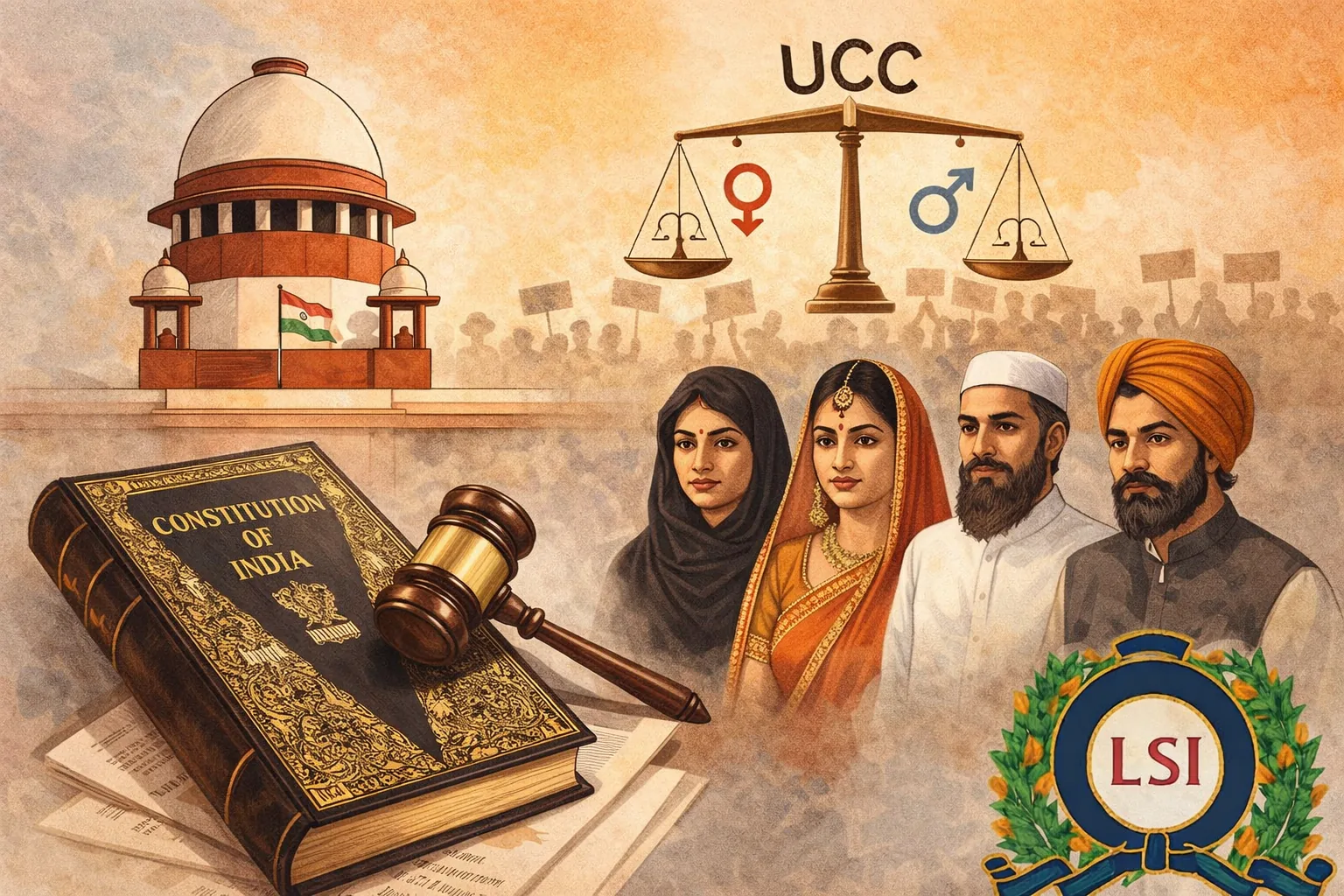
The idea of a Uniform Civil Code (UCC) has remained one of the most debated constitutional aspirations in India. It seeks to replace diverse personal laws based on religion with a single, common civil law governing matters such as marriage, divorce, inheritance, adoption, and succession. The objective behind a UCC is not merely uniformity, but the promotion of gender justice, equality before law, and secularism.
While the debate around the UCC is largely ideological and political, its constitutional, judicial, and social dimensions demand serious legal examination. This article undertakes both a doctrinal analysis of the UCC and an empirical study to assess public awareness and perception regarding its implementation.
Constitutional Position of the Uniform Civil Code
The concept of a UCC finds its constitutional basis in Article 44 of the Constitution of India, which forms part of the Directive Principles of State Policy. Article 44 states that “The State shall endeavour to secure for the citizens a uniform civil code throughout the territory of India.”
Being a Directive Principle, Article 44 is not enforceable by courts, yet it plays a crucial role in guiding legislative policy. The framers of the Constitution envisioned gradual reform, balancing social diversity with constitutional morality. Consequently, the absence of a UCC does not indicate constitutional failure, but rather reflects the complex pluralistic fabric of Indian society.
Judicial Approach and Landmark Decisions
The judiciary has repeatedly highlighted the importance of a UCC while refraining from mandating its enactment.
Ahmed Khan v. Shah Bano Begum
In this landmark case, the Supreme Court held that a divorced Muslim woman is entitled to maintenance under Section 125 of the Criminal Procedure Code, a secular provision applicable to all citizens. The Court observed that the absence of a UCC leads to conflicting personal laws and hampers national integration. The political backlash following this judgment resulted in the Muslim Women (Protection of Rights on Divorce) Act, 1986, which diluted the ruling’s effect.
Sarla Mudgal v. Union of India
Here, the Court addressed fraudulent religious conversions undertaken to bypass monogamy laws. It ruled that conversion to Islam for the purpose of contracting a second marriage does not dissolve a Hindu marriage and constitutes bigamy. The judgment strongly reiterated the need for a UCC to prevent misuse of personal laws.
Shayara Bano v. Union of India
The Supreme Court declared the practice of instant triple talaq (talaq-e-biddat) unconstitutional, holding it violative of fundamental rights. Although not a UCC judgment, the case reinforced the principle that personal laws cannot override constitutional morality and gender justice.
State-Level Developments
| State | Key Development |
|---|---|
| Uttarakhand | Uttarakhand became the first Indian state post-independence to enact a UCC through the Uniform Civil Code of Uttarakhand Act, 2024, passed by the state legislature and receiving Presidential assent. The law came into force on 27 January 2025, marking a significant milestone in India’s legal landscape. |
| Goa | Goa follows a common civil code derived from the Portuguese Civil Code of 1867, retained after its integration into India in 1961. Unlike Uttarakhand, Goa’s UCC is not a post-independence legislative initiative but a continuation of an existing framework, with limited exceptions. |
Empirical Study: Survey Findings and Interpretation
This study is based on a primary survey of 58 respondents, conducted through a structured questionnaire.
Demographic Overview
Age
- 75.9% were aged 18–35, indicating a youth-centric sample.
Gender
- 56.9% male and 43.1% female; no non-binary representation.
Education
- A majority (74.1%) had education up to graduate level or below.
Interpretation
The sample reflects younger, moderately educated respondents, which may influence progressive attitudes toward legal reform while limiting depth of legal understanding.
Awareness and Knowledge Levels
| Indicator | Finding |
|---|---|
| Awareness of the UCC | 84.5% had heard of the UCC. |
| Self-rated Knowledge Level | 60.3% rated their knowledge as moderate. |
| Primary Information Sources | Television and social media (30.36%), followed by newspapers and personal discussions. |
Interpretation
The UCC has entered mainstream discourse, but understanding remains largely superficial, driven by media narratives rather than academic engagement.
Perceptions and Attitudes
| Response Category | Percentage |
|---|---|
| Strongly Support UCC Implementation | 55.2% |
| Neutral | 31% |
| Strongly Oppose | 13.8% |
| Not Sure About Promoting Gender Equality | 43.9% |
Interpretation
Support for the UCC is high, but uncertainty regarding its actual impact—particularly on gender justice—reveals a disconnect between ideological approval and substantive understanding.
Combined Analysis
First, the survey shows that the UCC is no longer a niche, legal-only subject; it has entered the mainstream. Nearly everyone surveyed had heard of it, largely thanks to news and social media. This indicates that the conversation around UCC is widespread, reaching beyond academic or political circles.
Second, while people are aware of the UCC, their understanding is often shallow. The majority of respondents only have “moderate” knowledge, which means they grasp the basic idea—that UCC aims to create one set of civil laws for everyone—but they don’t know the fine details or potential real-world effects.
Third, this lack of detailed knowledge leads to a significant level of uncertainty. The most striking example is the nearly 44% of respondents who are “not sure” whether the UCC would actually promote gender equality. This shows that while the UCC is often presented as a solution for gender-related issues in personal laws, the public is not fully convinced or informed about how it would work in practice.
Finally, Most people support the UCC because they like the idea of “one law for all” and social uniformity, but many do not fully understand the complexities of merging different religious laws and customs.
In short, the survey reveals a public that is receptive to the UCC, but their support is based on a foundational understanding and broad principles. Before any widespread implementation, there needs to be a significant effort to educate the public on the specifics of the UCC, as their current “support” could quickly turn to confusion or opposition if the real-world implications don’t match their simple, high-level expectations.
Conclusion
The study demonstrates that the Uniform Civil Code is no longer confined to constitutional theory or judicial commentary—it has become a subject of active public discourse. However, public support is largely principle-based rather than informed-based.
While respondents favour uniformity and equality, uncertainty persists regarding the UCC’s real-world implications, particularly in relation to gender justice and cultural diversity. This highlights the need for gradual, consultative reform, supported by transparent legal education and stakeholder dialogue.
In essence, the Indian public appears receptive but not prepared. Before any nationwide implementation of a Uniform Civil Code, sustained efforts must be made to bridge the gap between constitutional ideals and public understanding, failing which support may quickly give way to confusion or opposition.
References & Sources
Legal Sources
| Category | Source |
|---|---|
| Constitutional Provision | The Constitution of India, Article 44 |
| Judicial Precedent | Mohd. Ahmed Khan v. Shah Bano Begum, (1985) 2 SCC 556 |
| Judicial Precedent | Sarla Mudgal v. Union of India, (1995) 3 SCC 635 |
| Judicial Precedent | Shayara Bano v. Union of India, (2017) 9 SCC 1 |
| Legislation | Muslim Women (Protection of Rights on Divorce) Act, 1986 |
| State Legislation | Uniform Civil Code of Uttarakhand Act, 2024 |
| Comparative Law | Portuguese Civil Code, 1867 (as applicable in Goa) |
Survey Source
- Primary data collected by the author through a structured questionnaire administered to 58 respondents.
Methodology
- Descriptive and analytical method using convenience sampling and percentage-based analysis.
Disclaimer
This article is intended solely for academic and informational purposes. The views expressed are personal to the author and do not constitute legal advice.
Written By:
- Jay Rajesh Patil
- Asmita Tikhe
- Shubham Ugale
- Aditi Tondwalkar

