




What Is Copyright?
It is an exclusive right given to the creator/Author of the original work under Indian Copyright Act, 1957. It is an exclusive legal right to reproduce, to issue copies, to perform the work in public, to make recordings and adaptation.
Copyright is given to an author/creator whose work is, original and have at least a minimal degree of creativity/skill.
Contemporary Developments in Artificial Intelligence
The recent breakthrough in the development of AI generated content and its quality has taken the world by storm, not just textual responses but the audio and visual outputs can make the individuals question the reality itself.
LLM models like ChatGPT, Claude AI, Gemini, Gamma, Perplexity are trained on copyrighted work which are capable of producing copyrightable work like artistic work, literary work, music, images and videos.
As it is clear only human can get the copyright protection, this raises a fundamental question: can copyright law extend protection to AI-generated creative content?
Classification of AI Generated Work
The copyrightable work generated by AI models can be classified into two sub categories, namely,
- Fully autonomous AI-generated works.
- AI-assisted works (human control).
Fully Autonomous AI-Generated Works
Fully autonomous AI generated work refers to creative output like text, image, audio, etc. produced by an AI system without substantial artistic human input.
Ex- 1 the Road (2018), it was an experimental novel composed by AI during road trip across US. It was created by technologist Ross Goodwin.
AI-Assisted Works (Human Control)
AI assisted work refers to creative output like text, image, audio, etc. produced by an AI system, where a human has significant creative input and control on the final work.
Ex- Zarya of the Dawn, it is an AI illustrated comic where, the story was original, but visuals were created using Midjourney (an AI image generator).
Provisions Under Indian Copyright Act, 1957
Section 2(vi) of Indian Copyright Act, 1957 provides that “in relation to any literary, dramatic, musical or artistic work which is computer-generated, the person who causes the work to be created;”. Whereas, this is debated where some says the statute does not expressly recognize non-human entities such as AI as authors, stressing that the law is human centric and does not meaningfully address AI creation. While some argue that, the current language can be interpreted broadly enough to cover AI generated work if there is meaningful human involvement.
Section 13(1) of Indian Copyright Act, 1957 defines the subject matter of the copyright protected work in India, where
- Original literary, dramatic, musical, and artistic works;
- Cinematograph films;
- Sound recordings.
This perfectly fits within the type of work which the AI model like ChatGPT, Gemini, Claude, Midjourney generates.
Moreover, under section 17 of Indian Copyright Act, 1957 lays down the general rule that, Author of the work is the first owner of the copyright, with few exceptions being in relationship such as employment, commissioned works, and government works. But AI is not recognized as author in section 2(d) of Indian Copyright Act, 1957, hence fully autonomous AI generated work cannot be copyrighted.
The Registration of Raghav AI as Co-Author
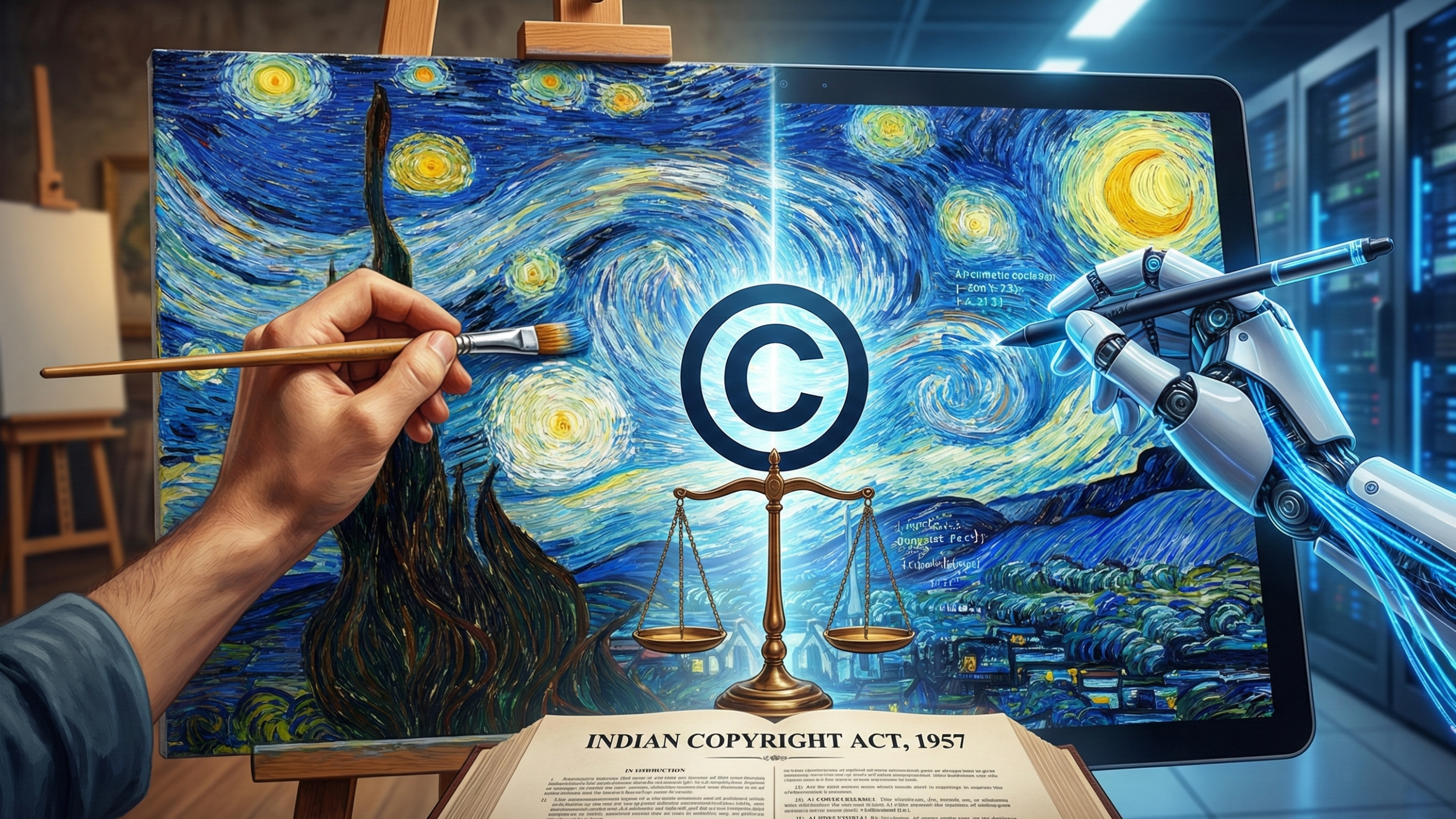
Ankit Sahni, an artist and lawyer commissioned Raghav AI tool to generate Vincent van Gogh’s The Starry Night (style image). Raghav stands for Robust Artificially Intelligent Graphics and Art Visualizer, it is a trained model on various art styles, one of which is Vincent van Gogh’s The Starry Night. He inputted his original photograph (base image) and used the starry night style to generate the artwork called “suryast”.
Indian copyright office granted the copyright protection to suryast, where Sahni and RAGHAV AI were co-authors. This marks suryast, the first copyrighted work in India where an AI is registered as co-author.
Soon after that, Sahni, applied to US copyright office which was rejected and his subsequent appeals were rejected as well, seeing this Indian copyright office issued a withdrawal notice seeking details on RAGHAV’s legal status under Sections 2(d)(iii) and 2(d)(vi) of the Copyright Act, 1957, questioning AI as “author.” Sahni argued the office lacked authority to review its grant; no further action occurred, and it remains listed.
International Scenario
United States
While, the US Copyright Office (USCO) refused copyright claim to the work “suryast”. The Review Board of the USCO held that, the work lacked the human authorship necessary to support a copyright claim. Also, because the work is a derivative work that does not contain enough original human authorship to support a registration. And held that it was a classic example of derivative authorship.
Derivative authorship refers to authorship in a work that is created by adapting or building upon an existing work, rather than creating something entirely new.
US courts have interpreted statutory phrase “works of authorship” in 17 U.S.C. § 102(a) needs a human author, stating that “human authorship is a bedrock requirement of copyright” in Thaler v. Perlmutter 4 (D.D.C. Aug. 18, 2023).
European Union
Under EU law, copyright protects original work of authorship, where the work should reflect authors own intellectual creation. EU follows Infopaq standard, it arises out of a decision Infopaq International A/S v Danske Dagblades Forening, where court held that the work is protected if it is authors own intellectual creation, while the work generated by AI is not copyrightable.
China
Copyright laws of China are more flexible than US or EU copyright law. China’s recent judicial trends emphasize on In Li v. Liu (Nov 2023), where Beijing Internet Court recognized copyright in AI generated content where the plaintiff, Mr. Li got copyright protection to the image he generated using Stable Diffusion.
The court held that, plaintiff designed the image by giving the prompts and by making creative decisions and shaping the compositions of the image, which reflected his own creativity and input to make that image copyrightable.
Conclusion
Indian Copyright Act, 1957 requires distinct guidelines about copyrightability of the AI generated content, where as the minimum creativity which is established in Eastern Book Company v. D.B. Modak (2008), similarly should be interpreted in case of AI generated copyrightable work, where it is often argued that a highly detailed, 1000-word prompt describing a scene, that prompt is arguably a “literary work” protected by copyright. The current provisions are ambiguous about whether to call it derivative work or adaption of the prompt.
For works created fully autonomously by AI, the statutory provisions make it clear that AI cannot be recognized as the copyright owner of a work created fully autonomously. Copyright protection is reserved for intellectual and creative contributions made by humans.
Where in AI functions as a tool and not the creator, the provisions are ambiguous. In Ankit Sahni’s case, India has administratively acknowledged AI co-authorship through the Copyright Office’s initial grant for Suryast, but issued a notice questioning RAGHAV’s status as an AI co-author rather than consistently affirming it. This highlights regulatory uncertainty about AI authorship under the Indian Act. Whereas US Copyright Office called it “Derivative Work”. This disharmony in international copyright frameworks impacts stakeholder rights, as copyright operates across national boundaries.
