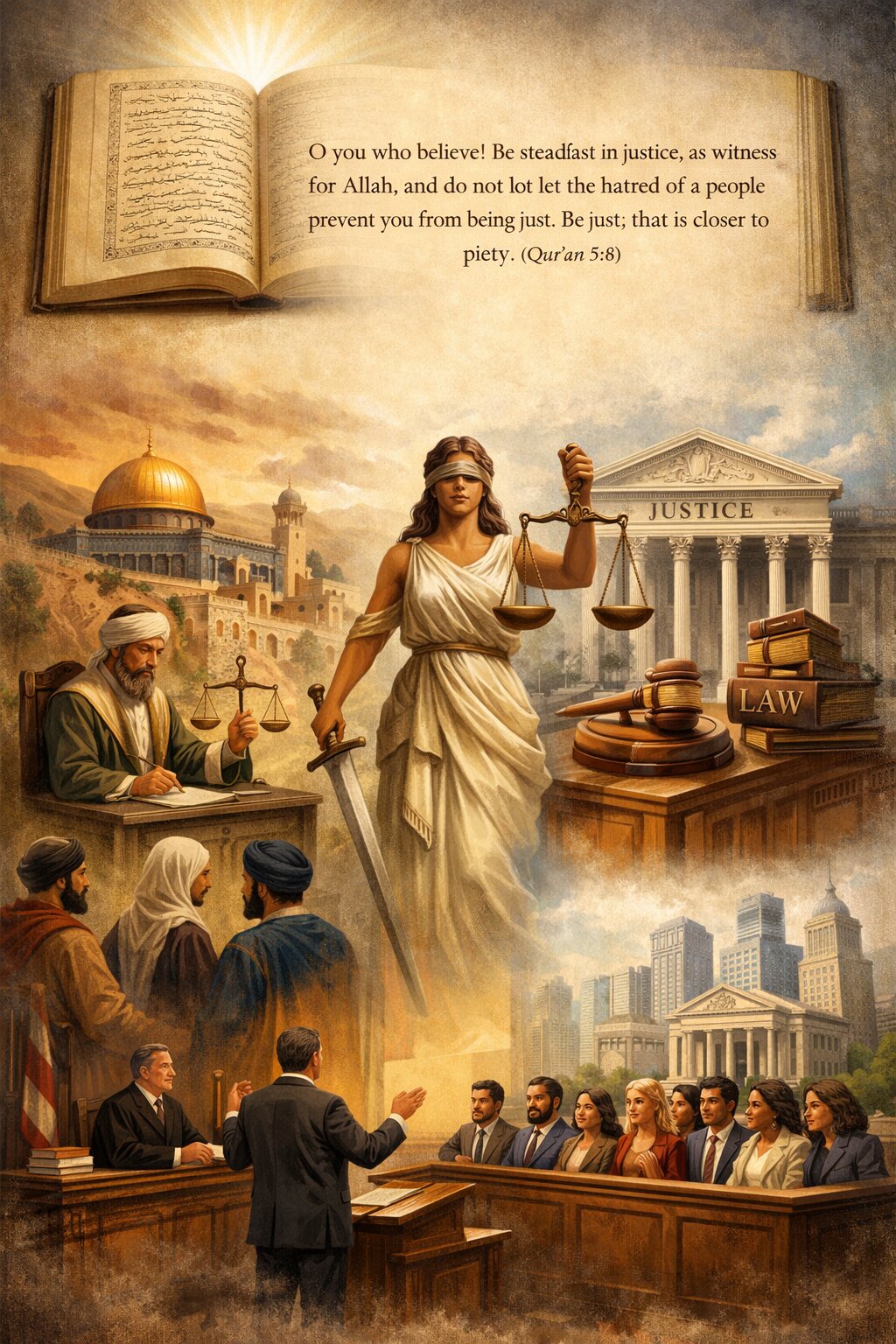
Every stable civilization in history—from the ancient laws of Mesopotamia to the modern International Court of Justice—is built on the foundation of fairness. For any government or leader to be seen as legitimate, people must believe that disputes will be settled using facts and law, rather than the personal whims of the powerful or the prejudices of the majority. Without this trust in impartial justice, the structure of society eventually collapses.
In the Islamic tradition, this universal need for fairness is turned into a strict legal and spiritual requirement in Surah Al-Ma’idah (5:8). This verse extends far beyond mere moral kindness. It mandates a level of total objectivity that challenges deep human psychology, forcing individuals to put aside their personal feelings to ensure that justice remains pure and unbiased for everyone involved.
The Divine Mandate: Surah Al-Ma’idah (5:8)
Surah Al-Ma’idah (5:8) was revealed at a time when tribal loyalties often dominated systems of justice. In that historical context, justice was usually just a tool to help your own family and a weapon to hurt your enemies. This verse completely changed that mindset by introducing a system of “blind” justice—meaning the law should be fair to everyone, regardless of who they are—long before modern legal systems adopted the same idea.
The verse commands believers to “stand firm” as witnesses for what is right, even if it means going against their own feelings. It explicitly warns that you must not let your hatred for a group of people stop you from being fair to them. By stating that being just is “nearer to righteousness,” the Quran teaches that true character isn’t just about religious rituals; it’s about having the integrity to treat an enemy with the same fairness you would give a friend.
A Higher Duty and the End of Bias
By framing justice as “standing firm for Allah,” the Quran elevates fairness above politics or social pressure. In modern terms, this is like a Judicial Oath, where a judge swears to act “without fear or favour.” It means a person is accountable to a higher truth that doesn’t change with the election cycles. Furthermore, the command to not let “hatred” interfere with justice is a sophisticated way of tackling Cognitive Bias. It recognizes that humans naturally favor their own “in-group” and warns that true justice only exists when the “out-group”—the unpopular, the minority, or even the enemy—is given the exact same fair treatment as everyone else.
The True Test of Character
Finally, the verse links equity to piety, suggesting that a person’s true moral standing isn’t found in their rituals alone, but in their ability to be fair when it is hardest. This creates a “spiritual safeguard” where being just is seen as the highest form of worship. It reminds us that while we might hide our prejudices from other people, we cannot hide them from a higher power. By making justice a requirement for righteousness, the text ensures that the law serves as a shield for the vulnerable, rather than a weapon for the powerful to use against those they dislike.
Global Legal Parallels
The Quranic call to “stand firm” for justice mirrors the ancient Roman maxim, “Let justice be done though the heavens fall.” Both traditions argue that justice is an absolute necessity that cannot be traded for political gain or public approval. Similarly, the legal rule that “no one should be a judge in their own case” matches the Quranic warning against letting personal hatred cloud our judgment. These concepts all demand the same thing: the removal of “self” and personal bias from the seat of power so that the truth remains the only priority.
Equality and the Law
In modern times, this spiritual command has become the foundation of Constitutional Law, such as the principle of “Equal Protection.” Whether it is the U.S. 14th Amendment or Article 14 of the Indian Constitution, the goal is to ensure the law acts as a shield for the weak rather than a sword for the powerful. By demanding fairness even toward those we dislike, the Quran established an early version of universal equality. It reminds us that for a legal system to be valid, it must see every individual as equal, ensuring that identity never dictates the outcome of a trial.
Comparative Framework: Traditions of Fairness
This shared commitment to fairness across traditions can be summarized as follows:
|
Tradition |
Key Maxim/Principle |
Core Objective |
|
Qur’anic Law |
“Do not let hatred prevent justice” |
Impartiality despite enmity |
|
Roman Law |
Fiat justitia ruat caelum |
Absolute supremacy of law |
|
Common Law |
Audi alteram partem |
Hearing both sides (Due Process) |
|
International Law |
Universal Declaration of Human Rights |
Non-discrimination and equality |
Modern Applications: From the Bench to the Bureaucracy
How does a 7th-century verse apply to a 21st-century administrative state? The applications are surprisingly practical:
- Judicial Recusal: When a judge removes themselves from a case because of a potential conflict of interest or personal bias, they are fulfilling the spirit of Surah Al-Ma’idah.
- Anti-Discrimination Law: Laws that prevent employers or governments from treating individuals differently based on race, religion, or political affiliation are modern enactments of the command to ignore “hatred” or “bias” in decision-making.
- International Diplomacy: In an era of global conflict, the verse serves as a reminder that international tribunals must apply the same standards of human rights to all nations, regardless of their geopolitical standing or current diplomatic relations.
Challenges to Impartiality
Even with clear rules, perfect fairness is hard to achieve because humans are often tempted by bias and power. This verse addresses those flaws by reminding us that “Allah is Acquainted with what you do,” serving as a moral check against systemic unfairness. It warns against political expediency, where leaders choose popular opinions over legal truths, and personal vindictiveness, where people use their authority to settle old grudges. By emphasizing that a higher power sees every action, the text provides a “spiritual safeguard” that encourages individuals to remain honest even when no one else is watching.
To truly protect justice in the modern world, we must combine this internal integrity with external systems of accountability. While an individual’s personal conscience (taqwa) is the first line of defense, it must be supported by transparent laws, the right to appeal unfair decisions, and a free press. When these personal and public safeguards work together, they create a balanced system that prevents the law from being used as a weapon, ensuring that fairness is applied equally to everyone regardless of their status or identity.
Justice, Bias, and Equality: Key Case Laws
- Equality Despite Identity: In Brown v. Board of Education, the issue was racial segregation in schools under the idea of “separate but equal.” The U.S. Supreme Court ruled that such segregation is inherently unequal and unconstitutional. This landmark judgment ended legally accepted racial discrimination in education and reinforced that the law must treat all individuals equally, regardless of race or identity.
- Fair Trial Despite Public Pressure: In Sheppard v. Maxwell, a doctor was convicted in a trial heavily influenced by media pressure and public opinion. The courtroom atmosphere was chaotic, and the press played a dominant role, affecting the fairness of the proceedings. The U.S. Supreme Court later overturned the conviction, holding that the accused was denied a fair trial. It emphasized that judges must protect the judicial process from external pressures like media and public sentiment, ensuring that justice remains impartial and based only on evidence.
- Equality Before Law Regardless of Status: In R v. Bow Street Metropolitan Stipendiary Magistrate, ex parte Pinochet (No 2), the former Chilean dictator Augusto Pinochet challenged proceedings against him, but it was discovered that one of the judges had indirect links with Amnesty International, a party interested in the case. The House of Lords set aside its own earlier judgment, holding that even the appearance of bias was enough to invalidate the decision. This case reinforced that justice must be completely impartial, and no person—no matter how powerful—is above the law or entitled to a biased hearing.
- Standing Firm Against “Mobocracy”: In Tehseen S. Poonawalla v. Union of India, the Supreme Court dealt with increasing incidents of mob lynching fuelled by misinformation and collective hatred. The Court warned against the danger of “mobocracy” and held that the State has a duty to protect individuals from such violence. It issued guidelines to prevent and punish mob lynching, stressing that the rule of law must always prevail over public anger or group pressure.
- Justice Against Public Hatred: In the State of Maharashtra v. Mohsien Sheikh, a young man was killed by a mob, and a lower court granted bail to the accused on the ground that they were provoked by religious sentiments rather than personal enmity. The Supreme Court strongly disapproved of this reasoning, making it clear that courts cannot justify violence based on community feelings or prejudice. It emphasized that justice must remain neutral—serving as a shield for the vulnerable rather than a tool of power—and must focus solely on the illegality of the act, not on the emotions or sentiments of the majority.
- The Rule Against Personal Bias: In AK Kraipak v. Union of India, a person who was himself a candidate for a job became part of the selection committee. Even though he did not vote for himself, the Supreme Court cancelled the entire selection process. The Court held that even the possibility or appearance of bias is enough to invalidate a decision, establishing that justice must be completely fair and also appear to be fair.
Conclusion: The Universal Necessity
Surah Al-Ma’idah (5:8) serves as a foundational blueprint for true justice, teaching that fairness is not a passive concept but an active, physical act of “standing firm.” It challenges us to rise above our most basic human instincts—such as the desire for revenge or the urge to favour our own “tribe”—and instead act with a clear conscience. According to this text, true righteousness is only achieved when we choose to do what is right over what is emotionally easy, ensuring that our internal moral compass stays steady regardless of external pressure.
In today’s polarized world, the Quranic instruction to remain just even toward those we dislike is a powerful and necessary social command. It highlights that while laws may be written on paper, real justice begins in the human heart. When we commit to impartial fairness, we create a society where every person is seen and respected by the law. Ultimately, this principle suggests that the only way to heal a divided community is to ensure that identity never dictates how a person is treated in the pursuit of truth.
In the end, a just society is not defined by the laws it writes, but by the fairness with which it applies them—especially when it is hardest to do so.