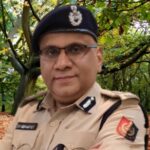
It was the eve of Eid al‑Adha—known as Bakrid or Eid‑uz‑Zoha—and I was already running on empty. As the additional superintendent of police stationed at Krishnanagar in Nadia district in the years 2010-2011, my entire night had been consumed by duty. I was overseeing the Jagadhatri idol immersion, a high‑stakes assignment given the area’s history of club rivalries and clashes between puja committees during such processions. My foremost responsibility was to safeguard the thousands of devotees thronging the streets. By the time the first light of dawn broke across the town, I had not enjoyed a single moment of rest.
Despite the fatigue, I went home, freshened up, and joined the town for the Eid prayers. Following our family tradition, we sacrificed four goats that morning. It was a meaningful and happy time for my family, but my eyes were burning from lack of sleep. All I wanted was to lie down and rest. However, for those in uniform, peace is a rare luxury.
Just as I was finally falling asleep, my phone rang. It was the superintendent of police. He told me that communal tension was building in Tehatta and that I was needed there immediately.
I politely asked if another officer could go, explaining that I hadn’t slept and was celebrating the festival with my family. The SP remained firm; he told me that the higher authorities had specifically requested me to handle the situation. With a deep sigh, I pushed my tiredness aside, put on my uniform, and began the drive to Tehatta.
The Tension in Tehatta
When I reached the Sub-Divisional Officer’s office, the situation was clear and delicate. The Muslim community had erected a temporary pandal (structure) for Bakrid prayers. Even though the Namaz was over, they had not yet removed it. Meanwhile, the Hindu community wanted to set up their own pandal for an upcoming festival. The wooden structure was blocking the space, and both sides were upset. A meeting with representatives from both communities was already underway, but progress was slow and tempers were rising.
I observed quietly for some time. It was evident that the issue was not just about space — it was about pride, tradition, and mutual trust. In such sensitive moments, heavy-handed orders often backfire. I decided to try a different approach.
I gently asked the leader of the Muslim group to step aside for a private conversation. In a calm and respectful voice, I explained the problem. Then, I did something unusual — I shared my own situation with complete honesty.
“Brother,” I said, “my family is waiting for me at home to complete the Bakrid sacrifice. I have not slept the whole night because of duty. I understand how important our religious traditions are. But right now, your pandal—erected for Bakrid Namaz, which has already concluded—is obstructing the other community from setting up their puja pandal. If we extend our help today, we preserve peace for everyone.
I could see my words touching him. By speaking as a fellow believer rather than just a police officer, I connected with his religious sentiments and sense of fairness. He realised that holding onto the pandal was causing hardship to others on a day meant for compassion and sacrifice.
Moved by the conversation, the leader agreed without hesitation. He promised to have the structure removed immediately. I thanked him warmly for his understanding and cooperation. When I returned to the meeting and announced the decision, the relief on everyone’s faces was visible. The SDO and others were surprised at how quickly the deadlock had ended, but I kept the personal details of our talk private.
True to his word, the Muslim leader ensured the pandal was dismantled peacefully. No arguments, no protests. As I drove back to Krishnanagar, a deep sense of satisfaction washed over me. No more emergency calls came. The matter had been resolved with goodwill on both sides.
A Powerful Lesson in Humanity
That day taught me something profound: true leadership often lies in vulnerability, not authority. By sharing my own faith and fatigue, I built a bridge of understanding. It reminded everyone present that behind uniforms and community identities, we are all human beings who value our traditions.
In a diverse country like India, where festivals of different faiths often fall close together, such small acts of empathy become vital. They prevent minor disputes from turning into major conflicts.
The Changing Face of Communal Issues
While the personal approach worked beautifully in Tehatta, the landscape of communal tension has evolved dramatically. Today, such conflicts are more volatile, layered, and unpredictable. People are quicker to anger, often swayed by rumours, political manipulation, and the viral speed of social media. What once began as a local misunderstanding can now escalate into a district-wide crisis within hours.
Modern communal clashes are rarely the result of isolated grievances. Instead, they are increasingly engineered by vested interests aiming to polarise communities for electoral gain. This calculated manipulation deliberately transforms minor local disputes into explosive flashpoints of division.
For law enforcement, these conflicts are exceptionally difficult to manage. They are not spontaneous eruptions of public anger, but rather strategically fuelled confrontations. Often backed by institutional patronage and rapidly amplified through misinformation, these orchestrated events require a sophisticated and firm police response to prevent escalation.
They are fuelled by deep mistrust, electoral opportunism, historical resentments, economic anxiety, and digital misinformation. The crowd psychology has changed — once emotions ignite, reason struggles to keep pace. In such charged environments, even sincere appeals to peace can be drowned out by the noise of provocation.
This new reality demands policing that is smarter, faster, and deeply empathetic — free from political bias or communal discrimination. Officers must combine traditional wisdom with modern tools — understanding community dynamics, anticipating flashpoints, and using technology to monitor and counter misinformation before it spreads. The challenge is not merely to control unrest but to rebuild trust in institutions and remind citizens that peace is a shared responsibility.
The Way Forward: Smarter Policing for Harmony
To handle today’s challenges effectively, we need a well-rounded strategy:
Better Training: Officers must be trained in crowd psychology, de-escalation techniques, and cultural sensitivity.
Deep Community Engagement: Building trust with leaders and people long before any crisis occurs is essential.
Fast Response Teams: Specially trained units that can reach trouble spots quickly and prevent small sparks from becoming fires.
Technology as an Ally: Using drones, cameras, data analysis, and social media monitoring to stay ahead of rumours and planned disturbances.
Clear Public Communication: Fighting fake news with timely, transparent information from trusted sources.
Personal empathy and human connection: Personal empathy and human connection will always remain powerful tools. However, they must now be supported by professional systems and modern methods.
Final Thoughts
That memorable Bakrid taught me that duty and faith are not opposites – they can beautifully support each other. Even in exhaustion, choosing understanding over force helped preserve peace. As I finally returned home to my family and much-needed rest, I carried a quiet pride — not just for solving a problem, but for upholding the values that keep our diverse society together.
In the end, communal harmony is not built by laws alone. It grows through countless small acts of respect, honesty, and shared humanity. If every one of us – whether in uniform or not – remembers this, we can create a stronger, more peaceful tomorrow.
Peace endures not through sleepless nights alone but through hearts that choose understanding over division.