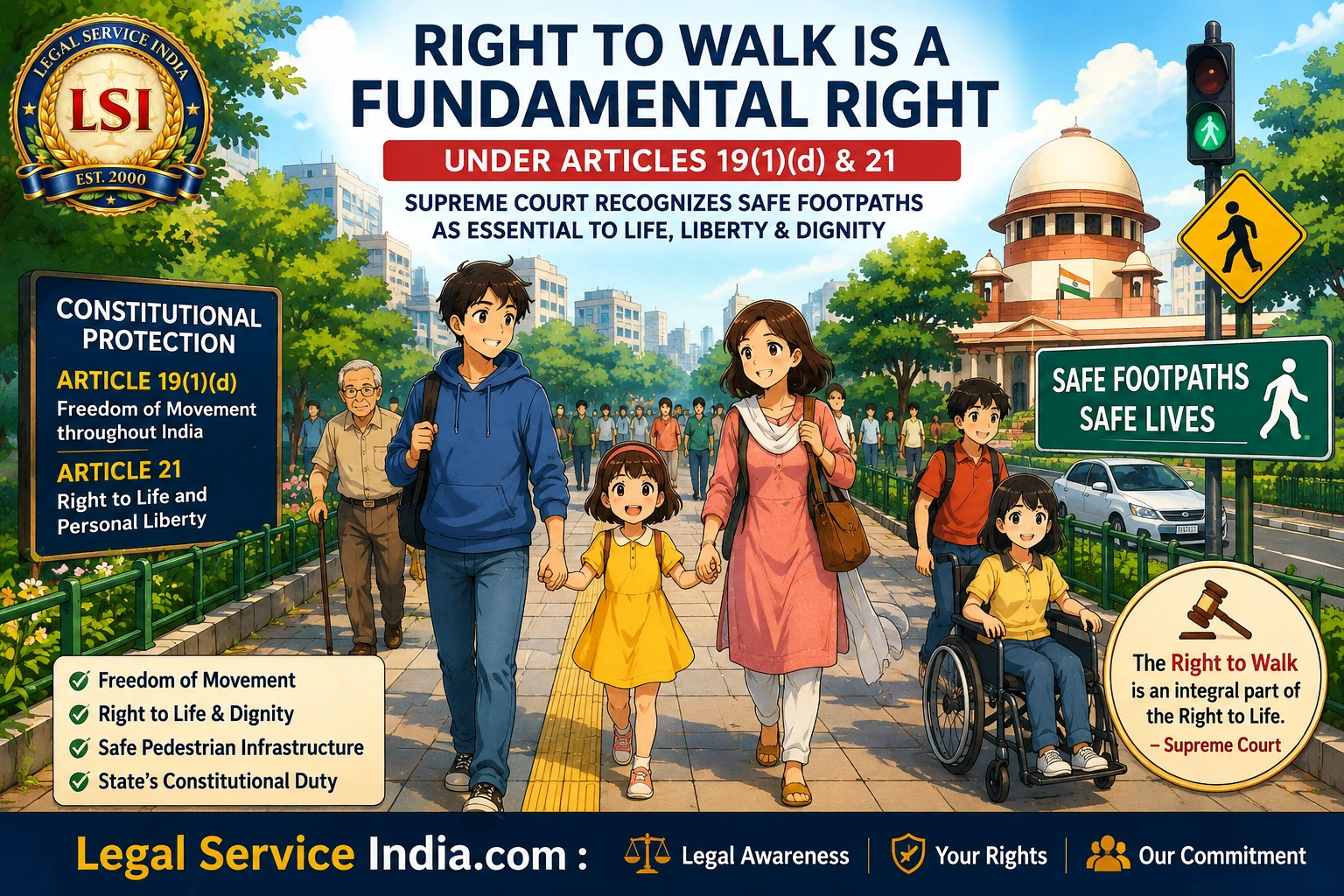
Right to Walk Is a Fundamental Right: Supreme Court Declares Safe Footpaths Part of Articles 19(1)(d) & 21
A detailed analysis of the Supreme Court's landmark ruling recognizing safe pedestrian movement as a constitutional right, expanding the scope of Articles 19(1)(d) and 21 while strengthening the State's duty to provide safe footpaths and pedestrian infrastructure.
The Constitution of India guarantees the freedom of movement and the protection of life and personal liberty defined through Articles 19(1)(d) and 21. Judicial interpretation of these provisions has considerably expanded their scope, transforming them from negative rights against state interference into positive obligations requiring the state to ensure conditions necessary for a dignified life. One of the most recent developments in constitutional jurisprudence is the recognition of the ‘right to walk’ as a fundamental right. The Supreme Court has held that safe and accessible footpaths are indispensable to the enjoyment of the freedoms that are guaranteed under Articles 19(1)(d) and 21. This article examines the constitutional foundation, judicial evolution, and contemporary significance of pedestrian rights in India.
Constitutional protection under Articles 19(1)(d) and 21.
Judicial expansion of the right to life and freedom of movement.
Recognition of the right to walk as a fundamental right.
Importance of safe and accessible pedestrian infrastructure.
Growing relevance of pedestrian rights in modern constitutional jurisprudence.
Constitutional Focus at a Glance
Constitutional Provision
Scope
Relevance to Pedestrian Rights
Article 19(1) (d)
Freedom of movement throughout India
Protects the freedom to move safely on public roads and footpaths.
Article 21
Right to life and personal liberty
Requires the State to provide conditions necessary for safe and dignified mobility.
Introduction
The Indian Constitution is a dynamic living document designed to respond to changing social realities. The judiciary, particularly the Supreme Court, has played a pivotal role in expanding the scope of fundamental rights to meet the needs of a modern democratic society. Among the rights that have undergone significant transformation are the freedom of movement under Article 19(1)(d) and the right to life and personal liberty under Article 21.
In recent years, increasing urbanization, rising vehicular traffic, and inadequate pedestrian infrastructure have created serious challenges for pedestrians. Thousands of people lose their lives every year due to the absence of safe footpaths and pedestrian facilities. Recognizing these concerns, the Supreme Court has recently declared that the right to walk safely on demarcated footpaths is a fundamental right flowing from Articles 19(1)(d) and 21.
This recognition marks a significant shift in Indian constitutional jurisprudence from a vehicle-centric approach to a human-centric understanding of mobility and urban government.
Why This Topic Matters
Addresses the growing need for pedestrian safety in rapidly urbanizing cities.
Highlights the constitutional evolution of the right to walk.
Explains the relationship between Articles 19(1)(d) and 21.
Demonstrates the Supreme Court’s role in protecting fundamental rights.
Emphasises the state’s obligation to provide safe pedestrian infrastructure.
Historical Evolution of Right to Life and Personal Liberty
The history of the right to life and personal liberty demonstrates a gradual evolution from the concept of natural rights to a comprehensive constitutional guarantee. In India, Article 21 has transformed from a narrowly interpreted provision into a source of numerous human rights essential for living with dignity. Through judicial activism and constitutional interpretation, the right to life and personal liberty has become the cornerstone of human rights jurisprudence and the foundation of a democratic society. The concept of this right has been taken from various sources. These are as follows.
2.1 Ancient and Natural Law Concepts
The idea of personal liberty can be traced back to ancient civilizations. Philosophers such as Aristotle and Cicero believed that certain rights, including liberty, are inherent to human beings and cannot be taken away by rulers.
The concept of natural rights was further developed by philosophers like John Locke, who argued that every individual possesses natural rights to life, liberty, and property.
Philosopher
Contribution
Aristotle
Recognized liberty as an inherent human value.
Cicero
Advocated natural law and inherent human rights.
John Locke
Developed the theory of natural rights to life, liberty, and property.
2.2 Development in England
(a) Magna Carta (1215)
The Magna Carta was the first significant document to limit the powers of the king and protect individual liberty. Clause 39 provided that no person could be deprived of liberty except by the lawful judgement of peers or the law of the land.
(b) Petition of Right
It prohibited arbitrary imprisonment and strengthened the principle that the king must act according to law.
(c) English Bill of Rights
This document further secured civil liberties and limited governmental powers.
Document
Significance
Magna Carta (1215)
Protected individual liberty and restricted the king’s arbitrary powers.
Petition of Right
Prohibited arbitrary imprisonment.
English Bill of Rights
Strengthened civil liberties and constitutional governance.
2.3 Development in America
The right to life and liberty was strongly recognized in the:
United States Declaration of Independence, which proclaimed that all men are endowed with the unalienable rights of ‘life, liberty, and the pursuit of happiness.’
The United States Bill of Rights and the Due Process Clause of the Fifth and Fourteenth Amendments, which protect life and personal liberty against arbitrary state action.
2.4 International Recognition
(a) Universal Declaration of Human Rights
Article 3 states:
“Everyone has the right to life, liberty and security of person.”
(b) International Covenant on Civil and Political Rights
Article 9 guarantees the right to liberty and security of person and prohibits arbitrary arrest and detention.
International Instrument
Relevant Provision
Universal Declaration of Human Rights
Article 3: Right to life, liberty, and security of person.
International Covenant on Civil and Political Rights
Article 9: Protection against arbitrary arrest and detention.
5. Right to Life and Personal Liberty in India
(a) Constitutional Framework
The framers of the Constitution incorporated the right to life and personal liberty under Article 21, inspired by international human rights principles and democratic constitutionalism.
Initially, the Supreme Court interpreted Article 21 narrowly.
Judicial Interpretation of Articles 19(1)(d) and 21
A.K. Gopalan v. State of Madras (1950)
The Supreme Court adopted a narrow interpretation and treated Articles 19 and 21 as separate and independent rights. The scope of personal liberty remained restricted.
R.C. Cooper v. Union of India (1970)
The court rejected the compartmentalized approach and recognized the interrelationship among fundamental rights.
Maneka Gandhi v. Union of India (1978)
This landmark judgment revolutionized constitutional jurisprudence. The Court held that Articles 14, 19, and 21 (which are famously known as the golden triangle) are interconnected and that any law affecting personal liberty must be fair, just, and reasonable. The court has given the widest possible interpretation of personal liberty. Thus, article 21 requires the following conditions to be fulfilled before a person is deprived of their personal liberty.
Conditions Before Deprivation of Personal Liberty
There must be a valid law.
The law must provide a procedure.
The procedure must be just, fair, and reasonable, ensuring natural justice.
The right to life included within its ambit the right to live with human dignity. The S.C. held that the right to life defines not only physical existence but also the ‘quality of life.’
Case
Principle Established
A.K. Gopalan v. State of Madras (1950)
Narrow interpretation of Article 21.
R.C. Cooper v. Union of India (1970)
Recognized the interrelationship among fundamental rights.
Maneka Gandhi v. Union of India (1978)
Articles 14, 19, and 21 form the Golden Triangle; procedures must be just, fair, and reasonable.
3.1 Judicial Pronouncement on Right to Life and Personal Liberty
The decision laid the foundation for the expansion of Article 21 into various implied rights, including the following:
Right to Livelihood
Right to Health
Right to Education
Right to Shelter
Right to Clean Environment
Right to Dignified Living
Right to choose a life partner
Right to die with dignity (passive euthanasia)
Rights Expanded Under Article 21
Right to Livelihood
Right to Health
Right to Education
Right to Shelter
Right to Clean Environment
Right to Dignified Living
Right to choose a life partner
Right to die with dignity (passive euthanasia)
The recent recognition of the right to walk represents a continuation of this judicial interpretation.
4. Constitutional Framework of Pedestrian Rights
The constitutional protection of pedestrian rights in India flows directly from the guarantees of freedom of movement and the right to life. These constitutional provisions collectively recognize that safe walking conditions are indispensable for the meaningful exercise of fundamental rights.
Article 19(1)(d): Freedom of Movement
‘All citizens shall have the right to move freely throughout the territory of India.’
The freedom to move freely necessarily includes the freedom to walk. The constitutional guarantee would become illusory if citizens were unable to use public spaces safely due to the absence of pedestrian infrastructure.
Article 21: Right to Life and Personal Liberty
‘No person shall be deprived of his life or personal liberty except according to procedure established by law.’
The expression ‘life’ under Article 21 has been interpreted broadly to mean a life of dignity, safety, and meaningful existence. The right to life includes all those rights that make human existence complete and worth living.
Walking is the most basic and universal mode of transportation. However, Indian cities have historically prioritized motorized transport over pedestrian movement. Encroached footpaths, poor road design, and inadequate pedestrian crossings have made walking increasingly unsafe.
The constitutional question, therefore, is whether the State can guarantee freedom of movement and the right to life without providing safe infrastructure for pedestrians.
The Supreme Court has answered this question in the negative by holding that pedestrian rights are an essential component of fundamental rights.
Constitutional Foundation of the Right to Walk
Constitutional Provision
Protection Guaranteed
Relevance to Pedestrian Rights
Article 19(1) (d)
Freedom of movement
Includes the freedom to walk safely throughout India.
Article 21
Right to life and personal liberty
Protects life, dignity, safety, and meaningful existence, including safe pedestrian infrastructure.
4.1 Supreme Court Judgment on the Right to Walk
Maniyar Iliyaz @ Shaik Riyaz & Anr. V. P. Ayyappan & Ors. (2026 INSC 647) (2026 INSC 647)
In this case, the Supreme Court held the following:
‘The right to walk on footpaths without fear and danger to life is a fundamental right guaranteed under Articles 19(1)(d) and 21 of the Constitution.’
The case arose from the death of a young child who was compelled to walk on the road due to the absence of proper pedestrian infrastructure. The court made the following important observations.
Key Observations of the Supreme Court
The right to walk is an integral part of freedom of movement.
Safe pedestrian infrastructure is essential to the right to life and human dignity.
The right of pedestrians on public roads is at least equal to those of motor vehicle users.
The state has a constitutional duty to construct and maintain footpaths and pedestrian facilities.
Failure to provide safe pedestrian infrastructure may amount to a violation of fundamental rights.
Summary of the Constitutional Principles
Issue
Supreme Court’s Position
Right to walk
An integral part of the freedom of movement.
Safe footpaths
Essential for the protection of life and dignity.
Status of pedestrians
Rights are at least equal to those of motor vehicle users.
Duty of the State
Must construct and maintain safe pedestrian infrastructure.
Failure of authorities
May amount to a violation of fundamental rights.
Challenges in the Protection of Pedestrian Rights
Despite constitutional recognition, several challenges continue to exist. They are as follows:
Encroachment of footpaths by vendors and parked vehicles.
Lack of pedestrian infrastructure in rural and semi-urban areas.
Limits safe walking, especially in rural and semi-urban areas.
Weak urban planning
Fails to prioritize pedestrian-friendly public spaces.
Poor policy implementation
Reduces the effectiveness of road safety measures.
Lack of accountability
Delays corrective action by public authorities.
Unless these challenges are addressed, the constitutional recognition of pedestrian rights may remain largely symbolic.
Critical Analysis
The recognition of the right to walk is a transformative development in Indian constitutional law. It demonstrates the judiciary’s commitment to protecting vulnerable road users and promoting inclusive urban development.
However, judicial recognition alone cannot guarantee effective implementation. Legislative reforms, policy interventions, and administrative accountability are essential to convert this constitutional promise into reality.
The judgement also reinforces the principle that fundamental rights are not static but evolve in response to changing social conditions and contemporary human needs.
Key Observations
The judiciary has strengthened constitutional protection for pedestrians.
The state has an affirmative obligation to ensure safe and accessible pedestrian infrastructure.
Legislative and administrative reforms remain essential for effective implementation.
The judgement reflects the dynamic and evolving nature of fundamental rights under the Constitution.
Critical Analysis Summary
Aspect
Observation
Constitutional Significance
Recognition of the right to walk as part of Articles 19(1)(d) and 21.
Judicial Role
Strengthens protection for vulnerable road users.
Implementation Challenge
Requires legislative reforms, policy measures, and administrative accountability.
Long-Term Impact
Expands constitutional jurisprudence relating to human dignity and safe mobility.
Conclusion
The constitutional expansion from the ‘Right to Life’ to the ‘Right to Walk’ represents one of the most momentous developments in Indian constitutional jurisprudence. Through progressive judicial interpretation, Articles 19(1)(d) and 21 have evolved from mere guarantees against state interference into powerful instruments for ensuring human dignity and safe mobility.
The Supreme Court’s recognition of pedestrian rights acknowledges that the ability to walk safely on public roads and footpaths is not a matter of governmental charity but a constitutional entitlement. It places an affirmative obligation on the state to create and maintain pedestrian-friendly infrastructure and marks a decisive step toward a more inclusive and humane understanding of constitutional rights in India.
The recognition of the right to walk may, therefore, be regarded as a new constitutional milestone in the continuing expansion of the right to life and the protection of human dignity under the Indian Constitution.
Key Takeaways
The right to walk is now recognized as an extension of the constitutional right to life.
Articles 19(1)(d) and 21 collectively protect safe pedestrian mobility.
The state has a constitutional duty to develop and maintain pedestrian-friendly infrastructure.
The judgement strengthens human dignity, accessibility, and inclusive urban development.
The decision represents another significant milestone in India’s evolving constitutional jurisprudence.
References
Books
M. Seervai, Constitutional Law of India, Universal Law Publishing.
V.N. Shukla, Constitution of India, Eastern Book Company.