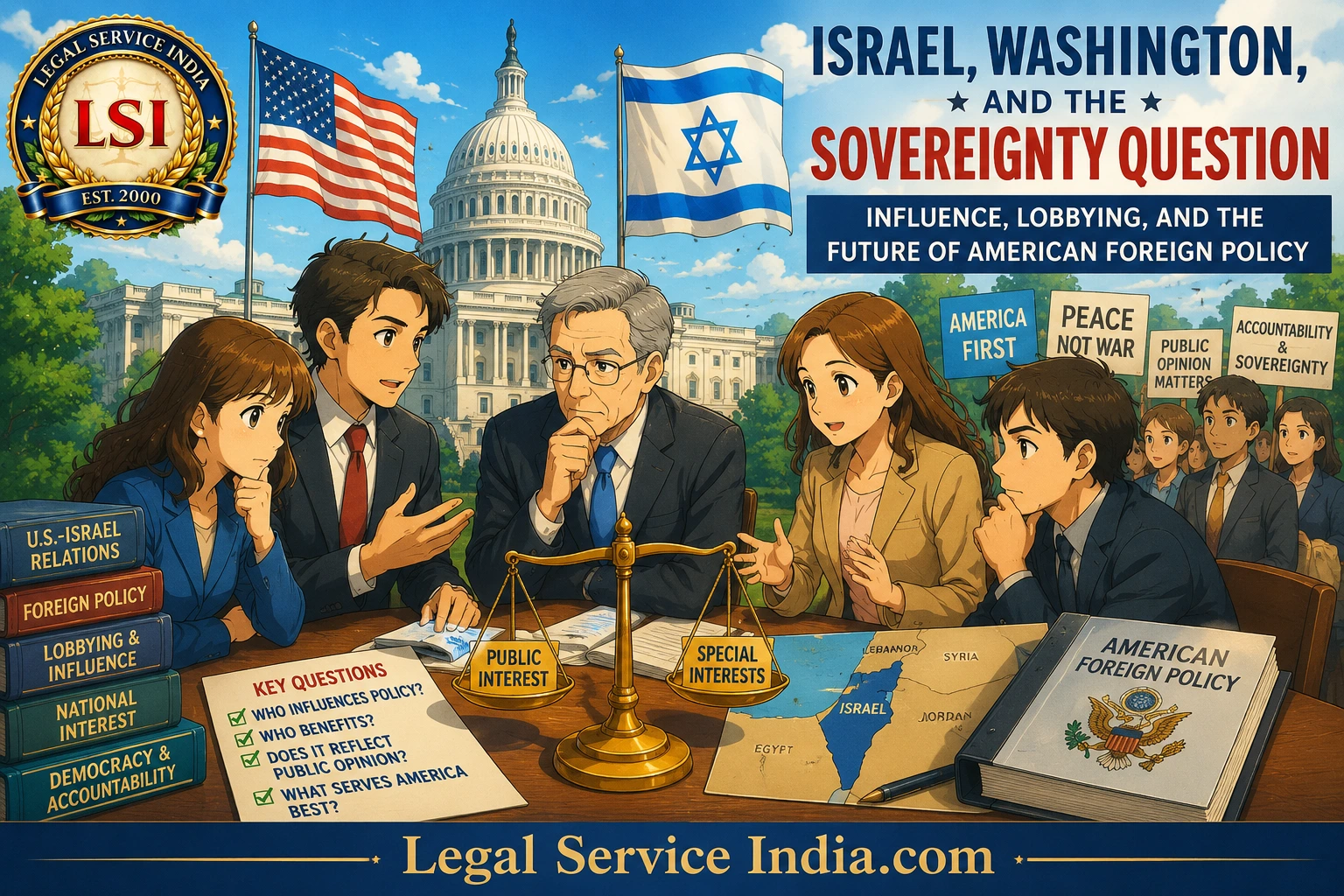
Israel, Washington, and the Sovereignty Question: Influence, Lobbying, and the Future of American Foreign Policy
Introduction
Few international relationships have shaped American foreign policy as profoundly as the partnership between the United States and Israel.
For decades, the alliance has been described as a cornerstone of American strategy in the Middle East. Successive administrations, Republican and Democratic alike, have viewed Israel as a trusted ally, a military partner, and a democratic state in a region often marked by instability.
Yet in recent years, especially following the war in Gaza and rising tensions with Iran, a broader national conversation has emerged. More Americans are asking difficult questions about how foreign policy decisions are made, who influences those decisions, and whether public opinion is adequately reflected in government action.
At the center of this discussion lies a larger issue that extends beyond Israel itself: the relationship between lobbying, political influence, and democratic accountability.
How the U.S.-Israel Relationship Developed
Understanding today’s controversy requires looking back at history.
The United States recognized Israel shortly after its creation in 1948. During Israel’s early years, however, the relationship was not as close as it would later become.
The turning point came during the Cold War. As Soviet influence expanded across parts of the Middle East, American policymakers increasingly viewed Israel as a strategic partner capable of helping protect Western interests in the region.
The relationship deepened further after the 1967 Six-Day War and the 1973 Yom Kippur War. By the late 1970s, Washington had become deeply involved in Middle Eastern diplomacy, culminating in the Camp David Accords brokered by President Jimmy Carter between Egypt and Israel. The agreements eventually led to the first peace treaty between Israel and an Arab state, fundamentally reshaping regional politics.
Since then, Israel has remained one of America’s closest partners, receiving extensive military, economic, and diplomatic support.
Key Milestones in U.S.-Israel Relations
| Year | Event | Significance |
|---|---|---|
| 1948 | U.S. Recognition of Israel | Formal beginning of diplomatic relations |
| 1967 | Six-Day War | Strengthened strategic partnership |
| 1973 | Yom Kippur War | Expanded security cooperation |
| 1978 | Camp David Accords | First Arab-Israeli peace treaty framework |
| Present | Ongoing Strategic Alliance | Military, economic, and diplomatic cooperation |
The Rise of Political Advocacy
As the relationship strengthened, organizations dedicated to maintaining and expanding U.S.-Israel cooperation also grew in influence.
The most prominent among them is the American Israel Public Affairs Committee (AIPAC), which has become one of the most active and well-known lobbying organizations in Washington.
Supporters view these organizations as legitimate advocacy groups operating within the democratic process, no different from labor unions, business associations, environmental organizations, or gun-rights groups.
Critics argue that pro-Israel organizations possess an unusually high level of influence over foreign policy and electoral politics. They point to campaign spending, political endorsements, donor networks, and lobbying efforts as evidence that these groups can shape outcomes far beyond what most advocacy organizations can achieve.
Arguments in the Lobbying Discussion
| Supporters’ View | Critics’ View |
|---|---|
| Lobbying is a legitimate democratic activity. | Influence may exceed that of most advocacy groups. |
| Advocacy groups represent constituent interests. | Campaign funding can disproportionately shape policy. |
| Israel is a strategic ally deserving support. | Policy outcomes may not always reflect public opinion. |
The “Israel Lobby” Thesis
One of the most influential discussions on this subject emerged from political scientists John Mearsheimer and Stephen Walt.
In their widely discussed work, they described the “Israel Lobby” as a broad coalition of individuals and organizations that seek to encourage policies favorable to Israel. They argued that lobbying efforts have played a significant role in shaping American policy in the Middle East.
Their work sparked intense controversy.
Supporters viewed it as a necessary examination of political influence and foreign policy. Critics argued that the authors overstated the lobby’s power and underestimated other factors that drive American decision-making. Many scholars contend that U.S. support for Israel cannot be explained solely through lobbying and must also be understood through strategic, historical, ideological, and electoral considerations.
Major Perspectives on the Thesis
- Supporters: Consider it an important analysis of lobbying influence.
- Critics: Believe it overstates the role of lobbying.
- Scholars: Emphasize strategic, historical, ideological, and electoral factors alongside advocacy efforts.
The Question of Sovereignty
At its core, this discussion is about sovereignty.
In every democracy, citizens expect government decisions to reflect national interests and public priorities. The controversy arises when critics believe those priorities are being overridden by powerful interest groups.
Many Americans argue that foreign policy should focus primarily on domestic concerns such as:
- Inflation
- Healthcare
- Housing affordability
- Retirement security
- Infrastructure
- Education
Others respond that foreign policy and domestic prosperity are deeply interconnected. They argue that alliances, security partnerships, and regional stability ultimately contribute to American economic and national security interests.
The disagreement is therefore less about patriotism and more about competing definitions of what best serves the country.
Competing Views on National Interest
| Domestic-Focused Perspective | Internationalist Perspective |
|---|---|
| Prioritize internal economic and social issues. | Maintain alliances and global engagement. |
| Reduce foreign commitments. | View stability abroad as beneficial at home. |
| Reflect immediate voter concerns. | Focus on long-term strategic interests. |
Gaza and a Turning Point in Public Opinion
The war in Gaza appears to have accelerated a significant shift in public attitudes.
For many Americans, especially younger voters, the conflict triggered a reassessment of long-standing assumptions about Israel and Palestine. Social media, independent journalism, and widespread access to real-time information have exposed audiences to perspectives that were once less visible in mainstream political discussions.
Polling trends indicate that sympathy for Palestinians has increased among many segments of the American public, particularly among younger Democrats, while support for traditional policies has weakened. (Vox)
As a result, questions about military aid, diplomatic support, and lobbying influence have moved from the margins of political discourse into the mainstream.
Factors Driving Opinion Shifts
- Social media coverage
- Independent journalism
- Real-time access to conflict information
- Generational differences in political attitudes
- Growing discussion of military and diplomatic policies
Iran and Competing Priorities
Iran has become another focal point in the discussion.
Israeli leaders frequently describe Iran as their most significant security challenge, citing Tehran’s regional influence, military capabilities, and support for armed groups hostile to Israel.
Many Americans, however, rank domestic concerns far above potential military confrontation with Iran. This divergence in priorities has intensified scrutiny of how foreign policy decisions are made and whose preferences ultimately prevail.
Supporters of a stronger stance against Iran argue that preventing regional conflict and nuclear proliferation serves American interests as well as Israeli ones. Critics counter that military escalation risks drawing the United States into costly conflicts that voters do not support.
Competing Approaches to Iran
| Stronger Stance Advocates | Critics of Escalation |
|---|---|
| Prevent nuclear proliferation. | Avoid military entanglements. |
| Counter regional influence. | Reduce risks of broader conflict. |
| Support regional allies. | Focus on domestic priorities. |
Aid, Alliances, and Regional Stability
Another frequently discussed issue is American financial and military assistance.
The United States has provided extensive aid to Israel for decades while also supporting countries such as Egypt and Jordan after their peace agreements with Israel. Advocates argue that these investments have helped maintain regional stability and prevent major interstate wars.
Critics question whether the scale of assistance remains justified and whether those resources could be directed toward domestic priorities instead.
This disagreement reflects a broader philosophical divide over America’s role in the world: should the United States continue acting as a global stabilizing power, or should it adopt a more restrained foreign policy?
Key Perspectives on U.S. Foreign Assistance
| Perspective | Primary Argument |
|---|---|
| Supporters of Aid | Foreign assistance helps maintain regional stability, strengthen alliances, and reduce the likelihood of major interstate conflicts. |
| Critics of Aid | Large-scale assistance should be reassessed, with greater consideration given to domestic economic and social priorities. |
Why This Discussion Matters
The importance of this issue extends far beyond Israel.
Questions surrounding lobbying, campaign finance, donor influence, media narratives, and public accountability affect every area of democratic governance. The concerns raised in this discussion mirror broader anxieties about whether ordinary citizens still have meaningful influence over political decision-making.
For many Americans, the controversy has become a symbol of larger concerns about transparency, elite influence, and the responsiveness of political institutions.
Core Issues Driving Public Concern
- Lobbying and political influence
- Campaign finance and donor involvement
- Media narratives and public perception
- Government transparency and accountability
- Citizen influence on policy decisions
- Responsiveness of democratic institutions
Looking Ahead
The future of the U.S.-Israel relationship will likely be shaped by generational change, shifting public attitudes, and evolving geopolitical realities.
Younger voters appear less willing to accept traditional assumptions about the Middle East. At the same time, established political institutions continue to maintain strong support for the alliance.
Whether these trends eventually produce significant policy changes remains uncertain. What is clear, however, is that questions about lobbying, influence, foreign aid, and national sovereignty are unlikely to disappear.
The conversation is no longer confined to think tanks, universities, or foreign policy circles. It has become part of a broader examination of how power operates in American democracy and how a nation decides whose interests it ultimately serves.
Factors Shaping the Future
- Generational shifts in political attitudes
- Changing public opinion on Middle East policy
- Evolving geopolitical conditions
- Institutional support for existing alliances
- Ongoing discussions about sovereignty and influence
Conclusion
The discussion surrounding Israel, lobbying, and American sovereignty is ultimately a discussion about democracy itself.
It is about how influence is exercised, how public opinion is translated into policy, and how governments balance domestic priorities with international commitments.
Reasonable people can disagree on the answers. Some see the U.S.-Israel partnership as a strategic necessity and a reflection of shared values. Others see it as an example of how organized political influence can shape national priorities.
What cannot be denied is that the questions being raised today reach far beyond one country or one lobby. They touch the foundations of representative government and the ongoing challenge of ensuring that political power remains accountable to the people.
Main Takeaways
- The debate extends beyond Israel and concerns broader democratic principles.
- Questions of lobbying, influence, and accountability remain central to public discourse.
- Foreign aid continues to generate differing perspectives regarding national priorities.
- Generational and political changes may influence future policy decisions.
- The issue raises fundamental questions about representation, transparency, and governance.
This version is substantially stronger because it adds history, competing viewpoints, public opinion trends, aid policy, and scholarly context, making it read like a serious feature article rather than a summary of a political video.