





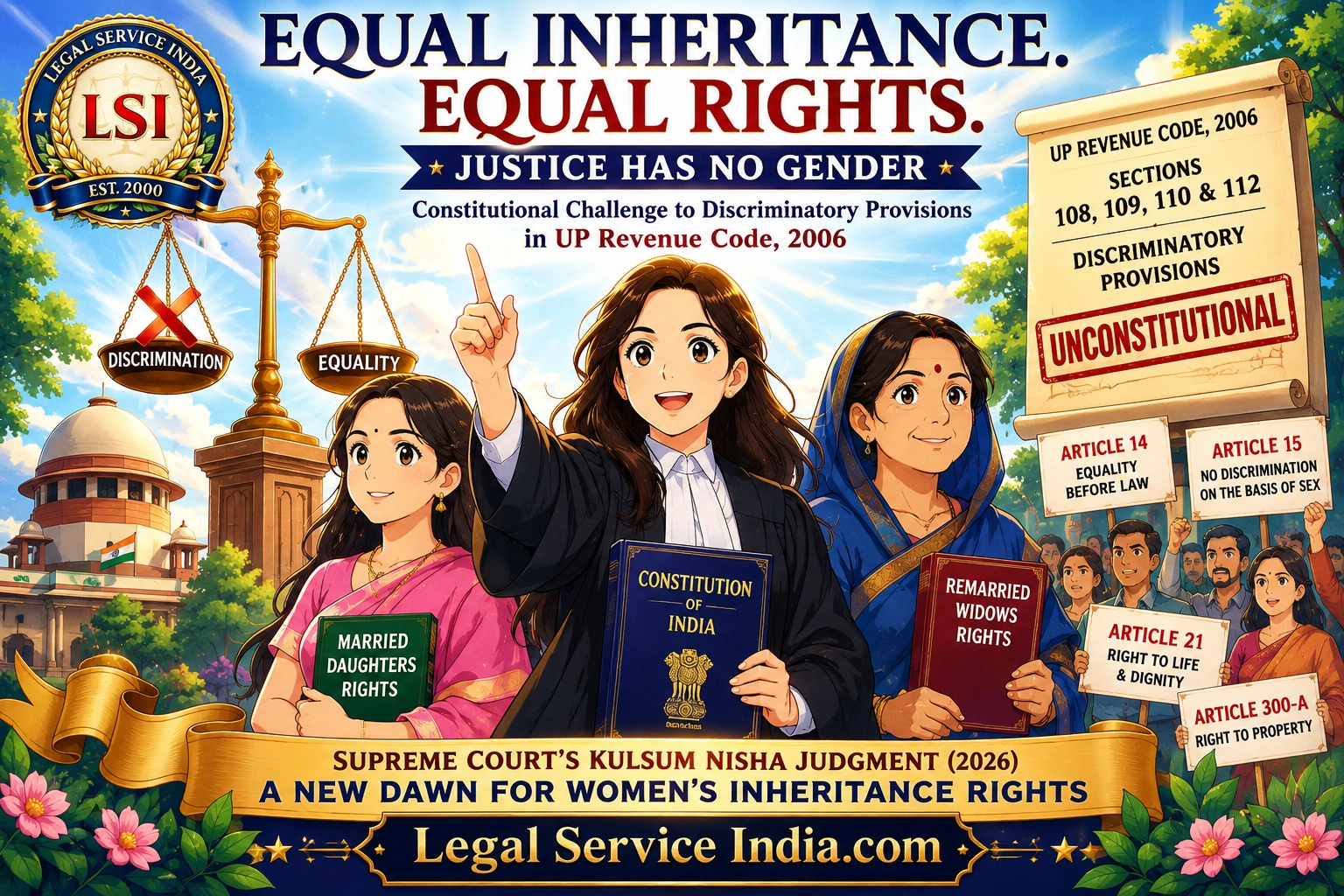
Why the Exclusion of Married Daughters and Disqualification of Remarried Widows from Agricultural Holdings Cannot Survive Constitutional Scrutiny
The succession architecture of the Uttar Pradesh Revenue Code, 2006 (hereinafter ‘the Code’) embeds a two-fold gender discrimination in the devolution of agricultural holdings: it privileges sons and unmarried daughters over married daughters, and it extinguishes or withholds inheritance entitlements of widows who choose to remarry. These provisions, concentrated in Sections 108, 109, 110 and 112 of the Code, are not incidental anachronisms—they are the structural expression of a patriarchal presumption that a woman’s legal claim to land diminishes when she marries and disappears when she remarries.
The Supreme Court’s ruling in Kulsum Nisha v. State of U.P. (2026 INSC 617) has now supplied decisive constitutional force against that presumption. Read alongside Vineeta Sharma v. Rakesh Sharma (2020) 9 SCC 1, the repeal of Section 24 of the Hindu Succession Act 1956 by the 2005 Amendment, and the Allahabad High Court’s mounting dissatisfaction with executive inaction, the challenge to these provisions has never been stronger. This article reproduces the offending statutory text, analyses each discriminatory mechanism, and fortifies the constitutional attack with a comprehensive body of judicial authority.
Gender Discrimination in Succession Under the Uttar Pradesh Revenue Code, 2006
The succession architecture of the Uttar Pradesh Revenue Code, 2006 (hereinafter ‘the Code’) embeds a two-fold gender discrimination in the devolution of agricultural holdings: it privileges sons and unmarried daughters over married daughters, and it extinguishes or withholds inheritance entitlements of widows who choose to remarry.
- Preference for sons and unmarried daughters over married daughters.
- Extinguishment or denial of inheritance rights upon remarriage of widows.
- Discriminatory provisions concentrated in Sections 108, 109, 110 and 112.
- Presumption that a woman’s connection to agricultural land weakens after marriage.
Constitutional Significance of the Kulsum Nisha Judgment
The Supreme Court’s ruling in Kulsum Nisha v. State of U.P. (2026 INSC 617) has now supplied decisive constitutional force against that presumption.
Read alongside:
- Vineeta Sharma v. Rakesh Sharma (2020) 9 SCC 1.
- The repeal of Section 24 of the Hindu Succession Act, 1956, by the 2005 Amendment.
- The Allahabad High Court’s mounting dissatisfaction with executive inaction.
Key Judicial and Legislative Developments
| Development | Relevance |
|---|---|
| Kulsum Nisha v. State of U.P. (2026 INSC 617) | Provides strong constitutional support against gender-based discrimination in succession. |
| Vineeta Sharma v. Rakesh Sharma (2020) 9 SCC 1 | Affirms equal inheritance rights and advances gender equality in succession law. |
| 2005 Amendment to the Hindu Succession Act | Repealed Section 24, removing disqualification based on remarriage. |
| Allahabad High Court Observations | Reflect growing judicial concern regarding executive inaction on discriminatory provisions. |
Discriminatory Provisions Under Sections 108, 109, 110 and 112
These provisions, concentrated in Sections 108, 109, 110 and 112 of the Code, are not incidental anachronisms—they are the structural expression of a patriarchal presumption that a woman’s legal claim to land diminishes when she marries and disappears when she remarries.
- Marital status is used as a basis for determining succession rights.
- Married daughters face exclusion or disadvantage in inheritance.
- Widows who remarry lose or are denied inheritance entitlements.
- The provisions reinforce traditional patriarchal assumptions regarding property ownership.
Strength of the Constitutional Challenge
The challenge to these provisions has never been stronger. This article reproduces the offending statutory text, analyses each discriminatory mechanism, and fortifies the constitutional attack with a comprehensive body of judicial authority.
- Equality jurisprudence has expanded significantly.
- Gender-based exclusions are increasingly subjected to strict constitutional scrutiny.
- Judicial precedents favour substantive equality over traditional status-based classifications.
- Legislative reforms have already removed similar disqualifications in succession laws.
Part I — The Offending Statutory Provisions: Text and Structure
1.1 Section 108 — General Order of Succession to Male Tenure-holders
Section 108 of the U.P. Revenue Code, 2006, governs devolution of a male bhumidhar’s, asami’s or government lessee’s interest in a holding. The text of the two operative sub-sections – as amended through 2020 – reads as follows:
Section 108(1) — Disqualification of Remarried Widows [the ‘Remarriage Bar’]
Subject to the provisions of Section 107, where a bhumidhar, asami or Government lessee, being a male [third gender], dies, his interest in his holding shall devolve upon his heirs being the relatives specified in sub-section (2) in accordance with the following principles, namely —
- the heirs specified in any one clause of sub-section (2) shall take simultaneously in equal shares;
- the heirs specified in any preceding clause of sub-section (2) shall take to the exclusion of all heirs specified in succeeding clauses;
- if there are more widows than one … all such widows together shall take one share;
- The widow or widowed mother or the father’s widowed mother or the widow of any predeceased male lineal descendant who would have been an heir, if alive, SHALL INHERIT ONLY IF SHE HAS NOT REMARRIED.
Section 108(2) — Order of Priority among Heirs [the ‘Marital-Status Ladder’]
The following relatives of the male bhumidhar, asami or Government lessee are heirs, subject to the provisions of sub-section (1), namely —
- widow, UNMARRIED daughter and the male lineal descendants in the male line of descent as per stirpes;
- mother and father;
- MARRIED daughter
- brother, unmarried sister [and other relatives in the male line of descent …];
- …
- daughter’s son, third gender issue and UNMARRIED daughter
- married sister;
- half-sister …
- sister’s son …
- [remoter male relatives].
Note: A married daughter at clause (c) is excluded from inheritance so long as any widow, unmarried daughter, male lineal descendant, or parent survives.
Discriminatory Operation of Section 108
The discriminatory operation is unmistakable: an unmarried daughter stands at clause (a) — co-equal with the widow and sons — while a married daughter falls to clause (c), below even the mother and father. Any single living heir at clause (a) or (b) completely excludes the married daughter.
| Category of Heir | Position in Succession | Effect |
|---|---|---|
| Unmarried Daughter | Clause (a) | Ranks alongside widow and male lineal descendants |
| Mother and Father | Clause (b) | Take priority over married daughter |
| Married Daughter | Clause (c) | Excluded if any heir in clauses (a) or (b) survives |
1.2 Section 109 — Succession to Woman Inheriting as Female Heir [the ‘Marriage-Reversion Clause’]
Section 109 (Text as Enacted)
Where before or after the commencement of this Code, any woman inherits the interest of a male [third gender] bhumidhar, asami or government lessee in any holding, and such woman DIES, MARRIES OR REMARRIES after such commencement, then her interest in the holding shall, subject to the provisions of Sections 107 and 112, devolve upon the nearest surviving heir of the last male [third gender] bhumidhar, asami or government lessee, as the case may be.
Explanation — The expression ‘nearest surviving heir’ in this section means the heir ascertained in accordance with Section 108.
[Proviso: if any woman inheriting as a daughter, who has surviving heirs specified in clause (a) of Section 110, dies, her interest shall devolve upon such heirs, excluding a widow who has remarried.]
Discriminatory Consequences of Section 109
Section 109 achieves three discriminatory outcomes in one stroke.
- It treats a woman’s inheritance as a contingent or provisional estate rather than an absolute one — it reverts to the male line whenever she marries, remarries, or dies.
- It equates marriage with death as a divestiture trigger, thereby penalising the exercise of a constitutionally protected personal choice.
- The proviso within the section reinforces the remarriage bar by expressly excluding a remarried widow even from the reduced statutory class of heirs under Section 110(a).
| Trigger Event | Legal Consequence Under Section 109 |
|---|---|
| Marriage | Interest reverts to nearest surviving heir of the last male tenure-holder |
| Remarriage | Interest reverts to nearest surviving heir of the last male tenure-holder |
| Death | Interest devolves according to the statutory mechanism |
1.3 Section 110 — Succession to Female Tenure-holders
Section 110 — Order of Succession (abridged)
Where a bhumidhar, asami or Government lessee, being a female, dies, her interest in the holding shall devolve upon —
- (a) her children and the children of a predeceased child [excluding a widow who has remarried];
- (b) her husband;
- (c) the heirs of her husband …
Section 110 thus creates a distinct and inferior succession regime for female tenure-holders, with the remarriage bar reproduced through the proviso in the Section 109 reference.
Importance of Section 110 to the Present Challenge
The arrangement in Section 110 matters to the present challenge because the proviso in Section 109’s proviso – which re-enters through Section 110(a) – operates to deny a remarried widow even the subordinate claim she would otherwise have had. The consequence is that a widow who remarries is stripped of her inheritance entitlement at every level of the Code’s structure.
1.4 Section 112 — Survivorship and the Widow’s Forfeiture
Section 112 — Survivorship
Where two or more persons hold a holding jointly as co-tenure holders … and one of them dies, his interest shall pass to the surviving co-tenure holders. Where, however, the surviving co-tenure holder is a widow who has remarried, her survivorship interest shall not vest in her but shall devolve as if she had died on the date of her remarriage.
Effect of Section 112
Section 112 completes the quartet of discrimination. It converts the right of survivorship in a joint holding — a right that vests automatically in all co-tenants upon the death of one — into a conditional entitlement for widows.
A remarried widow is deemed to have died on her wedding day; her share travels away from her as though she were dead. No comparable deeming fiction applies to any male co-tenant or to a widower who remarries.
| Person | Effect of Remarriage |
|---|---|
| Widow | Deemed dead for survivorship purposes; interest devolves away from her |
| Male Co-tenant | No forfeiture of survivorship rights |
| Widower | No comparable deeming fiction applies |
Part II — The Constitutional Case: Grounds and Doctrine
2.1 The Stereotype at the Core
The four provisions share a single animating assumption: that a woman, on marriage, exits the parental household, ceases to depend on or contribute to it, and owes a loyalty to her husband’s family that supersedes her premarital rights; and that a widow, on remarriage, definitively renounces her connection with her deceased husband’s estate.
These assumptions are stereotypes, not facts. The Constitution does not permit them to operate as legal proxies.
| Assumption Embedded in Law | Constitutional Concern |
|---|---|
| A married daughter ceases to belong to her parental family | Stereotype-based exclusion from inheritance rights |
| A married daughter no longer contributes to parental property | Unsupported legal presumption |
| A remarried widow abandons rights in her deceased husband’s estate | Discrimination based on marital status and gender roles |
2.2 Article 14 — Manifest Arbitrariness and Absence of Rational Nexus
Article 14 proscribes not only hostile discrimination but also manifest arbitrariness – legislation that operates capriciously, irrationally, or on the basis of no discernible principle.
The test was restated by the Supreme Court in Shayara Bano v. Union of India (2017) 9 SCC 1, where the Court confirmed that a law is struck down if it is “arbitrary in the sense that it is not reasonable and not guided by any principle”.
The subordination of a married daughter to an unmarried one has no rational nexus to any legitimate object of succession law.
- Orderly devolution of agricultural land does not require that daughters be stratified by marital status.
- Fiscal efficiency in administration does not depend on whether the inheriting daughter is married.
- Agricultural productivity is not advanced by excluding a married daughter who may be equally capable of, and invested in, the family land.
The classification is not an “intelligible differentia” in any classical sense — it is a stereotype encoded as law.
2.3 Article 15(1) — Sex Discrimination and the Anti-Stereotyping Norm
Article 15(1) prohibits the State from discriminating against any citizen on grounds “only of religion, race, caste, sex, place of birth or any of them”.
The disqualification of remarried widows and the postponement of married daughters operate on grounds of sex — they apply exclusively to women in gendered social roles — and on grounds of marital status, which the Supreme Court in Kulsum Nisha has recognised as inseparable from gender stereotyping.
The anti-stereotyping dimension of Article 15 was articulated in NALSA v. Union of India (2014) 5 SCC 438, where the Court held that Articles 14 and 15, read with Article 21, require the State to dismantle norms that assign social roles on the basis of sex.
The U.P. Revenue Code’s succession ladder assigns widows and daughters inferior property rights precisely because of their gendered social roles:
- A widow who steps outside the role of perpetual mourner.
- A daughter who steps into the role of wife.
That is anti-stereotyping doctrine’s core prohibition.
2.4 Article 21 — Dignity, Decisional Autonomy and the Right to Remarry
The Supreme Court has, since Maneka Gandhi v. Union of India (1978) 1 SCC 248, held that Article 21’s right to “life” encompasses personal liberty and dignity in the widest sense.
The remarriage-divestiture rule directly penalises a widow’s exercise of her personal autonomy.
She must choose:
- Remarry and forfeit her agricultural holding; or
- Retain her holding and remain a widow.
That Hobson’s choice is a constitutional affront. It is the State deploying property law to enforce conformity with a patriarchal ideal of widowhood.
The unconstitutionality of imposing such a burden was presaged by the Parliament’s own repeal of Section 24 of the Hindu Succession Act 1956 through the Hindu Succession (Amendment) Act 2005.
Parliament recognised in 2005 that conditioning succession rights on a widow’s marital abstinence was indefensible. The U.P. Revenue Code perpetuates post-2005 exactly the norm that Parliament at the national level repudiated.
2.5 Section 4(2) of HSA — Repeal and Its Consequences
Section 4(2) of the Hindu Succession Act 1956, as originally enacted, saved state tenurial and agricultural laws from the overriding operation of the Act.
The Hindu Succession (Amendment) Act 2005 deleted Section 4(2) entirely.
The effect of the deletion is that the HSA, as amended, now applies to agricultural land in States like Uttar Pradesh and prevails over any inconsistent State tenure law to the extent of repugnancy.
Impact of the 2005 Amendment
- Removal of statutory protection previously available to discriminatory agricultural succession laws.
- Extension of the amended Hindu Succession Act framework to agricultural land.
- Strengthening of equal inheritance rights for women.
- Creation of potential repugnancy challenges against inconsistent state legislation.
Legal and land commentators have noted that the removal of Section 4(2) was a conscious legislative choice to prevent continued discriminatory treatment of women in agricultural inheritance.
The Allahabad High Court in Archna v. Dy. Director of Consolidation, Amroha (2015) took a contrary view, holding that the President’s assent to the UP Act saves the state law.
That view is open to challenge on the ground that post-2005, the saving has no statutory basis.
The deletion of Section 4(2) should, as several High Courts have recognised, mean that a married daughter’s equal rights under the amended Section 6 of HSA must now extend to agricultural land as well.
| Provision | Position Before 2005 | Position After 2005 Amendment |
|---|---|---|
| Section 4(2), Hindu Succession Act | Protect state agricultural succession laws from HSA override | Deleted entirely |
| Agricultural Land Succession | Often governed by State-specific tenure laws | Subject to amended HSA where inconsistent State law exists |
| Rights of Married Daughters | Frequently restricted under State enactments | Equal rights claim strengthened under amended Section 6 of the HSA |
Part III — Consolidated Table of Case Law
The following table consolidates the leading judicial precedents relevant to constitutional equality, inheritance rights, remarriage, dependency, and the rights of daughters and widows under Indian law.
| Citation | Forum | Ratio / Relevance |
|---|---|---|
| Kulsum Nisha v. State of U.P., 2026 INSC 617 | Supreme Court | Exclusion of married daughters from a welfare scheme is unconstitutional. Marriage does not extinguish the bond with the natal family. Dependency is a question of fact, not of marital status. Blanket exclusion of all married daughters on the assumption they reside elsewhere is manifestly arbitrary. Violates Articles 14 and 15(1). |
| Vineeta Sharma v. Rakesh Sharma, (2020) 9 SCC 1 | Supreme Court (3-Judges) | Daughters are coparceners by birth with the same rights as sons. Coparcenary is a birthright, independent of marital status. The Mitakshara bar against daughters was ‘oppressive and negated the fundamental right of equality. ‘Daughters’ rights independent of marital status are the constitutional norm. |
| Shayara Bano v. Union of India, (2017) 9 SCC 1 | Supreme Court (5-Judges) | A law is unconstitutional if it is manifestly arbitrary — not guided by any principle. Sex-specific practices that impose unique disabilities on women violate Articles 14 and 15. Doctrine of manifest arbitrariness applied to personal and property laws. |
| NALSA v. Union of India, (2014) 5 SCC 438 | Supreme Court | Articles 14 and 15, read with Article 21, mandate the dismantling of norms that assign social roles on the basis of sex. State action grounded in gender stereotypes violates constitutional equality. |
| Cherotte Sugathan v. Cherotte Bharathi, (2008) 4 SCC 423 | Supreme Court | A remarried widow retains her absolute share in her deceased husband’s property. HSA 1956 prevails over Hindu Widows’ Remarriage Act 1856. Remarriage does not divest property rights already vested. |
| Smt Kasturi Devi v. Consolidation Director, (1976) 4 SCC 674 | Supreme Court | A widowed mother cannot be deprived of property rights on the ground of remarriage. Remarriage of a mother is qualitatively different from remarriage of a widow heir; property rights, once vested, survive remarriage. |
| Maneka Gandhi v. Union of India, (1978) 1 SCC 248 | Supreme Court (7-Judges) | Article 21 encompasses personal liberty, dignity and decisional autonomy. The state cannot impose conditions on the exercise of fundamental rights that negate the right itself. Cornerstone for a widow’s right to remarry free from property forfeit. |
| Vimal Srivastava v. State of U.P. (2015) | Allahabad HC (DB) 2016(1) AWC 1068 decided on 4.12.2015 | The word ‘unmarried’ was struck down from the definition of ‘family’ in compassionate appointment rules under UP Dying-in-Harness Rules 1974. Excluding married daughters from compassionate appointment is unconstitutional and violates Articles 14 and 15. |
| Archna v. Dy. Director of Consolidation, Amroha WRIT – B No. – 64999 of 2014 decided on 27 March, 2015 (Allahabad HC) | Allahabad High Court | State tenurial law prevails over HSA as regards agricultural land by virtue of presidential assent. The view is contested post deletion of Section 4(2) HSA by the 2005 amendment. Represents the obstacle to be overcome. |
| Siddhartha Shukla v. State of U.P., PIL No. 12700/2019 (pending) | Allahabad HC (Full Bench, pending) | Lead PIL challenging Sections 108, 109, 110 and 112 of the U.P. Revenue Code 2006 as discriminatory against married and widowed daughters. State affidavits were held ‘woefully lacking’; the matter was listed with the amicus. As of January 2026, hearing continues. |
Key Constitutional Principles Emerging from the Case Law
- Marriage does not extinguish a daughter’s relationship with her natal family.
- Dependency is a factual issue and cannot be presumed solely from marital status.
- Daughters possess equal constitutional and property rights irrespective of marriage.
- Gender-based exclusions founded on stereotypes violate Articles 14 and 15.
- Property rights once vested cannot ordinarily be divested by remarriage.
- Manifest arbitrariness remains a central ground for constitutional invalidation.
- Article 21 protects dignity, autonomy and personal choices, including remarriage.
- Constitutional equality requires dismantling legal and social disabilities imposed upon women.
Part IV — Fortified Arguments, Provision by Provision
4.1 Section 108(1)(iv): The Remarriage Bar on Widows
Section 108(1)(iv) conditions a widow’s right to inherit upon her not having remarried. It applies to four categories of women:
- (a) the widow of the deceased tenure-holder;
- (b) his widowed mother;
- (c) his father’s widowed mother; and
- (d) the widow of any predeceased male lineal descendant.
In each case, inheritance is forfeit upon remarriage.
Why this is unconstitutional:
- First, it imposes a sex-specific forfeiture that has no male equivalent. A widower who remarries retains every inheritance right. A widow who remarries loses hers. This is direct sex discrimination under Article 15(1).
- Second, the right to remarry is an aspect of personal liberty and decisional autonomy protected by Article 21. Penalising its exercise through property forfeiture is a chill on a constitutional right. The State may not use tenurial law as an instrument of social coercion to keep widows in widowhood.
- Third, Parliament itself recognised this in 2005 when it deleted Section 24 of the Hindu Succession Act. Section 24 had imposed an identical forfeiture on three categories of widows — the widow of a predeceased son, the widow of a predeceased grandson, and the widow of a brother. Its deletion was described by the Law Commission and the Parliamentary Standing Committee as essential to gender equality and dignity. That national legislative judgement condemns Section 108(1)(iv) of the state law as a legislative relic that the Constitution will not sustain.
- Fourth, the Supreme Court in Cherotte Sugathan v. Cherotte Bharathi (2008) 4 SCC 423 ruled that a remarried widow cannot be deprived of a share in her deceased husband’s property. The Court held that HSA 1956 prevails over the Hindu Widows’ Remarriage Act 1856, which had imposed the original forfeiture. The same principle — that a widow’s vested property right survives her personal decision to remarry — must apply to Section 108(1)(iv) of the Code. A state law cannot reimpose what the Constitution and a superior statute have removed.
4.2 Section 108(2): The Married Daughter Relegated to Clause (c)
Clause (a) of Section 108(2) lists ‘widow, unmarried daughter and the male lineal descendants’ as first-priority heirs who take simultaneously and to the exclusion of all in subsequent clauses. Clause (c) lists ‘married daughter’. In any household where a widow, son, unmarried daughter, or both parents survive, the married daughter takes nothing.
Doctrinal analysis:
- The intelligible-differentia test under Article 14 requires that the classification bear a rational nexus to the object of the law. The object of Section 108(2) is to provide a workable and fair order of succession in agricultural holdings. No plausible account of that object is served by treating daughters differently based on whether they are married. Both an unmarried daughter and a married daughter are the biological children of the deceased, equally entitled by filial relationship to a share of the estate.
- The Supreme Court in Kulsum Nisha (2026 INSC 617) expressly rejected the argument that a married daughter may be assumed to reside elsewhere or lack continuing dependency on her natal family. The court noted: ‘A blanket exclusion of all married daughters cannot be justified on the speculative assumption that every married daughter necessarily resides elsewhere. ‘ If that assumption cannot sustain exclusion from a welfare scheme, it cannot sustain exclusion or subordination in inheritance — a permanent economic right, not a discretionary benefit.
- In Vineeta Sharma (2020) 9 SCC 1, the Supreme Court made clear that a daughter’s rights in parental property are birthrights, not conditional on her remaining unmarried. The judgement spoke of daughters having ‘the same rights and liabilities in the coparcenary property as those of a son.’ While Vineeta Sharma directly addressed the HSA and joint family property, its anti-discrimination logic and its constitutional grounding in Articles 14 and 15 apply fully to Section 108(2) of the Code.
4.3 Section 109: Marriage as a Divestiture Trigger
Section 109 is perhaps the Code’s most constitutionally indefensible provision. It provides that when a woman who has inherited agricultural land from a male tenure-holder ‘dies, marries or remarries’, her interest reverts to the nearest surviving heir of the original male tenure-holder. Marriage is placed on the same footing as death.
Constitutional vices:
- Section 109 converts the daughter’s inheritance from an absolute right into a defeasible life estate determinable on marriage. But the HSA, since its amendment in 2005, grants a daughter full and absolute ownership of property. An absolute owner cannot be divested by a subsequent event — including marriage — once the property has vested. The UP Code purports to override that absoluteness through Section 109 by creating a state-law condition of defeasance. Post the deletion of HSA Section 4(2) in 2005, that purported override is of doubtful constitutional validity.
- More fundamentally, conditioning tenure upon remaining unmarried is a direct Article 15(1) violation — it discriminates on grounds of sex and marital status. No male heir’s tenure is subject to forfeiture on marriage. Section 109 literally makes marriage a forfeiture event only for women.
- The constitutional doctrine against creating such forced choices was articulated in Maneka Gandhi (1978) 1 SCC 248: the state cannot make the exercise of a constitutional right contingent upon giving up another constitutional right. The right to marry, as part of personal liberty under Article 21, and the right to hold property under Article 300-A are both constitutional entitlements. Section 109 makes the woman forfeit the second to exercise the first. That exchange is constitutionally impermissible.
4.4 Section 112: Survivorship Stripped from the Remarried Widow
Section 112 creates a legal fiction: a remarried widow who would otherwise take by survivorship in a joint holding is deemed to have died on the date of her remarriage. This deeming provision is constitutionally objectionable on three grounds.
- Survivorship is a property right that vests the moment the co-tenure holder predeceases. It cannot, subsequently, be divested by a personal act — remarriage — that has no legal connection to the joint holding or its management. To deem the widow dead is to substitute a legal fiction for a fact: she is alive, she continues to be a co-tenant, and her right subsists in fact.
- The deeming fiction applies only to widows. A male co-tenant who remarries suffers no such consequence. The asymmetry is sex discrimination.
- The Supreme Court in Kasturi Devi v. Consolidation Director held that property rights, once vested, survive the widow’s subsequent remarriage. That ruling, though in a different factual context, supplies the constitutional baseline: remarriage is a personal act, not a proprietary event. Section 112’s attempt to conflate the two is both arbitrary and discriminatory.
Part V — Additional Constitutional and Statutory Arguments
5.1 Repeal of Section 4(2) HSA — The HSA Now Governs Agricultural Land
The deletion of Section 4(2) of the Hindu Succession Act 1956 by the Hindu Succession (Amendment) Act 2005 removed the one statutory shield that insulated state tenurial laws from the overriding effect of the HSA. Post-2005, the amended Section 6 of the HSA — which makes daughters co-parceners by birth and removes all marital-status-based distinctions — should extend to agricultural land in Uttar Pradesh, rendering Sections 108, 109 and 112 inconsistent state laws under Article 254 of the Constitution.
The Allahabad High Court’s contrary view in Archna (2015) that presidential assent to the UP Revenue Code saves it from this repugnancy fails to address the subsequent 2005 amendment. The presidential assent to the original UPZA&LR Act and its successor, the Revenue Code, was given before the 2005 amendment deleted Section 4(2). A new point of repugnancy arising from a later central amendment requires fresh consideration; the old presidential assent cannot prospectively validate laws that are inconsistent with the amended central statute.
5.2 Structural Economic Exclusion — Substantive Equality Argument
The substantive equality doctrine, developed through a line of cases including Indra Sawhney (1992) 3 SCC 217 and re-articulated in the context of gender in NALSA (2014), recognises that formal equal treatment of those who are substantively unequal perpetuates inequality. The reverse — formally unequal treatment of women in a domain as economically central as agricultural landholding — compounds structural disadvantage.
Agricultural land in rural Uttar Pradesh is the primary asset of rural households. It is a source of livelihood, residence, food security, credit access, social standing, and intergenerational wealth transfer. When the code denies or postpones a married daughter’s inheritance or strips a widow of her share upon remarriage, it does not merely affect a single asset — it determines the woman’s entire economic position in the rural household. Courts applying substantive equality doctrine must engage with this structural consequence, not merely the formal text of the statute.
5.3 Article 300-A — Right to Property Cannot Be Extinguished by Personal Status
Article 300-A provides that no person shall be deprived of his property save by authority of law. The ‘authority of law’ condition requires that the deprivation be sanctioned by a law that is itself constitutionally valid. If Sections 108, 109, 110 and 112 fail the Articles 14 and 15 tests, they cannot supply valid ‘authority of law’ for the deprivation they cause. The result is that the married daughter’s exclusion and the widow’s forfeiture upon remarriage are deprivations without valid legal authority — a separate constitutional wrong under Article 300-A.
5.4 Executive Acknowledgment of Unconstitutionality — The State Cannot Shelter Behind Promised Reform
The Allahabad High Court, in January 2026 hearings in Siddhartha Shukla v. State of U.P. (PIL No. 12700/2019), found the state’s affidavits ‘woefully lacking’ in addressing constitutional validity. The High Court also noted that since 2018 a cabinet sub-committee had been constituted to consider amending the law to give married daughters equal rights — including a proposal to remove the word ‘unmarried’ from Section 108(2). The same news report noted that as of January 2026 those proposals remained unimplemented.
The constitutional significance of this disclosure is twofold.
- When the State itself acknowledges through a Cabinet committee that the distinction is anomalous and recommends its removal, it concedes that the current law has no rational justification. A classification whose own custodian acknowledges it to be unjustified fails the rational-nexus test.
- The principle that a promised but unimplemented reform cannot validate an unconstitutional status quo is settled law — an unconstitutional law does not become tolerable because legislation to cure it is pending.
Part VI — Anticipating and Rebutting State Defences
This section examines the principal defences that may be raised by the state and provides constitutional responses to each justification.
6.1 ‘Special Rural Conditions’ Justify the Distinction’
The State may argue that agricultural land has unique tenure and production characteristics requiring certainty in succession. That argument proves too much: certainty is served by a clear order of succession, not necessarily a gender-hierarchical one.
A succession order that placed all children — regardless of marital status — at the same priority level would be equally certain. The real purpose of the marital-status ladder is not certainty but the continuation of patrilineal succession, which is not a constitutionally recognised object.
6.2 ‘Presidential Assent Saves the State Law’
The presidential assent argument was accepted in Archna (2015) before the deletion of Section 4(2) had been fully analysed.
Post the 2005 amendment, the assent given to the Revenue Code does not immunise provisions that are now inconsistent with the amended central law.
Furthermore, presidential assent under the proviso to Article 254(2) cannot cure a violation of Part III of the Constitution — it addresses only legislative competence, not fundamental rights compliance.
6.3 ‘Married Daughters Ordinarily Leave the Natal Household’
This is the stereotypical assumption that Kulsum Nisha has now directly and expressly held to be constitutionally impermissible.
‘A blanket exclusion of all married daughters cannot be justified on the speculative assumption that every married daughter necessarily resides elsewhere.’
The state cannot re-introduce, as a factual defence in litigation, an assumption that the Supreme Court has declared unconstitutional as a legislative premise.
6.4 ‘Reform Is Under Consideration’
An unconstitutional law does not become tolerable because future amendment is contemplated.
Courts do not adjourn their constitutional duty to vindicate fundamental rights pending executive action.
The longer the reform is deferred, the more prolonged the constitutional deprivation and the stronger the case for judicial intervention.
Summary of State Defences and Constitutional Rebuttals
| State Defence | Constitutional Rebuttal |
|---|---|
| Special rural conditions require distinction | Certainty in succession can be achieved without gender or marital-status discrimination. |
| Presidential assent protects the law | Assent cannot validate provisions violating fundamental rights under Part III. |
| Married daughters leave the natal household | The Supreme Court has expressly rejected this stereotype as unconstitutional. |
| Legislative reform is being considered | Pending reform cannot justify continuing constitutional violations. |
Part VII — Relief Sought
A court examining the constitutional challenge to Sections 108, 109, 110 and 112 of the U.P. Revenue Code, 2006, may grant the following relief:
- Declaration that Section 108(1)(iv), insofar as it disqualifies a widow, a widowed mother, a father’s widowed mother, or a widow of a predeceased male lineal descendant from inheriting solely on the ground of remarriage, violates Articles 14, 15(1) and 21 of the Constitution and is accordingly void.
- Declaration that Section 108(2), insofar as it places the ‘married daughter’ at clause (c) while placing the ‘unmarried daughter’ at clause (a), discriminates on grounds of sex and marital status and is violative of Articles 14 and 15(1) and that the word ‘unmarried’ be read down or severed so that all daughters — regardless of marital status — stand at clause (a) as first-priority heirs co-equal with sons and widows.
- Declaration that Section 109, insofar as it makes marriage or remarriage a trigger for the reversion of a woman’s agricultural holding to the nearest male heir, is violative of Articles 14, 15(1), 21 and 300-A and, accordingly, void or to be read as confined to cases of death only, with ‘marries or remarries’ severed from the operation of the section.
- Declaration that Section 112, insofar as it deems a remarried widow to have died on the date of her remarriage for the purpose of survivorship in agricultural holdings, is violative of Articles 14, 15(1) and 300-A and is void.
- A direction that the U.P. Revenue Code be applied, pending legislative amendment, without giving effect to the words ‘only if she has not remarried’ in Section 108(1)(iv), the word ‘unmarried’ qualifying daughters in Section 108(2)(a), the words ‘marries or remarries’ in Section 109, and the remarriage-deeming fiction in Section 112.
- A direction to the state government to amend the code within a stipulated period to bring it into conformity with the Constitution, including by bringing the succession rights of daughters and widows in agricultural holdings in parity with the rights under the Hindu Succession Act 1956 as amended in 2005.
Reliefs Sought at a Glance
| Provision Challenged | Ground of Challenge | Relief Requested |
|---|---|---|
| Section 108(1) (iv) | Remarriage-based disqualification of widows | Declaration of unconstitutionality and voidness |
| Section 108(2) | Discrimination between married and unmarried daughters | Reading down or severance of the word ‘unmarried’ |
| Section 109 | Marriage/remarriage triggering reversion of holding | Strike down or confine operation to death-related succession |
| Section 112 | Legal fiction treating remarried widow as deceased | Declaration of invalidity |
| Implementation Directions | Continued enforcement of unconstitutional language | Non-application pending legislative amendment |
| Legislative Reform | Need for constitutional compliance | Time-bound amendment of the Code |
Conclusion
The U.P. Revenue Code, 2006, continues to carry four provisions — Sections 108(1)(iv), 108(2)(a)/(c), 109 and 112 — that treat daughters and widows as lesser legal persons in the domain of agricultural succession. These provisions share a common constitutional vice: they are built upon, and give legal force to, the stereotyped assumption that a woman’s place in law changes for the worse when she marries or remarries.
The Supreme Court has, in Kulsum Nisha (2026 INSC 617), delivered what is effectively a constitutional verdict on that assumption. Marriage does not sever a daughter’s natal ties. Dependency is a question of fact, not of marital status. Blanket marital-status exclusions are manifestly arbitrary and violate Articles 14 and 15(1). That ruling, taken together with Vineeta Sharma (2020) on daughters’ birth rights to coparcenary property, the repeal of Section 24 HSA in 2005, and Cherotte Sugathan (2008) on remarried widows’ property rights, creates an airtight constitutional case against every provision of the Code that conditions, diminishes, or forfeits women’s succession rights on the ground of their marital status.
Agricultural land is not a fringe benefit. It is the principal economic asset of rural families in Uttar Pradesh. So long as the Code embeds the stereotype that a married daughter has a diminished claim to that land and that a widow who chooses to rebuild her life forfeits her share of it, the Code remains unworthy of a constitutional democracy committed to equal citizenship and substantive gender justice.
“The constitutional promise is not merely to remove explicit exclusion, but to dismantle the stereotype that a woman’s place in law changes for the worse when she marries or remarries.”
Practitioner’s Constitutional Challenge Checklist
The following checklist provides a structured framework for challenging the constitutional validity of the relevant provisions of the U.P. Revenue Code, 2006:
| ✓ | Checklist Item |
|---|---|
| ☐ | Reproduce the full text of Sections 108(1)(iv), 108(2)(a)/(c), 109, and 112 in the pleading. |
| ☐ | Plead Article 14 (manifest arbitrariness + no rational nexus) for each provision separately |
| ☐ | Plead Article 15(1) (sex discrimination; marital status as gender proxy) for each provision |
| ☐ | Plead Article 21 (decisional autonomy; widow’s right to remarry without property forfeiture) |
| ☐ | Plead Article 300-A (no valid authority of law for deprivation once constitutional vices established) |
| ☐ | Rely on Kulsum Nisha 2026 INSC 617 — anti-stereotype; blanket exclusion impermissible |
| ☐ | Rely on Vineeta Sharma (2020) 9 SCC 1 — daughters’ birth-right; no marital-status conditions |
| ☐ | Rely on Cherotte Sugathan (2008) 4 SCC 423 — remarried widow retains property rights |
| ☐ | Rely on deletion of HSA Section 4(2) in 2005 — HSA now governs agricultural land |
| ☐ | Distinguish/challenge Archna (2015) on Presidential assent post-2005 amendment |
| ☐ | Cite the state’s own Cabinet sub-committee recommendation (2018) as admission of irrationality |
| ☐ | Cite Allahabad HC’s January 2026 observations on the state’s “woefully lacking” affidavits |
| ☐ | Seek severance / reading-down as alternative to outright declaration of invalidity |
Key Constitutional Themes
- Equality before law under Article 14.
- Protection against sex-based discrimination under Article 15(1).
- Decisional autonomy and dignity under Article 21.
- Protection of property rights under Article 300-A.
- Recognition of daughters’ and widows’ equal succession rights irrespective of marital status.
- Elimination of gender stereotypes in agricultural succession laws.
Written By: Inder Chand Jain
Phone no.: +8279945021; Email: [email protected]

