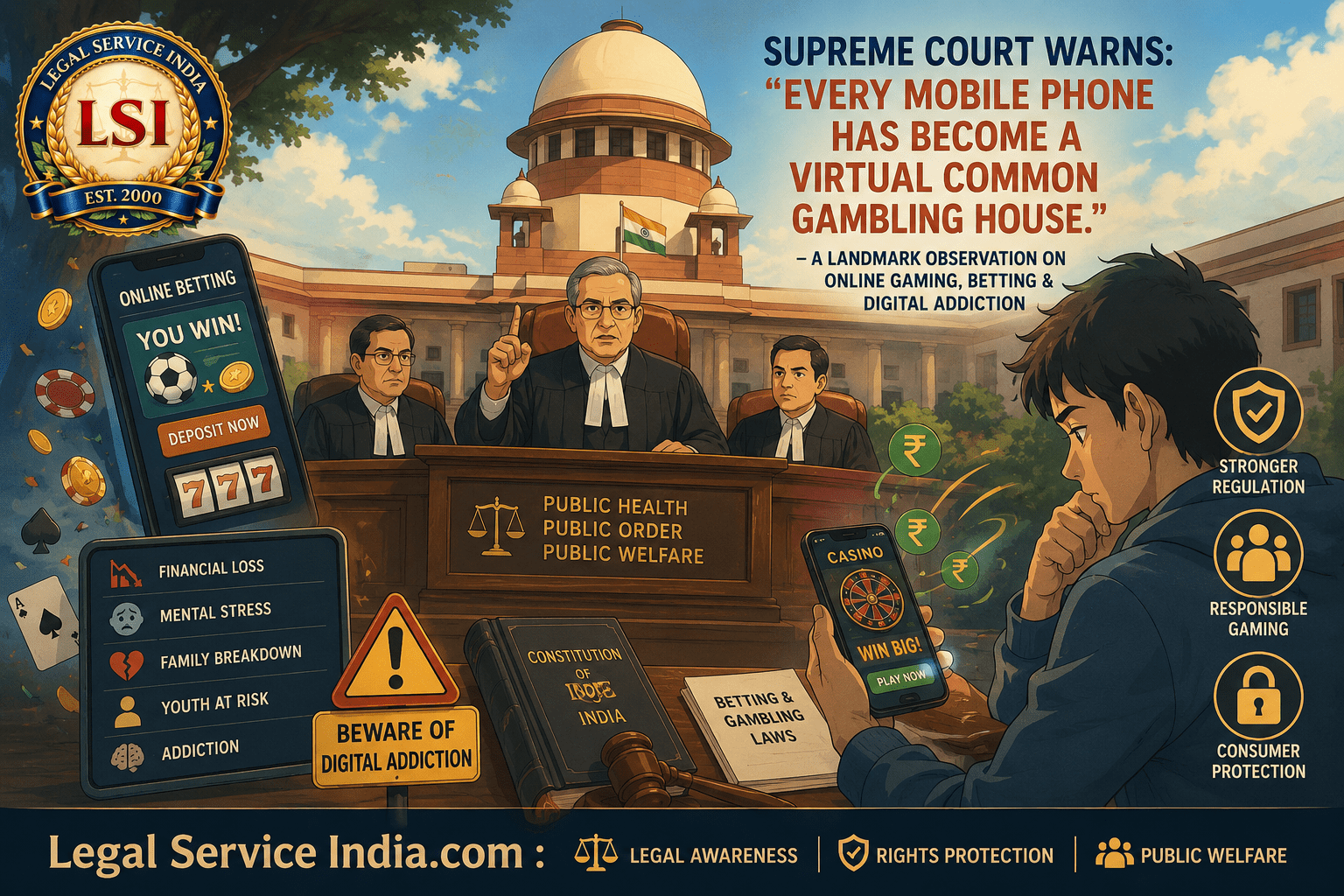
Every Mobile Phone Has Become a ‘Virtual Gambling House’: Supreme Court’s Landmark Warning on Online Gaming, Betting and Digital Addiction
Introduction
India’s rapidly expanding online gaming and betting ecosystem has received one of its most significant judicial examinations in recent years. In a powerful observation that is likely to influence future legislation, regulatory policy, and judicial interpretation, the Supreme Court of India has remarked that technological developments have transformed every mobile phone into a “virtual common gambling house”.
The court further warned that the increasing prevalence of online betting and gambling poses a serious threat to public order, public tranquillity, and public health.
These observations come at a time when India is witnessing unprecedented growth in online gaming, fantasy sports, esports, betting applications, casino-style gaming platforms, and real-money gaming portals. Millions of Indians participate daily in activities involving monetary stakes through smartphones and digital payment systems. What was once confined to physical gambling establishments has now entered homes, schools, colleges, offices, and public spaces through mobile technology.
The Supreme Court’s observations therefore transcend the immediate dispute before it. They raise profound questions concerning constitutional law, public health, consumer protection, technology regulation, federal governance, and the social consequences of digital gambling.
This judgement may well become a defining moment in the evolution of India’s online gaming jurisprudence. Citation: State of Tamil Nadu & Another v. Play Games 24×7 Private Limited & Others
The Observation That May Define India’s Digital Gambling Debate
The most striking aspect of the judgement is the court’s observation:
“Every mobile phone has become a virtual common gambling house.”
Few judicial observations in recent years have captured a contemporary social problem with such clarity.
Historically, gambling required a physical location—a casino, betting den, racecourse, card room, or gaming establishment. Today, however, a smartphone provides instant access to wagering opportunities around the clock.
- A user no longer needs to visit a gambling venue.
- The gambling venue now travels with the user.
The Court appears to have recognized that digital technology has fundamentally altered the scale, reach, and intensity of gambling activities. Online platforms operate continuously, employ sophisticated behavioural engagement techniques, and permit instant financial transactions. Consequently, gambling has become more accessible, more frequent, and more difficult to regulate than ever before.
Understanding the Constitutional Framework
A proper understanding of the judgement requires an examination of the constitutional position regarding gambling activities.
Unlike ordinary commercial businesses, gambling has historically occupied a special position in Indian constitutional jurisprudence.
The Supreme Court has repeatedly held that gambling activities do not enjoy the same level of constitutional protection as legitimate trade and commerce under Article 19(1)(g) of the Constitution.
The State possesses wide powers to regulate, restrict, or prohibit gambling activities in the interests of:
- Public order;
- Morality;
- Public health;
- Social welfare.
The constitutional basis for such regulation is found not only in judicial precedent but also in the Seventh Schedule of the Constitution.
State List Entries
| Constitutional Entry | Subject Matter |
|---|---|
| Entry 34 | Betting and Gambling |
| Entry 62 | Taxation concerning betting and gambling activities |
Consequently, state legislatures possess substantial authority to regulate gambling within their territories.
The present judgement reinforces this constitutional position and signals judicial willingness to uphold robust regulatory measures where public interest demands intervention.
Public Health: The Most Important Aspect of the Judgment
Perhaps the most significant contribution of this judgement is the Court’s recognition of online gambling and betting as a public health concern.
This represents an important shift in legal discourse.
For decades, gambling regulation was primarily justified on grounds of morality or public order. The Supreme Court has now expanded the debate by expressly linking online gambling with public health concerns.
This approach aligns Indian jurisprudence with emerging global regulatory trends.
Medical literature increasingly recognises gambling addiction as a behavioural disorder capable of producing consequences comparable to substance addiction.
Financial Ruin
Individuals often suffer devastating financial losses through repeated wagering behaviour.
Many users borrow money, liquidate savings, mortgage assets, or accumulate debt in pursuit of losses.
Mental Health Disorders
Research has repeatedly linked gambling addiction with the following:
- Depression;
- Anxiety;
- Stress disorders;
- Sleep disturbances;
- Social isolation;
- Suicidal ideation.
Family Breakdown
Compulsive gambling frequently produces:
- Marital discord;
- Domestic violence;
- Financial insecurity;
- Emotional neglect;
- Breakdown of family relationships.
Impact on Youth
Young adults and students represent one of the most vulnerable categories.
Aggressive online advertisements frequently portray betting as entertainment, skill development, or a pathway to financial success.
The court appears conscious of the growing influence of such narratives on impressionable users.
The Skill Versus Chance Debate
No discussion of online gaming law is complete without addressing the longstanding distinction between games of skill and games of chance.
Indian courts have historically protected genuine games of skill.
Important Precedents Include
- State of Bombay v. R.M.D. Chamarbaugwala – The Supreme Court recognised the distinction between skill-based competitions and gambling activities.
- K.R. Lakshmanan v. State of Tamil Nadu – The Court held that horse racing constituted a game where skill predominated.
- Dr. K.R. Lakshmanan Case – The judgment became the foundation for the “predominance of skill” test that continues to influence gaming litigation.
Under existing jurisprudence:
- Games predominantly involving skill generally enjoy legal protection.
- Games predominantly involving chance may be treated as gambling.
However, the present judgement indicates that future courts may increasingly examine not only the theoretical nature of a game but also its actual social consequences.
“Is this game skill-based?”
to
“What societal harm is this platform causing?”
That shift could significantly alter future litigation.
Why This Judgment Matters for Fantasy Sports Platforms
Fantasy sports operators have relied heavily upon the skill-based gaming doctrine.
Several high courts have recognised fantasy sports as involving substantial skill.
However, the Supreme Court’s observations suggest that classification alone may no longer settle the debate.
Future Scrutiny May Focus Upon
- User losses;
- Addiction rates;
- Frequency of participation;
- Algorithmic inducement mechanisms;
- Advertising practices;
- Consumer disclosures;
- Financial vulnerability of users.
Consequently, even skill-based platforms may face enhanced regulatory obligations.
Online Rummy, Poker and Real-Money Gaming Platforms
- Online Rummy;
- Online Poker;
- Fantasy Sports;
- Prediction Platforms;
- Real-Money Gaming Applications;
- Casino-style Gaming Platforms.
Federalism Challenges in the Digital Era
Betting and gambling remain subjects within the State List. However, digital gaming platforms operate nationally and often globally.
Key Constitutional Questions
- Which state’s law applies?
- Can one state prohibit an activity available elsewhere?
- How should offshore operators be regulated?
- Can states effectively regulate global digital platforms?
Consumer Protection and Dark Patterns
Common Behavioural Engagement Techniques
- Reward loops;
- Near-miss mechanics;
- Time-sensitive incentives;
- Cashback offers;
- Continuous notifications;
- Loyalty rewards;
- Artificial scarcity techniques.
Possible Future Regulatory Measures
- Warning labels;
- Spending alerts;
- Self-exclusion mechanisms;
- Cooling-off periods;
- Loss notifications;
- Addiction-risk disclosures.
The Economic Dimension
- Employment generation;
- Technological innovation;
- Startup growth;
- Foreign investment;
- Tax revenues.
However, the judgement highlights a crucial principle:
Economic benefits cannot outweigh public welfare considerations.
Impact on Future Legislation
Possible Reforms May Include
- Licensing Systems – Uniform licensing requirements for operators.
- Age Verification – Mandatory verification systems preventing participation by minors.
- Spending Caps – Daily and monthly expenditure limits.
- Advertising Restrictions – Controls on celebrity endorsements and promotional campaigns.
- Responsible Gaming Measures – Mandatory intervention mechanisms for problem users.
- Data Transparency – Disclosure obligations concerning user behaviour and platform practices.
- Addiction Monitoring – Identification of vulnerable users and mandatory protective actions.
Future Litigation Trends
- Online gaming regulation;
- Fantasy sports legality;
- State gambling laws;
- Consumer protection claims;
- Addiction-related litigation;
- Data protection issues;
- Advertising regulations;
- Constitutional challenges to gaming statutes.
A Judicial Warning to the Digital Age
Viewed broadly, the judgement reflects the Supreme Court’s growing concern regarding technology-driven social harms.
The court appears to recognise that digital innovation, while beneficial, can also magnify risks in unprecedented ways.
A smartphone is not merely a communication device.
It is increasingly a platform for commerce, entertainment, social interaction, financial transactions, and, as the Court observed, potentially gambling activities.
Conclusion
The Supreme Court’s observation that “every mobile phone has become a virtual common gambling house” may prove to be one of the most influential judicial statements in India’s evolving digital regulatory landscape.
More importantly, the judgement marks a significant shift in legal thinking. The debate surrounding online gaming is no longer confined to the traditional distinction between skill and chance. The Court has expanded the discussion to include public health, consumer protection, addiction, social welfare, public order, and the responsibilities of technology-driven enterprises.
For policymakers, the judgment provides constitutional support for stronger regulation. For gaming operators, it signals heightened scrutiny and greater accountability. For consumers, it highlights the risks associated with unrestricted digital gambling. For lawyers and courts, it offers a new analytical framework that is likely to shape litigation for years to come.
As India’s online gaming industry continues to expand, the central question will no longer be whether technology can facilitate gaming activities. The real question will be whether law, regulation, and public policy can evolve quickly enough to protect society from the harms that such technology may create.
The Supreme Court has now made its position unmistakably clear: digital convenience cannot become a justification for digital exploitation. The protection of public health, public order, and public welfare remains a constitutional imperative, even in the age of smartphones, algorithms, and instant online wagering.
The long-term significance of this judgment lies not merely in its legal reasoning but in its recognition of a profound societal transformation. The Court has identified a challenge that legislators, regulators, industry stakeholders, and citizens can no longer afford to ignore.