





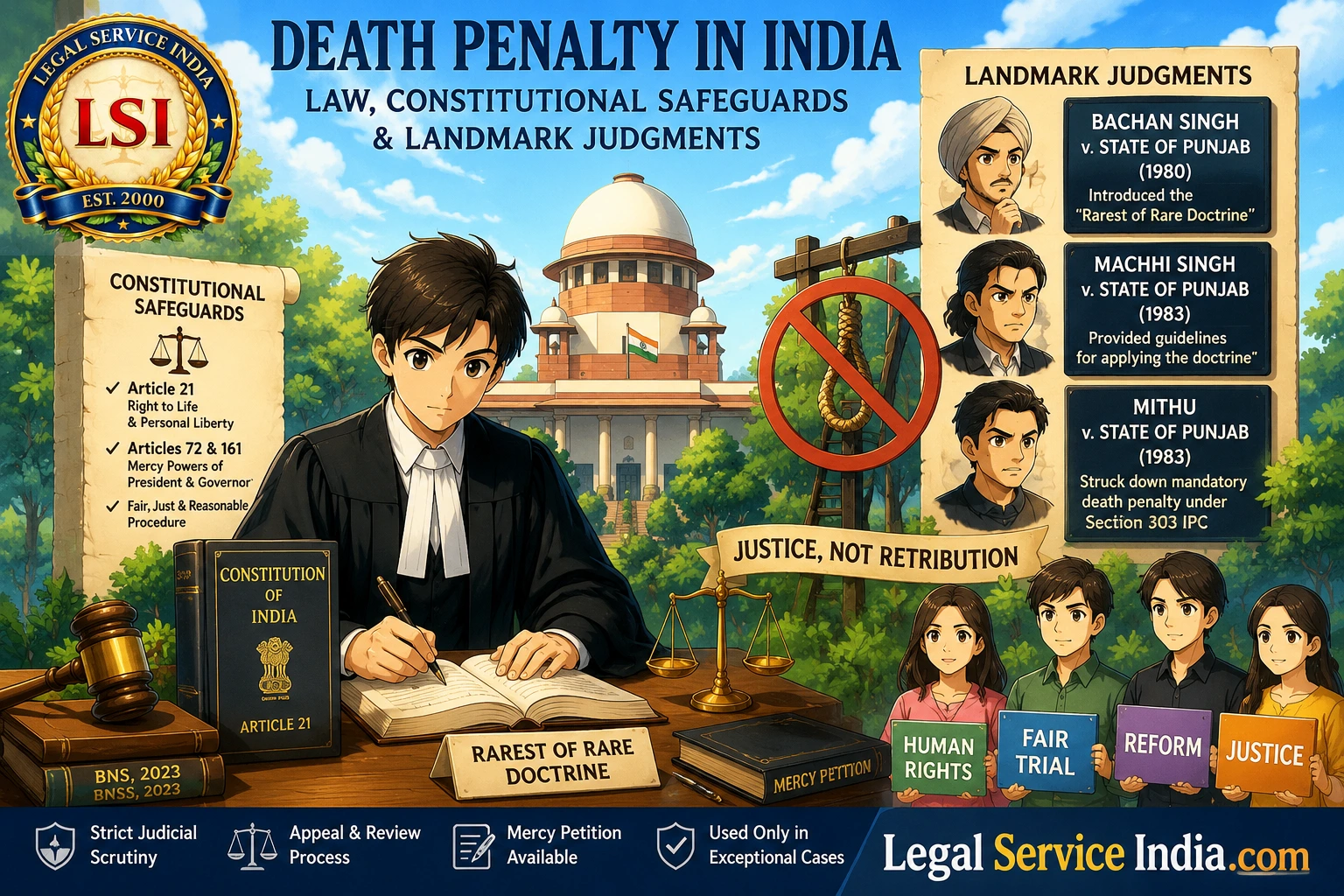
Introduction
The death penalty is one of the most debated punishments in the criminal justice system. In India, it is given only in the “rarest of rare” cases. The courts try to balance justice for victims with the protection of human rights.
Supporters believe that the death penalty punishes serious criminals and prevents others from committing similar crimes. Opponents argue that it is a cruel and irreversible punishment and may lead to the execution of innocent people.
This debate raises an important question: Should punishment focus on reforming offenders, or should it impose the highest punishment for the most serious crimes? Since the Indian Constitution protects the right to life under Article 21, the issue becomes even more significant.
This article discusses the laws, important court decisions, and ethical issues related to the death penalty in India. It also examines whether the death penalty provides justice or is simply a form of retribution.
Legal Provisions
Constitutional Provisions
Article 21
Article 21 of the Constitution guarantees the right to life and personal liberty. However, a person’s life can be taken according to a fair, just, and reasonable legal procedure.
Articles 72 and 161
These Articles provide powers of mercy:
- Article 72 gives the President of India the power to grant pardon, reprieve, remission, suspension, or commutation of sentences.
- Article 161 gives similar powers to the Governor of a State.
These powers act as safeguards against wrongful execution.
Bharatiya Nyaya Sanhita, 2023 (BNS)
The BNS provides the death penalty for certain serious offences, such as:
- Aggravated murder
- Terrorist acts causing death
- Certain offences against the State
- Repeat offenders in specific heinous crimes
- Gang rape of a minor in certain circumstances
Procedural Safeguards
Under the Bharatiya Nagarik Suraksha Sanhita, 2023 (BNSS):
- A death sentence given by a Sessions Court must be confirmed by the High Court.
- The accused has the right to appeal.
- Review and curative petitions can be filed before the Supreme Court.
- Mercy petitions can be submitted to the President or Governor.
Rarest of Rare Doctrine
In Bachan Singh v. State of Punjab (1980), the Supreme Court ruled that the death penalty should be awarded only in the “rarest of rare” cases, where life imprisonment is not sufficient.
Special Laws
Some special laws relating to terrorism and national security also provide for the death penalty when offences result in death or threaten the country’s sovereignty and integrity.
Thus, Indian law allows the death penalty but only after strict judicial scrutiny and procedural safeguards.
Summary of Legal Provisions
| Provision | Description |
|---|---|
| Article 21 | Protects the right to life and personal liberty subject to due process of law. |
| Article 72 | Provides mercy powers to the President of India. |
| Article 161 | Provides mercy powers to the Governor of a State. |
| BNS, 2023 | Prescribes death penalty for certain serious offences. |
| BNSS, 2023 | Provides procedural safeguards before execution. |
| Rarest of Rare Doctrine | Limits the use of the death penalty to exceptional cases. |
Important Cases
1. Bachan Singh v. State of Punjab (1980)
Facts
Bachan Singh was convicted of murder and sentenced to death. He challenged the constitutional validity of the death penalty.
Issue
Does the death penalty violate Articles 14, 19, and 21 of the Constitution?
Ruling
The Supreme Court upheld the validity of the death penalty by a 4:1 majority.
Judgment
The Court introduced the “Rarest of Rare Doctrine” and held that the death penalty should be imposed only in exceptional situations.
Significance
This case made life imprisonment the normal punishment and the death penalty an exception.
2. Machhi Singh v. State of Punjab (1983)
Facts
Machhi Singh and others murdered 17 people in a series of attacks due to a family dispute.
Issue
Did the case fall within the “rarest of rare” category?
Ruling
The Supreme Court upheld the death sentence.
Judgment
The Court explained the factors to be considered while awarding the death penalty, such as:
- Manner of committing the crime
- Motive
- Magnitude of the crime
- Impact on society
Significance
This case provided guidelines for applying the “rarest of rare” principle.
3. Mithu v. State of Punjab (1983)
Facts
Mithu, who was already serving a life sentence, was convicted of another murder. Section 303 of the IPC made the death penalty compulsory in such cases.
Issue
Was Section 303 IPC constitutional?
Ruling
The Supreme Court declared Section 303 unconstitutional.
Judgment
The Court held that a mandatory death sentence violates Articles 14 and 21 because judges must be allowed to consider the facts of each case.
Significance
The decision abolished mandatory death sentences and supported fair sentencing.
Important Cases at a Glance
| Case | Year | Key Principle |
|---|---|---|
| Bachan Singh v. State of Punjab | 1980 | Introduced the “Rarest of Rare Doctrine”. |
| Machhi Singh v. State of Punjab | 1983 | Provided guidelines for applying the doctrine. |
| Mithu v. State of Punjab | 1983 | Struck down mandatory death penalty under Section 303 IPC. |
Conclusion
The death penalty remains one of the most controversial punishments in India. Supporters believe it ensures justice and deters serious crimes, while opponents argue that it is inhumane and can result in irreversible mistakes.
Through important judgments such as Bachan Singh, Machhi Singh, and Mithu, the Supreme Court has limited the use of the death penalty by introducing the “rarest of rare” doctrine and ensuring strict procedural safeguards.
India continues to retain the death penalty, but it is used only in exceptional cases. The debate over whether it represents true justice or merely retribution continues and remains an important issue in Indian law and society.
Death Penalty in India – Law, Constitutional Safeguards, and Landmark Judgments
The death penalty in India remains one of the most debated aspects of criminal jurisprudence. While capital punishment continues to be legally recognized, the Indian judiciary has significantly restricted its application through constitutional safeguards and landmark judicial decisions. Today, the death penalty is reserved only for the “Rarest of Rare” cases, ensuring that it is imposed only in exceptional circumstances.
Death Penalty in India Is Reserved for the “Rarest of Rare” Cases
The Supreme Court of India has consistently held that capital punishment should be awarded only in exceptional situations where life imprisonment is considered inadequate. This principle ensures that the death sentence remains an extraordinary punishment rather than a routine sentencing option.
Article 21 and the Right to Life
Article 21 of the Constitution of India guarantees every person the right to life and personal liberty. However, the Constitution permits deprivation of life when it is carried out according to a procedure established by law that is fair, just, and reasonable. Consequently, the death penalty continues to be constitutionally valid under Indian law.
Multiple Safeguards Against Wrongful Execution
Indian criminal justice law incorporates several procedural protections to minimize the risk of wrongful execution.
- Mandatory confirmation of the death sentence by the High Court.
- Right to appeal before higher courts.
- Review petitions before the Supreme Court.
- Curative petitions in exceptional circumstances.
- Mercy petitions before the President of India or the Governor of a State.
These safeguards create multiple opportunities for judicial scrutiny before a death sentence can be carried out.
Presidential and Gubernatorial Clemency Powers
Articles 72 and 161 of the Constitution provide important constitutional safeguards against miscarriages of justice.
| Constitutional Provision | Authority | Power Granted |
|---|---|---|
| Article 72 | President of India | Pardon, reprieve, remission, suspension, or commutation |
| Article 161 | Governor of a State | Pardon, reprieve, remission, suspension, or commutation |
These powers act as an additional layer of protection in deserving cases.
Bharatiya Nyaya Sanhita (BNS), 2023 Retains Capital Punishment
The Bharatiya Nyaya Sanhita (BNS), 2023 continues to prescribe the death penalty for certain serious offences, including:
- Aggravated murder.
- Terrorist acts causing death.
- Certain offences against the State.
- Repeat heinous offenders.
- Specific cases involving gang rape of minors.
Landmark Supreme Court Judgments on Death Penalty
Bachan Singh v. State of Punjab (1980)
This landmark judgment transformed death penalty jurisprudence in India. The Supreme Court introduced the “Rarest of Rare Doctrine,” making life imprisonment the general rule and the death penalty the exception.
Machhi Singh v. State of Punjab (1983)
The Court clarified the factors that should be considered while deciding whether a case qualifies for capital punishment.
- Motive behind the crime.
- Manner of commission.
- Magnitude of the offence.
- Impact on society.
Mithu v. State of Punjab (1983)
This important decision struck down mandatory death sentences and emphasized that judges must retain discretion to consider the unique facts and circumstances of every case.
Judicial Scrutiny Is Central to Capital Punishment
Before imposing a death sentence, courts are required to carefully balance aggravating and mitigating factors. This individualized approach helps ensure fairness and prevents arbitrary sentencing.
Ongoing Debate: Justice vs. Retribution
The death penalty continues to generate intense public and legal debate.
| Arguments in Favour | Arguments Against |
|---|---|
| Acts as a deterrent to serious crimes. | Considered inhumane by many human rights advocates. |
| Provides justice for victims and society. | Irreversible in case of judicial errors. |
| Reflects societal condemnation of heinous crimes. | Risk of wrongful conviction remains. |
Human Rights and Criminal Justice Remain at the Core of the Discussion
The controversy surrounding capital punishment reflects the broader challenge of balancing public safety, justice for victims, and the protection of fundamental human rights. This tension continues to shape legal and policy discussions in India.
Conclusion
India retains the death penalty as a lawful punishment, but its use has been significantly restricted through constitutional safeguards and judicial precedents. Landmark decisions such as Bachan Singh v. State of Punjab, Machhi Singh v. State of Punjab, and Mithu v. State of Punjab have ensured that capital punishment remains confined to the “Rarest of Rare” cases, reinforcing the principles of fairness, justice, and due process.

