





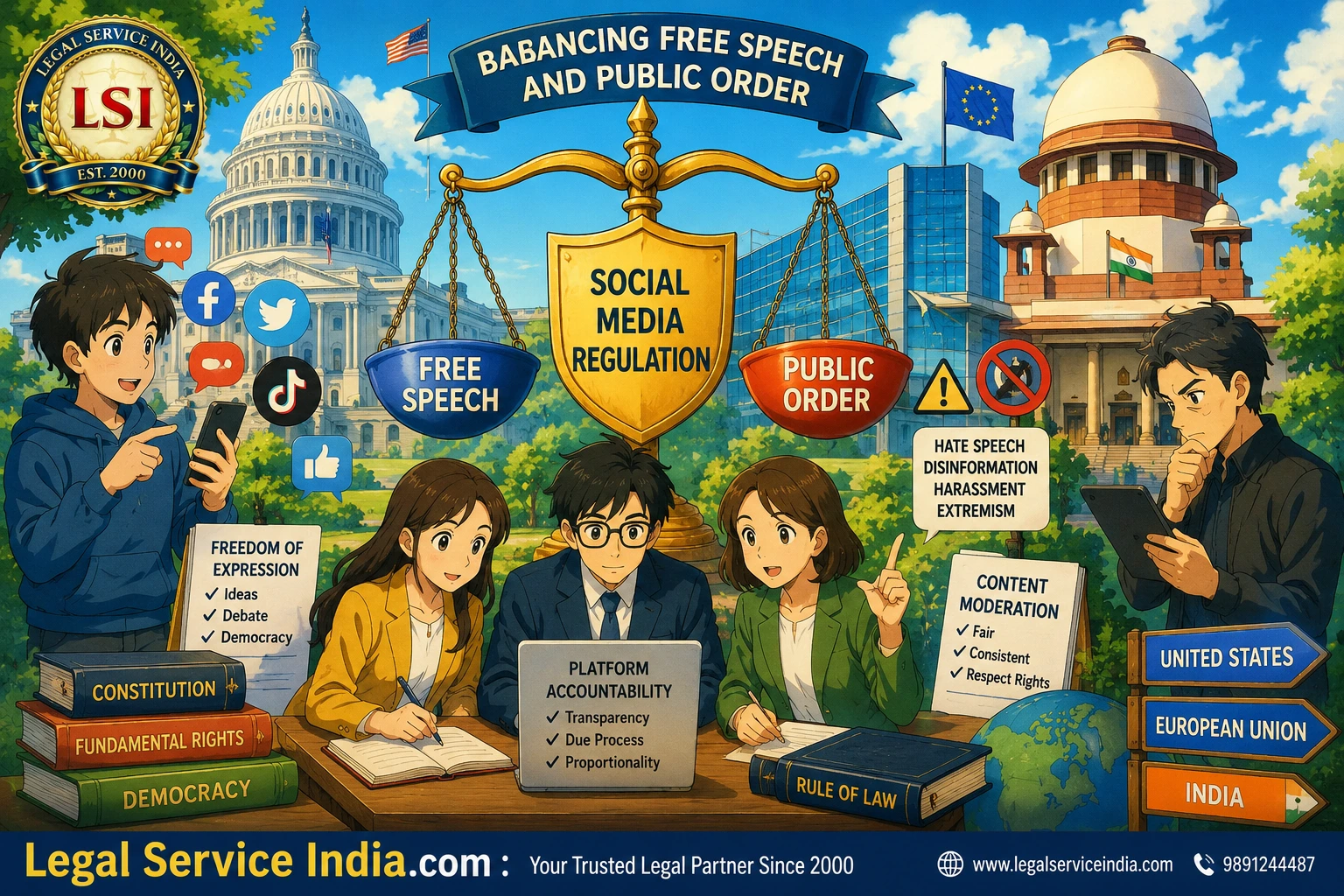
Abstract
The rapid proliferation of social media platforms has fundamentally transformed public discourse, creating unprecedented challenges for legal systems worldwide. This paper examines the tension between protecting free speech and maintaining public order in the context of social media regulation. Through a comparative analysis of regulatory frameworks in the United States, the European Union, and India, this study identifies the key legal, political, and technological dimensions of platform governance. The paper argues that effective regulation requires a multi-stakeholder approach that combines platform accountability, transparent content moderation, and robust due process protections. While no single model provides a universal solution, emerging frameworks suggest that proportionality principles and procedural safeguards can help reconcile competing interests without unduly restricting legitimate expression.
Introduction
Social media platforms have become the de facto public square of the twenty-first century. With over 4.9 billion social media users worldwide as of 2025, platforms such as Facebook, X (formerly Twitter), YouTube, and TikTok exercise enormous influence over public discourse, political mobilisation, and information dissemination. [1] This concentration of communicative power in private hands raises fundamental questions about the relationship between free expression, democratic governance, and social order.
The challenge of regulating social media lies at the intersection of competing values. On one hand, free speech constitutes a foundational right in democratic societies, enabling political participation, artistic expression, and the pursuit of truth through open debate. [2] On the other hand, unregulated online spaces can facilitate the spread of disinformation, hate speech, terrorism recruitment, and coordinated harassment—phenomena that threaten public order, social cohesion, and democratic institutions themselves. [3]
Structure of the Paper
This paper examines how different jurisdictions have attempted to navigate this tension. Part II provides a theoretical framework for understanding the competing interests at stake. Part III surveys the regulatory approaches adopted in the United States, the European Union, and India—three jurisdictions representing distinct legal traditions and political contexts. Part IV analyses the role of platform self-regulation and content moderation. Part V proposes principles for a balanced regulatory framework. Part VI concludes with recommendations for policymakers.
Paper Overview
| Part | Focus Area |
|---|---|
| Part II | Theoretical framework for balancing free speech and public order. |
| Part III | Comparative analysis of regulatory approaches in the United States, European Union, and India. |
| Part IV | Platform self-regulation and content moderation. |
| Part V | Principles for a balanced regulatory framework. |
| Part VI | Recommendations for policymakers. |
Theoretical Framework
The Free Speech Rationale
The philosophical justifications for free speech provide essential context for evaluating regulatory interventions. Three principal theories have shaped contemporary free speech jurisprudence.
The Marketplace of Ideas Theory
The marketplace of ideas theory, articulated most famously by Justice Oliver Wendell Holmes, posits that truth emerges through the competition of ideas in open discourse. [4] Under this view, government restrictions on speech are suspect because they distort the epistemic process by which society distinguishes truth from falsehood. Applied to social media, this theory counsels scepticism toward content-based regulation, suggesting that the remedy for harmful speech is more speech rather than enforced silence.
The Democratic Self-Governance Theory
The democratic self-governance theory emphasises free speech as a prerequisite for meaningful political participation. [5] Citizens cannot hold governments accountable or make informed electoral choices without access to diverse information and viewpoints. Social media’s role in facilitating political organising from the Arab Spring to contemporary protest movements illustrates this function. [6]
The Individual Autonomy Theory
The individual autonomy theory grounds free speech in human dignity and self-determination. [7] Expression is constitutive of personal identity and moral agency; restrictions therefore implicate fundamental interests beyond the instrumental value of speech to democratic processes.
Key Free Speech Theories at a Glance
| Theory | Core Principle | Relevance to Social Media Regulation |
|---|---|---|
| Marketplace of Ideas | Truth emerges through open competition of ideas. | Supports minimal government interference in online speech. |
| Democratic Self-Governance | Free speech enables informed political participation. | Protects political discourse and civic engagement on digital platforms. |
| Individual Autonomy | Expression is central to dignity and self-determination. | Recognises speech as an aspect of personal liberty beyond democratic utility. |
Key Takeaways
- Social media platforms have become central to modern democratic discourse.
- Regulating online speech requires balancing freedom of expression with public order.
- The paper compares regulatory approaches in the United States, European Union, and India.
- Three major philosophical theories continue to influence contemporary free speech jurisprudence.
- A balanced regulatory framework should protect legitimate expression while addressing harmful online content.
The Public Order Rationale
Against these free speech justifications stand countervailing concerns about public order and social harm. The concept of public order encompasses several distinct interests.
Physical Safety and Public Order
Physical safety represents the most uncontroversial limitation on speech. Incitement to imminent violence, true threats, and speech integral to criminal conduct receive diminished protection across legal systems. [8] Social media has been implicated in real-world violence, including ethnic cleansing in Myanmar, where Facebook served as a vector for anti-Rohingya propaganda. [9]
Democratic Integrity and Online Manipulation
Democratic integrity concerns focus on the ways online manipulation can undermine electoral processes. Foreign interference campaigns, coordinated inauthentic behaviour, and the algorithmic amplification of divisive content have prompted regulatory responses aimed at protecting democratic institutions. [10]
Social Cohesion and Hate Speech
Social cohesion rationales address the role of hate speech and discrimination in marginalising vulnerable groups. Unlike the American constitutional tradition, many democracies recognise that unchecked hatred can silence minority voices and undermine equal citizenship. [11]
Psychological Harm and Protection of Minors
Psychological harm, particularly to minors, has emerged as a significant concern. Research suggests correlations between social media use and adolescent mental health challenges, prompting calls for age-appropriate design requirements and content restrictions. [12]
Key Public Order Concerns
| Concern | Description |
|---|---|
| Physical Safety | Limits on speech involving incitement to imminent violence, true threats, and criminal conduct. |
| Democratic Integrity | Protection against foreign interference, coordinated manipulation, and algorithmic amplification of divisive content. |
| Social Cohesion | Addressing hate speech and discrimination that may marginalise vulnerable communities. |
| Psychological Harm | Safeguarding minors through age-appropriate design and content restrictions. |
The Platform Problem
Traditional free speech frameworks developed in contexts where the state was the primary threat to expression. Social media introduces a novel configuration: private platforms exercise quasi-governmental power over public discourse yet remain largely unconstrained by constitutional free speech guarantees. [13]
This creates what scholars have termed the “platform problem”, the question of “how to conceptualise and regulate the communicative power of digital intermediaries”. Platforms are simultaneously publishers, conduits, and architects of online discourse. [14] Their content moderation decisions shape what billions of users can see and say, yet these decisions operate according to private terms of service rather than public law.
Regulatory Challenges for Digital Platforms
The platform problem resists easy solutions. Treating platforms as common carriers would require them to host all lawful speech, potentially amplifying harmful content. Treating them as traditional publishers would expose them to liability for user-generated content, likely prompting over-censorship. The challenge for regulators is to find an intermediate position that promotes accountability without undermining either free expression or platform innovation.
Platform Regulation Options
- Common Carrier Approach: Requires platforms to host all lawful speech but may amplify harmful content.
- Publisher Liability Approach: Makes platforms responsible for user-generated content but risks over-censorship.
- Intermediate Regulatory Model: Seeks accountability while preserving both free expression and platform innovation.
III. Comparative Regulatory Approaches
Different jurisdictions have adopted distinct approaches to regulating digital platforms and online speech. The following comparison highlights the contrasting regulatory models followed by the United States and the European Union.
United States: The First Amendment Framework
The United States represents one pole of the regulatory spectrum, characterised by expansive free speech protections and limited platform liability. Two legal pillars define this approach.
The First Amendment prohibits government restrictions on speech based on content or viewpoint, subject to narrow exceptions for categories such as incitement, true threats, and obscenity. [15] This constitutional framework constrains direct government regulation of online expression. Proposals to mandate content removal or restrict lawful speech face significant constitutional obstacles, even when targeting harmful material such as disinformation or hate speech. [16]
Section 230 of the Communications Decency Act provides platforms with broad immunity from liability for user-generated content. [17] Enacted in 1996, Section 230 declares that “[n]o provider or user of an interactive computer service shall be treated as the publisher or speaker of any information provided by another information content provider.” [18] This immunity enabled the growth of user-generated content platforms by shielding them from the defamation and other liability risks that constrain traditional publishers.
Section 230 has faced mounting criticism from across the political spectrum. Conservative critics argue that platforms engage in politically biased content moderation while enjoying immunity premised on neutrality. [19] Progressive critics contend that immunity enables platforms to profit from harmful content without accountability. [20] Reform proposals have ranged from complete repeal to targeted amendments conditioning immunity on compliance with transparency requirements or reasonable content moderation practices. [21]
Despite these debates, the U.S. approach remains fundamentally permissive. Government-mandated content removal is largely unconstitutional absent narrow categorical exceptions. Platform content moderation is treated as protected editorial discretion. [22] The primary regulatory tools are transparency requirements, such as those proposed in various state laws, rather than substantive speech restrictions.
Key Features of the United States Framework
| Aspect | Approach |
|---|---|
| Constitutional Foundation | First Amendment free speech protections |
| Platform Liability | Broad immunity under Section 230 |
| Government Regulation | Limited due to constitutional restrictions |
| Content Moderation | Protected as editorial discretion |
| Primary Regulatory Tool | Transparency requirements rather than direct speech regulation |
European Union: The Digital Services Act Framework
The European Union has adopted a more interventionist approach, culminating in the Digital Services Act (DSA), which entered into full application in February 2024. [23] The DSA establishes a comprehensive regulatory framework for digital intermediaries, with escalating obligations based on platform size and risk.
The DSA’s core innovation is its systemic risk framework for very large online platforms (VLOPs) and search engines reaching more than 45 million monthly active users in the EU. [24] These entities must conduct annual risk assessments examining how their services may contribute to:
- The dissemination of illegal content
- Negative effects on fundamental rights
- Negative effects on civic discourse and electoral processes
- Negative effects on public security
- Negative effects on gender-based violence and minors’ wellbeing
Based on these assessments, VLOPs must implement reasonable, proportionate, and effective mitigation measures, subject to independent auditing.
The DSA also mandates transparency in content moderation. Platforms must publish detailed information about their moderation practices, including the use of automated tools. Users who have content removed or accounts restricted must receive clear explanations and access to internal complaint mechanisms and out-of-court dispute resolution.
Notably, the DSA does not harmonise substantive standards for illegal content, which remain determined by member state law. However, it creates a “notice and action” framework requiring platforms to expeditiously address notified illegal content. Trusted flagger entities with demonstrated expertise receive priority treatment for their notices.
Enforcement rests with national digital services coordinators, with the European Commission exercising direct supervision over VLOPs. Penalties for non-compliance can reach up to six per cent of global annual turnover.
The DSA reflects the EU’s commitment to balancing free expression with other fundamental rights, including human dignity and non-discrimination. Critics worry that the framework may incentivise over-removal and create compliance burdens that disadvantage smaller platforms. [25] Supporters argue that systemic accountability is necessary to address the scale of online harms.
Key Features of the Digital Services Act
| Aspect | Digital Services Act (DSA) |
|---|---|
| Regulatory Model | Interventionist and risk-based |
| Primary Focus | Systemic accountability of digital platforms |
| Platforms Covered | Digital intermediaries, with additional obligations for VLOPs |
| Transparency | Mandatory reporting and explanation of moderation decisions |
| User Rights | Complaint mechanisms and dispute resolution |
| Risk Assessment | Annual assessments for systemic risks |
| Enforcement | National Digital Services Coordinators and European Commission |
| Maximum Penalty | Up to six percent of global annual turnover |
Comparison: United States vs. European Union
| Issue | United States | European Union |
|---|---|---|
| Speech Protection | Strong First Amendment protections | Balanced with competing fundamental rights |
| Platform Liability | Broad immunity under Section 230 | Conditional obligations under the DSA |
| Content Moderation | Editorial discretion protected | Subject to transparency and accountability obligations |
| Government Intervention | Limited | Extensive regulatory oversight |
| Regulatory Philosophy | Permissive | Risk-based and interventionist |
India: The Information Technology Rules Framework
India presents a distinct regulatory trajectory shaped by its constitutional framework, digital growth, and political context. The Information Technology (Intermediary Guidelines and Digital Media Ethics Code) Rules, 2021 (IT Rules), established sweeping obligations for social media platforms.
Traceability Requirement for Social Media Platforms
The IT Rules impose a traceability requirement on significant social media intermediaries (those with more than five million users), mandating that they identify the “first originator” of information upon government request.
This provision has generated substantial controversy, as it would require platforms to break end-to-end encryption or redesign their architectures to enable message tracing.
Critics argue that traceability chills free expression and threatens privacy, particularly for journalists and activists. The government contends it is necessary to combat viral disinformation and coordinate investigation of serious crimes.
| Key Requirement | Description |
|---|---|
| Applicability | Significant social media intermediaries with more than five million users. |
| Obligation | Identify the “first originator” of information upon government request. |
| Major Concern | Potential impact on end-to-end encryption, privacy, and freedom of expression. |
Mandatory Local Compliance Officers
Platforms must also appoint local compliance officers, including:
- Chief Compliance Officer
- Nodal Contact Person
- Resident Grievance Officer
All of whom must be resident in India.
This requirement enables government access to platform personnel and has been criticised for exposing employees to legal pressure.
Government Content Removal Powers
The IT Rules grant the government authority to order content removal and require platforms to comply within 36 hours for certain categories of content.
An emergency provision permits removal orders to take effect before any reasoned order is issued, raising due process concerns.
| Provision | Requirement | Concern Raised |
|---|---|---|
| Standard Removal Orders | Compliance within 36 hours | Limited response time |
| Emergency Orders | Immediate removal before reasoned order | Due process concerns |
2023 Fact Check Unit Amendments
Additional amendments in 2023 established a governmental fact-check unit with authority to identify “fake or false or misleading” information related to government business, which platforms must expeditiously remove.
This provision faced immediate legal challenge on grounds that it constitutes an unconstitutional prior restraint and lacks adequate procedural safeguards. [26]
Growing State Control Over Online Speech
India’s approach reflects a broader trend toward assertive state control over online speech, justified by reference to public order and national security.
Human rights organisations have expressed concern that the framework enables censorship of legitimate dissent and criticism.
Platform Self-Regulation and Content Moderation
The Architecture of Content Moderation
Beyond government regulation, platforms engage in extensive private content moderation governed by terms of service and community standards.
Understanding this architecture is essential for evaluating regulatory interventions.
Content moderation operates through three principal mechanisms.
- Rules articulated in community standards define prohibited content categories such as hate speech, violence, and misinformation.
- Detection systems combining automated classifiers, user reports, and human review identify potentially violating content.
- Enforcement applies graduated sanctions ranging from content removal and account suspension to permanent bans.
The scale of content moderation is staggering. [27] Meta reports removing billions of pieces of content annually across its platforms, with automated systems responsible for the vast majority of enforcement actions.
This industrialised moderation necessarily involves trade-offs between speed, accuracy, and consistency.
| Content Moderation Stage | Primary Function |
|---|---|
| Community Standards | Define prohibited categories of content. |
| Detection | Use AI, user reports, and human review to identify violations. |
| Enforcement | Apply sanctions ranging from removal to permanent bans. |
Challenges and Criticisms
Platform content moderation faces several structural challenges that regulation must address.
Opacity in Platform Decision-Making
Opacity characterises platform decision-making.
Despite recent transparency reports, platforms disclose limited information about their moderation policies, algorithmic systems, and enforcement patterns.
Independent researchers struggle to access data necessary for public-interest analysis.
Inconsistency in Enforcement
Inconsistency plagues enforcement.
Studies document significant variation in how platforms apply their stated policies across languages, regions, and user categories.
High-profile users often receive differential treatment through systems like Meta’s now-reformed “Cross Check” programme.
Due Process Deficits
Due process deficits affect users subject to enforcement.
While platforms have developed internal appeals processes, users frequently report difficulties understanding why content was removed and obtaining meaningful review.
The volume of moderation decisions makes individualised human review impractical at scale.
Commercial Incentives and Platform Behaviour
Commercial incentives shape platform behaviour in ways that may diverge from public interest.
- Engagement-optimising algorithms may amplify divisive or sensational content regardless of its social impact.
- Platforms face economic pressure to retain users.
- Platforms also seek to avoid advertiser backlash rather than to maximise speech values or democratic quality.
The Oversight Board Model
Meta’s Oversight Board represents an innovative experiment in quasi-independent review of content moderation decisions. Established in 2020, the Board comprises independent experts empowered to review and reverse Meta’s content decisions in specific cases and to issue policy recommendations.
Major Decisions and Policy Impact
The Board’s decisions have addressed significant issues, including the indefinite suspension of former President Donald Trump, COVID-19 misinformation policies, and the application of hate speech rules across diverse cultural contexts. Its recommendations have prompted policy changes, though implementation remains uneven.
| Key Area | Overview |
|---|---|
| Purpose | Independent review of selected content moderation decisions. |
| Authority | Can review and reverse specific Meta content decisions and issue policy recommendations. |
| Notable Cases | Donald Trump suspension, COVID-19 misinformation, and hate speech across different cultural contexts. |
| Impact | Recommendations have influenced policy changes, although implementation remains uneven. |
Criticisms and Support
Critics question whether the board provides meaningful accountability given its limited case selection capacity and advisory-only policy recommendations. Supporters view it as a valuable precedent for introducing external oversight and human rights reasoning into platform governance.
Toward a Balanced Regulatory Framework
Drawing on the comparative analysis above, this Part proposes principles for regulation that takes seriously both free expression and public order concerns.
Procedural Over Substantive Regulation
Given the diversity of speech norms across democratic societies and the risks of government content control, regulation should prioritise procedural requirements over substantive mandates. Rather than dictating what speech platforms must remove, regulators should focus on how platforms make and implement content decisions.
Key procedural requirements include the following:
- Transparency about content policies, automated systems, and enforcement statistics
- Notice and explanation to users whose content is removed or accounts restricted
- Appeals mechanisms providing meaningful human review
- External auditing of moderation systems and outcomes
- Researcher access to platform data for public-interest research
This approach enables accountability without requiring government definitions of permissible speech. It accommodates variation in platform policies while ensuring that private speech governance operates with appropriate safeguards.
Why Procedural Regulation Matters
| Procedural Measure | Purpose |
|---|---|
| Transparency | Improves public understanding of moderation practices. |
| User Notice | Ensures affected users receive explanations for moderation decisions. |
| Appeals Process | Provides meaningful human review of disputed decisions. |
| External Auditing | Promotes accountability and independent assessment. |
| Research Access | Supports public-interest research and evidence-based policymaking. |
Proportionality Principles
Where substantive regulation is necessary for categories such as child sexual abuse material, terrorism content, or illegal hate speech under applicable law, enforcement should adhere to proportionality principles.
The European Court of Human Rights has developed proportionality analysis requiring that speech restrictions:
- Pursue a legitimate aim
- Be prescribed by law with adequate precision
- Be necessary in a democratic society
- Be proportionate to the aim pursued [28]
Applied to social media regulation, proportionality counsels against overbroad content mandates, short removal timelines that prevent adequate review, and penalties that incentivise over-censorship. Graduated enforcement, prioritising prominent and viral content, for example, can address the most significant harms while reducing collateral restrictions on lawful speech. [29]
Core Elements of Proportionality
| Principle | Application to Social Media Regulation |
|---|---|
| Legitimate Aim | Restrictions should pursue a lawful and justified public objective. |
| Legal Precision | Rules should be clearly prescribed by law. |
| Necessity | Restrictions should be necessary in a democratic society. |
| Proportionality | Measures should not exceed what is required to achieve the intended objective. |
| Graduated Enforcement | Prioritise high-impact and viral content while minimising restrictions on lawful speech. |
Multi-Stakeholder Governance
Effective platform governance requires input from multiple stakeholders beyond governments and platforms themselves. Civil society organisations bring expertise on human rights impacts and vulnerable communities. Academic researchers provide independent analysis of platform effects. Technical standards bodies can develop implementation frameworks. International coordination helps avoid regulatory fragmentation and jurisdiction shopping.
Key Stakeholders in Platform Governance
| Stakeholder | Primary Contribution |
|---|---|
| Civil Society Organizations | Expertise on human rights impacts and protection of vulnerable communities. |
| Academic Researchers | Independent analysis of platform effects and evidence-based policy recommendations. |
| Technical Standards Bodies | Development of practical implementation frameworks and technical standards. |
| International Institutions | Coordination to reduce regulatory fragmentation and jurisdiction shopping. |
The Global Network Initiative and similar multi-stakeholder efforts provide models for collaborative governance, though their voluntary nature limits effectiveness. Regulatory frameworks should create incentives for meaningful stakeholder engagement rather than relying solely on government-platform dynamics.
Why Multi-Stakeholder Governance Matters
- Promotes balanced and inclusive decision-making.
- Protects human rights and vulnerable communities.
- Encourages evidence-based policymaking.
- Supports technical consistency across jurisdictions.
- Reduces regulatory fragmentation through international cooperation.
Addressing Algorithmic Amplification
Content moderation has focused primarily on removal of violating content. However, algorithmic amplification and the role of recommendation systems in determining content visibility may be equally consequential for public discourse.
Regulation should address amplification separately from hosting. Requiring platforms to remove illegal content differs from requiring them to promote it algorithmically. Transparency requirements should extend to recommendation systems, and users should have meaningful control over the algorithms that shape their information environment.
Key Principles for Algorithmic Regulation
- Differentiate content hosting from algorithmic promotion.
- Increase transparency in recommendation systems.
- Provide users with meaningful control over algorithmic recommendations.
- Promote accountability without undermining freedom of expression.
Conclusion
The regulation of social media platforms presents one of the defining governance challenges of our time. The platforms that host public discourse wield unprecedented influence over democratic participation, social cohesion, and individual expression. Yet regulating these private actors implicates foundational commitments to free speech that democratic societies must not abandon.
This paper has argued that effective regulation requires moving beyond the simple dichotomy of speech freedom versus speech control. The comparative analysis reveals that different democracies have struck different balances, reflecting their distinct constitutional traditions and political contexts. None has achieved an ideal equilibrium.
Core Principles of the Proposed Framework
- Procedural accountability.
- Proportionality.
- Multi-stakeholder governance.
- Attention to algorithmic amplification.
The framework proposed here emphasises procedural accountability, proportionality, multi-stakeholder governance, and attention to algorithmic amplification. These principles do not resolve all tensions; hard cases will remain, but they provide a foundation for regulation that takes seriously both the value of free expression and the reality of online harms.
Ultimately, the governance of online speech is not merely a technical or legal problem but a political one. It requires democratic deliberation about the kind of public discourse we wish to have and the role of both public and private power in shaping it. As social media continues to evolve with emerging challenges from artificial intelligence, immersive technologies, and shifting geopolitical dynamics, this deliberation must be ongoing.
Key Takeaways
- Effective social media regulation must balance free speech with protection against online harms.
- Different democratic systems adopt different regulatory approaches based on constitutional and political traditions.
- Procedural accountability and transparency are essential for legitimate platform governance.
- Algorithmic amplification requires separate regulatory consideration from content hosting.
- Ongoing democratic deliberation is necessary as technology and digital communication continue to evolve.
End Notes
- DataReportal, Digital 2025: Global Overview Report (January 2025).
URL: https://datareportal.com/reports/digital-2025-global-overview-report - John Stuart Mill, On Liberty (1859); Alexander Meiklejohn, Free Speech and Its Relation to Self-Government (1948).
- UN Special Rapporteur on Freedom of Opinion and Expression, Report on Online Content Moderation, A/HRC/38/35 (2018).
URL: https://undocs.org/A/HRC/38/35 - Abrams v. United States, 250 U.S. 616, 630 (1919) (Holmes, J., dissenting).
- Alexander Meiklejohn, “The First Amendment Is an Absolute,” Supreme Court Review (1961): 245–266.
- Zeynep Tufekci, Twitter and Tear Gas: The Power and Fragility of Networked Protest (2017).
- C. Edwin Baker, Human Liberty and Freedom of Speech (1989).
- Brandenburg v. Ohio, 395 U.S. 444 (1969); Virginia v. Black, 538 U.S. 343 (2003).
- UN Human Rights Council, Report of the Independent International Fact-Finding Mission on Myanmar, A/HRC/39/64 (2018).
URL: https://undocs.org/A/HRC/39/64 - Renée DiResta et al., The Tactics and Tropes of the Internet Research Agency, U.S. Senate Select Committee on Intelligence (2019).
- Jeremy Waldron, The Harm in Hate Speech (2012).
- Jonathan Haidt & Jean Twenge, “Adolescent Mood Disorders Since 2010: A Collaborative Review” (unpublished manuscript, 2023); U.S. Surgeon General, Social Media and Youth Mental Health (2023).
URL: https://www.hhs.gov/surgeongeneral/priorities/youth-mental-health/social-media/index.html - Kate Klonick, “The New Governors: The People, Rules, and Processes Governing Online Speech,” Harvard Law Review 131 (2018): 1598–1670.
- Tarleton Gillespie, Custodians of the Internet: Platforms, Content Moderation, and the Hidden Decisions That Shape Social Media (2018).
- United States v. Stevens, 559 U.S. 460 (2010).
- Genevieve Lakier, “The Non-First Amendment Law of Freedom of Speech,” Harvard Law Review 134 (2021): 2299–2372.
- 47 U.S.C. § 230.
URL: https://www.law.cornell.edu/uscode/text/47/230 - 47 U.S.C. § 230(c)(1).
URL: https://www.law.cornell.edu/uscode/text/47/230 - Clarence Thomas, concurring in Biden v. Knight First Amendment Institute, 141 S. Ct. 1220 (2021).
- Danielle Citron & Benjamin Wittes, “The Internet Will Not Break: Denying Bad Samaritans Section 230 Immunity,” Fordham Law Review 86 (2017): 401–423.
- See, e.g., PACT Act, S. 797, 117th Congress (2021); EARN IT Act, S. 3538, 116th Congress (2020).
- Moody v. NetChoice, 603 U.S. ___ (2024).
- Regulation (EU) 2022/2065 of the European Parliament and of the Council of 19 October 2022 on a Single Market for Digital Services (Digital Services Act).
URL: https://eur-lex.europa.eu/eli/reg/2022/2065/oj - Digital Services Act (DSA), Article 33.
URL: https://eur-lex.europa.eu/eli/reg/2022/2065/oj - Jacob Mchangama & Natalie Alkiviadou, “The Digital Berlin Wall: How the EU’s Digital Services Act Threatens Global Free Speech” (Justitia, 2023).
- Kunal Kamra v. Union of India, W.P. (C) 4541/2023 (Bombay High Court); stay granted pending final adjudication.
- Meta, Community Standards Enforcement Report (Q4 2024).
URL: https://transparency.meta.com/reports/community-standards-enforcement/ - Handyside v. United Kingdom, App. No. 5493/72, Eur. Ct. H.R. (1976); Delfi AS v. Estonia, App. No. 64569/09, Eur. Ct. H.R. (2015).
- Evelyn Douek, “Content Moderation as Systems Thinking,” Harvard Law Review 136 (2022): 526–607.
Bibliography
Primary Sources
Legislation and Regulations
- Communications Decency Act of 1996, 47 U.S.C. § 230.
- Information Technology (Intermediary Guidelines and Digital Media Ethics Code) Rules, 2021, Gazette of India.
- Regulation (EU) 2022/2065 on a Single Market for Digital Services (Digital Services Act).
Case Law
- Abrams v. United States, 250 U.S. 616 (1919).
- Brandenburg v. Ohio, 395 U.S. 444 (1969).
- Delfi AS v. Estonia, App. No. 64569/09, Eur. Ct. H.R. (2015).
- Handyside v. United Kingdom, App. No. 5493/72, Eur. Ct. H.R. (1976).
- Moody v. NetChoice, 603 U.S. ___ (2024).
Secondary Sources
Books
- Baker, C. Edwin. Human Liberty and Freedom of Speech. New York: Oxford University Press, 1989.
- Gillespie, Tarleton. Custodians of the Internet: Platforms, Content Moderation, and the Hidden Decisions That Shape Social Media. New Haven: Yale University Press, 2018.
- Mill, John Stuart. On Liberty. London: John W. Parker and Son, 1859.
- Roberts, Sarah T. Behind the Screen: Content Moderation in the Shadows of Social Media. New Haven: Yale University Press, 2019.
- Tufekci, Zeynep. Twitter and Tear Gas: The Power and Fragility of Networked Protest. New Haven: Yale University Press, 2017.
- Waldron, Jeremy. The Harm in Hate Speech. Cambridge: Harvard University Press, 2012.
- Zuboff, Shoshana. The Age of Surveillance Capitalism. New York: PublicAffairs, 2019.
Journal Articles
- Citron, Danielle, and Benjamin Wittes. “The Internet Will Not Break: Denying Bad Samaritans Section 230 Immunity.” Fordham Law Review 86 (2017): 401–423.
- Douek, Evelyn. “Governing Online Speech: From ‘Posts-as-Trumps’ to Proportionality and Probability.” Columbia Law Review 121 (2021): 759–834.
- Klonick, Kate. “The New Governors: The People, Rules, and Processes Governing Online Speech.” Harvard Law Review 131 (2018): 1598–1670.
- Lakier, Genevieve. “The Non-First Amendment Law of Freedom of Speech.” Harvard Law Review 134 (2021): 2299–2372.
- Meiklejohn, Alexander. “The First Amendment Is an Absolute.” Supreme Court Review 1961: 245–266.
Key Takeaways
The following key takeaways summarise the article’s core findings on social media regulation, freedom of speech, digital platform governance, and content moderation.
| Topic | Key Insight |
|---|---|
| Free Speech & Public Order | Balancing freedom of expression with public safety remains the central challenge of social media regulation. |
| Comparative Regulation | The United States, European Union, and India follow different constitutional and regulatory approaches. |
| Platform Governance | Transparency, accountability, and procedural safeguards are essential for responsible platform governance. |
| Future Regulation | AI-driven technologies require adaptive, rights-based, and transparent legal frameworks. |
Core Findings on Social Media Regulation
- Social media regulation requires a careful balance between freedom of speech, public order, privacy, and platform accountability, ensuring that democratic values are protected without encouraging censorship.
- The article compares the United States’s, European Union’s, and India’s social media laws, highlighting how different constitutional traditions shape online speech regulation and digital governance.
- The United States prioritises strong First Amendment protections and Section 230 immunity, while the European Union’s Digital Services Act (DSA) emphasises transparency, systemic risk management, and platform accountability.
- India’s Information Technology (Intermediary Guidelines and Digital Media Ethics Code) Rules, 2021, impose significant compliance obligations on digital platforms, including traceability requirements, content removal mechanisms, and local grievance officers, raising important debates on privacy and free expression.
- The paper explains why platform content moderation should be transparent, consistent, and supported by due process, including user notifications, appeals, independent audits, and accountability mechanisms.
- A procedural approach to regulating online speech is more effective than excessive government control over content, helping protect legitimate expression while addressing illegal and harmful online activities.
- The article highlights the growing importance of algorithmic transparency, emphasising that recommendation systems and AI-driven content amplification significantly influence public discourse and democratic participation.
- Multi-stakeholder governance, involving governments, technology companies, civil society, academia, and independent experts, offers the most sustainable framework for regulating social media platforms.
- The study concludes that future digital platform regulation must combine transparency, proportionality, human rights safeguards, platform responsibility, and democratic oversight to effectively address misinformation, hate speech, online harms, and emerging AI-driven challenges.
- As artificial intelligence, recommendation algorithms, and immersive digital technologies continue to reshape online communication, policymakers must adopt flexible and rights-based regulatory frameworks that protect both innovation and freedom of expression.
Summary
In summary, the future of social media regulation lies not in choosing between free speech and public order but in creating transparent, accountable, and proportionate legal frameworks that safeguard democracy, human rights, and responsible digital governance in the AI era.

