





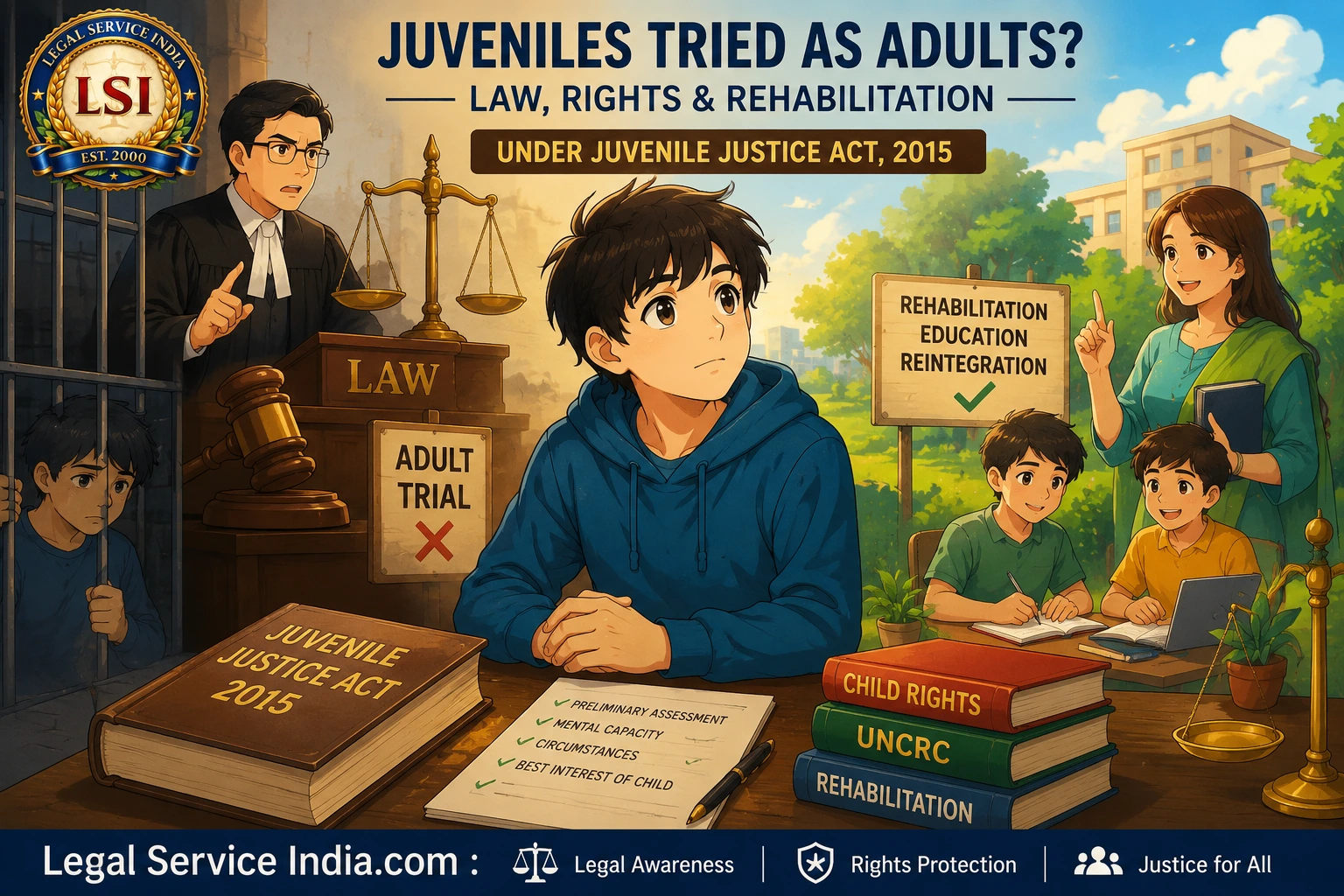
Introduction
The juvenile justice system is founded on the principle that children in conflict with the law should be treated differently from adults because of their age, mental maturity, and capacity for reform. International instruments such as the United Nations Convention on the Rights of the Child (UNCRC) emphasise rehabilitation rather than punishment.
However, rising concerns over serious crimes committed by adolescents led India to enact the Juvenile Justice (Care and Protection of Children) Act, 2015.
A significant feature of the Act is the provision allowing children aged 16–18 years accused of heinous offences to be tried as adults under certain circumstances. This provision has generated intense debate regarding its compatibility with child rights, constitutional principles, and international standards.
Legal Framework
The Juvenile Justice (Care and Protection of Children) Act, 2015, replaced the Juvenile Justice Act, 2000. The enactment was influenced by public concern following the 2012 Delhi gang rape, in which one of the accused was a juvenile.
Relevant Provisions
| Provision | Description |
|---|---|
| Section 2(33) | Defines “heinous offences” as offences punishable with a minimum imprisonment of seven years or more. |
| Section 15 | Empowers the Juvenile Justice Board (JJB) to conduct a preliminary assessment regarding: Mental and physical capacity of the child to commit the offence; Ability to understand consequences; circumstances in which the offence was committed. |
| Section 18(3) | Authorises transfer of the case to the Children’s Court if the child is found fit to be tried as an adult. |
| Section 19 | Empowers the Children’s Court to decide whether the child should be tried as an adult or dealt with under juvenile procedures. |
The Act therefore creates an exception to the traditional juvenile justice principle by permitting adult trials in certain serious cases.
Judicial Perspective and Case Law
1. Shilpa Mittal v. State (NCT of Delhi)
The Supreme Court interpreted the classification of offences under the JJ Act. It held that offences carrying a maximum sentence of more than seven years but without a prescribed minimum sentence do not fall within the category of “heinous offences”.
Significance: The judgement clarified ambiguities in offence classification and protected juveniles from arbitrary transfers to adult courts.
2. Dr Subramanian Swamy v. Raju
Although decided under the 2000 Act, the Court upheld the constitutional validity of treating all juveniles below 18 years differently from adults. The judgement emphasised reformative justice and acknowledged international obligations under the UNCRC.
Significance: The case reinforced the principle that juveniles possess diminished culpability and greater potential for rehabilitation.
3. Mukesh & Anr. v. State (NCT of Delhi)
The public reaction to this case significantly influenced legislative reforms leading to the 2015 Act. The involvement of a juvenile offender prompted demands for stricter treatment of adolescents committing heinous crimes.
Critical Analysis
The issue of trying juveniles as adults remains one of the most debated aspects of juvenile justice. While supporters emphasise public safety and accountability, critics highlight child rights, rehabilitation, and constitutional protections.
Arguments Supporting Adult Trials
| Ground | Analysis |
|---|---|
| A. Public Safety | Supporters argue that adolescents involved in heinous crimes pose serious threats to society and should face stricter accountability. |
| B. Deterrence | The possibility of adult prosecution may discourage juveniles from engaging in grave criminal conduct. |
| C. Recognition of Maturity | Modern adolescents have greater exposure to technology, media, and social awareness. Therefore, some may fully understand the consequences of their actions. |
Arguments Against Adult Trials
| Ground | Analysis |
|---|---|
| A. Violation of Child Rights | The UNCRC recognises every person below 18 years as a child. Adult trials may conflict with international child protection standards. |
| B. Subjectivity in Preliminary Assessment | Determining a juvenile’s mental capacity and understanding of consequences is inherently subjective and may produce inconsistent outcomes. |
| C. Neuroscientific Evidence | Research demonstrates that adolescent brains are still developing, particularly in areas governing impulse control, judgement, and risk assessment. |
| D. Reduced Rehabilitation Opportunities | Exposure to adult criminal procedures may stigmatise juveniles and undermine the rehabilitative objective of juvenile justice. |
Constitutional Concerns
Critics contend that adult trials may affect:
- Article 14 (Equality before Law);
- Article 21 (Right to Life and Personal Liberty);
- Principles of restorative and reformative justice recognised by Indian courts.
Comparative Analysis
The following table compares the approach adopted by various countries regarding the treatment of juveniles accused of serious offences.
| Country | Approach |
|---|---|
| India | Juveniles aged 16–18 accused of heinous offences may be tried as adults after assessment. |
| United Kingdom | Serious offences may result in trial before higher courts, but special protections remain available. |
| United States | Several states permit transfer of juveniles to adult courts for serious crimes. |
| Germany | Strong emphasis on rehabilitation; juvenile law may apply even to young adults aged 18–21. |
| Norway | Prioritises welfare and reintegration over punitive measures. |
The comparative study reveals that while some jurisdictions permit adult trials, many continue to prioritise rehabilitation and individualised treatment.
Suggestions and Recommendations
The following recommendations may help strengthen the juvenile justice system while balancing accountability with rehabilitation.
Strengthen Psychological Assessments
- Assessments should be conducted by qualified child psychologists and psychiatrists.
Develop Uniform Guidelines
- National standards should govern preliminary assessments to reduce subjectivity.
Enhance Rehabilitation Programs
- Educational, vocational, and psychological interventions should be expanded.
Periodic Judicial Review
- Decisions transferring juveniles to adult courts should be subject to rigorous appellate review.
Adopt Restorative Justice Models
- Victim-offender mediation and community-based rehabilitation should be encouraged where appropriate.
Compliance with International Standards
- Indian law should continue aligning with child-rights principles under the UNCRC.
Conclusion
The Juvenile Justice (Care and Protection of Children) Act, 2015, represents a significant shift in India’s juvenile justice policy by permitting the trial of certain juveniles as adults. While the provision seeks to balance public safety with accountability, it raises concerns regarding child rights, rehabilitation, and constitutional values. A careful and scientifically informed application of the law is necessary to ensure that justice is served without compromising the fundamental objective of juvenile justice—reformation and reintegration of children into society. The long-term success of the Act depends on maintaining an equilibrium between societal interests and the developmental needs of young offenders.
References
- Juvenile Justice (Care and Protection of Children) Act, 2015.
- Constitution of India.
- United Nations Convention on the Rights of the Child, 1989.
- Shilpa Mittal v. State (NCT of Delhi), (2020) 2 SCC 787.
- Dr Subramanian Swamy v. Raju, (2014) 8 SCC 390.
- Mukesh & Anr. v. State (NCT of Delhi), (2017) 6 SCC 1.
- M.P. Jain, Indian Constitutional Law, LexisNexis.
- V.N. Shukla, Constitution of India, Eastern Book Company.
- Barry C. Feld, The Evolution of the Juvenile Court.
- UNICEF Reports on Juvenile Justice and Child Rights.
Citation
Bluebook Citation
- Shilpa Mittal v. State (NCT of Delhi), (2020) 2 SCC 787.
- Dr Subramanian Swamy v. Raju, (2014) 8 SCC 390.
OSCOLA Citation
- Shilpa Mittal v State (NCT of Delhi) (2020) 2 SCC 787.
- Dr Subramanian Swamy v Raju (2014) 8 SCC 390.
Online Resources (Plain Text URLs)
- https://legislative.gov.in
- https://indiankanoon.org
- https://main.sci.gov.in
- https://www.unicef.org
- https://www.ohchr.org
Key Takeaways
The following key takeaways summarise the important legal, constitutional, and policy aspects of trying juveniles as adults under the Juvenile Justice (Care and Protection of Children) Act, 2015.
- The Juvenile Justice (Care and Protection of Children) Act, 2015, allows children aged 16–18 years accused of heinous offences to be tried as adults after a mandatory preliminary assessment by the Juvenile Justice Board.
- Section 15 requires the Juvenile Justice Board to evaluate the child’s mental and physical capacity, ability to understand the consequences of the offence, and the circumstances in which it was committed before deciding whether the case should be transferred to the Children’s Court.
- The Supreme Court in Shilpa Mittal v. State (NCT of Delhi) clarified the scope of “heinous offences”, ensuring that juveniles are not arbitrarily transferred for adult trials.
- The decision in Dr Subramanian Swamy v. Raju reaffirmed that juvenile justice is fundamentally based on reformation, rehabilitation, and reintegration, while recognising India’s obligations under the United Nations Convention on the Rights of the Child (UNCRC).
- The provision permitting adult trials seeks to balance public safety and accountability with the constitutional objective of protecting children’s rights and promoting rehabilitation.
- Critics argue that trying juveniles as adults may conflict with Article 14 (Equality before Law), Article 21 (Right to Life and Personal Liberty), and international child-rights standards because adolescents possess diminished maturity and greater potential for reform.
- Scientific research on adolescent brain development supports a cautious approach, as decision-making, impulse control, and risk assessment continue to develop during adolescence.
- Comparative legal systems demonstrate that while countries such as India, the United States, and the United Kingdom permit adult trials in limited circumstances, jurisdictions like Germany and Norway continue to prioritise rehabilitation and individualised treatment.
- Strengthening psychological assessments, adopting uniform national guidelines, expanding rehabilitation programmes, encouraging restorative justice, and ensuring periodic judicial review can improve the fairness and effectiveness of the juvenile justice system.
- The future of India’s juvenile justice framework depends on maintaining a careful balance between protecting society, ensuring accountability for serious offences, and preserving the core objective of juvenile justice—reforming and reintegrating children into society.
Quick Summary Table
| Topic | Key Takeaway |
|---|---|
| Adult Trial Provision | Children aged 16–18 years accused of heinous offences may be tried as adults after a preliminary assessment. |
| Section 15 | The Juvenile Justice Board evaluates mental capacity, understanding of consequences, and circumstances of the offence. |
| Supreme Court Guidance | Shilpa Mittal clarified the meaning of “heinous offences”, while Dr Subramanian Swamy emphasised rehabilitation. |
| Constitutional Issues | Concerns relate to Article 14, Article 21, child rights, and international standards. |
| Comparative Law | Several countries allow adult trials, whereas others continue to prioritise rehabilitation. |
| Way Forward | Better assessments, uniform guidelines, rehabilitation, restorative justice, and judicial review can strengthen the juvenile justice system. |

