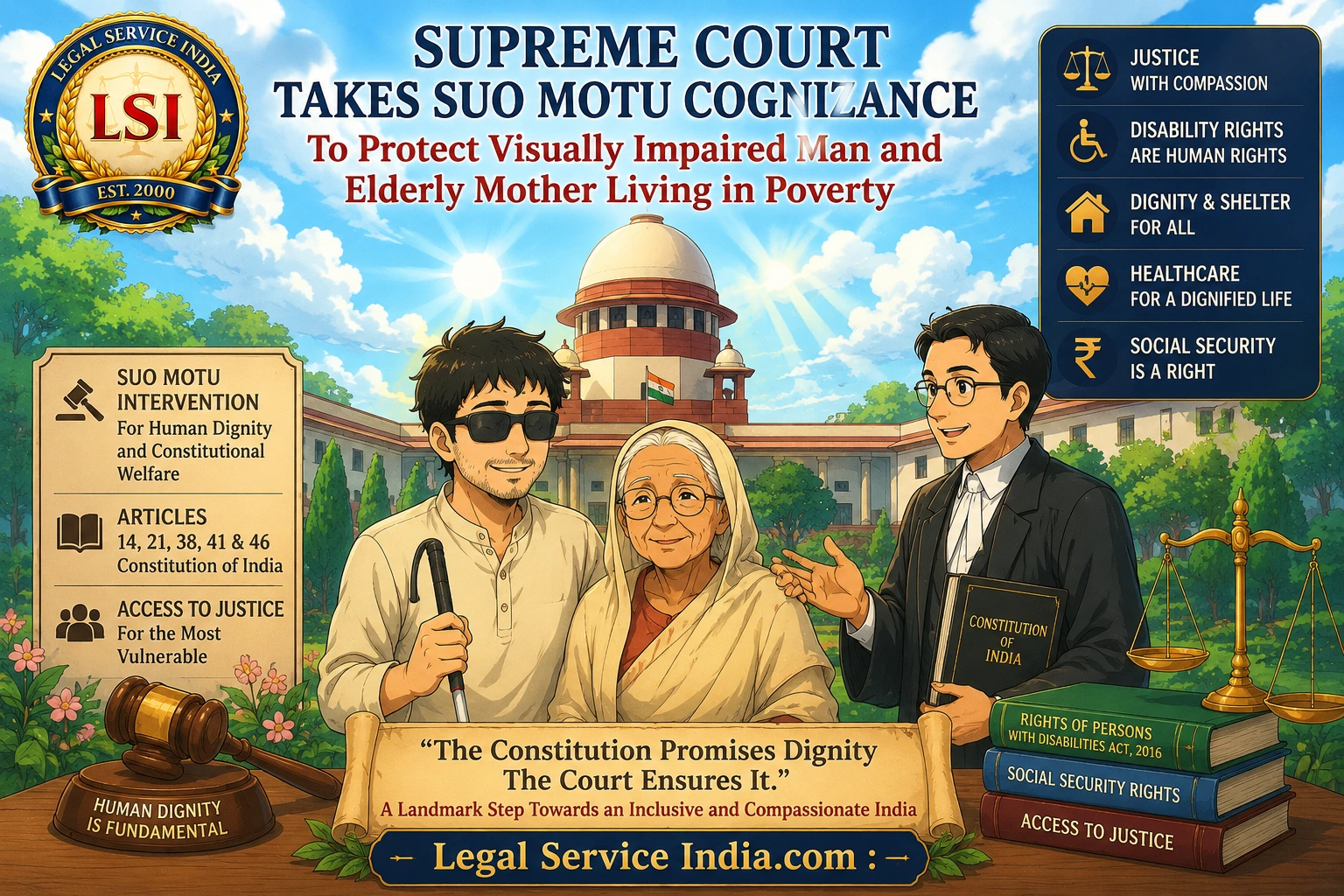
Supreme Court Takes Suo Motu Cognizance to Protect Visually Impaired Man and Elderly Mother Living in Poverty: A Landmark Reaffirmation of Dignity, Disability Rights, and Constitutional Welfare
Introduction
The true strength of a constitutional democracy is tested not when it protects the powerful, but when it safeguards those who have neither influence nor access to power.
In a remarkable exercise of its constitutional jurisdiction, the Supreme Court of India recently took suo motu cognisance of the plight of a visually impaired man and his elderly mother living in extreme poverty in Odisha. The case concerns Japa Bhue, blind since birth, and his approximately eighty-year-old mother Radhika Bhue, whose living conditions raised serious concerns regarding access to social security, disability benefits, housing, healthcare, and basic human dignity.
What began as a human-interest story has now evolved into a significant constitutional proceeding. By stepping in on its own motion, the Supreme Court has once again demonstrated that constitutional courts are not merely forums for dispute resolution but institutions entrusted with protecting the most vulnerable members of society.
The order is significant not only because it provides immediate relief to one family but also because it raises larger questions concerning disability rights, welfare governance, administrative accountability, access to justice, and the State’s constitutional obligation to ensure a dignified life for every citizen.
At a time when discussions on constitutional rights often revolve around high-profile political and commercial matters, this case serves as a powerful reminder that the Constitution’s promises are ultimately meant for ordinary citizens struggling on the margins of society.
Case Citation
| Case Title | In Re: Ensuring Basic Human Dignity and Social Security for Differently Abled Citizens Living in Extreme Poverty and Other Ancillary Issues |
|---|---|
| Case Number | Suo Motu Writ Petition (Civil) No. 18 of 2026 |
| Court | Supreme Court of India |
| Order Date | June 16, 2026 |
Citation: In Re: Ensuring Basic Human Dignity and Social Security for Differently Abled Citizens Living in Extreme Poverty and Other Ancillary Issues, Suo Motu Writ Petition (Civil) No. 18 of 2026, Supreme Court of India, Order dated June 16, 2026.
Why This Case Is Legally Significant
The Supreme Court’s intervention is notable for three reasons.
1. Rare Use of Suo Motu Jurisdiction
First, it is a rare instance of the Court exercising its suo motu jurisdiction to address the suffering of an individual citizen rather than a broad policy issue.
2. Constitutional Focus on Dignity and Disability Rights
Second, the case transforms a welfare dispute into a constitutional conversation about dignity, equality, and disability rights.
3. Shift Toward Rights-Based Disability Justice
Third, the Court’s directions indicate a shift from a charity-based approach toward a rights-based model of disability justice.
Key Legal Significance at a Glance
| Aspect | Significance |
|---|---|
| Suo Motu Intervention | Demonstrates judicial willingness to protect vulnerable citizens without waiting for formal litigation. |
| Disability Rights | Reinforces recognition of disability rights as enforceable constitutional rights. |
| Human Dignity | Places dignity at the centre of welfare and social justice jurisprudence. |
| Administrative Accountability | Highlights the responsibility of state authorities to ensure delivery of welfare benefits. |
| Access to Justice | Expands judicial protection for citizens unable to effectively approach courts. |
Broader Constitutional Implications
The proceedings therefore transcend the circumstances of one family and potentially establish an important framework for future welfare and disability-related litigation.
- Strengthening the constitutional right to live with dignity.
- Promoting effective implementation of disability welfare measures.
- Enhancing accountability in social security administration.
- Expanding access to justice for marginalised and vulnerable populations.
- Reinforcing the welfare obligations of the state under the Constitution.
Understanding Suo Motu Jurisdiction: Why the Court Stepped In
The expression “suo motu” literally means “on its own motion”.
Ordinarily, courts act when a petition is filed by an aggrieved person. However, constitutional courts have evolved the doctrine of suo motu jurisdiction to address situations where vulnerable individuals may lack the means, knowledge, resources, or physical ability to approach the judicial system.
This principle emerged from India’s public interest litigation jurisprudence and has historically been used to address bonded labour, prison conditions, environmental degradation, custodial violence, child rights, and violations of human dignity.
The present case perfectly fits that constitutional philosophy.
A blind individual living in poverty and an elderly mother struggling for survival cannot realistically be expected to navigate complex legal processes. The Court’s intervention therefore reflects the constitutional commitment that access to justice should not depend upon wealth, education, or social privilege.
Facts Before the Supreme Court
The matter came before the court following reports highlighting the condition of Japa Bhue and his mother in Odisha.
Although the state informed the court that housing benefits had been sanctioned under government welfare schemes, the bench was clearly concerned that the issue could not be reduced to a mere question of housing allotment.
The Court sought answers to a much broader question:
Were the beneficiaries actually living with dignity?
The distinction is crucial.
Indian governance frequently focuses on inputs and approvals rather than outcomes. A house may be sanctioned, a pension approved, or a benefit technically granted. Yet citizens often remain trapped in poverty due to bureaucratic obstacles, delayed implementation, lack of awareness, or institutional neglect.
The Supreme Court’s inquiry therefore shifted the focus from paperwork to reality.
Paperwork vs. Ground Reality
| Administrative Approach | Constitutional Approach |
|---|---|
| Focus on approvals and sanctions | Focus on actual living conditions |
| Benefits granted on paper | Benefits effectively received |
| Compliance with procedures | Protection of dignity and rights |
| Input-based governance | Outcome-based governance |
Constitutional Vision: Dignity Is Not Charity
The most important aspect of the order is its constitutional foundation.
For decades, the Supreme Court has interpreted Article 21 to include far more than mere animal existence. The right to life now encompasses dignity, shelter, health, livelihood, education, accessibility, and social security.
The court’s concern in the present case was not whether welfare schemes existed on paper but whether constitutional rights were being meaningfully realised.
The judgement also resonates with the following:
Article 14 – Equality Before Law
A disabled citizen cannot be denied meaningful access to welfare merely because of poverty or administrative inefficiency.
Article 15 – Non-Discrimination
Persons with disabilities must receive equal treatment and effective protection against exclusion.
Article 38 – Social Justice
The state must strive to minimise inequalities and promote welfare.
Article 41 – Public Assistance
The Constitution specifically directs the State to provide assistance in cases of disability, old age, and undeserved want.
Article 46 – Protection of Weaker Sections
The state has a constitutional duty to protect vulnerable groups from social and economic injustice.
Constitutional Principles at a Glance
| Constitutional Provision | Core Principle | Relevance to the Case |
|---|---|---|
| Article 14 | Equality Before Law | Equal access to welfare and justice |
| Article 15 | Non-Discrimination | Protection of persons with disabilities |
| Article 38 | Social Justice | Reduction of inequality and promotion of welfare |
| Article 41 | Public Assistance | Support for disability, old age, and poverty |
| Article 46 | Protection of Weaker Sections | Safeguarding vulnerable groups from injustice |
Key Constitutional Takeaways
- Access to justice should not depend upon wealth, education, or social privilege.
- Welfare schemes must deliver real benefits, not merely administrative approvals.
- Human dignity remains central to constitutional governance.
- Persons with disabilities are entitled to meaningful and effective state support.
- Constitutional rights require practical implementation, not just policy announcements.
Viewed collectively, these provisions transform welfare from an act of governmental generosity into a constitutional obligation.
Rights of Persons with Disabilities Act, 2016: The Larger Statutory Context
The order also aligns with the philosophy underlying the Rights of Persons with Disabilities Act, 2016 (RPwD Act).
The RPwD Act marked a fundamental shift in Indian disability law by recognising persons with disabilities as rights-holders rather than passive recipients of aid.
The legislation guarantees:
- Equality and non-discrimination;
- Community living;
- Accessibility;
- Social protection;
- Employment opportunities;
- Legal capacity;
- Independent living with dignity.
| Key Guarantee | Objective |
|---|---|
| Equality and non-discrimination | Ensure equal treatment and protection under the law. |
| Community living | Promote inclusion within society |
| Accessibility | Enable access to public spaces, services, and opportunities |
| Social protection | Provide welfare and support mechanisms |
| Employment opportunities | Encourage economic participation |
| Legal capacity | Recognize equal legal rights and decision-making authority |
| Independent living with dignity | Support autonomy and self-respect |
The Supreme Court’s directions mirror these objectives and reinforce the idea that disability rights must be understood as human rights.
Directions Issued by the Supreme Court
The Court directed the Odisha government to file a comprehensive affidavit through an officer not below the rank of Chief Secretary.
The affidavit must disclose:
- Status of old-age pension benefits;
- Disability pension entitlements;
- Housing assistance;
- Healthcare support;
- Other welfare measures available under law;
- Additional steps being taken to ensure a dignified life for the family.
| Information Required in the Affidavit |
|---|
| Status of old-age pension benefits |
| Disability pension entitlements |
| Housing assistance |
| Healthcare support |
| Other welfare measures available under law |
| Additional steps being taken to ensure a dignified life for the family |
This requirement is significant because it places responsibility at the highest administrative level, thereby reducing the possibility of bureaucratic evasion.
The Role of the Odisha State Legal Services Authority
Another notable feature of the order is the involvement of the Odisha State Legal Services Authority.
The authority was directed to:
- Visit the family;
- Assess living conditions;
- Coordinate with district officials;
- Ensure implementation of welfare schemes;
- Facilitate necessary assistance.
| Authority’s Responsibility | Purpose |
|---|---|
| Visit the family | Understand the ground realities |
| Assess living conditions | Evaluate immediate needs and challenges |
| Coordinate with district officials | Ensure effective administrative support |
| Ensure implementation of welfare schemes | Facilitate delivery of statutory benefits |
| Facilitate necessary assistance | Provide practical support and guidance |
This reflects a broader understanding of access to justice.
For marginalised citizens, justice is not confined to courtrooms. It often begins with obtaining a pension, accessing healthcare, securing food assistance, and understanding legal entitlements.
The court’s approach recognises this reality.
A Transformative Direction: From Welfare Recipient to Community Resource
Perhaps the most innovative aspect of the order is the court’s direction regarding Japa Bhue’s future engagement.
Instead of limiting relief to welfare assistance, the Court directed that he be considered for engagement as a paralegal volunteer, with remuneration linked to minimum wage standards.
This direction is remarkable for two reasons.
Rejecting Stereotypes About Persons with Disabilities
First, it rejects the stereotype that persons with disabilities are merely beneficiaries.
Promoting Economic Participation and Self-Respect
Second, it promotes economic participation and self-respect.
| Transformative Impact | Significance |
|---|---|
| Consideration for engagement as a Paralegal Volunteer | Creates meaningful participation in the justice system |
| Remuneration linked to minimum wage standards | Recognizes the value of work and contribution |
| Shift from beneficiary to stakeholder | Promotes empowerment and inclusion |
By enabling a visually impaired citizen to assist others in understanding legal rights and welfare entitlements, the Court has converted a beneficiary into a stakeholder in the justice delivery system.
This is empowerment in its truest sense.
Connecting the Order with Recent Disability Rights Jurisprudence
The present case forms part of a larger judicial movement toward disability inclusion.
In 2025, the Supreme Court held that visually impaired persons cannot be excluded from judicial services solely on account of disability and emphasised substantive equality and reasonable accommodation. The court recognised that disability cannot be a basis for denying opportunity where capability exists.
Similarly, courts across India have increasingly emphasised the following:
- Reservation rights;
- Accessibility rights;
- Right to education;
- Right to employment;
- Right to reasonable accommodation;
- Independent living and community participation.
The Odisha case extends this jurisprudence from equality in opportunity to equality in survival and dignity.
What This Case Reveals About India’s Welfare System
Beyond its immediate facts, the case exposes a recurring governance challenge.
India has numerous welfare schemes for the following:
- Senior citizens;
- Persons with disabilities;
- Rural housing beneficiaries;
- Below-poverty-line families.
Yet many intended beneficiaries continue to remain excluded due to procedural complexity, lack of awareness, administrative delays, and inadequate monitoring.
The Supreme Court’s intervention implicitly acknowledges that the existence of welfare schemes does not guarantee effective welfare delivery.
This case may therefore prompt governments across the country to review implementation mechanisms rather than merely expanding policy announcements.
Key Welfare Delivery Challenges
| Challenge | Impact on Beneficiaries |
|---|---|
| Procedural complexity | Eligible individuals struggle to access benefits. |
| Lack of awareness | Beneficiaries remain unaware of available schemes. |
| Administrative delays | Critical assistance is postponed or denied. |
| Inadequate monitoring | Implementation gaps remain unaddressed. |
Broader Implications for Disability Rights in India
The long-term significance of this order extends well beyond Odisha.
The judgement reinforces five critical principles:
1. Dignity Is Enforceable
Human dignity is not a philosophical ideal but a constitutional right capable of judicial enforcement.
2. Disability Rights Are Fundamental Rights
Persons with disabilities are entitled to equal citizenship and meaningful inclusion.
3. Welfare Must Produce Real Outcomes
Governments will increasingly be judged by delivery and impact rather than allocation and announcements.
4. Courts Can Bridge Access-to-Justice Gaps
Suo motu jurisdiction remains an important constitutional safeguard for vulnerable citizens.
5. Empowerment Must Accompany Assistance
Long-term solutions require participation, employment, and inclusion rather than dependency.
Five Principles Reinforced by the Judgment
| Principle | Core Message |
|---|---|
| Dignity Is Enforceable | Human dignity is a constitutionally protected right. |
| Disability Rights Are Fundamental Rights | Equal citizenship and inclusion must be guaranteed. |
| Welfare Must Produce Real Outcomes | Delivery matters as much as policy design. |
| Courts Can Bridge Access-to-Justice Gaps | Judicial intervention can protect vulnerable citizens. |
| Empowerment Must Accompany Assistance | Inclusion and participation are essential for long-term progress. |
Conclusion
The Supreme Court’s suo motu intervention on behalf of Japa Bhue and his elderly mother is far more than a welfare order. It is a profound reaffirmation of the Constitution’s commitment to dignity, equality, and social justice.
At its core, the case asks a question that lies at the heart of constitutional governance:
Can the State truly claim success if its most vulnerable citizens continue to live without dignity despite the existence of welfare schemes?
By directing high-level administrative accountability, involving legal services institutions; ensuring social security benefits; and creating pathways for meaningful participation, the Court has crafted a remedy that combines compassion with constitutional principle.
The order stands as a reminder that the Constitution is not merely a legal document. It is a promise to every citizen—including those who are poor, disabled, elderly, and unheard—that their dignity matters.
For disability rights advocates, policymakers, administrators, and constitutional scholars alike, this case may ultimately be remembered as one of the most human-centred judicial interventions of 2026—an instance where the Supreme Court transformed a story of deprivation into a reaffirmation of citizenship, dignity, and hope.
Key Takeaways
- The Supreme Court of India intervened suo motu to support a visually impaired man and his elderly mother in extreme poverty, highlighting dignity and disability rights.
- This landmark case shifts the focus from welfare bureaucracy to real outcomes, emphasising the need for effective delivery of assistance.
- The court’s actions signify a broader shift toward recognising disability rights as enforceable human rights within India’s constitutional framework.
- Key principles include ensuring dignity as a constitutional right, bridging access-to-justice gaps, and promoting empowerment alongside assistance.
- This case may reshape disability rights jurisprudence and welfare governance in India, showcasing the need for accountability and genuine support for marginalised communities.