





Introduction
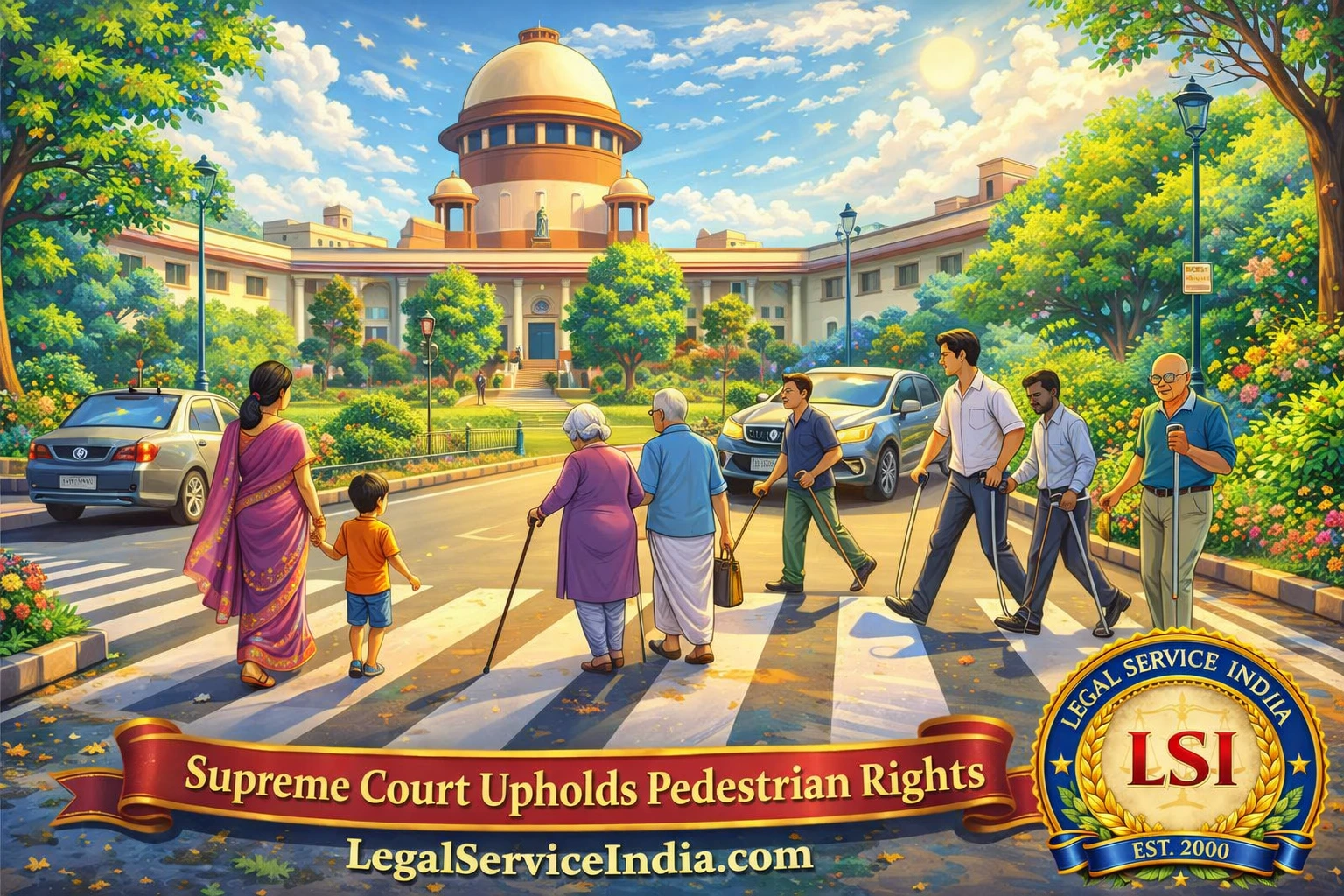
In a significant development for constitutional jurisprudence and urban governance, the Supreme Court of India has recognised that the right to walk safely and conveniently on public roads and footpaths is intrinsically linked to the fundamental rights guaranteed under the Constitution. ¹ This observation underscores the importance of pedestrian rights in a rapidly urbanising society where public infrastructure often prioritises vehicles over people.
Walking is the most basic and universally accessible mode of transportation. Every citizen, irrespective of age, gender, income, or physical ability, relies on walking at some stage of their daily movement. Yet, in many Indian cities and towns, pedestrians face numerous challenges, including:
- Encroached footpaths
- Poorly maintained walkways
- Unsafe crossings
- Inadequate street lighting
These conditions not only inconvenience citizens but also expose them to serious risks of accidents and injuries.
Constitutional Recognition of the Right to Walk
The Supreme Court’s recent pronouncement in S. Rajaseekaran v. Union of India & Others marks a significant milestone in the evolution of pedestrian rights in India. ² A bench comprising Justice P. S. Narasimha and Justice A. S. Chandurkar held that the right to walk safely on demarcated footpaths is a fundamental right flowing from:
| Article | Provision |
|---|---|
| Article 19(1) (d) | Guarantees freedom of movement³ |
| Article 21 | Protects the right to life and personal liberty.⁴ |
The court emphasised that roads are not meant exclusively for motor vehicles and that pedestrians possess an equal, if not greater, claim to public spaces. It observed that the availability of unobstructed, safe, and accessible footpaths is essential for ensuring human dignity, personal safety, and meaningful mobility.
The judgement further highlighted the importance of disability-friendly infrastructure and the obligation of authorities to prioritise pedestrian welfare in urban planning. ⁵
Linking Pedestrian Mobility with Article 21
This ruling builds upon the Supreme Court’s expansive interpretation of Article 21 in earlier decisions such as Olga Tellis v. Bombay Municipal Corporation, wherein the Court recognised that the right to life encompasses the right to live with dignity and includes those conditions necessary for meaningful human existence. ⁶
By linking pedestrian mobility with constitutional guarantees, the Court has reaffirmed that access to safe public spaces is not merely an administrative concern but a matter of fundamental rights.
The judgement serves as a reminder that constitutional rights must be reflected in everyday realities. A citizen’s ability to walk safely on roads and footpaths is integral to equality, accessibility, and social inclusion, particularly for children, senior citizens, and persons with disabilities. ⁷
Pedestrian Rights and Constitutional Values
The Supreme Court’s recognition of the right to walk as part of the broader framework of fundamental rights draws strength from Article 21 of the Constitution, which guarantees the right to life and personal liberty. ⁴ Over the years, the judiciary has expansively interpreted Article 21 to include:
- Right to dignity
- Right to health
- Right to a clean environment
- Right to safe living conditions
Safe pedestrian infrastructure is essential for ensuring these rights. A person cannot fully enjoy life and liberty if basic mobility is compromised.
Principles of Equality under Article 14
The judgement also aligns with the principles of equality enshrined under Article 14 of the Constitution. ⁸ Public spaces must be accessible to all citizens, including:
- Children
- Senior citizens
- Persons with disabilities
- Economically weaker sections who rely heavily on walking
When footpaths are encroached upon or neglected, these groups suffer disproportionately, creating barriers to their participation in public life.
Urban Planning and Sustainable Development
From an urban planning perspective, prioritising pedestrian-friendly infrastructure contributes to sustainable development. Encouraging walking reduces traffic congestion, lowers carbon emissions, and promotes healthier lifestyles. Cities designed for pedestrians tend to be more inclusive, environmentally friendly, and economically vibrant. The court’s observations therefore serve as a reminder that development should focus not merely on expanding roads for vehicles but on creating safe and accessible public spaces for people. ⁹
Recognition of Pedestrian Rights
The recognition of pedestrian rights also imposes a greater responsibility on municipal authorities and state governments. Ensuring the availability of unobstructed footpaths, safe crossings, proper lighting, and accessible infrastructure should become a governance priority rather than an afterthought. Effective implementation of these measures is essential to translate constitutional promises into lived realities.
Conclusion
The Supreme Court’s affirmation of the right to walk marks a significant advancement in India’s constitutional and urban governance framework. Through its decision in S. Rajaseekaran v. Union of India & Others, the Court has elevated pedestrian mobility from a matter of administrative convenience to a constitutionally protected right. The judgement reinforces the idea that public spaces belong to all citizens and that mobility is deeply connected to dignity, equality, and freedom. As India continues to urbanise, policymakers and local authorities must prioritise pedestrian-friendly infrastructure, ensuring that constitutional guarantees are translated into everyday realities. Ultimately, a truly developed city is not measured by the number of vehicles on its roads but by how safely, freely, and comfortably its people can walk through its streets.
Endnotes
| Note | Reference |
|---|---|
| 1 | Supreme Court of India, observations recognising the right to walk safely on footpaths as a fundamental right, June 2026. |
| 2 | S. Rajaseekaran v. Union of India & Ors., Supreme Court of India, Order dated 19 June 2026. |
| 3 | Constitution of India, art. 19(1)(d). |
| 4 | Constitution of India, art. 21. |
| 5 | S. Rajaseekaran v. Union of India & Ors., supra note 2. |
| 6 | Olga Tellis v. Bombay Municipal Corporation, (1985) 3 SCC 545. |
| 7 | Rights of Persons with Disabilities Act, 2016. |
| 8 | Constitution of India, art. 14. |
| 9 | Ministry of Housing and Urban Affairs, Government of India, Smart Cities Mission Guidelines. |

