





Abstract
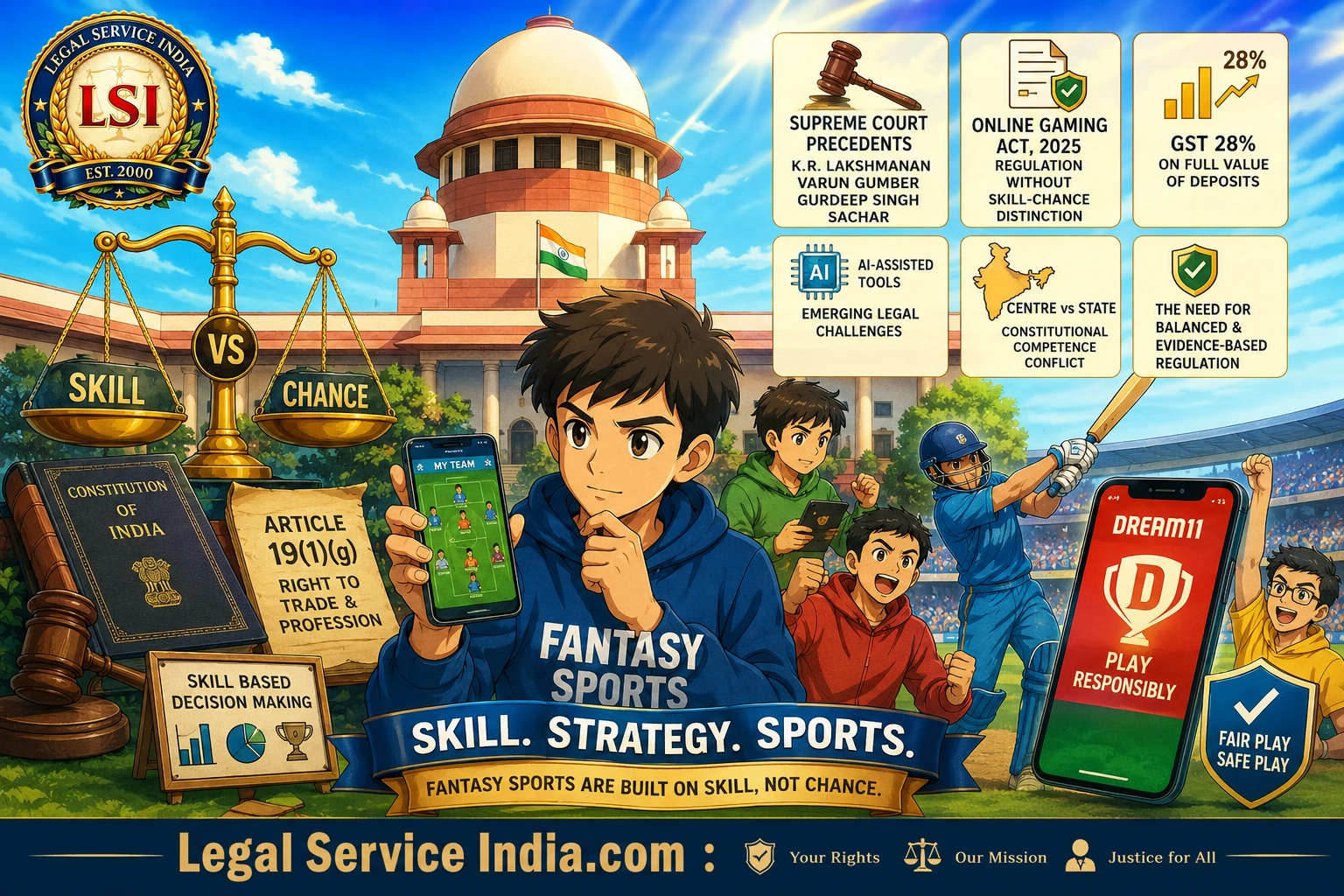
This article examines the legal and regulatory landscape governing fantasy sports in India, with particular focus on the constitutional skill-versus-chance distinction that has defined a decade of litigation. Indian courts, relying on the predominance test established in K.R. Lakshmanan and applied in Varun Gumber and Gurdeep Singh Sachar, consistently held that fantasy sports platforms such as Dream11 operate as skill-based activities protected under Article 19(1)(g) of the Constitution.
However, these precedents rested on SLP dismissals rather than a reasoned Supreme Court judgement, leaving the doctrinal foundation structurally fragile. The article analyses the fragmented state regulatory landscape, the MeitY-led IT Amendment Rules, 2023, and the far-reaching Promotion and Regulation of Online Gaming Act, 2025, which prohibits all online money gaming without engaging with the skill-chance question.
It further identifies critical gaps:
- The absence of empirical validation of the skill-predominance claim.
- The challenge posed by AI-assisted team selection tools.
- Unresolved centre-state constitutional competence.
The article concludes that thoughtful, evidence-based national legislation — rather than judicial improvisation or legislative overreach — is the only durable solution.
I. Introduction
For nearly a decade, Indian courts answered one question consistently: can a platform collect entry fees, pool them, and pay cash prizes to winners without being classified as a gambling operator?
The answer was broadly yes — provided winning depended primarily on the participant’s skill. That single judicial distinction kept Dream11, MPL, and My11Circle operating as multi-billion-rupee businesses while facing near-constant legal challenges.
Constitutional Foundation of the Debate
The controversy is constitutional at its core. Under Entry 34 of the State List, betting and gambling are exclusively within state legislative competence. [2]
If fantasy sports fall within that entry, Parliament cannot regulate them, states may ban them at will, and the industry’s position is perpetually exposed. If they do not — because skill, not chance, determines outcomes — they qualify as a trade or profession protected under Article 19(1)(g), and blanket state bans become constitutionally suspect. [3]
| Issue | If Fantasy Sports Are Gambling, | If Fantasy Sports Are Skill-Based |
|---|---|---|
| Legislative Competence | States have primary authority | Outside Entry 34 restrictions |
| Parliament’s Role | Limited constitutional space | Greater scope for regulation |
| Business Protection | Subject to state prohibitions | Protected under Article 19(1)(g) |
| Industry Stability | Highly uncertain | Relatively secure |
Judicial Approach to Skill Versus Chance
Courts drew that line in favour of fantasy sports. Multiple High Courts upheld Dream11. The Supreme Court dismissed every challenge. But no bench ever delivered a reasoned judgement directly on the question, leaving the precedents structurally fragile.
That fragility was eventually tested. The GST Council’s decision in August 2023 to impose 28% tax on the full face value of user deposits altered the industry’s economics sharply.
Parliament then enacted the Promotion and Regulation of Online Gaming Act, 2025 (PROGA), prohibiting all online money games without drawing any skill-versus-chance distinction at all. [22]
Scope and Objectives of This Article
This article examines the following:
- How the judicial skill-chance test developed.
- What the courts actually decided and why.
- What the regulatory framework got wrong.
- What sensible national regulation would be required.
II. Understanding Fantasy Sports and Online Gaming
A. What Fantasy Sports Involve
In a fantasy sports contest, a participant selects a virtual team of real players before a match begins. Points are earned based on those players’ actual on-field performances — runs, wickets, goals, and assists. The platform retains a service fee, typically 15–20% of the pooled entry amounts, and distributes the remainder as prize money.
The critical structural difference from traditional betting is that the participant does not wager on which team wins. A user’s fantasy score depends on individual player performances, not the match result. The platform profits from its service fee, not from the user’s loss. This distinction underpins every court ruling in favour of fantasy sports.
| Fantasy Sports | Traditional Betting |
|---|---|
| The user selects a virtual team of real players | A user wagers on a match or event outcome |
| Points depend on player performances | The outcome depends on winning or losing prediction |
| The platform earns a service fee | A betting model typically profits from losing wagers |
| Focus on skill-based decision-making | Focus on predicting a result |
B. Why Team Selection Is Treated as Skill
The argument for fantasy sports as a skill-based activity flows from what a participant must actually decide. Before finalising a team, a user must consider:
- Recent player form across multiple matches;
- Head-to-head records at the venue;
- Pitch report and expected conditions;
- Injury updates;
- Batting order and bowling rotation; and
- Whether the format favours spinners or seamers.
The captain and vice-captain choices carry multiplied scoring weight — a poor captaincy call can cost a contest even with an otherwise strong squad.
A user who tracks player statistics and understands match conditions will make systematically better decisions than one picking on name recognition alone. Courts in Varun Gumber and Gurdeep Singh Sachar found exactly this — that decision-making quality, not chance, substantially drives outcomes. [17] [19]
The horse racing analogy used in K.R. Lakshmanan is actually weaker than fantasy sports’ own facts. [16] A bettor wagers on a single unpredictable event. A fantasy user’s score aggregates performance across eleven players through a full match in multiple statistical categories. The scope for personal skill to influence the outcome is structurally larger. Courts transferred the doctrinal framework from Lakshmanan without spelling this out — a gap that left the reasoning thinner than it needed to be.
| Skill Factors in Fantasy Sports | Impact on Outcome |
|---|---|
| Player Form Analysis | Improves team selection accuracy |
| Pitch and Venue Assessment | Helps predict player performance |
| Injury and Team News Tracking | Reduces selection risks |
| Captain and Vice-Captain Selection | Significantly affects scoring |
| Statistical Evaluation | Enhances strategic decision-making |
C. The Legal Stakes of the Classification
The skill-versus-chance distinction is not a regulatory technicality. Gambling is res extra commercium – outside lawful trade and commerce – carrying no protection under Article 19(1)(g). [4] A skill-based activity is a trade or profession, and any state restriction on it must satisfy the reasonableness standard under Article 19(6). This is why the classification question has produced a decade of litigation: it determines the constitutional limits on how the government — centre or state — may respond.
III. Legal Framework Governing Fantasy Sports
A. Constitutional and Statutory Position
Betting and gambling fall under Entries 34 and 62 of the State List. [2][5] Parliament has no direct authority over gambling. The centre approached this by treating online gaming as a digital industry — when MeitY was designated the nodal ministry for online gaming in December 2022, through an amendment to the Government of India (Allocation of Business) Rules, 1961, the constitutional claim was that online gaming falls under Entry 52 (industries in public interest) or the residuary Entry 97 of the Union List. [6]
The Public Gambling Act, 1867, is the operative central legislation. [7] Section 12 exempts “any game of mere skill wherever played”. [8] This became the primary legal shield for fantasy sports. The limitation is obvious: enacted for physical gambling dens, the Act offers no guidance on what “mere skill” means or how digital platforms should be assessed. Courts filled that gap.
| Legal Instrument | Key Relevance to Fantasy Sports |
|---|---|
| Entries 34 & 62, State List | States regulate betting and gambling |
| Entry 52, Union List | Basis for treating online gaming as an industry |
| Entry 97, Union List | Residuary legislative power |
| Public Gambling Act, 1867 | Provides exemption for games of mere skill |
| Article 19(1)(g) | Protection available to lawful trade and professions. |
| Article 19(6) | Permits reasonable restrictions |
B. State Laws — A Study in Divergence
The variation in state approaches shows how badly a national framework was needed.
Tamil Nadu’s 2021 amendment to the Tamil Nadu Gaming Act swept skill-based online games into the definition of gambling. The Madras High Court struck it down in Junglee Games (2021) as disproportionate. [9] Tamil Nadu returned with the more careful Tamil Nadu Prohibition of Online Gambling and Regulation of Online Games Act, 2022, which the Madras High Court substantially upheld in All India Gaming Federation (2023) [10], including Aadhaar KYC and night-time gaming restrictions.
Telangana and Andhra Pradesh banned online gaming outright, including activities judicially recognised as skill-based elsewhere. Nagaland took the opposite route: the Nagaland Prohibition of Gambling and Promotion and Regulation of Online Games of Skill Act, 2016, created India’s first licensing regime for online skill games, clearly distinguishing skill from chance. [11]
The result was that the same platform could be lawful in Maharashtra, prohibited in Telangana, and licensable in Nagaland simultaneously. That is not a regulatory landscape — it is an enforcement lottery.
| State | Regulatory Approach |
|---|---|
| Tamil Nadu | Regulated framework with restrictions and compliance requirements |
| Telangana | Broad prohibition on online gaming activities |
| Andhra Pradesh | Broad prohibition on online gaming activities |
| Nagaland | Licensing regime for online games of skill |
| Maharashtra | Platform operations may remain lawful subject to applicable laws |
C. The 2023 IT Amendment Rules
The IT (Intermediary Guidelines and Digital Media Ethics Code) Amendment Rules, 2023, notified by MeitY on April 6, 2023, were the first structured central attempt at online gaming regulation. [13] They introduced Self-Regulatory Bodies (SRBs) to verify permissible games, imposed KYC obligations on online gaming intermediaries, banned credit financing of gaming, and restricted advertising of unverified platforms.
The SRBs, however, were never formally designated. The framework existed on paper without the infrastructure to support it, and PROGA superseded it before it could function.
- Introduction of Self-Regulatory Bodies (SRBs);
- Verification of permissible online games;
- KYC obligations for Online Gaming Intermediaries;
- Ban on credit financing of gaming activities; and
- Restrictions on advertising unverified gaming platforms.
IV. Judicial Interpretation: The Skill versus Chance Debate
A. Building the Doctrinal Foundation
Indian courts inherited the skill-chance test from card game and horse racing litigation. In State of Bombay v. R.M.D. Chamarbaugwala (AIR 1957 SC 699), a five-judge Constitution Bench established that gambling is res extra commercium and falls outside the protection of Article 19(1)(g). [14] Activities predominantly based on chance receive no constitutional protection as a trade or profession, which set the structural stakes for all gaming litigation that followed.
State of Andhra Pradesh v. K. Satyanarayana (AIR 1968 SC 825) applied this to Rummy. [15] The Court held that Rummy is “mainly and preponderantly a game of skill” because it requires memorising cards, building sequences, and strategic discarding. The presence of chance in the initial deal does not convert it into gambling. This is the clearest early articulation of the predominance test: if skill predominantly determines outcomes, the activity is a game of skill regardless of incidental chance elements.
| Case | Principle Established | Significance |
|---|---|---|
| State of Bombay v. R.M.D. Chamarbaugwala (1957) | Games of chance receive no constitutional protection as trade | Foundation of Indian gaming jurisprudence |
| State of Andhra Pradesh v. K. Satyanarayana (1968) | Rummy is predominantly a game of skill | Established the predominance test |
B. K.R. Lakshmanan — The Judgment That Built an Industry
Dr K.R. Lakshmanan v. State of Tamil Nadu ((1996) 2 SCC 226) is the most cited case in Indian gaming law. [16] A three-judge bench held that horse racing is a game of skill – a knowledgeable bettor who studies pedigrees, track conditions, and jockey form applies genuine expertise. The Court clarified that the “mere skill” exception extends to any game where skill substantially predominates; pure skill is not required.
Dream11 relied on this in every subsequent case, and courts accepted the application. But the analogy has limits. A horse bettor wagers on a single uncertain event; a fantasy user’s score aggregates across eleven players. The scope for personal expertise to determine outcomes is structurally larger in fantasy sports. Courts transferred the Lakshmanan framework without explaining why the analogy holds, leaving the reasoning open to challenge if Parliament or a future court chose to press it.
C. Varun Gumber and Gurdeep Singh Sachar — Fantasy Sports Directly Examined
Shri Varun Gumber v. Union Territory of Chandigarh (2017 SCC OnLine P&H 5372) was the first Indian court ruling examining a fantasy sports platform directly. [17] The Punjab and Haryana High Court held that Dream11 constitutes “mere skill” under Section 12 of the 1867 Act — a user who assesses player form, fitness, and match conditions exercises genuine judgement, not luck. The Supreme Court dismissed the SLP on September 15, 2017. [18]
Gurdeep Singh Sachar v. Union of India (2019 SCC OnLine Bom 13059) went further. [19] A PIL alleged both illegal gambling and GST evasion of approximately ₹2,173 crore by Dream11. The Bombay High Court dismissed it, holding that Dream11’s outcomes depend on “superior knowledge, judgement and attention” and not on the actual match result. The Supreme Court dismissed SLPs by Sachar, the Union of India, and the State of Maharashtra on December 13, 2019. [20]
By 2020, three High Courts — Punjab and Haryana, Bombay, and Rajasthan — had upheld fantasy sports, with every Supreme Court challenge dismissed. This was a strong run of precedent. But it rested on SLP dismissals, not on a reasoned judgement from a bench deciding the question directly on its merits — a structural weakness that became relevant when Parliament chose to legislate around it entirely.
- The Punjab and Haryana High Court upheld fantasy sports.
- Bombay High Court upheld Dream11’s business model.
- Rajasthan High Court followed the same approach.
- Supreme Court challenges were dismissed at the SLP stage.
D. Junglee Games — Testing the Limits of State Power
Junglee Games India Pvt. Ltd. v. State of Tamil Nadu (2021 SCC OnLine Mad 2762) addressed how far states could go. [9] Tamil Nadu’s blanket ban on online gaming with stakes was struck down as “capricious, irrational, excessive and disproportionate” – prohibiting skill-based gaming without considering less intrusive alternatives fails the proportionality test under Article 19(6).
When Tamil Nadu returned with the more targeted 2022 Act, the Madras High Court largely upheld it in the All India Gaming Federation (2023). [10] The contrast is instructive: calibrated consumer protection survives scrutiny; an outright ban does not.
| Case | Issue | Outcome |
|---|---|---|
| Junglee Games (2021) | Blanket ban on online gaming with stakes | Struck down as disproportionate |
| All India Gaming Federation (2023) | Targeted regulatory framework | Largely upheld |
E. The Legislative Override
For nearly a decade, the judicial trend was consistent — fantasy sports are skill-based, blanket bans are disproportionate, and state regulation must be targeted. PROGA side-stepped this body of reasoning. It does not overrule these decisions; it simply prohibits all online money gaming without engaging with the skill-chance question at all. Whether Parliament has the constitutional competence to do so, given that gambling is expressly a State List subject, is what the Supreme Court has been asked to resolve.
V. Economic and Social Impact of Fantasy Sports
Economic Contribution and Industry Growth
The industry’s scale was significant. NITI Aayog’s December 2020 paper cited projections of FDI potential exceeding ₹10,000 crore and 1.5 billion annual online transactions. [1] Fantasy sports created employment across data analytics, technology, content creation, and sports journalism. Dream11’s IPL title sponsorship was the most visible expression of a broader sponsorship ecosystem that channelled platform revenue into professional cricket. Before October 2023, platforms paid 18% GST on gross gaming revenue and TDS on user winnings — a fiscal contribution the Centre itself acknowledged when it assigned MeitY regulatory responsibility for the sector. [6] [21]
- FDI potential exceeding ₹10,000 crore.
- Approximately 1.5 billion annual online transactions.
- Employment generation in analytics, technology, media, and sports journalism.
- Revenue support for professional sports through sponsorships.
- GST and TDS contributions to government revenues.
Social Concerns and Regulatory Challenges
The social concerns, however, are not manufactured. Addiction is a documented risk in real-money gaming, and fantasy platforms’ mobile-first design, low entry barriers, and heavy prime-time advertising made them accessible to users who may not have been financially resilient enough to absorb regular losses. Several state governments cited cases of financial distress and suicides linked to gaming losses when enacting restrictive legislation. Age verification was largely nominal. Responsible gaming tools existed but were self-imposed and inconsistently implemented.
| Key Concern | Impact |
|---|---|
| Addiction Risk | Potential for repeated financial losses |
| Low Entry Barriers | Easy access for vulnerable users |
| Heavy Advertising | Increased user participation |
| Weak Age Verification | Risk of underage participation |
| Inconsistent Responsible Gaming Measures | Uneven consumer protection |
Regulation Versus Prohibition
These concerns argue for regulation, not necessarily prohibition. Eliminating the regulated Indian industry does not eliminate demand — it redirects users to offshore platforms outside Indian law, untaxed, and beyond any consumer protection regime. Whether a ban that produces that outcome actually protects users is a question the legislative process did not seriously engage with.
VI. Challenges and Critical Analysis
A. Fragmentation and the Regulatory Vacuum
The absence of a national framework was the fantasy sports industry’s foundational legal problem. The same platform was simultaneously legal in some states and prohibited in others. Operators geofenced hostile states and incorporated permissive ones. Offshore betting platforms exploited the gap throughout this period. The industry’s aggressive advertising — normalising real-money gaming to mass audiences during cricket broadcasts — likely accelerated the political backlash that eventually arrived.
| Regulatory Issue | Practical Impact |
|---|---|
| Absence of a national framework | Different legal treatment across states |
| Geofencing by operators | Restricted access in hostile jurisdictions |
| Offshore betting platforms | Exploited regulatory gaps |
| Aggressive advertising | Increased public and political scrutiny |
B. The Empirical Gap in the Skill-Chance Test
Courts applied the predominance test as though legal analysis could resolve what is fundamentally an empirical question. Whether skill predominantly determines fantasy sports outcomes requires data on user performance patterns, contest structures, and whether experienced users consistently outperform casual ones across large pools. No court has commissioned independent empirical investigation. Rulings rested substantially on expert evidence filed by platforms with a direct financial interest in the outcome.
What courts actually determined is that fantasy sports structurally resemble skill games. That is not the same as finding that skill in fact predominantly determines outcomes across a large, diverse user base. A platform serving millions of casual users through large low-barrier contests may be so structured that chance overwhelms the skill advantage of expert users in practice. That possibility has not been examined, and the judicial test as applied would not catch it.
Key Concerns in the Predominance Test
- Lack of independent empirical investigation.
- Reliance on expert evidence submitted by interested platforms.
- Limited assessment of actual user behaviour across large player pools.
- Potential mismatch between legal theory and practical outcomes.
C. Has the Skill-Chance Test Become Outdated?
The predominance test was designed for human participants applying their own knowledge and judgement. That assumption deserves scrutiny in the current environment.
AI-assisted team selection tools and automated fantasy team builders are now widely available. Third-party applications process player statistics, pitch conditions, and match histories to generate optimised team compositions — effectively completing the selection process without meaningful human input. If a user relies on an algorithm to build their team, the output reflects the tool’s analytical capacity, not their cricket knowledge.
The counterargument is that deploying better tools is itself a form of skill — a user who identifies and properly uses superior analytics should consistently outperform one who does not, which is the hallmark of skill competition. The parallel to algorithmic trading is reasonable; using analytical tools does not convert investing into gambling.
But it points to a genuine problem courts have not addressed. The skill-chance test was built for human decision-making. When that decision-making is substantially automated and the tools are widely accessible, the original premise shifts. Whether contest design and platform architecture should be factored into the skill assessment — and whether AI-assisted team selection should be treated differently from manual team selection — are questions a future regulatory framework must engage with seriously.
Emerging Regulatory Questions
- Should AI-assisted team selection be treated differently from manual team selection?
- How should platform architecture influence the assessment of skill?
- Does widespread automation alter the legal basis of the predominance test?
- Should contest design become a factor in determining legality?
D. What Adequate Regulation Requires
The regulatory history of fantasy sports in India has been almost entirely reactive — courts responding to PILs, states responding to electoral pressure, and Parliament eventually responding with a blanket prohibition passed in a day without publicly visible consultation or independent impact assessment.
A workable framework requires, at minimum, a statutory definition of “game of skill” informed by empirical criteria rather than doctrinal inheritance from horse racing cases; a national licensing regime giving operators consistent legal standing across states; mandatory and independently audited responsible gaming features — spending limits, cooling-off periods, self-exclusion, and addiction helplines; enforceable advertising standards; and a settled constitutional framework for centre-state regulatory overlap that does not reset with every new state amendment or PIL.
Essential Elements of a Workable Framework
- Statutory definition of “game of skill” based on empirical criteria.
- National licensing regime for consistent legal recognition.
- Mandatory and independently audited responsible gaming measures.
- Spending limits, cooling-off periods, and self-exclusion mechanisms.
- Addiction helplines and consumer protection safeguards.
- Enforceable advertising standards.
- Clear constitutional framework governing centre-state regulatory overlap.
| Regulatory Requirement | Purpose |
|---|---|
| Definition of “game of skill” | Reduce legal uncertainty |
| National licensing regime | Ensure uniform compliance |
| Responsible gaming safeguards | Protect consumers |
| Advertising standards | Prevent misleading promotion |
| Centre-state regulatory clarity | Avoid recurring jurisdictional disputes |
VII. Way Forward
The Nagaland Act, 2016, demonstrated that a licensing-based framework for online skill games is operationally feasible. [11] The Tamil Nadu Act, 2022, demonstrated that targeted consumer protection survives constitutional scrutiny without amounting to prohibition. [10] A national statute synthesising those approaches — developed through genuine parliamentary deliberation and independent consultation, rather than rushed passage — remains the most defensible direction.
Key Elements of a National Gaming Framework
- Legislative precision in defining skill games and games of chance.
- Empirical criteria rather than reliance on historical judicial precedents.
- Mandatory and independently audited responsible gaming measures.
- Effective enforcement mechanisms for advertising standards.
- Clear resolution of Centre-State constitutional competence issues.
That statute should define skill games and games of chance with legislative precision, mandating empirical criteria rather than relying on case law from an earlier era. Responsible gaming features should be independently audited and non-negotiable. Advertising standards need enforcement teeth. And the framework must resolve the constitutional question of Centre-state competence rather than leaving it permanently open to litigation.
Recommended Regulatory Priorities
| Regulatory Area | Recommended Approach |
|---|---|
| Skill vs Chance Classification | Define through legislation using measurable and empirical standards. |
| Responsible Gaming | Require independent audits and mandatory compliance. |
| Advertising Regulation | Strengthen enforcement and accountability mechanisms. |
| Constitutional Competence | Clarify centre-state jurisdiction to reduce litigation. |
VIII. Conclusion
Fantasy sports in India occupied a legally tolerable but structurally uncertain position for close to a decade. Courts provided constitutional protection through the skill-chance test, but that protection rested on High Court decisions confirmed by SLP dismissals – never on a reasoned Supreme Court judgement on the merits. Parliament provided a statutory response in 2025, but without engaging with the skill-chance question that was the entire basis of a decade’s jurisprudence.
Unresolved Legal Questions in Fantasy Sports
- Whether fantasy sports are genuinely skill-predominant for most participants or only for expert users.
- Whether Parliament possesses the constitutional competence to prohibit online money gaming nationally despite gambling being allocated to the State List.
- Whether the existing skill-chance test remains suitable in an environment increasingly influenced by AI analytics and automated team selection.
The legal questions that matter most remain unresolved. Whether fantasy sports are genuinely skill-predominant for most participants — or only for a small subset of expert users — has never been empirically examined. Whether Parliament has the competence to prohibit online money gaming nationally given the State List’s explicit allocation of gambling is now before the Supreme Court. And whether the skill-chance test, as currently formulated, is adequate for a market shaped by AI analytics and automated team selection is a question that litigation has not yet reached.
Lessons From Ten Years of Gaming Regulation
| Issue | Observed Outcome |
|---|---|
| Absence of National Framework | Recurring litigation and regulatory uncertainty. |
| State-Level Regulation | Fragmented and inconsistent approaches. |
| Legislative Intervention | Risk of regulatory overreach. |
| Future Direction | Need for evidence-based and consultative national legislation. |
What ten years of gaming regulation in India demonstrates above all is that the absence of a thoughtful statutory framework does not produce a stable industry — it produces recurring litigation, fragmented state responses, and eventually legislative overreach. A carefully designed national framework, built on evidence and real consultation, is overdue. Whether it arrives through parliamentary initiative or Supreme Court intervention remains to be seen.
Endnotes
- NITI Aayog, Guiding Principles for the Uniform National-Level Regulation of Online Fantasy Sports Platforms in India (Discussion Paper, December 2020), available at niti.gov.in. Growth figures and FDI projections cited are from industry estimates referenced therein.
- Entry 34, List II (State List), Seventh Schedule, Constitution of India — “Betting and gambling”.
- Article 19(1)(g), Constitution of India.
- State of Bombay v. R.M.D. Chamarbaugwala, AIR 1957 SC 699; 1957 SCR 874 (Supreme Court, April 9, 1957).
- Entry 62, List II (State List), Seventh Schedule, Constitution of India.
- Amendment to the Government of India (Allocation of Business) Rules, 1961, notified December 23, 2022, designating MeitY as the nodal ministry for matters relating to online gaming.
- Public Gambling Act, 1867 (Act No. 3 of 1867).
- Section 12, Public Gambling Act, 1867.
- Junglee Games India Pvt. Ltd. v. State of Tamil Nadu, 2021 SCC OnLine Mad 2762 (Madras High Court, Division Bench, August 3, 2021).
- All India Gaming Federation v. State of Tamil Nadu, 2023 SCC OnLine Mad 6973 (Madras High Court, November 9, 2023).
- Nagaland Prohibition of Gambling and Promotion and Regulation of Online Games of Skill Act, 2016.
- Section 69A, Information Technology Act, 2000 (Act No. 21 of 2000).
- IT (Intermediary Guidelines and Digital Media Ethics Code) Amendment Rules, 2023, notified by MeitY on April 6, 2023 (PIB Press Release PRID 1914358).
- State of Bombay v. R.M.D. Chamarbaugwala, AIR 1957 SC 699; 1957 SCR 874. Indian Kanoon Doc ID: 212098.
- State of Andhra Pradesh v. K. Satyanarayana & Ors., AIR 1968 SC 825; (1968) 2 SCR 387 (Supreme Court, November 22, 1967). Indian Kanoon Doc ID: 84963.
- Dr K.R. Lakshmanan v. State of Tamil Nadu & Anr., (1996) 2 SCC 226; AIR 1996 SC 1153 (Supreme Court, January 12, 1996). Indian Kanoon Doc ID: 1248365.
- Shri Varun Gumber v. Union Territory of Chandigarh & Ors., CWP No. 7559 of 2017; 2017 SCC OnLine P&H 5372 (Punjab and Haryana High Court, April 18, 2017).
- SLP dismissed by the Supreme Court, Diary No. 27511/2017, September 15, 2017 (Bench: Justice Rohinton Fali Nariman and Justice Sanjay Kishan Kaul). Indian Kanoon Doc ID: 160942730.
- Gurdeep Singh Sachar v. Union of India & Ors., CRLPIL No. 22 of 2019; 2019 SCC OnLine Bom 13059 (Bombay High Court, April 30, 2019).
- SLPs dismissed by the Supreme Court, Diary Nos. 43346/2019 and 41632/2019, December 13, 2019 (Bench: Justice Rohinton Fali Nariman and Justice S. Ravindra Bhat). Indian Kanoon Doc ID: 191838574.
- Decision of the 51st GST Council Meeting (August 2, 2023), imposing 28% GST on the full face value of deposits in online gaming, casinos and horse racing, effective October 1, 2023.
- Promotion and Regulation of Online Gaming Act, 2025, Act No. 32 of 2025 — Lok Sabha: 20 August 2025; Rajya Sabha: August 21, 2025; Presidential assent: August 22, 2025.
References and Authorities
A. Cases
- State of Bombay v. R.M.D. Chamarbaugwala, AIR 1957 SC 699; 1957 SCR 874 (Supreme Court, April 9, 1957).
- State of Andhra Pradesh v. K. Satyanarayana & Ors., AIR 1968 SC 825; (1968) 2 SCR 387 (Supreme Court, November 22, 1967).
- Dr K.R. Lakshmanan v. State of Tamil Nadu & Anr., (1996) 2 SCC 226; AIR 1996 SC 1153 (Supreme Court, January 12, 1996).
- Shri Varun Gumber v. Union Territory of Chandigarh & Ors., CWP No. 7559 of 2017; 2017 SCC OnLine P&H 5372 (Punjab and Haryana High Court, April 18, 2017).
- Gurdeep Singh Sachar v. Union of India & Ors., CRLPIL No. 22 of 2019; 2019 SCC OnLine Bom 13059 (Bombay High Court, April 30, 2019).
- Junglee Games India Pvt. Ltd. v. State of Tamil Nadu, 2021 SCC OnLine Mad 2762 (Madras High Court, Division Bench, August 3, 2021).
- All India Gaming Federation v. State of Tamil Nadu, 2023 SCC OnLine Mad 6973 (Madras High Court, November 9, 2023).
B. Statutes and Constitutional Provisions
- Constitution of India — Article 19(1)(g); Article 19(6); Entry 34, List II (State List); Entry 62, List II (State List); Entry 52, List I (Union List); Entry 97, List I (Union List), Seventh Schedule.
- Public Gambling Act, 1867 (Act No. 3 of 1867), Section 12.
- Information Technology Act, 2000 (Act No. 21 of 2000), Section 69A.
- IT (Intermediary Guidelines and Digital Media Ethics Code) Amendment Rules, 2023 (notified April 6, 2023).
- Nagaland Prohibition of Gambling and Promotion and Regulation of Online Games of Skill Act, 2016.
- Tamil Nadu Prohibition of Online Gambling and Regulation of Online Games Act, 2022.
- Promotion and Regulation of Online Gaming Act, 2025 (Act No. 32 of 2025).
- Amendment to the Government of India (Allocation of Business) Rules, 1961 (notified December 23, 2022).
C. Government Reports
- NITI Aayog, Guiding Principles for the Uniform National-Level Regulation of Online Fantasy Sports Platforms in India (Discussion Paper, December 2020), available at niti.gov.in.
- Decision of the 51st GST Council Meeting (August 2, 2023) — imposition of 28% GST on online gaming deposits.
D. Other Sources
- PIB Press Release PRID 1914358 — IT (Intermediary Guidelines and Digital Media Ethics Code) Amendment Rules, 2023.
- Indian Kanoon — Doc IDs referenced throughout footnotes for case verification.
Editorial Flags: Citations and Footnotes
Potentially Incomplete or Requiring Verification
The following items were identified during the editorial review as potentially requiring independent verification or as appearing incomplete. They have NOT been modified in the article body.
| Footnote | Issue Identified | Verification Required |
|---|---|---|
| [12] | Section 69A, Information Technology Act, 2000, is cited but does not correspond to any passage in the article text where a [12] reference appears. | The cross-reference in the article body appears absent. The author should verify whether this footnote is matched to an in-text citation or was inadvertently omitted. |
| [22] | PROGA, 2025: The Promotion and Regulation of Online Gaming Act, 2025 (Act No. 32 of 2025) is cited with Lok Sabha passage on August 20, 2025, and presidential assent on August 22, 2025. | Given that this legislation is recent and citation details are specific, the author should independently verify the Act number, passage dates, and official gazette notification before submission. |
| [21] | GST Council: The 51st GST Council meeting date is cited as August 2, 2023. | This should be verified against the official Press Information Bureau release. |
| [1] | NITI Aayog projections: The projections of FDI exceeding ₹10,000 crore and 1.5 billion annual transactions are described as “industry estimates referenced” in the NITI Aayog paper rather than NITI Aayog’s own projections. | This should be accurately reflected in any public version of the article to avoid misattribution. |
Quick Reference Summary
| Category | Key Authorities |
|---|---|
| Leading Supreme Court Cases | R.M.D. Chamarbaugwala, K. Satyanarayana, and Dr K.R. Lakshmanan |
| Leading High Court Cases | Varun Gumber; Gurdeep Singh Sachar; Junglee Games; All India Gaming Federation |
| Core Statutes | Public Gambling Act, 1867; Information Technology Act, 2000; PROGA, 2025 |
| State Legislation | Nagaland Online Skill Games Act, 2016; Tamil Nadu Online Gambling Act, 2022 |
| Government Policy Sources | NITI Aayog Discussion Paper (2020); 51st GST Council Decision (2023) |
| Regulatory Framework | IT Rules, 2023; MeitY Nodal Ministry Notification (2022) |
Written By: Aryan Sahu, Final Year B.A., LL.B. – Guru Ghasidas Vishwavidyalaya, Bilaspur, Chhattisgarh
Email: [email protected]

