





Abstract
This article explores the rising paradox in the Indian examination system, where students are subjected to more stringent security measures while systemic flaws like regular paper leaks and exam cancellations continue to occur. It draws attention to how overzealous inspection frequently jeopardizes students’ dignity while ignoring the underlying issues that lead to leaks, such as administrative errors and a lack of responsibility.
The essay examines the wide-ranging effects of such failures on students’ academic achievement, emotional health, and belief in the institution based on reported statistics and current occurrences of exam cancellations. The Public Examination (Prevention of Unfair Means) Bill, 2024’s legal structure is further examined, and the necessity of more robust enforcement is highlighted.
1. Introduction: Security Theatre or Genuine Integrity?
“In India, students are subjected to extremely strict screening before examinations, as though they are under suspicion. Yet, despite multiple paper leaks in the past decade, there is a visible lack of accountability from the authorities responsible for safeguarding the system.”
Recent reports and videos circulating on social media have reignited concerns regarding the treatment of candidates during examination security checks, showing security personnel cutting buttons off students’ trousers during pre-examination screening. It reminded me of similar situations during the NEET examinations in 2022, when girls were reportedly asked to remove their hair rubber bands and even their innerwear in the name of security.
Such actions raise a crucial question:
- Are we protecting exam integrity?
- Or are we jeopardising students’ dignity?
2. The Alarming Pattern of Exam Cancellations
The issue extends beyond paper leaks to the increasing number of examinations being cancelled in recent years. Notable examples include:
| Examination | Year |
|---|---|
| Jharkhand CGL Examination | 2024 |
| TPSC Junior Engineering (Town Planning) Examination | 2023 |
| Bihar Police Constable Examination | 2023 |
| Rajasthan Teacher Recruitment Examination | 2022 |
| Diploma in Elementary Education (D.El.Ed) Examination, West Bengal | 2022 |
| Rajasthan REET Examination | 2021 |
The recurrence of such incidents across different states and examinations suggests that these are not isolated failures but symptoms of broader systemic weaknesses in examination administration.
3. Scale of the Crisis: Data, Incidents, and Human Cost
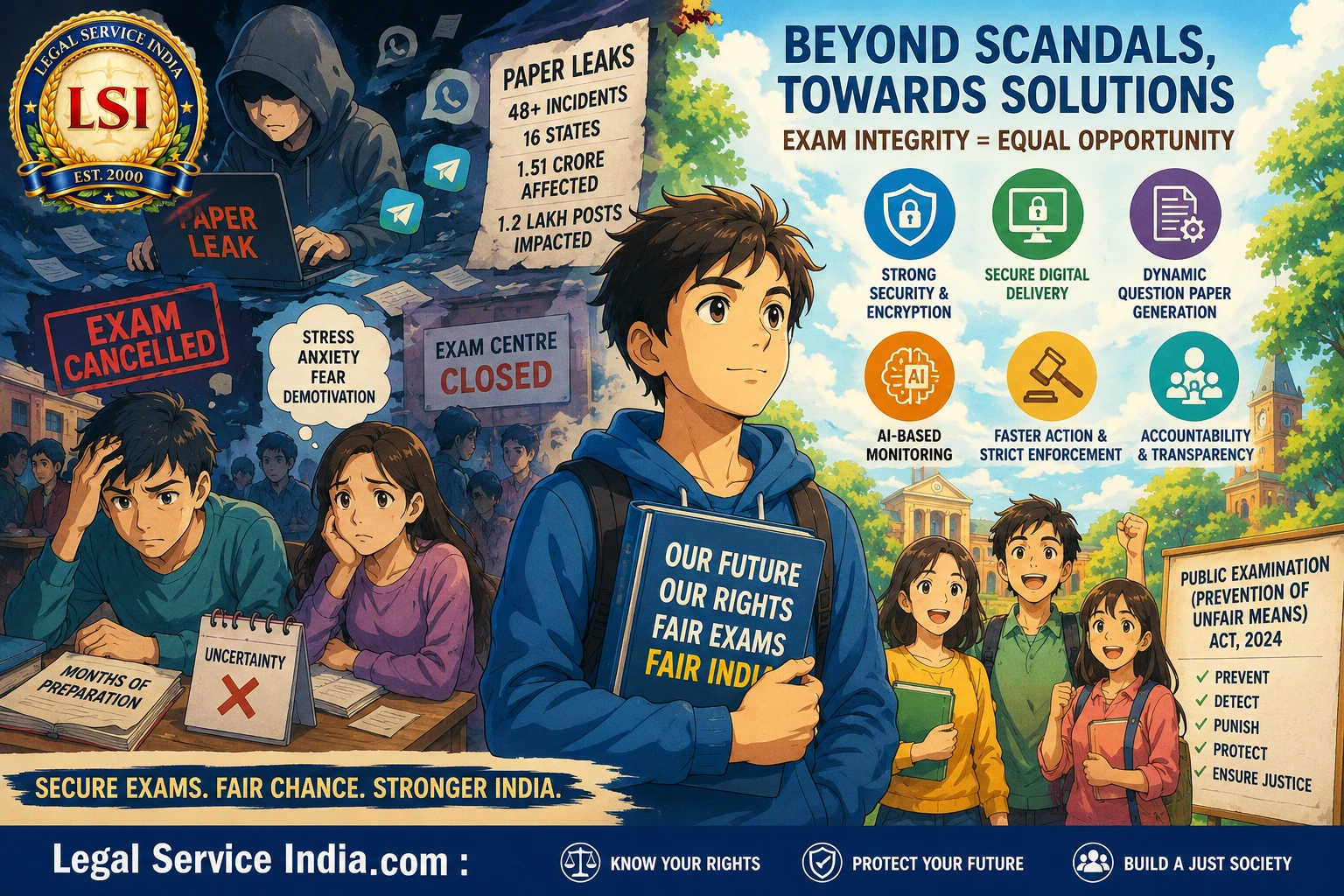
According to the Indian Express’s investigation, there have been at least 48 instances of paper leaks in 16 states over the past five years that have badly affected the recruiting process for government positions. The leaks touched the lives of at least 1.51 crore applicants for about 1.2 lakh posts. This is a huge scandal that has been plaguing the nation for a long time.
Paper Leak Impact at a Glance
| Indicator | Reported Figure |
|---|---|
| States Affected | 16 |
| Paper Leak Incidents | 48+ |
| Applicants Affected | 1.51 Crore |
| Government Posts Involved | Approximately 1.2 Lakh |
According to a BBC report from 2024, a 25-year-old freelancer, researcher and disability campaigner used a wheelchair because she has a unique hereditary ailment of stiff joints and found it to be difficult to get to the exam centre. She could not use the steep ramps, the centre itself lacked a wheelchair, and the road outside had been dug up.
She faced a bigger shock after the four-hour test, with her caregiver mother waiting outside in the scorching heat, during an exam taken by over 900,000 candidates across more than 300 cities. The education ministry initially issued a vague statement about the potential compromise of the exam’s integrity. A day later, Minister Dharmendra Pradhan confirmed that the question paper had been leaked on social media.
The NEET-UG 2026 Controversy
The NEET-UG 2026 controversy further exposed the vulnerabilities of India’s examination system. The examination conducted on 3 May 2026 was cancelled after investigative findings indicated that the integrity of the examination process had been compromised, leading the National Testing Agency (NTA), with the approval of the Government of India, to announce a fresh examination.
The cancellation of NEET-UG 2026 serves as a reminder that examination integrity requires:
- Robust institutional accountability
- Open inquiry procedures
- Efficient application of current rules
- More than just stringent student scrutiny
For millions of medical aspirants, the cancellation meant not only the loss of months of preparation but also prolonged uncertainty, emotional stress, and financial burden.
The incident demonstrated that despite increasingly stringent security measures imposed on candidates, systemic failures at the institutional level continue to threaten the credibility of public examinations.
4. Impact on Students’ Academic Achievement and Mental Health
Students’ academic achievement and mental health are significantly affected by paper leaks. In terms of academic performance, students who receive leaked exam papers may perform better academically than those who do not. This benefit is fleeting, though, and it may eventually negatively impact their academic achievement.
Paper leaks seriously compromise exam validity and reliability. Exam results no longer fairly represent students’ knowledge and skills when they obtain leaked papers, undermining the examination’s impartiality. Additionally, this may lower the value of academic credentials and damage the integrity of the educational system.
Academic Consequences of Paper Leaks
| Area | Impact of Paper Leaks |
|---|---|
| Academic Performance | Students with access to leaked papers may gain an unfair advantage. |
| Exam Validity | Assessment results no longer accurately reflect students’ actual knowledge and skills. |
| Exam Reliability | The credibility and consistency of examination outcomes are weakened. |
| Educational Integrity | The overall trustworthiness of the educational system is compromised. |
| Academic Credentials | The value and credibility of certificates and degrees may decline. |
Psychological and Emotional Impact on Students
Exam cancellations and paper leaks cause candidates a great deal of emotional and psychological anguish in addition to academic repercussions. The possibility of a re-examination frequently causes students to become frustrated, unsure, and lose faith in the system’s fairness after spending months or even years preparing for difficult exams.
The cancellation and re-conduct of NEET-UG 2026 serves as a recent example of how examination irregularities can impose academic, financial, and emotional burdens on millions of candidates.
- Increased stress and anxiety among students.
- Loss of confidence in the examination process.
- Emotional distress caused by uncertainty regarding re-examinations.
- Financial burden due to additional preparation and travel expenses.
- Reduced motivation after prolonged preparation efforts.
5. Legal Framework: The Public Examination (Prevention of Unfair Means) Bill, 2024
The Public Examination (Prevention of Unfair Means) Bill, 2024, was enacted to curb paper leaks, unauthorised access to exam materials, impersonation, and other unfair activities illegal in an effort to reduce exam-related fraud. The law imposes severe penalties for individuals and organised groups who compromise the integrity of exams.
Objectives of the Bill
- Prevent paper leaks and examination fraud.
- Restrict unauthorised access to confidential examination materials.
- Address impersonation and other unfair practices.
- Strengthen the integrity and credibility of public examinations.
- Impose strict penalties on offenders and organised groups involved in malpractice.
Although the enactment of the law is a significant step in the right direction to protect exam integrity, repeated instances of paper leaks and exam cancellations cast doubt on its application. The difficulty seems to be not just in the lack of legislative protections but also in making sure that those who are at fault are promptly identified, held accountable, and prosecuted.
Implementation Challenges
| Challenge | Description |
|---|---|
| Enforcement Issues | Ensuring effective implementation of existing legal provisions. |
| Accountability | Prompt identification and prosecution of responsible individuals. |
| Recurring Exam Leaks | Repeated incidents continue to undermine public confidence. |
| Institutional Coordination | Need for stronger collaboration among stakeholders. |
The NEET-UG 2026 controversy shows that robust legislative frameworks might not be enough on their own. To stop widespread exam fraud, law enforcement, technological companies, and examination authority must all work together effectively.
Strengthening Public Trust in Examinations
Any legal framework’s efficacy ultimately depends on how it is put into practice. Legislative changes by themselves might not be enough to rebuild public trust in the examination system unless accountability systems are reinforced and infractions are swiftly looked into.
- Strengthen monitoring and accountability mechanisms.
- Ensure timely investigation of examination irregularities.
- Enhance coordination between authorities and technology providers.
- Improve transparency throughout the examination process.
- Take swift action against individuals involved in malpractice.
6. Policy Recommendations
At the end, I would like to suggest a few methods to prevent paper leaks and cancellations at the last minute:
6.1 Complete Encryption of Question Papers
Every step of the question paper development, storage, and transmission process should be encrypted. Decryption access should be granted only to authorised officials, and only right before the test.
6.2 Delivery of Digital Question Papers
Use safe digital delivery methods instead of traditional paper-based transportation. Exam centres might use secure servers to obtain papers just before the test.
6.3 Dynamic Question Paper Generation
Just hours or minutes before the test, use software to create question papers at random from a sizable question bank. Early leaks are less likely as a result.
6.4 Swift Investigation and Enforcement
While strong penalties already exist under the Public Examination (Prevention of Unfair Means) Act, 2024, their effectiveness depends on prompt investigation, prosecution, and accountability.
6.5 Technology Use (AI & Data Monitoring)
To identify odd trends (such as mass sharing on messaging applications), use AI techniques.
- To identify odd trends (such as mass sharing on messaging applications), use AI techniques.
- Before tests, keep an eye on social media to spot leaks early.
6.6 Institutional Accountability
Independent audits and accountability systems ought to be applied to examination authorities and service providers. When exam cancellations or paper leaks are caused by carelessness or wrongdoing, the responsible officials should be held accountable, and appropriate action should be taken.
Summary of Recommended Reforms
| Recommendation | Purpose |
|---|---|
| Complete Encryption of Question Papers | Protect question papers during development, storage, and transmission. |
| Delivery of Digital Question Papers | Reduce risks associated with physical transportation. |
| Dynamic Question Paper Generation | Minimise the possibility of early leaks. |
| Swift Investigation and Enforcement | Ensure effective implementation of legal penalties. |
| Technology Use (AI & Data Monitoring) | Detect suspicious activities and identify leaks early. |
| Institutional Accountability | Promote transparency and responsibility among authorities. |
Recent incidents, including the cancellation and re-conduct of NEET-UG 2026, demonstrate the urgency of implementing these reforms to restore confidence in India’s examination system.
Several nations, including Singapore, South Korea, and the UK, have implemented secure examination procedures that integrate institutional accountability with technological safeguards. These systems show how crucial openness, strict monitoring, and defined accountability are to preserving public confidence, even while they are not impervious to anomalies. Similar procedures could be adopted by India to improve the legitimacy of its testing procedure.
7. Conclusion
In conclusion, exam cancellations and paper leaks have a significant negative impact on students’ mental health and diligence, and disrupt the educational system. Stricter laws and technological improvements can drastically reduce these kinds of accidents, but their effectiveness depends on proper implementation and accountability. To ensure transparency and fairness in exams, authorities, organisations, and society must work together. Then and only then will we be able to protect students’ futures and rebuild confidence in the system.
This article raises an important question for policymakers, examination authorities, and society at large: can public confidence in examinations be restored without addressing the systemic failures that continue to undermine their integrity? Ensuring fairness requires not only strict security measures for candidates but also accountability, transparency, and effective implementation of safeguards at every level of the examination process.
Key Takeaways from India’s Examination Crisis
The growing number of examination paper leaks and exam cancellations in India has raised serious concerns about the integrity of the public examination system. The following key takeaways highlight the major findings and concerns discussed in the article.
1. Students Face Strict Scrutiny, but Institutions Often Escape Accountability
- Examination candidates are subjected to invasive security checks, sometimes affecting their dignity.
- Despite these measures, paper leaks and exam cancellations continue to occur, suggesting that the real problem lies within the system rather than with students.
2. Exam Leaks and Cancellations Are Becoming a Recurring National Problem
- Multiple major examinations across different states have been cancelled due to leaks and irregularities.
- These incidents point to systemic weaknesses in examination administration rather than isolated failures.
3. The Scale of the Crisis Is Enormous
The impact of examination paper leaks extends far beyond individual candidates and affects millions of aspirants across India.
| Indicator | Reported Figure |
|---|---|
| Paper Leak Incidents | More than 48 |
| States Affected | 16 |
| Applicants Affected | Approximately 1.51 Crore |
| Government Posts Involved | Approximately 1.2 Lakh |
- More than 48 paper leak incidents were reported across 16 states in the last five years.
- Around 1.51 crore applicants and approximately 1.2 lakh government posts were affected.
4. Students Bear the Biggest Burden
- Months or years of preparation can be wasted when exams are cancelled.
- Re-examinations create uncertainty, financial strain, and emotional distress.
- Students often lose trust in the fairness of the examination system.
5. Paper Leaks Damage Educational Credibility
- Leaked papers give some candidates unfair advantages.
- Exam results no longer accurately reflect merit or knowledge.
- The credibility of certificates, degrees, and recruitment processes suffers.
6. Mental Health Impacts Are Significant
- Increased stress, anxiety, frustration, and demotivation are common consequences.
- Candidates experience emotional trauma due to uncertainty and repeated disruptions.
7. The NEET-UG 2026 Controversy Highlights Systemic Vulnerabilities
- The cancellation and re-conduct of the exam demonstrated that strict candidate screening alone cannot guarantee exam integrity.
- Institutional accountability and transparent investigations are equally important.
8. India Already Has a Legal Framework, but Enforcement Remains Weak
- The Public Examination (Prevention of Unfair Means) Bill, 2024 aims to curb leaks, impersonation, and exam fraud.
- The challenge lies not in the absence of laws but in effective implementation, investigation, and prosecution.
9. Technology and Accountability Must Work Together
- Stronger coordination among examination authorities, law enforcement agencies, and technology providers is needed.
- Transparency and swift action against offenders are essential for restoring trust.
10. Major Reforms Recommended by the Author
The article proposes several reforms that can help strengthen examination security and restore public confidence.
| Recommended Reform | Purpose |
|---|---|
| End-to-End Encryption of Question Papers | Protect examination content throughout the process |
| Secure Digital Delivery | Reduce risks associated with physical transportation |
| Dynamic Question Paper Generation | Minimize the possibility of early leaks |
| AI-Based Monitoring | Detect suspicious activities and identify leaks early |
| Faster Investigations and Enforcement | Ensure accountability and deterrence |
| Institutional Audits and Accountability | Improve transparency and responsibility |
- End-to-end encryption of question papers.
- Secure digital delivery instead of physical transportation.
- Dynamic generation of question papers from large question banks.
- AI-based monitoring for suspicious activities and leak detection.
- Faster investigations and stricter enforcement.
- Institutional audits and accountability mechanisms.
One-Line Summary
The article argues that India’s examination crisis is not primarily a student-security problem but an institutional-accountability problem; restoring public trust requires stronger implementation, transparency, technology-driven safeguards, and responsibility at every level of the examination system.

