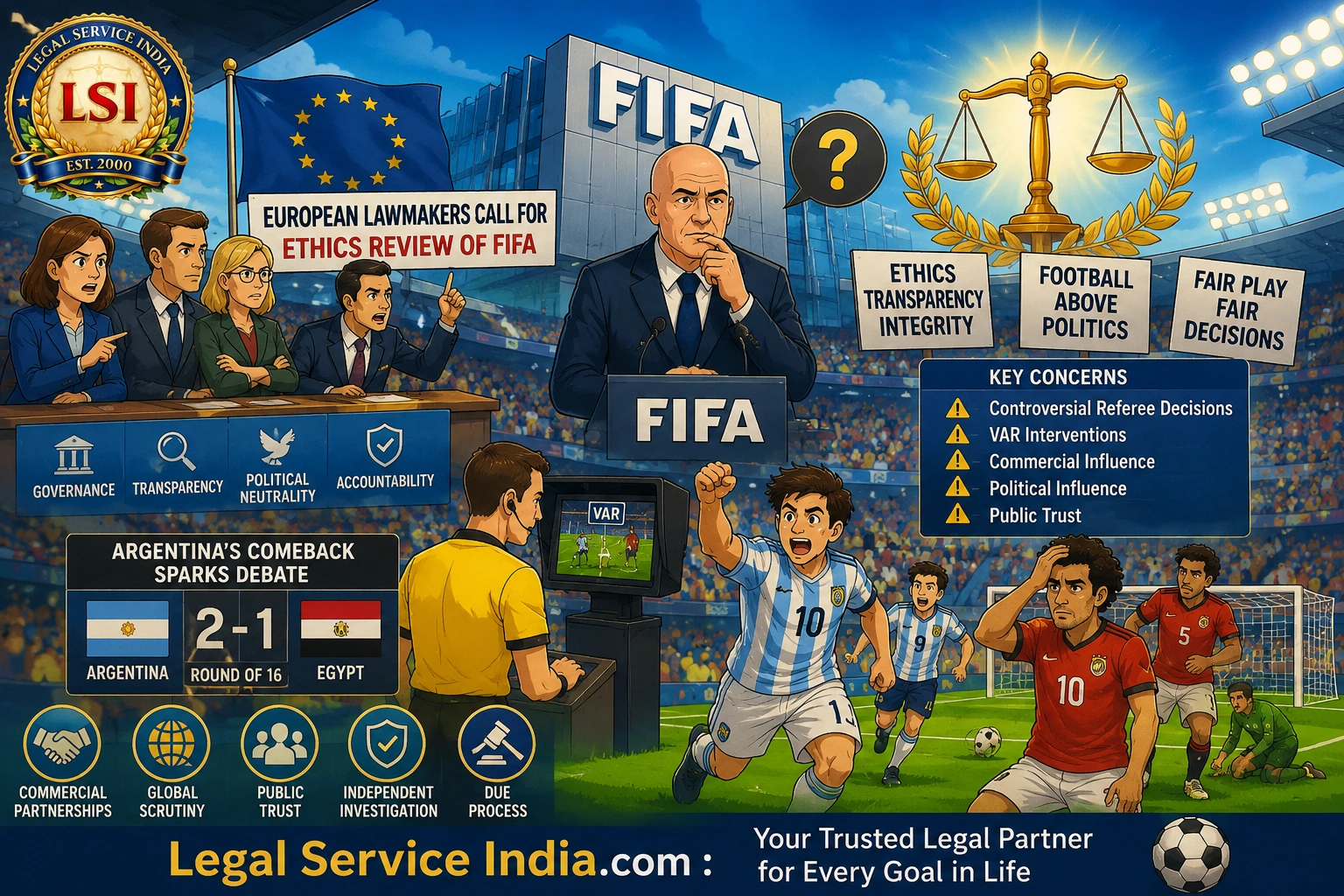
The 2026 FIFA World Cup has delivered unforgettable football moments, but it has also become the center of an unexpected political controversy. Just as fans around the world celebrated Argentina’s dramatic comeback victory over Egypt in the Round of 16, a separate debate began unfolding far away from the football pitch.
A group of Members of the European Parliament (MEPs) reportedly called for an ethics review concerning FIFA President Gianni Infantino, raising broader questions about governance, transparency, political neutrality, and the integrity of international football. The developments have transformed what began as a sporting discussion into a wider debate about the relationship between global sport, politics, and commercial interests.
A Dramatic Match Sparks Intense Debate
Argentina’s dramatic victory over Egypt was one of the most talked-about matches of the tournament. Egypt surprised many observers by taking an early lead and extending its advantage during the second half, placing the defending champions on the verge of elimination.
Argentina eventually mounted a remarkable comeback, scoring late goals to secure qualification for the quarter-finals. While many football supporters described the victory as one of the tournament’s greatest comebacks, others questioned certain refereeing decisions, including stoppage time, VAR interventions, and disciplinary actions during the closing stages of the match.
Although such controversies are common in elite football, the match generated widespread debate across social media and sports forums, with supporters expressing sharply divided opinions.
Key Match Discussions
- Argentina’s comeback victory over Egypt.
- Questions surrounding stoppage time.
- VAR interventions during crucial moments.
- Disciplinary decisions in the closing stages.
- Extensive debate across social media and sports forums.
Political Attention Extends Beyond the Pitch
According to reports discussed in the uploaded material, approximately 50 Members of the European Parliament from multiple European countries urged football authorities to examine FIFA’s governance practices and ethics framework.
The lawmakers reportedly sought an independent review into whether FIFA’s leadership has maintained the standards of political neutrality and institutional independence required under its own Code of Ethics.
If accurate, such a request would represent one of the most significant political interventions involving FIFA during an active World Cup tournament.
Questions About Governance
The concerns described in the transcript extend beyond a single football match.
They reportedly focus on broader governance issues, including:
- FIFA’s institutional independence.
- Political neutrality.
- Transparency in decision-making.
- Commercial partnerships.
- Public confidence in football administration.
Critics argue that football’s governing bodies must remain free from political influence and ensure that sporting decisions are made solely on merit.
Supporters of FIFA, however, maintain that football’s governing institutions regularly face criticism whenever controversial refereeing decisions occur and that allegations should only be accepted after credible investigations and evidence.
Governance Focus Areas
| Area | Issue Raised |
|---|---|
| Institutional Independence | Whether FIFA operates independently of political influence. |
| Political Neutrality | Compliance with FIFA’s Code of Ethics. |
| Transparency | Decision-making processes and accountability. |
| Commercial Partnerships | Perceived influence of sponsors and commercial interests. |
| Public Confidence | Maintaining trust in football administration. |
Previous Controversies Resurface
The debate also revives earlier controversies involving FIFA President Gianni Infantino.
The uploaded material refers to criticism surrounding the presentation of a FIFA Peace Prize to U.S. President Donald Trump during events connected with the World Cup preparations. Human rights organizations reportedly questioned whether such actions complied with FIFA’s obligation to remain politically neutral.
These earlier controversies are now being cited by critics as part of a broader discussion regarding FIFA’s governance and public accountability.
Commercial Influence Under the Spotlight
Another issue raised concerns FIFA’s expanding commercial partnerships.
Modern football depends heavily upon sponsorship revenue, broadcasting rights, and global marketing agreements. Critics argue that increasing commercial interests may create perceptions that financial considerations influence decision-making.
Particular attention has reportedly been directed toward FIFA’s major sponsorship agreements and its relationship with state-backed corporations.
While no conclusive evidence has been presented that commercial partnerships directly affect sporting outcomes, the discussion reflects growing public concern about transparency in global sports governance.
Commercial Governance Concerns
- Sponsorship revenue.
- Broadcasting rights.
- Global marketing agreements.
- Relationship with state-backed corporations.
- Transparency in commercial decision-making.
The Challenge of Maintaining Public Trust
Football remains the world’s most popular sport because supporters believe that every match is ultimately decided on sporting merit.
Whenever controversial refereeing decisions occur in high-profile tournaments, questions naturally arise about fairness and consistency. The widespread use of VAR has improved decision-making in many situations, yet it has also introduced new debates regarding interpretation and consistency.
For governing bodies like FIFA, maintaining public confidence is just as important as organizing successful competitions.
FIFA Yet to Respond
According to the transcript, FIFA had not publicly responded to the allegations at the time the material was prepared.
It is important to note that allegations or political demands for investigation do not establish wrongdoing. Any conclusions regarding misconduct would depend upon independent investigations and evidence, rather than public opinion or political statements alone.
Sport, Politics and Public Perception
The controversy highlights an increasingly complex reality facing international sport.
Global sporting events now operate at the intersection of politics, business, diplomacy, media, and entertainment. As football continues to generate billions of dollars in revenue and attract worldwide audiences, scrutiny of its governing institutions is likely to intensify.
Regardless of differing opinions, transparency and accountability remain essential to preserving confidence in international football.
Key Themes
- Sport and politics.
- Institutional transparency.
- Ethics and accountability.
- Commercial influence.
- Public trust in international football.
Conclusion
The 2026 FIFA World Cup will be remembered for extraordinary matches, emotional comebacks, and remarkable individual performances. Yet it may also be remembered as the tournament during which questions about football governance became almost as prominent as the action on the field.
Whether the concerns raised by European lawmakers ultimately lead to formal investigations or institutional reforms remains to be seen. What is certain, however, is that the debate has reignited important conversations about the balance between sport, politics, commercial interests, and public trust.
As with any serious allegations involving international sporting bodies, the outcome should ultimately be determined through transparent investigations, credible evidence, and due process—not speculation or public sentiment alone.
Key Takeaways
The following key takeaways summarize the major developments, governance concerns, and political issues surrounding FIFA during the 2026 FIFA World Cup.
- European lawmakers have reportedly called for an ethics review of FIFA President Gianni Infantino during the 2026 FIFA World Cup, bringing football governance under intense global scrutiny.
- The controversy extends beyond on-field action, focusing on FIFA’s governance, transparency, political neutrality, and institutional accountability.
- Approximately 50 Members of the European Parliament reportedly urged football authorities to examine whether FIFA’s leadership complies with its own Code of Ethics.
- Argentina’s dramatic Round of 16 victory over Egypt sparked widespread debate over refereeing decisions, VAR interventions, stoppage time, and match officiating.
- Critics argue that international football bodies must remain independent of political influence and ensure that sporting decisions are based solely on merit.
- Supporters of FIFA maintain that controversial refereeing decisions are common in elite football and that allegations should only be judged through credible investigations and evidence.
- The debate has revived previous controversies involving FIFA President Gianni Infantino, including criticism over actions perceived as politically sensitive during World Cup-related events.
- FIFA’s expanding commercial partnerships and sponsorship agreements have also come under renewed public scrutiny, with transparency emerging as a major governance concern.
- The controversy highlights the growing intersection of sport, politics, business, diplomacy, and global public perception in modern international football.
- At the time the article was prepared, FIFA had not publicly responded to the reported calls for an ethics review.
- No allegations establish wrongdoing, and any findings regarding misconduct must ultimately depend on independent investigations, credible evidence, and due process.
- The 2026 FIFA World Cup may be remembered not only for memorable matches but also for reigniting global discussions about ethics, governance, accountability, and public trust in football.
- The developments underscore the increasing importance of transparency and institutional integrity in preserving confidence in the world’s most popular sport.
- As global football continues to grow commercially and politically, scrutiny of FIFA’s governance is likely to remain a significant international issue.
Summary Table
| Topic | Key Point |
|---|---|
| Ethics Review | European lawmakers reportedly sought an ethics review concerning FIFA President Gianni Infantino. |
| Governance | Questions have been raised regarding transparency, accountability, and political neutrality. |
| World Cup Match | Argentina’s comeback against Egypt intensified debate over refereeing and VAR decisions. |
| Political Scrutiny | Approximately 50 Members of the European Parliament reportedly requested a governance review. |
| Commercial Influence | FIFA’s sponsorships and commercial partnerships have attracted renewed public attention. |
| Official Response | FIFA had not publicly responded to the reported calls for an ethics review when the article was prepared. |
| Legal Position | Allegations alone do not establish wrongdoing, and any conclusions must rely on evidence and due process. |
| Broader Impact | The controversy has reignited global discussions on football governance, ethics, transparency, and public trust. |