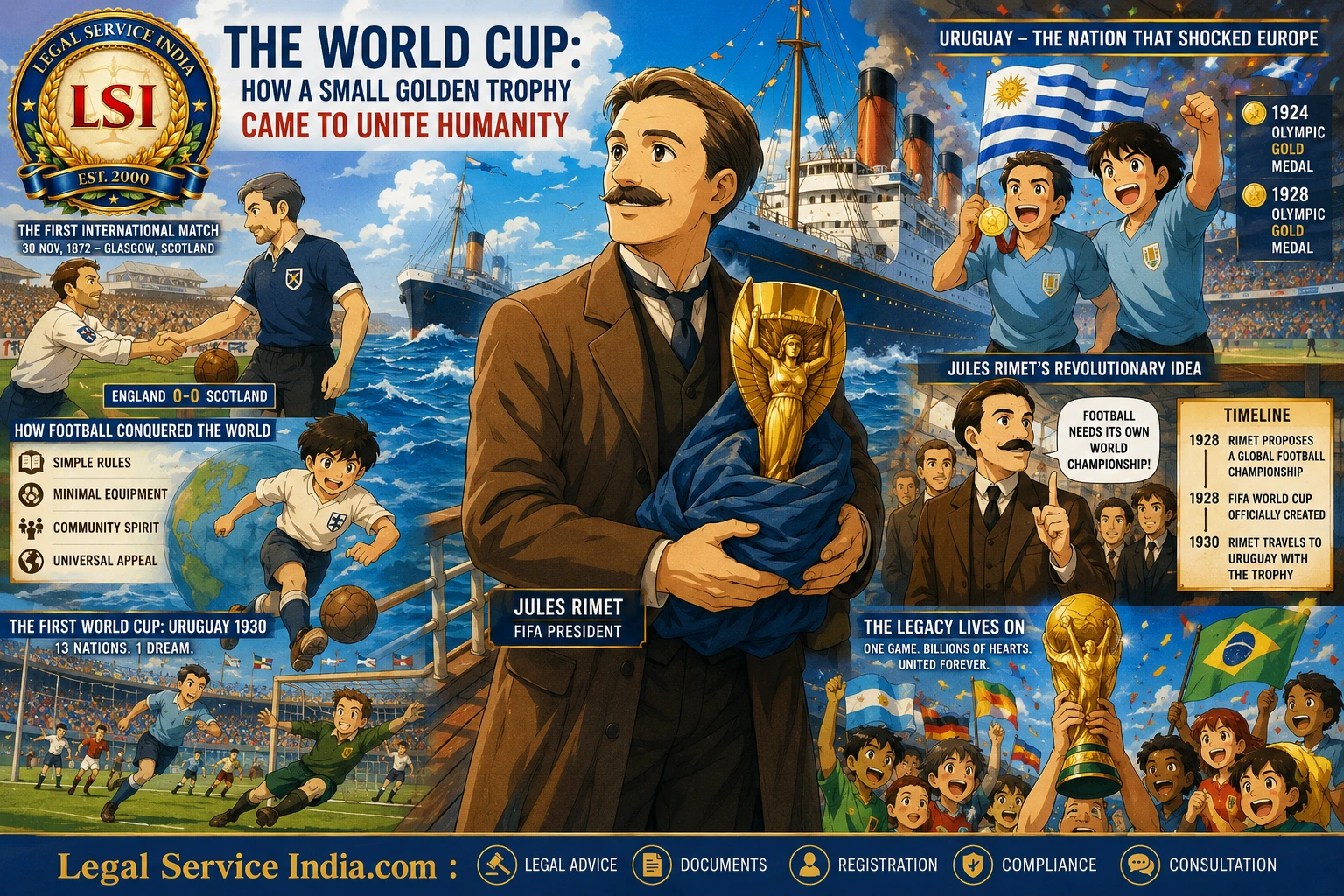
The World Cup: How a Small Golden Trophy Came to Unite Humanity
The FIFA World Cup is more than a football tournament. It is a story of vision, perseverance, and a dream that connected people across continents. What began as an ambitious idea in the early twentieth century has evolved into the largest sporting event on Earth.
The Man Who Carried a Dream Across an Ocean
Imagine standing on the deck of a ship in the middle of the Atlantic Ocean.
The sky is grey. The sea stretches endlessly in every direction. The wind is cold enough to sting your face. A man stands alone, holding a small bag close to his chest.
Inside the bag is a golden trophy.
- It weighs less than four kilograms.
- No crowds are waiting for him on the other side.
- No one knows whether his journey will succeed.
- Many people think the entire idea is unrealistic, perhaps even foolish.
Yet the man is smiling.
His name is Jules Rimet.
The year is 1930.
And he is carrying something far more important than a trophy.
He is carrying a dream.
A dream that one day people from every continent, every language, every religion, and every culture might gather around a single game and understand each other without saying a word.
Nearly a century later, that dream has become the FIFA World Cup.
Today it is watched by billions, celebrated in almost every nation on Earth, and capable of stopping entire countries in their tracks for ninety minutes.
But the greatest sporting event in history began with a simple idea and one man who refused to let it die.
The First International Match: Where the Journey Began
Long before packed stadiums, television broadcasts, sponsorship deals, and global superstars, football was little more than a pastime.
On November 30, 1872, in Glasgow, Scotland, two teams walked onto a field.
| Nation | Role in the Historic Match |
|---|---|
| England | Participating Team |
| Scotland | Participating Team |
Around 4,000 spectators gathered to watch.
- The match lasted ninety minutes.
- Nobody scored.
- The game ended 0–0.
By modern standards, it was unremarkable.
Yet it was the first official international football match in history.
For the first time, two nations agreed to compete through sport rather than conflict.
Nobody present could have imagined that this modest event would eventually grow into the largest shared cultural experience on the planet.
The seed had been planted.
How a British Game Conquered the World
Football spread rapidly from Britain.
- Merchants carried it.
- Sailors introduced it to ports.
- Workers played it in factories.
- Students carried it abroad.
Soon, football was no longer Britain’s game.
It belonged to everyone.
Across Europe, South America, Africa, and Asia, people embraced the sport because its rules were simple.
You needed little more than a ball and a patch of ground.
The game became a universal language.
| Why Football Spread Globally | Impact |
|---|---|
| Simple Rules | Easy to learn and teach |
| Minimal Equipment | Accessible to rich and poor alike |
| Community Participation | Encouraged local and international competition |
| Universal Appeal | Crossed social, cultural, and national boundaries |
Rich and poor could play it.
Children and adults could understand it.
It crossed social classes, borders, and cultures with remarkable ease.
By the early twentieth century, football had become truly international.
Yet the world was still waiting for its first global champion.
Uruguay: The Nation That Shocked Europe
At the 1924 Olympic Games in Paris, a small South American country arrived with little fanfare.
That country was Uruguay.
Europe expected its own teams to dominate.
Instead, Uruguay dazzled audiences.
- They played with creativity.
- They attacked fearlessly.
- They treated football as both art and competition.
Crowds who had never seen South American football before watched in amazement.
| Year | Achievement |
|---|---|
| 1924 | Olympic Gold Medal |
| 1928 | Olympic Gold Medal |
Uruguay won the gold medal.
Then they won again in 1928.
Europe suddenly realised something profound:
Greatness could come from anywhere.
The football world would never look the same again.
Jules Rimet’s Revolutionary Idea
Watching these events unfold was FIFA President Jules Rimet.
He believed football needed something greater than an Olympic tournament.
- It needed its own world championship.
- A competition dedicated solely to football.
In 1928, he proposed the idea to FIFA.
Many doubted him.
- The logistics seemed impossible.
- The costs were enormous.
- The risks were obvious.
Yet the proposal passed.
The FIFA World Cup was born.
From Vision to Reality
Two years later, Rimet boarded a ship bound for Uruguay, carrying football’s future in a small bag.
| Milestone | Year |
|---|---|
| Jules Rimet Proposes a Global Football Championship | 1928 |
| FIFA World Cup Officially Created | 1928 |
| Rimet Travels to Uruguay with the Trophy | 1930 |
What appeared to be a simple voyage was, in reality, the beginning of a sporting phenomenon that would unite humanity through a shared passion for football.
The small golden trophy in his bag represented far more than a prize. It symbolised hope, international friendship, and the belief that sport could bring the world together.
The rest, as history would prove, became the greatest football story ever told.
The First World Cup: Uruguay 1930
The inaugural tournament nearly collapsed before it began.
The Great Depression was spreading across the world.
Travel to South America required a lengthy sea voyage.
European Nations Decline Participation
Many European nations declined.
- England stayed home.
- Germany stayed home.
- Italy stayed home.
- Spain stayed home.
Eventually, only France, Belgium, Yugoslavia, and Romania agreed to travel.
Romania’s squad was reportedly selected personally by King Carol II himself.
Thirteen nations arrived in Montevideo.
First Goal in World Cup History
On July 13, 1930, French player Lucien Laurent scored the first goal in World Cup history.
Today, millions know the names of modern football superstars.
Few remember Laurent.
Yet history never forgets firsts.
Uruguay vs Argentina Final
| Match Detail | Information |
|---|---|
| Final | Uruguay vs Argentina |
| Result | Uruguay 4–2 Argentina |
| Venue | Montevideo |
| Attendance | Nearly 93,000 Spectators |
| Trophy Presentation | Jules Rimet Handed Over the Trophy |
Uruguay defeated Argentina 4–2 in the final before nearly 93,000 spectators.
Jules Rimet handed over the trophy.
His dream had survived its first test.
The Lesson That Changed Football Forever
The first World Cup revealed a truth that still defines the tournament today.
- In football, reputation guarantees nothing.
- Power guarantees nothing.
- Money guarantees nothing.
- Small nations can defeat giants.
- Unknown players can become legends.
That lesson would return again and again throughout World Cup history.
The Day 200,000 People Fell Silent
Brazil hosted the World Cup in 1950.
The nation expected victory.
The Maracanã Stadium in Rio de Janeiro held nearly 200,000 spectators.
Brazil needed only a draw against Uruguay to become champions.
Celebrations had already begun.
Newspapers had already printed victory headlines.
Then disaster struck.
The Maracanazo
Uruguay scored.
Then scored again.
Brazil lost.
An entire nation fell silent.
The event became known as the Maracanazo—the Shock of the Maracanã.
Decades later, Uruguay’s winning goalscorer joked that only three people had ever silenced the Maracanã:
- Frank Sinatra.
- The Pope.
- And himself.
The World Cup had once again reminded humanity that certainty is an illusion.
A Boy, A Grapefruit, and a Dream Called Pelé
In 1958, a seventeen-year-old Brazilian boy arrived in Sweden.
His family was poor.
As a child, he often practised with a grapefruit stuffed into a sock because proper footballs were expensive.
His name was Edson Arantes do Nascimento.
The world would know him as Pelé.
Youngest World Cup Final Star
| Achievement | Details |
|---|---|
| Tournament | 1958 FIFA World Cup |
| Age | 17 Years Old |
| Final Goals | 2 |
| Outcome | Brazil Won the World Cup |
He became the youngest player ever to appear in a World Cup final.
He scored twice.
Brazil won.
When the final whistle blew, Pelé collapsed in tears.
At seventeen years old, he had become football’s brightest star.
His story inspired generations of children who dreamed beyond their circumstances.
Garrincha: The Genius Who Wasn’t Supposed to Run
Football’s greatest stories are often stories of defiance.
Garrincha was born with severely deformed legs.
Doctors doubted he would ever run properly.
Instead, he became one of the greatest dribblers the sport has ever seen.
Carrying Brazil in 1962
When Pelé was injured during the 1962 World Cup, Garrincha carried Brazil forward almost single-handedly.
- He played with joy.
- He played with freedom.
- He played as though football was life’s greatest gift.
Brazil became champions again.
The impossible had happened once more.
The Beautiful Game Reaches Perfection
The 1970 World Cup in Mexico produced what many still consider the greatest team in football history.
Brazil combined Pelé with a collection of extraordinary talents.
Their football seemed effortless.
- Elegant.
- Creative.
- Beautiful.
Carlos Alberto’s Iconic Goal
In the final against Italy, a flowing move ended with Carlos Alberto scoring one of the most celebrated goals ever witnessed.
| 1970 World Cup Final | Details |
|---|---|
| Final | Brazil vs Italy |
| Result | Brazil 4–1 Italy |
| Historic Achievement | Third World Cup Title |
| Trophy Outcome | Jules Rimet Trophy Permanently Awarded to Brazil |
Brazil won 4–1.
The Jules Rimet Trophy was permanently awarded to them after their third title.
The world gave a name to what Brazil had shown:
Jogo Bonito—The Beautiful Game.
The Trophy Hidden in a Shoebox
Not every World Cup chapter is glorious.
World War II stopped the tournament entirely.
- No World Cups were held in 1942.
- No World Cups were held in 1946.
The trophy itself faced danger.
Italian FIFA Vice-President Ottorino Barassi feared Nazi forces might seize it.
He secretly removed the trophy.
- Wrapped it in cloth.
- Placed it inside a shoebox.
- And hid it beneath his bed.
For years he protected football’s greatest treasure.
| Key Element | Details |
|---|---|
| Protector | Ottorino Barassi |
| Method | Hidden inside a shoebox beneath his bed |
| Purpose | Protect the World Cup trophy during World War II |
One man.
One shoebox.
One belief that the game would return.
He was right.
Pickles the Dog Saves Football
In 1966, another extraordinary incident occurred.
The World Cup trophy was stolen in England.
Police searched everywhere.
Days passed.
Nothing.
Then a dog named Pickles discovered a package hidden beneath a bush in South London.
Inside was the missing trophy.
Pickles became a national hero.
- He received fan mail.
- Appeared on television.
- And secured his place in football folklore.
The Trophy’s Final Disappearance
Many people do not know the final chapter of the Jules Rimet Trophy.
After Brazil permanently received it in 1970, the trophy remained in the country.
In 1983, it was stolen again.
This time it was never recovered.
Authorities believe it was melted down by thieves.
The original trophy Jules Rimet carried across the Atlantic no longer exists.
The trophy lifted today is a different one, introduced in 1974.
Yet the spirit behind it remains unchanged.
| Year | Event |
|---|---|
| 1970 | Brazil permanently received the Jules Rimet Trophy |
| 1983 | Trophy stolen again |
| Outcome | Never recovered and believed to have been melted down |
| 1974 | The current FIFA World Cup trophy was introduced |
Television Turned Football into a Global Religion
Another revolution transformed the World Cup.
Television.
Early tournaments were witnessed only by those inside stadiums.
Then television arrived.
By 1970, satellite technology enabled live broadcasts across continents.
Suddenly, millions could watch together.
A football match in Mexico could be seen in Europe, Africa, Asia, and South America simultaneously.
The World Cup was no longer a sporting event.
It had become a global experience.
How Television Changed the World Cup
- Expanded audiences beyond stadiums.
- Connected continents through live broadcasts.
- Created shared global sporting moments.
- Transformed football into a worldwide cultural phenomenon.
Football, Politics, and the World Stage
The World Cup has never existed in isolation from world events.
Political tensions often followed the tournament.
The Cold War cast its shadow over several competitions.
The 1974 meeting between East Germany and West Germany became more than a football match.
Argentina hosted the tournament in 1978 during military rule.
Political debates surrounded the event.
Yet despite these controversies, football continued to provide rare moments when divided nations could meet peacefully.
The World Cup became one of humanity’s few truly global stages.
Major Political Moments
| Year | Event | Significance |
|---|---|---|
| 1974 | East Germany vs West Germany | Symbolic Cold War encounter |
| 1978 | Argentina World Cup | Held during military rule amid political debate |
India’s Forgotten World Cup Story
Few people realise that India once qualified for the World Cup.
In 1950, India earned a place in the tournament after several Asian teams withdrew.
However, India ultimately did not participate.
Various explanations have been offered over the decades, including financial difficulties and logistical challenges.
It remains one of football’s great unanswered “what if” questions.
Had India played in Brazil, the history of football in South Asia might have unfolded very differently.
India’s 1950 World Cup Opportunity
- Qualified for the tournament.
- Benefited from withdrawals by other Asian teams.
- Did not participate in the final competition.
- Remains one of football history’s greatest unanswered questions.
Opening the Doors to the Entire World
For decades, the World Cup remained dominated by Europe and South America.
Africa fought for recognition.
Asia sought greater representation.
At the 1966 World Cup, African nations boycotted the competition in protest against unequal qualification opportunities.
Their message was simple:
“We exist.”
The protest succeeded.
- Africa received guaranteed places.
- The tournament expanded.
- Twenty-four teams in 1982.
- Thirty-two teams in 1998.
- And eventually forty-eight teams.
The World Cup was becoming truly global.
World Cup Expansion Timeline
| Year | Number of Teams |
|---|---|
| 1982 | 24 Teams |
| 1998 | 32 Teams |
| Eventually | 48 Teams |
The Great Upsets That Changed History
The World Cup thrives on surprises.
- North Korea stunned Italy in 1966.
- Cameroon defeated defending champions Argentina in 1990.
- Senegal shocked France in 2002.
- Saudi Arabia defeated Argentina in 2022.
These moments remind us why billions watch.
The World Cup does not reward reputation.
It rewards performance.
For ninety minutes, every nation has a chance.
Historic World Cup Upsets at a Glance
| Year | Upset Result |
|---|---|
| 1966 | North Korea stunned Italy |
| 1990 | Cameroon defeated Argentina |
| 2002 | Senegal shocked France |
| 2022 | Saudi Arabia defeated Argentina |
Morocco and the Dream of a Continent
In 2022, Morocco achieved what no African nation had done before.
- They defeated Belgium.
- Spain.
- Portugal.
- They reached the semi-finals.
Celebrations erupted across Africa.
One image captured the moment perfectly.
After defeating Spain, Ashraf Hakimi ran to embrace his mother in the stands.
The photograph spread across the globe.
It represented:
- Sacrifice
- Family
- Dreams
- Gratitude
Everything the World Cup means beyond football.
Messi’s Final Quest
The 2022 World Cup also delivered one of football’s greatest endings.
For nearly two decades, Lionel Messi had conquered almost every challenge.
Yet one achievement remained elusive.
The World Cup.
At age thirty-five, he led Argentina to glory.
The final against France became one of the greatest matches ever played.
When Messi finally lifted the trophy, millions felt they had witnessed history.
The image instantly joined football’s most iconic moments.
The Rise of Women’s Football
The vision that began with Jules Rimet continues to expand.
The FIFA Women’s World Cup has grown dramatically in popularity and importance.
- Record crowds.
- Record television audiences.
- Record participation.
Women’s football has shown that the universal appeal of the game transcends gender and geography.
The global football family continues to grow.
The 2026 World Cup: A New Era
The 2026 World Cup marks another historic step.
For the first time, three countries—the United States, Mexico, and Canada—are hosting together.
Forty-eight nations will participate.
- More teams.
- More stories.
- More dreams.
Millions will travel.
Billions will watch.
Children who have never seen their country on football’s biggest stage may finally experience that moment.
New heroes will emerge.
New legends will be born.
2026 World Cup Key Highlights
| Feature | Details |
|---|---|
| Host Nations | United States, Mexico, and Canada |
| Participating Teams | 48 Nations |
| Significance | First World Cup hosted by three countries |
Why Billions Still Care
People do not watch the World Cup merely because it is football.
They watch because they see themselves in it.
The tournament is filled with stories of the following:
- Hope
- Sacrifice
- Failure
- Redemption
- Family
- Perseverance
- Courage
- Unexpected triumph
Every generation finds its own heroes.
Every nation finds its own memories.
Every tournament produces moments that become part of collective human history.
The Trophy Is Only an Excuse
When Jules Rimet stood on that ship in 1930, he was not carrying gold.
He was carrying belief.
A belief that people separated by oceans, borders, politics, languages, and cultures could still share something meaningful.
Nearly a century later, that belief remains alive.
- The World Cup belongs to Pelé practising with a grapefruit.
- It belongs to Garrincha, who ran despite being told he could not.
- It belongs to Ottorino Barassi protecting a trophy beneath his bed.
- It belongs to Pickles the dog.
- It belongs to Ashraf Hakimi and his mother.
- It belongs to Messi finally completing his journey.
- It belongs to Morocco, inspiring a continent.
- It belongs to every child kicking a ball in a dusty street and imagining greatness.
The trophy itself is merely an object.
The real prize is hope.
Humanity’s Shared Story
From a scoreless match in Glasgow in 1872 to the grand stages of 2026 and beyond, the World Cup has become humanity’s shared story—a reminder that even in a divided world, billions of people can still dream together.
And perhaps that is Jules Rimet’s greatest victory of all.
Key Takeaways
- The FIFA World Cup unites humanity through football, starting from Jules Rimet’s dream in 1930.
- The tournament began with the first official match in 1872, showcasing football’s potential for peaceful competition.
- Uruguay shocked Europe in the 1920s, leading to the establishment of the World Cup as a global championship.
- Over the decades, football evolved into a cultural phenomenon, breaking down social and national barriers.
- The World Cup continues to inspire hope and represents humanity’s shared dreams, culminating in iconic moments and stories.