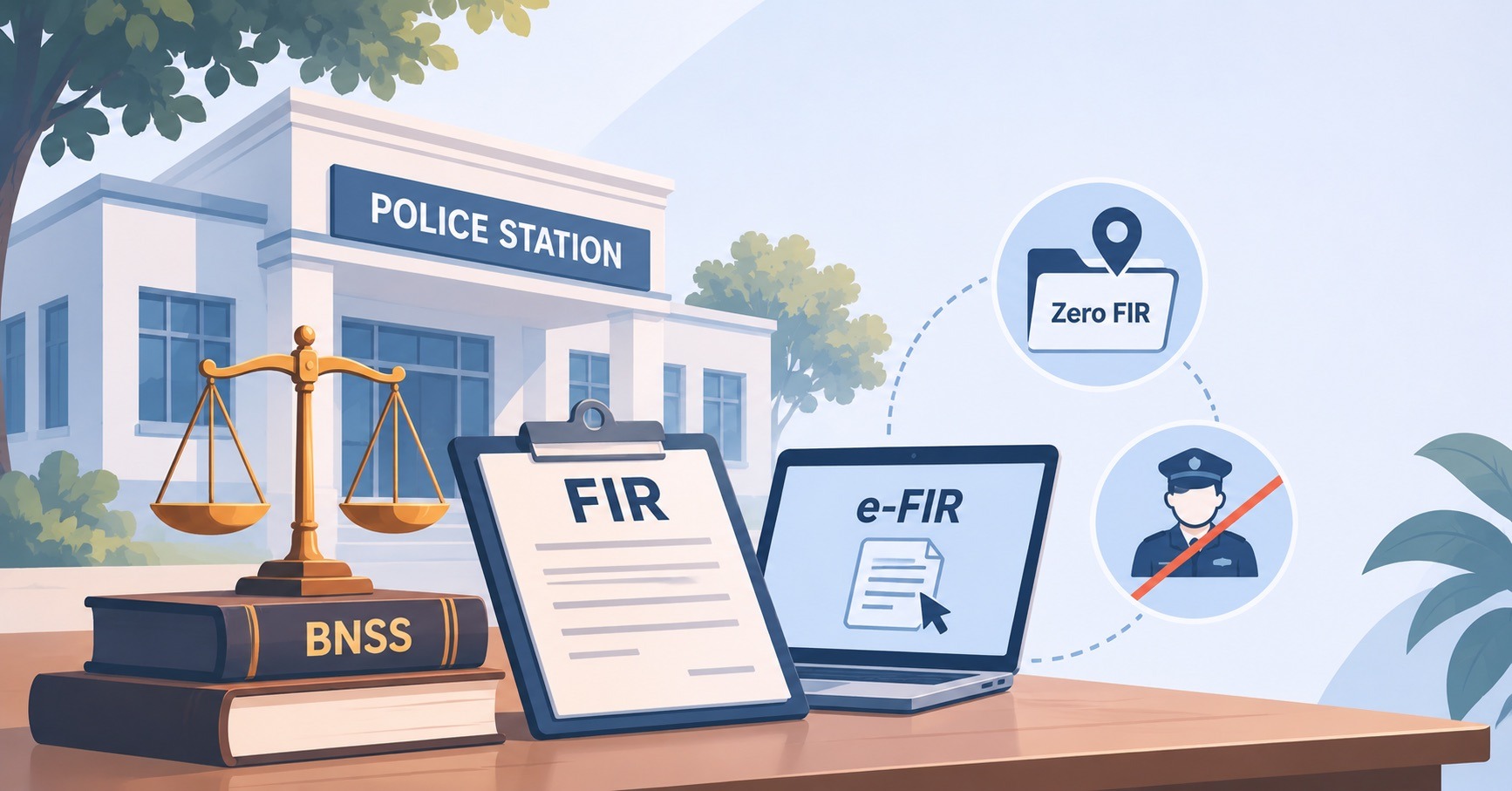
FIR Registration Under BNSS: Procedure, Rights and Remedies Against Police Refusal
Every criminal case in India begins with a single document: the First Information Report. It sets the criminal law in motion, fixes the version of events the investigation will test, and very often decides whether a victim will see justice at all. A delayed, diluted or refused FIR can weaken a case before the first witness is examined.
The scale is enormous. According to the National Crime Records Bureau’s Crime in India 2024 report, released in May 2026, India registered 5,885,867 cognisable crimes in 2024, the first year to include cases under the Bharatiya Nyaya Sanhita, 2023. Cybercrime crossed one lakh registered cases for the first time, at 101,928 (NCRB). Behind each of those numbers is an FIR that someone had to get registered.
Since 1 July 2024, the law on registering an FIR is no longer found in Section 154 of the Code of Criminal Procedure, 1973. It now sits in Section 173 of the Bharatiya Nagarik Suraksha Sanhita, 2023 (BNSS), with the remedies against police inaction spread across Sections 173(4) and 175(3). The official texts of the three new criminal laws are available on the Ministry of Home Affairs website.
This article explains, section by section, how an FIR is registered under the BNSS, what has changed, what a complainant is entitled to, and what to do when the police refuse to act.
Section 173 BNSS: What Changed From Section 154 CrPC?
The core duty is unchanged. When information about a cognisable offence is given to the officer in charge of a police station, it must be reduced to writing and entered in the prescribed register. The BNSS keeps that duty and adds three reforms that matter in practice. (For a section-wise map of old and new provisions, see this CrPC vs BNSS comparative chart.)
1. Zero FIR Is Now Statutory
Section 173(1) requires information to be recorded “irrespective of the area where the offence is committed”. Before 2024, the Zero FIR existed only through court decisions and administrative circulars. Now it is the text of the law.
A victim of an offence committed in Mohali can therefore walk into a police station in Chandigarh and insist on registration. The station records the FIR and transfers it to the police station with territorial jurisdiction. “This did not happen in our area” is no longer a lawful reason to turn a complainant away.
2. e-FIR: Information by Electronic Communication
Section 173(1)(ii) allows information to be given by electronic communication. It is taken on record once the person giving it signs within three days. This is a meaningful shift: a complainant no longer has to be physically present at the police station to set the process in motion.
Most states now offer citizen portals through the CCTNS network. Haryana residents can use the citizen services on the Haryana Police website, and the Union Territory of Chandigarh offers e-FIR for specified categories such as vehicle theft.
3. A Free Copy to the Informant and the Victim
Section 173(2) requires a copy of the recorded information to be given free of cost, forthwith, to the informant or the victim. Under Section 154(2) CrPC, the right belonged only to the informant. A victim who did not personally lodge the report, for instance, where a relative did, now has an independent right to the copy.
4. FIRs Must Be Visible Online
The Supreme Court in Youth Bar Association of India v. Union of India (2016) 9 SCC 473 directed that FIRs be uploaded on police websites within 24 hours of registration, save for sensitive categories. Read with the new e-FIR framework, a complainant should be able to verify registration quickly and remotely.
Preliminary Enquiry: The 3-to-7-Year Window
The most debated change is Section 173(3). For a cognisable offence punishable with imprisonment of three years or more but less than seven years, the officer in charge may, with the prior permission of an officer not below the rank of Deputy Superintendent of Police and considering the nature and gravity of the offence, either:
- Conduct a preliminary enquiry to ascertain whether there is a prima facie case, to be completed within 14 days; or
- Proceed with investigation straight away where a prima facie case exists.
To understand why this matters, recall Lalita Kumari v. Government of Uttar Pradesh (2014) 2 SCC 1. A Constitution Bench held that registration of an FIR is mandatory where the information discloses a cognisable offence. It allowed a preliminary enquiry only in limited categories, such as matrimonial and family disputes, commercial offences, medical negligence, corruption cases and cases with abnormal delay, and only to check whether a cognisable offence is disclosed, not to test whether the information is true. Such an enquiry was to be completed within seven days.
Section 173(3) departs from that framework in three ways:
- The trigger is the punishment, not the category of case. Any offence in the three-to-seven-year bracket qualifies, including simple cheating and criminal breach of trust, which are among the most common complaints police stations receive.
- The time limit is 14 days, not seven.
- The purpose is wider. The enquiry asks whether a prima facie case exists, which invites more scrutiny than Lalita Kumari’s narrower question of whether a cognisable offence is disclosed.
The safeguards remain important. The enquiry needs DSP-level permission, it is time-bound, and for offences punishable with seven years or more, registration remains mandatory with no preliminary enquiry. A complainant whose matter is placed under enquiry should note the date, ask for the reference number, and follow up firmly once 14 days pass.
When the Police Refuse to Register an FIR: A Three-Step Ladder
Refusal to register an FIR remains one of the most common grievances in criminal practice. The BNSS builds a structured ladder, and the order of its steps now matters more than ever.
Step 1: Write to the Superintendent of Police (Section 173(4)).
If the officer in charge refuses to record the information, the aggrieved person may send the substance of it, in writing and by post, to the Superintendent of Police. If satisfied that a cognisable offence is disclosed, the SP must either investigate personally or direct a subordinate officer to investigate.
Keep proof of dispatch: a speed-post receipt, a diary number, or an acknowledgement from the SP’s office. You will need it at the next step.
Step 2: Apply to the Magistrate (Section 175(3))
If the SP also fails to act, the complainant may apply to a magistrate empowered under Section 210 BNSS. This is the successor to the familiar Section 156(3) CrPC application, but with important new conditions:
- The application must be supported by an affidavit. This codifies Priyanka Srivastava v. State of Uttar Pradesh (2015) 6 SCC 287, where the Supreme Court required affidavits to deter frivolous applications.
- The complainant must show that the remedy before the SP under Section 173(4) was actually pursued.
- The magistrate may make such enquiries as necessary and must consider the submissions of the police officer before ordering an investigation.
The Supreme Court confirmed these three departures from the old Section 156(3) in Om Prakash Ambadkar v. State of Maharashtra, 2025 INSC 139 (Verdictum report). In practice, an application filed without the affidavit or without proof of the SP step is liable to be rejected, and an investigation ordered on it is open to challenge.
Step 3: The Private Complaint and Constitutional Remedies
The complainant can also file a private complaint before the magistrate. Where the facts justify it, the magistrate takes cognisance and conducts the enquiry. In exceptional cases involving gross police inaction or a demonstrable violation of rights, a writ petition before the High Court remains available. Courts, however, generally expect the statutory ladder to be exhausted first.
A Word of Caution
The law protects complainants, but it also punishes false complaints. Giving false information to a public servant is an offence under Section 217 of the Bharatiya Nyaya Sanhita, and instituting criminal proceedings on a false charge is an offence under Section 248. An affidavit under Section 175(3) is a sworn statement, so draft it accurately.
Special Protections: Women, Persons With Disabilities and Cybercrime Victims
Women and Persons With Disabilities
The provisos to Section 173(1) carry forward and strengthen protections first introduced in 2013. Where information about specified sexual offences is given by the woman against whom the offence is alleged, it must be recorded by a woman police officer or any woman officer.
Where the victim is temporarily or permanently mentally or physically disabled, the information must be recorded at her residence or a place of her choice, in the presence of an interpreter or special educator where needed, and the recording must be videographed. The aim is to remove the police station as a barrier to reporting.
These protections sit alongside the BNSS’s wider victim-centric design, which the Government summarised in its highlights of the new criminal laws.
Cybercrime: Speed Is Everything
With cybercrime registrations rising to 101,928 cases in 2024, an online fraud complaint is now one of the most common reasons people approach the police. Two national channels exist:
- Helpline 1930, the national cyber-fraud helpline, for immediate reporting of financial fraud so that the money trail can be frozen; and
- The National Cyber Crime Reporting Portal, for registering complaints online, including anonymous reporting of certain categories.
In financial frauds, the first few hours decide whether the money can be traced and frozen before it is moved, so call 1930 first. Then follow up with a written complaint and an FIR, attaching transaction IDs, screenshots, bank statements and the suspect’s numbers or handles.
Several States run their own portals as well; Punjab, for example, operates a dedicated cybercrime reporting portal. A complaint on a portal does not replace the FIR where a cognizable offence is made out. Insist on registration under Section 173.
After the FIR: The Victim’s Rights Continue
Registration is the beginning, not the end. The BNSS gives the victim rights that run through the investigation.
Progress Updates Within 90 Days
Under Section 193(3)(ii), the police must inform the informant or victim of the progress of the investigation within 90 days, including by electronic communication. A victim who hears nothing for three months has a statutory basis to demand an update in writing.
Forensic Investigation in Serious Cases
Under Section 176(3), for offences punishable with seven years or more, a forensic expert must visit the crime scene to collect evidence, and the process is to be videographed. A complainant can legitimately ask whether this was done.
A Copy of the Police Report
Under Section 230, a victim represented by an advocate is entitled, free of cost, to copies of the police report and the documents relied on, which allows meaningful participation at trial.
Free Legal Aid
Victims who cannot afford a lawyer can approach the District or State Legal Services Authority. Information on eligibility and how to apply is available from the National Legal Services Authority.
If the police later file a closure report, the informant must be given notice and an opportunity to be heard before the Magistrate accepts it. The FIR is therefore not only a starting point but also an anchor that keeps the investigation accountable.
A Practical Checklist for Complainants
Drawn from everyday criminal practice, these steps make the difference between an FIR that holds up and one that unravels.
- Write it down before you go. A short, dated, signed written complaint, setting out who, what, when and where, prevents your account from being reshaped in the station.
- Stick to facts. Describe what happened; leave the choice of legal sections to the police. Avoid exaggeration, because inconsistencies are the first thing the defence will test.
- Report promptly, or explain the delay. Unexplained delay is a routine ground of attack at trial. If there is a reason, such as medical treatment, fear or an attempt at settlement, state it in the complaint.
- Ask for the free copy under Section 173(2), and check that what was recorded matches what you said.
- Note the FIR number and police station, and check it on the State police website.
- If refused, go up the ladder in order: SP under Section 173(4) by post, keeping proof, then the Magistrate under Section 175(3) with an affidavit.
- For online fraud, call 1930 immediately, then file on cybercrime.gov.in and pursue the FIR.
- Preserve evidence: screenshots, call records, medical reports, CCTV references and the names of witnesses.
- Follow up at 90 days under Section 193(3)(ii) if you have not heard about the progress of the investigation.
- Take advice early in serious matters. The drafting of the first complaint often shapes the entire case.
Conclusion
The BNSS has made registering an FIR easier on paper. A statutory Zero FIR, e-FIR, a free copy for the victim and time-bound updates are real gains for citizens. It has also added new filters: the 14-day preliminary enquiry for mid-range offences, and a stricter path to the Magistrate that demands an affidavit and proof that the SP was approached first.
The result is a system that rewards complainants who know the procedure and penalises those who skip steps. For victims, the lesson is to act promptly, document everything and climb the statutory ladder in the right order. For the police, the message from Lalita Kumari still stands: where a cognizable offence is disclosed, registration is a duty, not a favour.
References
- Ministry of Home Affairs – The new criminal laws (BNS, BNSS, BSA)
- Press Information Bureau – Highlights of the new criminal laws
- National Crime Records Bureau – Crime in India reports
- Indian Cyber Crime Coordination Centre – National Cyber Crime Reporting Portal
- National Legal Services Authority – Free legal aid
- Haryana Police – Citizen services
- Punjab Police – Cybercrime reporting portal
- Om Prakash Ambadkar v. State of Maharashtra, 2025 INSC 139 – Verdictum report
- Sheokand Legal – CrPC vs BNSS comparative chart
Cases Cited
- Lalita Kumari v. Government of Uttar Pradesh, (2014) 2 SCC 1;
- Priyanka Srivastava v. State of Uttar Pradesh, (2015) 6 SCC 287;
- Youth Bar Association of India v. Union of India, (2016) 9 SCC 473.
About the Author
Written By: Naveen Sheokand is an Advocate and Managing Partner at Sheokand Legal, practising criminal law before the Punjab & Haryana High Court and the district courts of Chandigarh.
Disclaimer: This article is for general information and does not constitute legal advice.