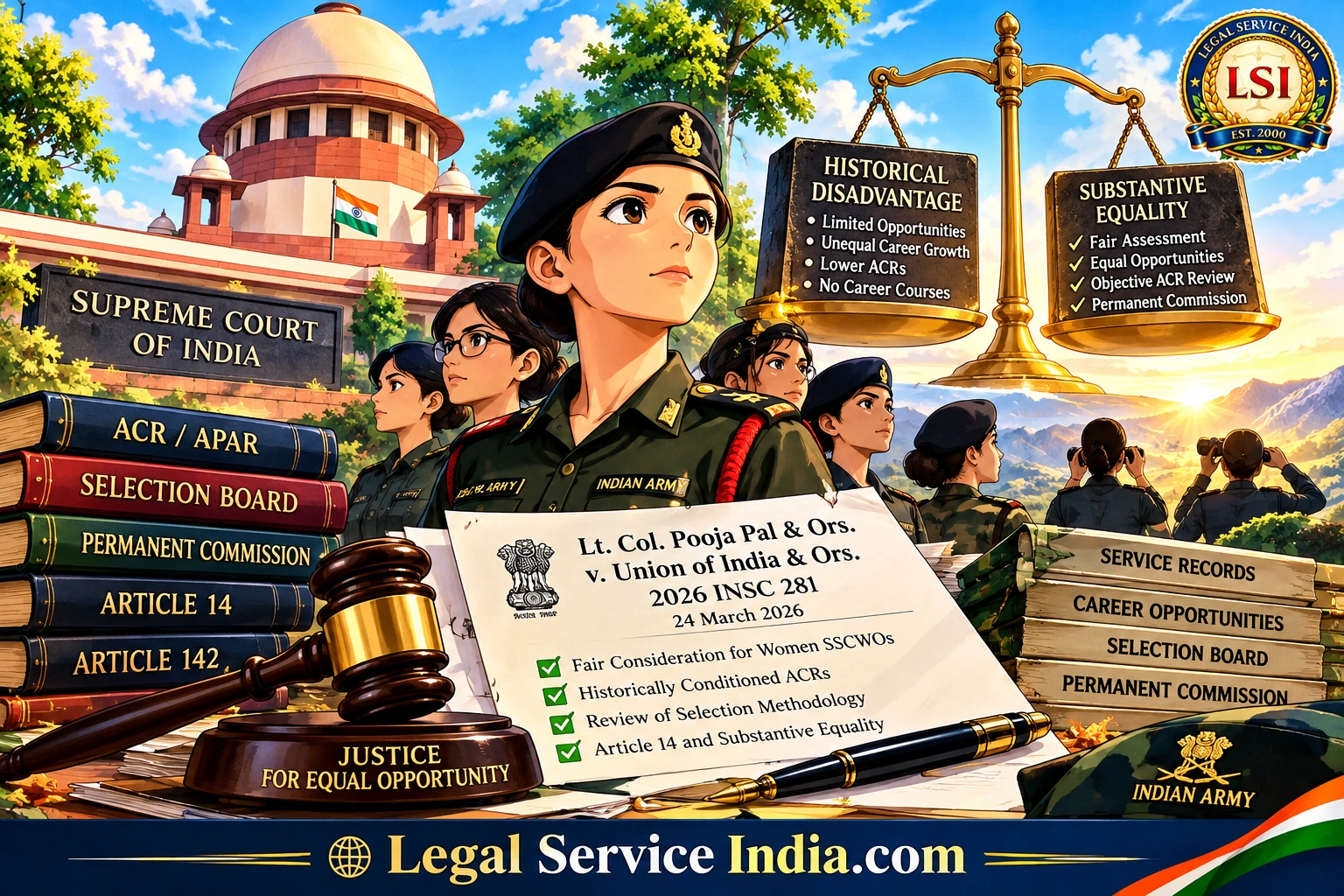
Women SSCWOs, Permanent Commission, and the Supreme Court’s 24 March 2026 Judgment: When an Unfair Past Enters Today’s Service Record
Introduction: Your Final Rejection May Not Tell the Whole Story
In service litigation, the most important part of a case is sometimes not the final order.
It may be the history behind that order.
An officer may receive a rejection from a selection board. A promotion may be denied. An ACR or APAR may appear lower than expected. A career-enhancing course may not have been offered. A particular appointment may have gone to someone else.
On the face of it, the final decision may look completely neutral.
But what if the record on which that decision was based was created at a time when the officer did not have the same career opportunities as others?
What if the ACR was written when the institution itself did not expect that officer to have a long-term career?
What if professional courses, appointments, or other career-building opportunities were unavailable because of the rules that existed at that time?
And what if those historical disadvantages were later placed into a numerical selection system and used to determine comparative merit?
That is where the Supreme Court’s judgment in Lt. Col. Pooja Pal & Ors. v. Union of India & Ors., 2026 INSC 281, decided on 24 March 2026, becomes particularly important.
The case concerned women Short Service Commission Officers of the Indian Army and their consideration for Permanent Commission.
But its importance extends beyond the immediate dispute.
The judgment requires us to look at an issue that can arise in many service matters:
Can a present-day decision genuinely be called neutral when the records used to make that decision were themselves created under historically unequal conditions?
The Supreme Court’s answer, on the facts before it, was that the history embedded in those records could not simply be ignored.
For officers facing service-related adversity, that is a significant legal point.
It means that a lawyer examining a service dispute may need to look beyond the final rejection and examine how the record leading to that rejection was created in the first place.
The Supreme Court Judgment at a Glance
| Particular | Details |
|---|---|
| Case | Lt. Col. Pooja Pal & Ors. v. Union of India & Ors. |
| Citation | 2026 INSC 281 |
| Date | 24 March 2026 |
| Court | Supreme Court of India |
| Bench | Chief Justice Surya Kant, Justice Ujjal Bhuyan, and Justice Nongmeikapam Kotiswar Singh |
| Authoring Judge | Chief Justice Surya Kant |
| Lead Appeals | Civil Appeal Nos. 9747–9757 of 2024 and connected matters |
| Constitutional Provisions | Articles 14 and 142 |
| Principal Issue | Fair consideration of women SSC officers for permanent commission |
| Important Precedent | Lt. Col. Nitisha v. Union of India, 2021 INSC 210 |
| Earlier Foundation | Secretary, Ministry of Defence v. Babita Puniya, (2020) 7 SCC 469 |
| Central Question | Whether historically conditioned ACRs and unequal career opportunities distorted later comparative assessment |
| Relief | A limited and specified Article 142 remedial package for defined categories |
The Court ultimately disposed of the appeals and modified the relevant Armed Forces Tribunal judgments. Officers considered in later selection boards were left to pursue their ordinary legal remedies, while the methodology for future batches was directed to be reviewed.
Why This Judgment Matters to Service Officers
The legal issue becomes easier to understand if we put the technical language aside for a moment.
Imagine two officers entering a competitive assessment.
Today, both are judged by exactly the same formula.
That appears equal.
But suppose that, for several years before that assessment, one officer had been denied access to professional courses, appointments, or career opportunities that the other officer routinely received.
Suppose the first officer’s ACRs were also written during a period when the organization did not regard that officer as having the same long-term career prospects.
By the time the final selection takes place, the two officers may technically be competing under identical rules.
But they are not necessarily bringing identical histories into that competition.
That was the constitutional difficulty examined by the Supreme Court.
The judgment is therefore important because it shifts attention from merely asking:
“Was the final selection process the same for everyone?”
to the more fundamental question:
“Were the inputs into that selection process themselves created under comparable conditions?”
For service-law litigation, that distinction can be critical.
From Babita Puniya to Nitisha to Pooja Pal
The 2026 judgment should not be read in isolation.
It is part of a developing line of Supreme Court jurisprudence concerning women officers and substantive equality.
Babita Puniya: The Door to Permanent Commission
In Secretary, Ministry of Defence v. Babita Puniya, (2020) 7 SCC 469, the Supreme Court fundamentally changed the legal position concerning consideration of women officers for Permanent Commission in the relevant services.
The significance was enormous.
Permanent commission is not simply about continuing employment.
It affects:
- length of service;
- career progression;
- professional appointments;
- training and courses;
- promotional opportunities;
- pensionary benefits; and
- long-term career development.
But opening the door to consideration created another question.
What happens to officers whose careers had already been shaped by the earlier system?
That question became central in Nitisha.
Nitisha: Equality Is More Than Applying the Same Formula
In Lt. Col. Nitisha & Ors. v. Union of India & Ors., 2021 INSC 210, the Supreme Court examined whether formally neutral criteria could nevertheless reproduce disadvantages created by an earlier institutional structure.
The significance of Nitisha lies in its substantive-equality approach.
The Court considered issues including:
- indirect discrimination;
- systemic disadvantage;
- ACR evaluation;
- medical standards;
- access to career-enhancing opportunities;
- disproportionate impact; and
- the operation of selection criteria upon women officers.
The constitutional question therefore moved beyond:
“Was there an openly discriminatory rule?”
It also became necessary to ask:
“Does an apparently neutral rule reproduce the consequences of an earlier unequal institutional structure?”
That principle provides the doctrinal foundation for understanding Pooja Pal.
Pooja Pal: What Happens When Inequality Becomes Part of the Record?
This is where the 24 March 2026 judgment becomes particularly significant.
The women officers before the Supreme Court were considered through regular No. 5 Selection Boards for 2020 and 2021.
Their ACRs were an important part of the evaluation.
But many of those ACRs had been written before the legal transformation brought about by Babita Puniya.
At the time those records were prepared, women SSCWOs outside JAG and AEC were generally regarded as not having the same entitlement to Permanent Commission.
That institutional reality mattered.
The Supreme Court examined whether the absence of a meaningful long-term career horizon could affect:
- expectations regarding the officer’s career;
- professional opportunities;
- ACR assessment;
- appointments;
- courses; and
- the eventual comparative assessment.
The Court concluded that the problem could not simply be reduced to isolated individual assessments.
It identified a systemic framework rooted in assumptions that entrenched disadvantages in career progression.
That is a very important distinction.
The court was not saying that every reporting officer consciously intended to discriminate.
The issue was deeper.
The institutional structure itself could influence the circumstances in which records were created.
And those records could later become evidence of “merit” in a completely different legal environment.
The ACR Issue: Why 75 Marks Matter
The importance of the ACR issue becomes even clearer when the selection methodology is examined.
The ACR/Overall Average Performance component carried 75 out of 100 marks.
That is not a peripheral consideration.
If an officer’s historical ACR grading had been affected by the institutional circumstances in which those reports were prepared, the consequences could follow the officer into the later selection process.
The factual sequence identified in the judgment can therefore be understood as follows:
| Stage | Potential Consequence |
|---|---|
| 1 | Historical exclusion from Permanent Commission |
| 2 | No meaningful perceived career horizon |
| 3 | Different institutional expectations and opportunities |
| 4 | Consequences in ACRs and career profiles |
| 5 | Later use of those records in comparative selection |
| 6 | Potential reduction in comparative merit |
The significance of the judgment lies in the court examining that entire chain rather than looking only at the final selection board.
Why Anonymization Did Not End the Constitutional Problem
One of the important arguments advanced by the government was that the final selection board was anonymized.
The argument was straightforward.
If the Selection Board did not know the identity or gender of the officer, how could gender discrimination affect the final assessment?
The Supreme Court did not regard anonymization as a complete answer.
The reason is important.
The anonymity existed at the final stage.
But the ACRs had already been prepared.
The officers preparing those records knew whom they were assessing and did so within the institutional framework existing at that time.
In other words, the potential disadvantage had already entered the record before the anonymous assessment took place.
This leads to an important proposition:
A neutral decision-maker cannot necessarily neutralize an unequal input simply by making the final decision anonymously.
For lawyers handling service matters, this is potentially an important evidentiary insight.
The investigation may need to begin much earlier than the final Selection Board.
“Institutional Bias” — An Important Phrase, But One That Requires Precision
The expression “institutional bias” is useful in describing the concern raised by the case.
But there is an important legal distinction.
The Supreme Court did not announce a standalone constitutional doctrine formally called “institutional bias.”
The judgment uses expressions including
- institutional mindset;
- systemic pattern;
- systemic framework;
- systematic traits;
- differential treatment;
- disproportionate impact; and
- unfair and unequal consideration.
The safer legal description is therefore
The Supreme Court addressed systemic disadvantage embedded in administrative records and evaluation.
That formulation is more precise.
The real development in Pooja Pal is not the creation of a brand-new constitutional test.
Rather, it is the application of the substantive-equality reasoning of Nitisha to a particularly difficult factual problem:
The consequences of historical inequality had already become embedded in the administrative record.
Career Opportunities Matter Too
The Court did not look at ACRs in isolation.
It also examined access to career-enhancing opportunities.
One example concerned the Junior Command Course.
SSCWOs had been excluded from that course on the basis of their then-existing Permanent Commission position, while male SSCOs could undertake the course after the relevant period of service.
The Court also considered criteria appointments and other professional opportunities.
This mattered because the selection framework did not depend entirely upon mechanical numerical calculations.
There was also a five-mark value-judgment component, in which factors such as performance in courses and appointments held could be considered.
Therefore, even where unequal access did not mechanically alter the separate course-average calculation, it could influence the value judgment component.
The point is subtle but important:
An unequal career opportunity can affect a later selection even when the opportunity itself does not appear as a separate line item on the final score sheet.
When Less Than Half a Mark Can Become Legally Significant
The judgment also noted that some officers missed the relevant cut-off by less than 0.5 marks.
That fact becomes significant when viewed alongside the larger picture.
If:
- ACRs constituted 75 marks;
- Career opportunities affected the value-judgment component;
- historical institutional assumptions affected the service record; and
- Some officers fell below the cut-off by less than half a mark
Then relatively small differences could potentially become outcome-determinative.
This illustrates why a service-law challenge cannot always be assessed simply by looking at the final score.
Sometimes the more important question is
Where did the difference in that score come from?
Formal Equality Versus Substantive Equality
The easiest way to understand the constitutional issue is to distinguish between formal and substantive equality.
| Type of Equality | Question |
|---|---|
| Formal Equality | Are all officers being assessed under the same rule today? |
| Substantive Equality | Were the officers placed in sufficiently comparable institutional conditions for that present-day comparison to be fair? |
The Supreme Court’s reasoning in Pooja Pal is concerned with the second question.
This distinction is particularly important for service litigation.
An officer challenging a promotion, selection, or ACR-related decision may therefore need to establish more than the fact that another officer received a better result.
The legal inquiry may involve examining why the two records look different in the first place.
What the Supreme Court Held About the 250-Vacancy Ceiling
The judgment also addresses the Army’s 250-officer annual ceiling for Permanent Commission.
It is important not to misunderstand this part of the decision.
The Supreme Court did not abolish the 250-vacancy policy.
Nor did it hold that the Army must permanently increase the number of Permanent Commissions granted every year.
The Court accepted that determining the appropriate number of vacancies remains within the policy domain of the competent authority.
However, the Court did not allow the ceiling to operate as an absolute barrier to effective constitutional relief after finding the relevant method of consideration unfair and unequal.
Therefore, the correct legal proposition is
The 250-vacancy ceiling remains part of the policy framework, but it cannot automatically defeat an effective constitutional remedy in circumstances where the underlying method of consideration has been found unfair.
That distinction matters considerably when the judgment is cited in future litigation.
Also Read: File Legal Notice in India: Complete Guide to Drafting, Procedure, Cost & Legal Rights
Article 142: The Remedy Came After the Constitutional Finding
Article 142 is another central part of the judgment.
But it is important to understand the sequence.
The Court did not begin by saying:
“Article 142 permits us to grant Permanent Commission.”
It first examined the underlying process, including:
- ACRs;
- historical eligibility;
- career opportunities;
- courses;
- criteria appointments;
- comparative assessment;
- anonymization; and
- vacancy structure.
After identifying systemic disadvantage, the Court then considered what remedy would actually provide justice to the affected officers.
That is where Article 142 became important.
| Stage | Legal Sequence |
|---|---|
| 1 | Constitutional finding |
| 2 | Systemic consequence |
| 3 | Remedial difficulty |
| 4 | Article 142 |
| 5 | Tailored relief |
Article 142 was therefore a remedial mechanism, not the source of the equality right itself.
The Relief Was Limited—Not a Blanket Permanent Commission Order
This is perhaps the most important point for anyone considering relying on this judgment.
The Supreme Court did not hold that every woman SSCWO is automatically entitled to a permanent commission.
The relief was carefully structured.
Officers Already Granted Permanent Commission
Permanent commissions already granted through the relevant No. 5 Selection Boards and Armed Forces Tribunal orders were not disturbed.
Also Read: Foreign Court Judgment Enforcement in India: Supreme Court RAKIA Judgment & Section 44A CPC
Certain Released Officers
Specified SSCWOs released during the litigation were deemed, for pensionary purposes, to have completed 20 years of qualifying service.
They received a pension and consequential benefits, but not arrears of pay.
Pension Arrears
The judgment fixed pension arrears from 1 January 2025, subject to its terms.
JAG and AEC
The relevant pension relief did not apply to JAG and AEC officers because those cadres had already been eligible for Permanent Commission from 2010.
Continuing Officers
Women SSCWOs continuing under the relevant Supreme Court orders who had secured at least 60% in the regular No. 5 Selection Boards of 2020 and 2021 were directed to receive the Permanent Commission.
That relief remained subject to:
- medical criteria;
- disciplinary clearance; and
- vigilance clearance.
Later Selection Boards
Officers considered after 2021 were not automatically brought within the same relief.
They retained their ordinary legal remedies.
Future Batches
The Court directed review of the ACR evaluation methodology and cut-off for future batches, following the earlier direction in Nitisha.
What the Judgment Does Not Say
A responsible legal analysis must be equally clear about the limits of the judgment.
Pooja Pal does not establish that:
- Every woman in SSCWO is entitled to a permanent commission;
- Every adverse ACR is constitutionally invalid;
- Every historically disadvantaged employee has suffered unconstitutional discrimination;
- Every neutral promotion system is unconstitutional;
- Every public-employment dispute must be described as “institutional bias”;
- The reservation law has been rewritten;
- Article 16 jurisprudence has been comprehensively changed; or
- Private-sector employment is governed by the same methodology.
Nor does the judgment hold that Article 142 allows courts to disregard vacancy policies whenever historical disadvantage is alleged.
The factual architecture of the case matters.
That is precisely why the judgment should be applied carefully in future service litigation.
Why the Army Context Matters
There is another important limitation.
This was a dispute involving the Indian Army.
Military service involves distinctive considerations concerning:
- cadre management;
- medical standards;
- operational requirements;
- hierarchical progression;
- career pyramids;
- vacancies;
- professional courses; and
- command appointments.
Accordingly, a lawyer should be cautious before mechanically applying every factual aspect of Pooja Pal to civilian employment.
The potentially transferable principle is narrower:
When a public authority makes a present decision using records generated under materially unequal institutional conditions, the constitutional analysis may require examination of how those records were created.
What This Means for Future Service-Law Litigation
This is perhaps where the judgment becomes most useful for an officer considering legal action.
Suppose you have received an adverse promotion or selection decision.
The first instinct is often to challenge the final order.
But Pooja Pal illustrates why the legal investigation may need to go further.
A lawyer may need to examine:
1. Your Historical Eligibility
What opportunities were actually available to you when your career record was being built?
2. The Policy Is Then in Force
What did the organization believe about your career prospects at that time?
3. Your ACR/APAR History
Were your performance reports prepared against the same expectations applicable to comparable officers?
4. Career-Enhancing Opportunities
Were you denied courses, appointments, postings, or professional exposure that affected your later career profile?
5. Selection Methodology
How heavily were those historical records weighted in the later selection?
6. Comparative Records
Were similarly placed officers treated differently?
7. The Timing of the Disadvantage
Did the disadvantage arise before the final selection process?
8. The Cumulative Effect
Did several apparently neutral decisions combine to produce an unequal outcome?
These questions can sometimes be more important than the final rejection letter itself.
If You Are Challenging an ACR, Promotion, or Selection Board Decision, Start With the Record
For an officer considering litigation, one practical lesson stands out.
Do not examine only the final order.
Collect and preserve the complete relevant record, including:
- ACR/APARs;
- service particulars;
- promotion records;
- Selection Board results;
- relevant policies;
- course records;
- appointment/posting records;
- representations;
- replies from the authorities;
- Armed Forces Tribunal orders;
- High Court orders, where applicable; and
- correspondence relating to the disputed decision.
The objective is not simply to show that the final decision was adverse.
The objective is to determine whether the decision was reached through a legally sustainable process.
The Difference Between an Adverse Decision and a Constitutional Service Claim
Not every disappointing service decision becomes a constitutional case.
That distinction is important.
A strong service-law challenge may require evidence showing something more substantial—for example:
- procedural unfairness;
- unequal treatment;
- improper application of policy;
- reliance on materially flawed records;
- historical disadvantage affecting present evaluation;
- discriminatory impact;
- denial of a legitimate opportunity;
- violation of applicable service rules; or
- infringement of constitutional guarantees.
The Pooja Pal judgment is particularly relevant to the question of historical disadvantage becoming embedded in present administrative decision-making.
That is why the complete record matters.
Where Legal Assistance May Become Important
A service dispute can move through different legal forums and stages depending upon the nature of the officer’s grievance and the applicable statutory framework.
Issues arising from this area may involve:
- Women SSCWO Permanent Commission
- Indian Army service matters
- ACR/APAR disputes
- Promotion and Selection Board challenges
- Denial of professional courses or appointments
- Substantive equality under Article 14
- Indirect or systemic discrimination
- Service-record-based constitutional challenges
- Pensionary and consequential benefits
- Armed Forces Tribunal proceedings
- High Court service-law proceedings
- Supreme Court appeals
- Special Leave Petitions (SLPs)
The appropriate remedy depends on the facts, the applicable service framework, the limitation, the forum having jurisdiction, and the orders already passed in the matter.
There is therefore no substitute for examining the actual record.
A Service Record Is More Than a Collection of Numbers
This is, in my view, one of the most important practical lessons emerging from Pooja Pal.
An ACR is a record.
A course posting is a record.
An appointment is a record.
A promotion assessment is a record.
A selection board score is a record.
But behind every record there is a history.
- Who created it?
- Under what policy?
- With what expectations?
- What opportunities were available?
- What opportunities were unavailable?
- And when that record was later used to assess the officer, was the historical context still visible?
The Supreme Court’s reasoning in Pooja Pal demonstrates why these questions can matter.
The Constitution may require a court to look not only at the rule applied today but also at the conditions under which the evidence used to apply that rule was created.
The Broader Constitutional Significance
The deepest lesson of the judgment can be stated simply:
Equality may sometimes have to be examined at the point where the record is created and not merely at the point where the record is finally used.
The Court looked behind the anonymized Selection Board.
It looked behind the numerical score.
It looked behind the ACR.
It looked behind the career profile.
And it examined the institutional conditions in which those materials had been generated.
That approach does not mean every administrative decision is constitutionally suspect.
It means that, in an appropriate case, formal neutrality at the final stage may not be enough to answer a substantive-equality challenge.
Why This Judgment Could Matter Beyond the Military
The immediate dispute concerns women officers in the Indian Army.
The reasoning may nevertheless be relevant, as persuasive authority, in future public-employment disputes where a similar factual structure exists.
For example, consider a public institution where:
- A particular class was historically denied advancement;
- Supervisors knew that the class had limited career prospects;
- Performance records were created against that background;
- Career-building opportunities were restricted;
- the governing rules subsequently changed; and
- The historical records were later used to compare those employees with persons who had always enjoyed a normal career pathway.
The question then becomes:
Can the historical conditions under which the records were created be ignored merely because the final assessment is formally neutral?
Pooja Pal provides an important constitutional framework for examining that question.
But each case will still depend on its own facts.
What Lawyers Should Take From Pooja Pal
If I were examining a service-law challenge involving an ACR, promotion, Selection Board, or career progression issue, I would not begin by asking only:
“Was the final order wrong?”
I would begin with a broader set of questions:
- How was the record created?
- What policy governed the officer’s career at that time?
- What opportunities were actually available?
- Were comparable officers receiving different opportunities?
- Did those differences affect the officer’s ACR or career profile?
- Was the historical record later used as a major component of comparative merit?
- Was the officer given a meaningful opportunity to challenge the underlying material?
- What remedy is legally available now?
That approach is consistent with the deeper lesson of Pooja Pal: the legality of a present decision may sometimes depend upon the history of the evidence on which it rests.
A Word of Caution Before Relying on the Judgment
The judgment should not be cited loosely as establishing a general rule that:
“Historical discrimination automatically makes later neutral criteria unconstitutional.”
That would be too broad.
A more accurate proposition is
Where a public authority relies upon historical performance records to make a present comparative decision, and there is demonstrable evidence that those records were generated under an institutional framework that denied the affected class comparable career opportunities, the constitutional court may need to examine whether the apparent neutrality of the later assessment conceals an accumulated structural disadvantage.
That is much closer to what the Supreme Court actually decided.
It also leaves room for the government to demonstrate in another case that the historical circumstances did not materially affect the later assessment.
The Real Significance of Pooja Pal
The Women SSCWO’s judgment is therefore much more than a dispute about a numerical cut-off.
It is about the relationship between history, administrative records, and constitutional equality.
The Supreme Court did not create a standalone constitutional doctrine called “institutional bias.”
It did something more precise.
It applied the substantive-equality principles developed in Nitisha to a situation in which the consequences of an earlier institutional structure had become embedded in ACRs, professional opportunities, and service profiles.
The Court then used Article 142 to provide a carefully defined remedy for the officers before it.
The central lesson is this:
A later neutral assessment cannot necessarily be treated as constitutionally neutral when the material on which it operates was itself produced under an institutional structure that denied the affected class comparable opportunities.
That principle may have significance wherever public authorities rely upon historical records to make present decisions concerning promotion, career progression, professional advancement, or equality.
But the boundaries of the judgment matter just as much.
- It is an Army service-law decision.
- Its Article 142 relief is limited and case-specific.
- Its doctrinal foundation remains Nitisha.
- And it should not be converted into a universal doctrine that the Supreme Court itself did not announce.
Key Cases to Read Together
| Case | Reference | Significance |
|---|---|---|
| 1. Lt. Col. Pooja Pal & Ors. v. Union of India & Ors. | 2026 INSC 281—decided 24 March 2026 | The principal judgment deals with ACR methodology, historical career disadvantage, professional opportunities, anonymized evaluation, the 250-vacancy ceiling, Article 142, and the specific remedial directions. |
| 2. Lt. Col. Nitisha & Ors. v. Union of India & Ors. | 2021 INSC 210 | The principal doctrinal foundation for indirect discrimination, substantive equality, and systemic disadvantage in the Permanent Commission process. |
| 3. Secretary, Ministry of Defence v. Babita Puniya | (2020) 7 SCC 469 | The foundational Permanent Commission decision that transformed the legal position concerning women SSC officers in the relevant services. |
| 4. Supreme Court Bar Association v. Union of India | (1998) 4 SCC 409 | Important for understanding the limits of Article 142 and why the remedial power cannot itself be treated as an unrestricted source of substantive law. |
If Your Service Record Has Been Used Against You, Look Beyond the Final Order
This is where the judgment becomes particularly relevant to an officer facing a real service dispute.
If you have been denied:
- Permanent Commission;
- promotion;
- a Selection Board opportunity;
- a career-enhancing course;
- an appointment;
- a pensionary benefit;
- or another important service entitlement,
The legal question may not be limited to whether the final decision appears reasonable.
It may be necessary to examine the entire chain of decisions that produced that outcome.
An adverse ACR may have a history.
A promotion score may have a history.
A selection board assessment may have a history.
And a seemingly neutral rejection may depend upon all of them.
That is why a proper service-law assessment should begin with the complete record, rather than with assumptions about what the final order means.
Need Legal Assistance in a Service, ACR, Promotion, or Permanent Commission Matter?
Was Your Career Evaluated on a Record Created Under Unequal Conditions?
The Supreme Court’s judgment in the Women SSCWOs case highlights an important legal question:
Was the decision against you truly based on a neutral assessment—or was that assessment built upon records created under an earlier policy or institutional structure that had already affected your career?
If your ACR/APAR, promotion, permanent commission, selection board assessment, professional course opportunity, career progression, or pensionary rights have been affected by circumstances of this nature, the complete service history deserves careful legal examination.
The final order may tell you what happened.
The underlying record may explain why it happened.
And, in an appropriate case, that distinction can be legally significant.
Legal Assistance May Be Relevant In Matters Involving
- Women SSCWO Permanent Commission
- Indian Army service matters
- ACR/APAR grading and adverse assessment
- Promotion and Selection Board challenges
- Denial of career-enhancing courses or appointments
- Article 14 and substantive equality
- Indirect or systemic discrimination
- Service-record-based constitutional challenges
- Pension and consequential service benefits
- Armed Forces Tribunal proceedings
- High Court service-law proceedings
- Supreme Court appeals
- Special Leave Petitions (SLPs)
Why I Recommend Starting With the Complete Record
Before deciding what legal remedy may be appropriate, it is important to understand the underlying documents.
That may include:
- service orders;
- ACR/APAR records;
- Selection Board results;
- promotion records;
- relevant policies;
- course and appointment records;
- representations;
- departmental responses;
- Armed Forces Tribunal orders; and
- High Court or Supreme Court orders, where applicable.
The purpose is not to promise an outcome.
It is to determine whether the facts disclose a procedural, statutory, or constitutional issue and, if so, what legal remedy may be available.
Speak With an Experienced Supreme Court Advocate
If your career, permanent commission, promotion, ACR, selection board assessment, or pensionary rights have been affected, do not look only at the final administrative decision.
The history behind that decision may matter.
Adv. Tarun Choudhury
Supreme Court Advocate | 25+ Years of Legal Experience
📞 Call: 9650499965
💬 WhatsApp: 8851978611
✉️ Email: [email protected]
Request a Confidential Legal Assessment
If you are considering legal action, you can provide the relevant service orders, ACR/APAR records, Selection Board results, promotion records, representations, tribunal orders, and other supporting documents for a preliminary assessment of the legal issues involved.
The objective is to understand your case from the complete service record, not from one adverse order viewed in isolation.
Your service record tells a history. The legal question may be whether that history was created, assessed, and later used under equal conditions.
If you believe that it was not, obtaining a professional legal assessment before deciding your next step can help you understand the available legal options.
Adv. Tarun Choudhury
Supreme Court Advocate | 25+ Years of Legal Experience
Frequently Asked Questions
1. What did the Supreme Court decide in the Women SSCWO Permanent Commission case?
The Supreme Court in Lt. Col. Pooja Pal & Ors. v. Union of India & Ors., 2026 INSC 281, examined whether historically conditioned ACRs and unequal career opportunities had affected the later comparative assessment of women Short Service Commission Officers (SSCWOs) for Permanent Commission. The Court found that the historical institutional circumstances could not simply be ignored and provided a limited remedial framework under Article 142 for defined categories of officers.
2. Can an adverse ACR or APAR affect my Permanent Commission or promotion rights?
Yes. An ACR or APAR can be an important component of service evaluation, promotion, and Selection Board assessment. The Pooja Pal judgment is particularly relevant where an officer argues that the service record was created under conditions of historical or systemic disadvantage and was later relied upon in a supposedly neutral selection process. The complete ACR/APAR and service record should therefore be examined before determining the appropriate legal remedy.
3. Does the Supreme Court judgment mean every woman in SSCWO is entitled to the Permanent Commission?
No. The judgment does not grant an automatic permanent commission to every woman in SSCWO. The relief was specifically structured for defined categories of officers and remained subject to conditions, including medical, disciplinary, and vigilance requirements. Officers covered by later selection boards were not automatically included and retained their ordinary legal remedies.
4. Can an Armed Forces Tribunal or Supreme Court challenge or examine the history behind an adverse Selection Board decision?
Potentially, depending on the facts and applicable law. The Pooja Pal judgment demonstrates the importance of examining not only the final Selection Board result but also the ACRs, career opportunities, professional courses, appointments, applicable policies, and the circumstances in which the underlying service records were created. In an appropriate case, these factors may be relevant to an Article 14 or service-law challenge.
5. What legal remedies are available for Women SSCWO, ACR, promotion, or permanent commission disputes?
The appropriate remedy depends on the officer’s facts, service status, applicable regulations, limitations, and the orders already passed. Depending on the circumstances, a matter may involve proceedings before the Armed Forces Tribunal, High Court, or Supreme Court, including an appeal or Special Leave Petition (SLP). A proper assessment normally requires examination of the complete service record, including ACR/APARs, Selection Board results, promotion records, representations, and previous tribunal or court orders.
Key Takeaways: Women SSCWO Permanent Commission & Supreme Court Judgment
- The Supreme Court’s 24 March 2026 judgment in Lt. Col. Pooja Pal & Ors. v. Union of India & Ors., 2026 INSC 281, examines the fairness of the Permanent Commission selection process for women Short Service Commission Officers (SSCWOs).
- The Supreme Court considered whether historically conditioned ACRs and unequal career opportunities could have affected the later comparative assessment of women SSCWOs.
- The judgment is closely connected with the Supreme Court’s earlier decisions in Babita Puniya (2020) and Nitisha (2021) concerning women officers, the Permanent Commission, and substantive equality.
- A central issue was whether ACRs created under an earlier institutional framework could later be treated as neutral indicators of merit after the legal position concerning the Permanent Commission had changed.
- The ACR/Overall Average Performance component carried 75 out of 100 marks, making historical ACR grading potentially significant to the final comparative assessment.
- The Court also considered the impact of unequal access to career-enhancing courses, appointments, and professional opportunities on the later Selection Board assessment.
- The Supreme Court did not consider final-stage anonymization of the Selection Board sufficient to eliminate the potential effect of disadvantage that had already entered the service record.
- The judgment should not be described as creating a standalone constitutional doctrine of “institutional bias.” Its more precise significance lies in applying substantive-equality principles to systemic disadvantage embedded in administrative records and evaluation.
- The Supreme Court did not hold that every woman SSCWO is automatically entitled to a permanent commission. The Article 142 relief was limited, structured, and applicable to defined categories of officers.
- The Court did not abolish the Army’s 250-officer Permanent Commission vacancy framework, but it held that the ceiling could not automatically prevent effective constitutional relief in the circumstances before the Court.
- Article 142 was used as a remedial power after the Court examined the constitutional and systemic problems in the selection methodology. It was not the source of the underlying equality right.
- The judgment is particularly relevant to the legal examination of ACR/APAR disputes, promotion challenges, Selection Board decisions, Permanent Commission claims, career progression, professional-course opportunities, and pensionary benefits.
- For service-law litigation, the judgment highlights the importance of examining the history behind the final administrative decision, rather than relying only on the final rejection order or Selection Board result.
- A potential service-law challenge may require examination of ACRs, APARs, service records, applicable policies, course opportunities, appointments, Selection Board methodology, comparative treatment, and previous tribunal or court orders.
- The broader constitutional lesson is that a later neutral assessment may require scrutiny when the material used for that assessment was itself created under materially unequal institutional conditions.
- The judgment arises from the Indian Army service context, so its principles should not automatically be treated as governing every civilian employment, promotion, or reservation dispute.
- Officers facing Women SSCWO Permanent Commission, ACR/APAR, promotion, Selection Board, Armed Forces Tribunal, High Court, or Supreme Court service-law issues should have the complete service record examined before determining the appropriate legal remedy.
Summary
The Supreme Court’s Women SSCWO judgment shows that constitutional equality may require examination not only of the neutrality of the final selection process but also of the historical conditions under which the service records used in that process were created.