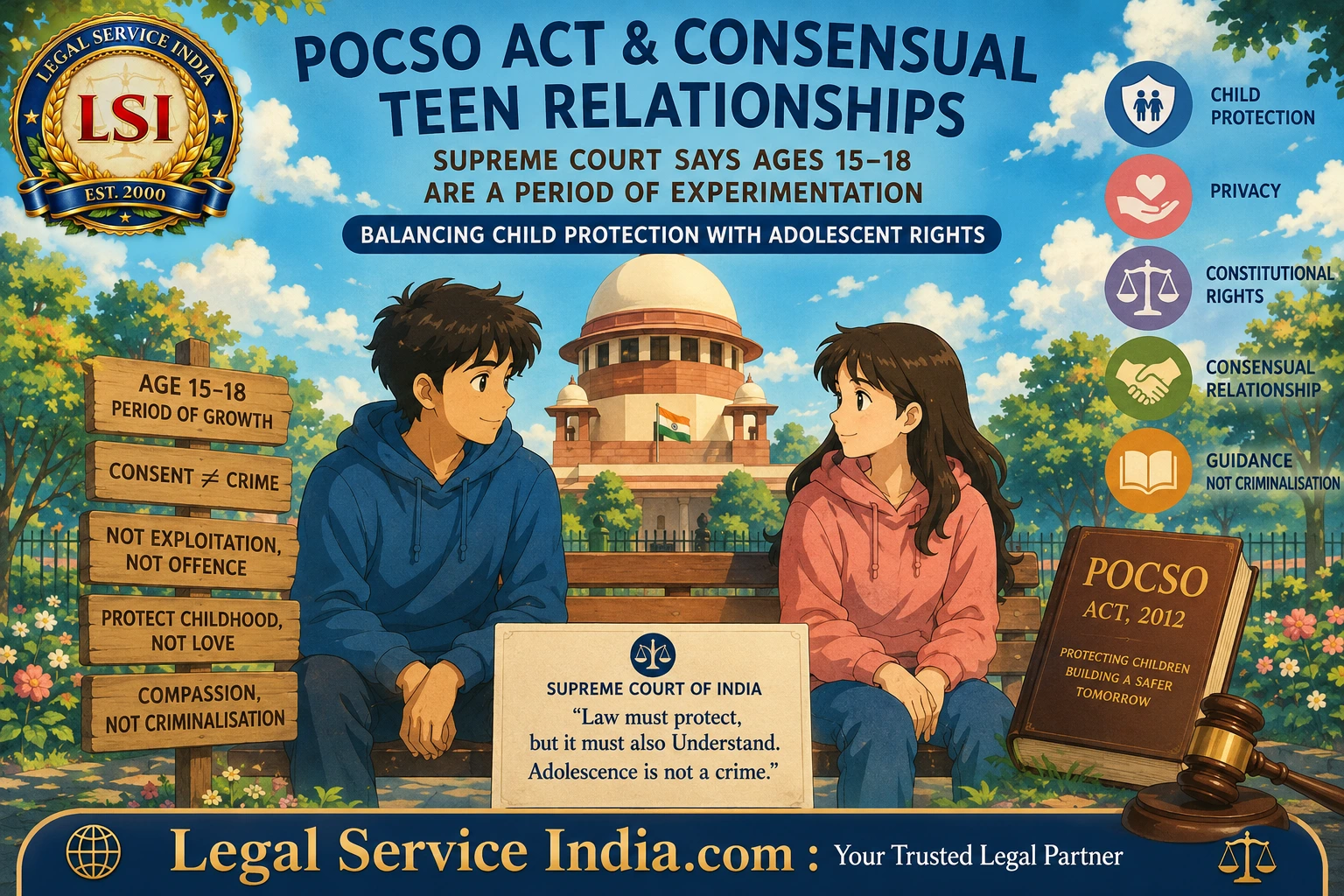
POCSO Act Cannot Criminalise Consensual Teen Relationships: Supreme Court Calls for a Constitutional Balance Between Child Protection and Adolescent Rights
Citation: In Re: Right to Privacy of Adolescents (Suo Motu Proceedings), Supreme Court of India, Bench comprising Justice B.V. Nagarathna and Justice R. Mahadevan, July 2026. (Proceedings continuing.)
Introduction
The Protection of Children from Sexual Offences Act, 2012 (POCSO Act),Act), is among India’s most stringent child protection statutes. Enacted with the noble objective of safeguarding children from sexual abuse, exploitation, pornography and trafficking, the legislation reflects Parliament’s commitment to protecting every child below the age of eighteen years from sexual offences. Over the past decade, the Act has undoubtedly strengthened the criminal justice system’s response to crimes against children and has become an indispensable pillar of child protection jurisprudence.
Yet, allall legislation—however well-intentioned—must be interpreted in the light of constitutional principles and social realities. A law designed to protect children cannot, by an overbroad application, become an instrument that unintentionally criminalises normal adolescent behaviour or destroys the future of young individuals who themselves require protection and guidance.
Recognising this difficult balance, the Supreme Court of India has made significant observations while hearing the suo motu proceedings titled In Re: Right to Privacy of Adolescents. A Bench of Justice B.V. Nagarathna and Justice R. Mahadevan expressed serious concern over the growing tendency to invoke the POCSO Act in cases involving consensual romantic relationships between teenagers, particularly where criminal complaints are filed by disapproving parents after adolescent elopements or relationships.
The Court observed that the 15–18 age group is a period of experimentation, emotional development and identity formation, and questioned whether every such relationship should inevitably attract criminal prosecution under the POCSO Act. The Bench also remarked that the State cannot realistically prevent adolescents from forming relationships or eloping and cautioned against using criminal law merely to preserve family honour.
These observations do not dilute the statutory protection available to children against sexual abuse. Rather, they seek to distinguish genuine exploitation from consensual adolescent relationships, thereby ensuring that the law remains faithful to its original purpose.
From a constitutional perspective, the issue is profoundly significant. It requires the judiciary to reconcile two equally compelling objectives: protecting minors from sexual exploitation while respecting the constitutional guarantees of dignity, privacy, bodily integrity and personal liberty under Article 21. The challenge lies in ensuring that the criminal justice system remains an effective shield against predators without becoming a punitive mechanism against adolescents navigating the complex transition from childhood to adulthood.
The present proceedings therefore transcend the facts of an individual case. They raise fundamental questions concerning child rights, parental authority, adolescent autonomy, constitutional morality and the future interpretation of one of India’s most important social welfare legislations. Depending upon the eventual outcome, this case has the potential to become a watershed moment in the evolution of Indian criminal jurisprudence relating to children and adolescents.
Key Highlights
- The SupremeThe Supreme Court examines the constitutionalthe constitutional balance between child protection and adolescent autonomy.
- Bench questions blanket criminalisation of consensual teenage relationships.
- Observes that adolescence (15–18 years) is a stage of emotional and psychological development.
- Emphasises that criminal law should target exploitation, not ordinary adolescent behaviour.
- Proceedings could significantly influence future interpretation of the POCSO Act.
Case Citation
| Case | In Re: Right to Privacy of Adolescents (Suo Motu Proceedings) |
|---|---|
| Court | Supreme Court of India |
| Bench | Justice B.V. Nagarathna and Justice R. Mahadevan |
| Year | July 2026 |
| Status | Proceedings continuing |
| Origin | The suo motu case originated after the Supreme Court set aside controversial observations made by the Calcutta High Court concerning adolescent relationships and has since expanded into a broader examination of adolescent privacy, dignity and the implementation of the POCSO Act. |
The Genesis of the Suo Motu Proceedings
The present proceedings did not arise in isolation. They originated after the Supreme Court took exception to certain observations made by the Calcutta High Court while deciding a criminal appeal involving an adolescent girl.
During those proceedings, the High Court had made remarks suggesting that adolescent girls should exercise greater restraint over their sexual impulses and avoid becoming involved in romantic relationships for what was described as “two minutes of pleasure”.pleasure”.
Those observations attracted widespread criticism from child rights experts, psychologists and constitutional scholars for appearing to place a disproportionate burden upon adolescent girls while overlooking broader issues of child protection, gender equality and personal dignity.
The Supreme Court subsequently set aside those remarks and converted the matter into a broader suo motu exercise aimed at examining the larger issues surrounding adolescent privacy, emotional well-being and the operation of the POCSO Act. The Court has since treated the proceedings as an opportunity to address systemic concerns rather than merely correcting an individual judgement.judgement.
Why the Proceedings Were Initiated
- Controversial observations by the Calcutta High Court.
- Concerns regarding gender-sensitive judicial reasoning.
- Need to safeguard adolescent dignity and privacy.
- Examination of systemic issues under the POCSO Act.
- Focus shifted from one judgementjudgement to nationwide legal implications.
The Larger Constitutional Question Before the Supreme Court
Although the public debate has largely focused on consensual teenage relationships, the real constitutional issue before the Court is much broader.
The Court is effectively examining whether the blanket criminalisation resulting from a literal application of the POCSO Act is always consistent with the Constitution when both participants are adolescents engaged in a voluntary relationship.
The question is not whether children deserve protection—they unquestionably do.
Nor is the Court questioning Parliament’s authority to enact stringent child protection legislation.
Instead, the constitutional inquiry is whether every romantic relationship involving persons below eighteen years should automatically be treated as a criminal offence, irrespective of:
- absence of coercion;
- absence of exploitation;
- proximity in age;
- mutual consent;
- emotional maturity; and
- surrounding social circumstances.
This distinction is crucial because constitutional adjudication often requires balancing competing rights rather than mechanically applying statutory provisions.
Constitutional Balancing Factors
| Child Protection | Constitutional Rights |
|---|---|
| Prevent sexual exploitation.exploitation. | Right to dignity |
| Protect vulnerable minors.minors. | Right to privacy |
| Combat trafficking | Bodily integrity |
| Prevent abuse.abuse. | Personal liberty under Article 21 |
| Prosecute offenders.offenders. | Recognition of adolescent autonomy |
Understanding the Legislative Objective Behind the POCSO Act
To appreciate the significance of the Court’s observations, it is necessary to understand why Parliament enacted the POCSO Act.
Before 2012, India lacked comprehensivecomprehensive child-specific legislation dealing exclusively with sexual offences against minors. Existing provisions under the Indian Penal Code were fragmented and inadequate to address the diverse forms of child sexual abuse.
The POCSO Act therefore introduced a specialised statutory framework covering:
- penetrative sexual assault;
- aggravated penetrative sexual assault;
- sexual assault;
- aggravated sexual assault;
- sexual harassment;
- use of children for pornography;
- child-friendly investigation procedures;
- speedy trial mechanisms;
- mandatory reporting obligations; and
- special courts for child victims.
The legislation was enacted to comply with India’s international obligations under the United Nations Convention on the Rights of the Child (UNCRC), which obliges statesstates to protect children from every form of sexual exploitation and abuse.
Its primary objective was therefore protective—not punitive for its own sake.
The Supreme Court’s recent observations reinforce this legislative philosophy by emphasising that the Act should remain focused upon combating genuine exploitation rather than inadvertently criminalising adolescent development.
Primary Objectives of the POCSO Act
| Objective | Purpose |
|---|---|
| Child Protection | Protect minors from sexual abuse and exploitation.exploitation. |
| Special Procedures | Provide child-friendly investigation and trial.trial. |
| Speedy Justice | Fast-track disposal of offences against children |
| International Compliance | Fulfil India’s obligations under the UNCRC.UNCRC. |
The Challenge Created by the Statutory Age of Consent
One of the most debated aspects of the POCSO Act is that it defines every person below eighteen years as a “child”.”child”.
Consequently, any sexual activity involving a person below eighteen years may technically attract the provisions of the Act, irrespective of apparent consent.
This statutory framework was intentionally designed to ensure that children cannot legally consent to sexual exploitation.
However, practical difficulties arise where:
- BothBoth individuals are between sixteen and eighteen years oldyears old
- BothBoth are studentsstudents
- TheThe relationship is voluntaryvoluntary
- ThereThere is no allegation of forceforce
- there is no abuse of authority; and
- There is no trafficking or commercial exploitation.
In such situations, investigators, prosecutors and courts frequently encounter cases where the strict language of the statute produces consequences that may not align with the original legislative intent.
It is precisely this category of cases that appears to concern the Supreme Court during the ongoing proceedings.
Why the Court Recognised Adolescence as an “Age of Experimentation”
Perhaps the most widely discussed observation of the Bench is its acknowledgement that 15 to 18 years constitutes an age of experimentation.
From both legal and psychological perspectives, this observation is significant.
Adolescence represents a transitional phase marked by:
- rapid hormonal changes;
- emotional development;
- intellectual growth;
- evolving personal identity;
- curiosity regarding relationships;
- increasing independence from parents; and
- formation of emotional attachments.
Modern developmental psychology has consistently recognised that adolescents gradually acquire emotional maturity rather than suddenly becoming fully mature on their eighteenth birthday.
The Supreme Court’s observations reflect an important judicial willingness to acknowledge these developmental realities while interpreting child protection legislation.
Rather than viewing every adolescent relationship exclusively through the lens of criminal law, the Court appears to be encouraging a more contextual understanding of teenage behaviour consistent with constitutional values.
Developmental Characteristics of Adolescence
| Aspect | Development During Ages 15–18 |
|---|---|
| Physical | Rapid hormonal and biological changes |
| Emotional | Growing emotional awareness and attachments |
| Psychological | Identity formation and increasing independence |
| Social | Development of friendships and romantic relationships |
| Legal Relevance | Need for balanced constitutional interpretation under the POCSO Act |
The Growing Judicial Concern Over Criminalising Consensual Adolescent Relationships
The observations made by the Supreme Court are not emerging in a legal vacuum. Over the past decade, several High Courts across India have repeatedly expressed concern that the POCSO Act is increasingly being invoked in cases where the factual matrix does not resemble child sexual abuse but rather consensual romantic relationships between adolescents.
A recurring pattern has emerged in criminal prosecutions. A teenage girl voluntarily leaves her parental home with her boyfriend, often to escape familial opposition based on caste, religion, economic status or social background. The girl’s parents subsequently lodge a First Information Report alleging kidnapping, rape and offences under the POCSO Act because she is below eighteen years of age.
Common Pattern in POCSO Prosecutions
In many such cases:
- The relationship had continued for months or years;
- the parties attended the same school or college;
- Thethe age difference was negligible;
- forceThere was no allegation of physical force;
- Thethe girl consistently stated that she had voluntarily accompanied the boy.
| Recurring Feature | Description |
|---|---|
| Duration of Relationship | The relationship had continued for months or years. |
| Educational Background | The parties attended the same school or college. |
| Age Difference | The age difference was negligible. |
| Use of Force | There was no allegation of physical force. |
| Statement of the Girl | She consistently stated that she had voluntarily accompanied the boy. |
Despite these circumstances, the statutory framework leaves little room for investigating agencies to distinguish between consensual adolescent relationships and exploitative conduct. Once an FIR is registered under the POCSO Act, the criminal process usually follows its course.
The Supreme Court appears concerned that this mechanical application of the law may defeat the very object for which the legislation was enacted.
The Human Cost of Criminal Prosecution
As a practising lawyer before constitutional courts for over two decades, one repeatedly encounters cases where the criminal process itself becomes the punishment.
Even where an accused teenager is ultimately acquitted, the consequences of prosecution are often irreversible.
These consequences include:
Arrest and Detention
Young boys, many of whom are themselves below twenty years of age, are frequently arrested immediately after registration of the FIR.
Months may be spent in judicial custody before bail is granted.
Educational Disruption
- School education is interrupted.
- University admissions are lost.
- Competitive examinations are missed.
- Scholarships lapse.
The long-term impact upon a young person’s future can be devastating.
Social Stigma
An allegation under the POCSO Act carries enormous social consequences.
Neighbours, educational institutions and employers often treat the accused as guilty long before any judicial determination.
Even an eventual acquittal rarely erases the stigma attached to allegations of sexual offences.
Psychological Trauma
Criminal prosecution affects not merely the accused but also the adolescent girl.
She is repeatedly required to:
- record statements;
- undergo medical examination;
- appear before investigating officers;
- testify before courts;
- Reliverelive deeply personal experiences.
The criminal process itself may become emotionally traumatic for both teenagers.
| Impact Area | Effect of Criminal Prosecution |
|---|---|
| Personal Liberty | Arrest and judicial custody. |
| Education | Loss of schooling, admissions, examinations and scholarships. |
| Reputation | Long-lasting social stigma despite acquittal. |
| Mental Health | Emotional and psychological trauma for both adolescents. |
Distinguishing Exploitation from Mutual Adolescent Relationships
One of the central legal issues likely to influence future jurisprudence is the distinction between exploitative conduct and mutually consensual adolescent relationships.
The difference is substantial.
Genuine Exploitation Usually Involves
- significant age disparity;
- abuse of authority;
- coercion;
- deception;
- trafficking;
- intimidation;
- grooming;
- financial inducement;
- emotional manipulation.
These are precisely the situations for which the POCSO Act was enacted.
Consensual Adolescent Relationships May Involve
- classmates;
- neighbours;
- childhood friends;
- minimal age difference;
- mutual affection;
- absence of force;
- absence of threats;
- voluntary companionship.
| Exploitative Conduct | Consensual Adolescent Relationships |
|---|---|
| Significant age disparity | Minimal age difference |
| Abuse of authority | Classmates or childhood friends |
| Coercion or intimidation | Mutual affection |
| Deception or grooming | Absence of force |
| Financial inducement | Voluntary companionship |
Treating both categories identically raises serious questions regarding proportionality under constitutional law.
The Supreme Court appears to be exploring precisely this distinction.
Constitutional Dimensions of the Debate
Although the proceedings concern interpretation of the POCSO Act, their constitutional implications are far wider.
Several constitutional guarantees become relevant.
Article 21 — Right to Life and Personal Liberty
Article 21 has evolved into the broadest repository of human rights under the Indian Constitution.
The Supreme Court has repeatedly held that it includes:
- dignity;
- privacy;
- bodily integrity;
- decisional autonomy;
- reputation;
- mental well-being.
Children are unquestionably entitled to Article 21 protections.
The Constitution does not suspend fundamental rights merely because a person is below eighteen years of age.
The challenge therefore lies in balancing child protection with constitutional liberty.
Article 14 — Equality Before Law
stateArticle 14 prohibits arbitrary State action.
A constitutional question may arise where two entirely different factual situations receive identical criminal treatment.
For example:
- an adult predator exploiting a fourteen-year-old child; and
- Twotwo sixteen-year-old classmates voluntarily involved in a relationship.
Although both situations technically attract the POCSO Act, their moral, social and legal characteristics differ enormously.
Whether identical punishment in such cases satisfies constitutional standards of equality is an issue increasingly discussed by legal scholars.
Right to Privacy
The landmark judgement in Justice K.S. Puttaswamy (Retd.) v. Union of India (2017) 10 SCC 1 fundamentally transformed Indian constitutional law.
The nine-judge bench recognised privacy as an intrinsic part of Article 21.
Privacy includes:
- bodily integrity;
- personal relationships;
- decisional autonomy;
- dignity;
- informational privacy.
While children require greater protection than adults, they are not strangers to constitutional rights.
The ongoing suo motu proceedings appear to examine adolescent privacy through this constitutional framework.
The Role of Parents Versus the Role of the State
Another important issue raised by these proceedings concerns the relationship between parental authority and state intervention.
Parents naturally possess an important role in guiding adolescents.
However, criminal law cannot become an instrument through which family disagreements are automatically converted into serious criminal prosecutions.
The Supreme Court appears conscious that in many prosecutions:
- Parental opposition originates from caste considerations;
- religious differences;
- social status;
- economic disparity;
- family honour.
When criminal complaints are motivated primarily by social disapproval rather than genuine concerns of exploitation, the criminal justice system faces a difficult dilemma.
The Court therefore appears to be examining whether child protection laws should sometimes distinguish between protection and punishment.
The International Position: The “Romeo and Juliet” Principle
Several democratic jurisdictions have confronted precisely the same legal problem.
To prevent disproportionate criminalisation, many countries recognise what are commonly called “Romeo and Juliet” exceptions or close-in-age exemptions.
Although the details differ from country to country, the underlying principle remains similar.
Where:
- Both individuals are adolescents
- The age difference is minimal;
- consent exists;
- exploitation is absent;
- Criminal prosecution is either excluded altogether or substantially modified.
Countries Following Close-In-Age Exemptions
- Canada;
- several states in the United States;
- Australia;
- Germany;
- Italy;
- South Africa.
| Country/Jurisdiction | Approach |
|---|---|
| Canada | Recognises close-in-age exemptions in specified circumstances. |
| United States (Several States) | Romeo and Juliet laws or similar statutory protections. |
| Australia | Recognises variations of close-in-age exemptions. |
| Germany | Provides legal distinctions based on age and consent. |
| Italy | Recognises statutory exceptions in certain cases. |
| South Africa | Provides legal safeguards for consensual adolescent relationships. |
India presently has no comparable statutory exception under the POCSO Act.
Consequently, investigators often possess little discretion even where the factual circumstances clearly differ from predatory abuse.
Should India Introduce a Close-in-Age Exception?
The Supreme Court has not directed Parliament to amend the law.
Nevertheless, the present proceedings are likely to revive an important legislative debate.
Supporters of Reform Argue That a Carefully Drafted Close-in-Age Exemption Would:
- prevent unnecessary criminalisation;
- reduce misuse of the POCSO Act;
- allow police to focus upon genuine child abuse;
- protect adolescent mental health;
- preserve educational opportunities;
- reduce judicial backlog.
| Potential Benefit | Purpose |
|---|---|
| Prevent unnecessary criminalisation. | Avoid prosecution in consensual adolescent relationships. |
| Reduce misuse of the POCSO Act. | Ensure the Act targets genuine abuse. |
| Allow police to focus upon genuine child abuse. | Improve investigative priorities. |
| Protect adolescent mental health. | Reduce long-term psychological harm |
| Preserve educational opportunities. | Avoid disruption caused by criminal proceedings. |
| Reduce judicial backlog. | Decrease avoidable prosecutions |
At the same time, critics caution that any relaxation must not create loopholes capable of being exploited by offenders.
A poorly drafted exemption could potentially weaken child protection.
Therefore, if legislative reform is contemplated, it must incorporate stringent safeguards against coercion, grooming and abuse of power.
Balancing Child Protection with Constitutional Compassion
Perhaps the greatest contribution of the Supreme Court’s observations lies in recognising that compassion and constitutionalism are not inconsistent with child protection.
The criminal law performs its highest function when it distinguishes between:
- vulnerable victims requiring protection; and
- adolescents requiring guidance.
A justice system that punishes without appreciating factual nuance risks undermining public confidence in the law itself.
The POCSO Act remains one of India’s most important social welfare legislations.
Its effectiveness depends not merely upon severe punishment but upon ensuring that prosecutorial resources remain focused on genuine perpetrators of child sexual abuse.
The Supreme Court’s ongoing examination therefore seeks not to weaken the Act but to strengthen its moral and constitutional legitimacy by ensuring that it is applied in a manner consistent with its original purpose.
The Need for a Child-Centric Rather Than Crime-Centric Approach
One of the most significant aspects of the Supreme Court’s observations is the implicit recognition that child protection legislation must ultimately serve the best interests of the child. Criminal law is a means to that end—not an end in itself.
The United Nations Convention on the Rights of the Child (UNCRC), to which India is a signatory, emphasises that in all actions concerning children, the best interests of the child shall be a primary consideration. This principle requires courts, investigating agencies and child welfare institutions to assess not only whether a statutory offence has technically occurred but also whether the legal response advances the welfare, dignity and long-term interests of the child.
In cases involving sexual abuse, exploitation, trafficking or coercion, there can be no compromise. The full force of the POCSO Act must be invoked to protect the child and punish the offender.
However, where the case concerns two adolescents in a voluntary relationship, the question becomes more nuanced. The objective should be to protect both adolescents from harm, not to permanently scar their lives through an indiscriminate criminal process.
The Supreme Court’s observations suggest a shift towards a child-centric jurisprudence, where the welfare of adolescents remains paramount.
Mandatory Reporting Under the POCSO Act: An Emerging Area of Debate
Another aspect that has increasingly attracted judicial and academic attention is the provision relating to mandatory reporting.
The POCSO Act obliges any person who becomes aware of an offence under the Act to report it to the authorities. Failure to do so may itself attract penal consequences.
While this provision is essential for detecting cases of child sexual abuse, its application in consensual adolescent relationships has generated considerable debate.
For example, if a school counsellor, psychologist, doctor or healthcare professional learns that two seventeen-year-old students are involved in a consensual relationship, mandatory reporting may compel them to initiate criminal proceedings even where there is no indication of coercion or abuse.
This creates a difficult ethical dilemma.
Professionals entrusted with adolescent welfare may hesitate to provide counselling or medical assistance if every disclosure automatically results in criminal prosecution. Adolescents, in turn, may avoid seeking professional guidance out of fear that confidential conversations will lead to police intervention.
The Supreme Court’s broader examination of adolescent privacy may ultimately influence how such provisions are interpreted in practice.
The Role of Police and Investigating Agencies
The Court’s observations also carry important implications for law enforcement.
Police officers investigating POCSO cases perform an extremely sensitive function. They are expected to protect vulnerable children while ensuring that innocent individuals are not unnecessarily subjected to the rigours of criminal prosecution.
Where Allegations Clearly Disclose:
- coercion;
- intimidation;
- grooming;
- exploitation;
- trafficking; or
- abuse by persons in positions of trust,
The investigating agency must act promptly and decisively.
However, cases involving adolescent relationships often present a different factual landscape.
Investigating Officers May Encounter Situations Where:
- Both individuals are students
- Both families know each other
- The relationship has existed for a considerable period;
- The girl consistently maintains that she acted voluntarily;
- No evidence of force or exploitation emerges during the investigation.
Although investigators remain bound by the statutory framework, the Supreme Court’s observations may encourage greater sensitivity in the investigative process and discourage a mechanical, one-size-fits-all approach.
The Importance of Psychological and Developmental Science
Modern constitutional adjudication increasingly relies upon interdisciplinary knowledge. Courts today routinely consider medical science, psychology, neuroscience and sociology while interpreting statutes affecting human rights.
Developmental psychology consistently recognises adolescence as a unique stage of life characterised by:
- emotional volatility;
- evolving cognitive abilities;
- increased peer influence;
- exploration of identity;
- gradual acquisition of decision-making capacity.
Scientific research also indicates that the maturation of the human brain continues well into early adulthood, particularly in areas associated with impulse control, risk assessment and long-term planning.
The Supreme Court’s recognition of the 15–18 age group as a period of experimentation reflects an appreciation of these developmental realities. It does not imply that adolescents are capable of making every mature decision independently. Rather, it acknowledges that the legal system must account for the complexities of adolescent development when interpreting child protection legislation.
A legal framework informed by scientific understanding is more likely to achieve justice than one based solely on rigid textual interpretation.
Comparative Jurisprudence: Lessons from Other Democracies
Many constitutional democracies have grappled with the challenge of balancing child protection with adolescent autonomy.
Several jurisdictions distinguish between exploitative conduct and consensual relationships involving adolescents close in age.
For instance:
- Canada recognises close-in-age exceptions under specified circumstances.
- Several American states have enacted “Romeo and Juliet” laws to prevent disproportionate criminalisation of consensual teenage relationships.
- Germany, Italy, Austria and certain other European jurisdictions incorporate age-gap considerations while determining criminal liability.
- South Africa has witnessed constitutional litigation leading to legislative changes addressing consensual sexual conduct between adolescents.
These comparative models do not diminish child protection. Instead, they attempt to ensure that criminal sanctions are proportionate to the nature of the conduct and the vulnerability involved.
While foreign legal systems cannot be transplanted wholesale into Indian law, comparative jurisprudence often provides valuable guidance when constitutional courts confront emerging social issues.
The Need for Legislative Reflection
The Supreme Court has not rewritten the POCSO Act, nor has it read into the statute any judicially created exception. That remains within the legislative domain.
However, constitutional courts frequently initiate important national conversations by identifying practical difficulties in the implementation of existing laws.
The present proceedings may encourage Parliament to examine whether the existing statutory framework adequately distinguishes between:
- predatory sexual offences committed by adults against children;
- abuse by persons occupying positions of trust or authority;
- trafficking and commercial exploitation; and
- consensual relationships between adolescents who are close in age.
Any future legislative reform would have to proceed cautiously. The POCSO Act is a landmark social welfare legislation, and any amendment must preserve its core objective of protecting children from abuse.
If Parliament were to consider reforms, safeguards might include:
- a narrowly tailored close-in-age exemption;
- exclusion where there is coercion, intimidation or abuse of authority;
- judicial oversight before applying any exemption;
- mandatory counselling and child welfare interventions where appropriate;
- continued stringent punishment for exploitative conduct.
Such reforms would seek to balance child protection with constitutional proportionality rather than dilute the protective framework of the Act.
Implications for Trial Courts and High Courts
The Supreme Court’s observations, although made in ongoing suo motu proceedings, are likely to influence judicial thinking across the country.
Trial courts and High Courts may increasingly examine factors such as:
- the age difference between the parties;
- the existence or absence of coercion;
- the voluntariness of the relationship;
- evidence of exploitation or manipulation;
- the overall welfare of the adolescents;
- the constitutional values of dignity and privacy.
While courts remain bound by the statutory provisions of the POCSO Act until any legislative change is made, constitutional interpretation has always evolved through judicial engagement with changing social realities.
The present proceedings may therefore contribute to a more contextual and humane application of the law.
Key Legal Takeaways
- The POCSO Act remains a robust and indispensable child protection law intended to combat sexual abuse, exploitation, trafficking and pornography involving children.
- The Court has expressed concern over the indiscriminate application of the Act in cases involving consensual relationships between adolescents.
- The age group of 15–18 years has been recognised as a period of emotional development and experimentation, requiring sensitivity rather than blanket criminalisation.
- Constitutional rights such as dignity, privacy and personal liberty continue to extend to adolescents, even while they remain entitled to enhanced legal protection.
- The distinction between exploitation and consensual adolescent relationships may become central to future jurisprudence concerning the implementation of the POCSO Act.
- The proceedings may stimulate legislative and policy discussions on whether India should adopt a narrowly tailored “close-in-age” framework while preserving stringent safeguards against child sexual abuse.
Conclusion
The Supreme Court’s observations in the ongoing suo motu proceedings concerning the privacy, protection and well-being of adolescents represent a significant moment in the evolution of Indian constitutional and criminal jurisprudence. By acknowledging that the years between 15 and 18 are marked by emotional growth, curiosity and experimentation, the Court has encouraged a more nuanced understanding of adolescence—one that recognises both the need for protection and the realities of human development.
Importantly, the Bench has not questioned the constitutional validity or the indispensable role of the POCSO Act. On the contrary, it has reaffirmed that the Act remains a vital shield against child sexual abuse, exploitation, trafficking and predatory conduct. The Court’s concern is directed at ensuring that the law is not stretched beyond its legislative purpose to criminalise consensual adolescent relationships where the facts disclose neither coercion nor exploitation.
The broader constitutional message is equally compelling. A mature legal system must distinguish between predators who prey upon children and adolescents who are themselves navigating the complexities of growing up. Applying the same criminal consequences to both categories risks undermining the principles of proportionality, fairness and dignity that lie at the heart of the Constitution.
Whether these proceedings ultimately result in judicial guidelines, legislative reconsideration or policy reforms, they have already succeeded in initiating an important national conversation. The challenge before lawmakers, courts and society is to preserve the uncompromising protection afforded to children while ensuring that the criminal justice system responds to adolescent relationships with wisdom, sensitivity and constitutional balance.
In the years ahead, In Re: Right to Privacy of Adolescents may well be remembered as the case that prompted India to re-examine the delicate intersection between child protection, adolescent autonomy and constitutional liberty—an intersection where justice demands not only the enforcement of the law but also a humane appreciation of the lives it seeks to protect.
Need Expert Legal Assistance from the Supreme Court of India?
Whether you are planning to file a Special Leave Petition (SLP), Writ Petition, Civil Appeal, Criminal Appeal, Transfer Petition, Review Petition, Curative Petition, or require expert legal advice on any matter before the Supreme Court of India, experienced legal guidance can make all the difference.
Adv. Tarun Choudhury
Supreme Court Advocate | 25+ Years of Legal Experience
📞 Call: 9891244487
💬 WhatsApp: 9891244487
Get trusted legal advice, strategic case evaluation, expert drafting, and dedicated representation before the Supreme Court of India and other courts.
Contact today for a confidential consultation and protect your legal rights with experienced Supreme Court representation.