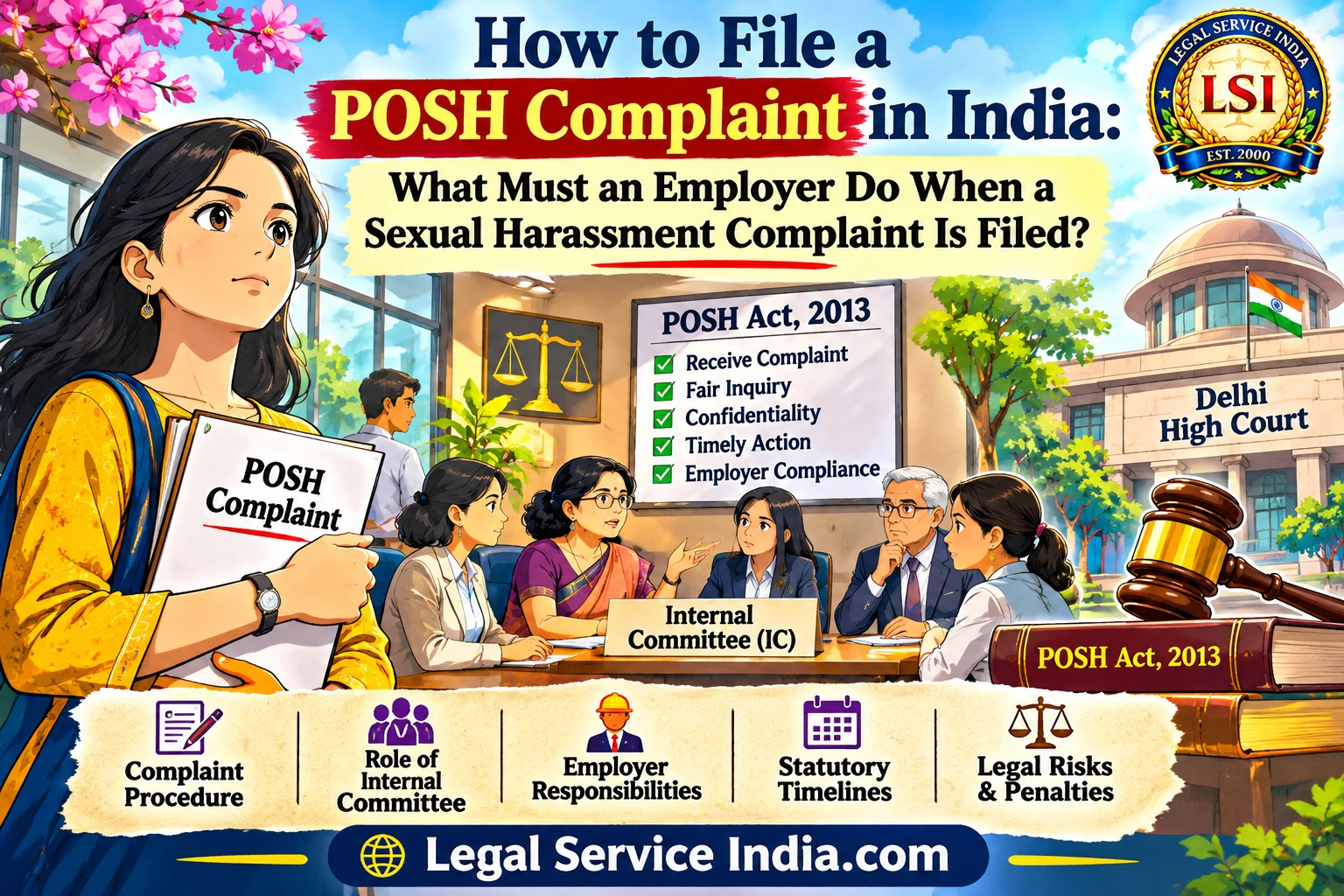
How to File a POSH Complaint in India: What Must an Employer Do When a Sexual Harassment Complaint Is Filed?
Introduction: A POSH Complaint Is Not an Ordinary Workplace Grievance
A complaint of sexual harassment at the workplace is one of the most sensitive matters an employer can face. It involves the dignity and safety of the complainant, the reputation and professional rights of the person accused, and the employer’s statutory responsibility to ensure a workplace free from sexual harassment.
Yet, one of the most common mistakes organisations make is treating a POSH complaint as an ordinary human resources dispute.
Some employers appoint an informal fact-finding team before approaching the Internal Committee. Others delay forwarding complaints, fail to constitute a properly qualified committee, or attempt to resolve the matter through informal discussions. In some cases, the inquiry itself becomes vulnerable because the committee is improperly constituted or fails to observe natural justice.
The consequences can be serious. An inquiry conducted contrary to the Sexual Harassment of Women at Workplace (Prevention, Prohibition and Redressal) Act, 2013 (the POSH Act) may invite judicial scrutiny, undermine disciplinary proceedings and expose the organisation and its management to legal consequences.
The law requires something more than a policy displayed on an office notice board. It requires a functioning statutory mechanism, a fair inquiry, confidentiality, timely action and accountability.
A particularly important development in this area is the Delhi High Court’s decision in Mere Apprehension of Bias Not Enough to Reconstitute PoSH Committee, reported on 29 October 2026. The decision brings renewed attention to the independence, constitution and functioning of Internal Committees.
This article examines how to file a POSH complaint, what an Internal Committee must do, the statutory timelines, the employer’s responsibilities and the legal risks of conducting an inquiry incorrectly.
Also Read: Employer Not Paying Salary After Resignation? Legal Remedies in India
1. The Latest Delhi High Court Judgement: Why the Constitution of the Internal Committee Matters
Important Recent Judgement
| Particulars | Details |
|---|---|
| Case | Dr Xxxxxxxx & Anr. v. University of Delhi & Ors. |
| Court | High Court of Delhi |
| Judge | Justice Swarana Kanta Sharma |
| Date of Judgement | 27 October 2026 |
| Case Number | W.P.(C) 13218/2026 & CM APPL. 61510/2026 |
| Neutral Citation | 2026: DHC: 9483 |
| Statute | Sexual Harassment of Women at Workplace (Prevention, Prohibition and Redressal) Act, 2013. |
The judgement was pronounced on 27 October 2026 and is listed in the Delhi High Court’s official pronouncement records. The full judgement has also been examined in its available text.
What Happened in This Case?
The dispute arose at Kalindi College, a constituent college of the University of Delhi.
Two Associate Professors submitted a joint written complaint dated 7 July 2025 alleging harassment, intimidation, derogatory remarks and sexually coloured comments by certain faculty members. The allegations included communications in a Staff Association WhatsApp group and incidents during a meeting held on 3 July 2025.
The complainants also raised objections concerning the participation of a member of the existing Internal Complaints Committee (ICC), who was allegedly connected with events forming part of the complaint.
The original committee completed its inquiry and concluded that the allegations were not sexual in nature. Its report was subsequently accepted by the college’s governing body.
The complainants challenged the inquiry and sought a fresh investigation by an impartial committee.
The Vice-Chancellor subsequently set aside the earlier inquiry and directed the College to constitute a fresh Internal Committee in accordance with the POSH Act and applicable University Grants Commission Regulations.
A new committee was constituted on 28 July 2026. However, the complainants again approached the High Court, questioning the principal’s authority to constitute the committee and alleging that certain members were unsuitable because of their connections or administrative relationships.
What Did the High Court Decide?
The High Court dismissed the challenge to the newly constituted committee.
The Court emphasised an important distinction: a mere apprehension of bias is not sufficient to invalidate the constitution of an Internal Committee. There must be cogent material demonstrating a real likelihood of bias.
The court examined whether the principal had a personal or pecuniary interest in the outcome of the inquiry. It found that dissatisfaction with previous administrative decisions, by itself, did not establish such an interest.
The Court also considered objections concerning the inclusion of faculty members who had attended the meeting in question and a non-teaching employee working under the principal.
It concluded that mere attendance at a meeting did not automatically establish disqualification. Similarly, ordinary administrative subordination, without additional evidence of an interest in the outcome, was insufficient to disqualify a member.
However, the decision should not be misunderstood. The Court did not give employers unrestricted discretion to appoint anyone they choose. The Committee must still comply with the statutory composition requirements and function independently.
Also Read: Can My Employer Terminate Me Without Notice in India? Know Your Rights
The Most Important Aspect of the Judgement
The Court recognised that the earlier inquiry had been rendered unsustainable because a person connected with the events complained of had participated in the proceedings and the required external-member appointment had not been properly complied with.
A fresh inquiry by a properly constituted Internal Committee was therefore necessary.
The Court also refused to permit a parallel university-level committee to assume the statutory fact-finding function where the complaint arose within the college and the statutory mechanism designated the college’s internal committee as the appropriate inquiry body.
Finally, because the complaint had remained pending for more than fifteen months, the Court directed the new Internal Committee to endeavour to complete the inquiry within 90 days of receiving a copy of the judgement, in accordance with the Act, Rules, UGC Regulations and principles of natural justice.
The Legal Significance
This judgement offers three important lessons:
- Proper constitution is essential: A committee must satisfy the applicable statutory requirements, including the external-member requirement.
- Independence must be real: a person directly involved in the events complained of, or having a disqualifying interest, should not participate in the inquiry.
- Objections must be evidence-based: a complainant cannot insist on the removal of committee members merely because of a general apprehension or dissatisfaction with administrative decisions.
For employers, the lesson is equally significant. The authority responsible for appointing the Committee must act within the law, while the Committee must independently decide the complaint.
2. What Is a POSH Complaint Under Indian Law?
The POSH Act, 2013 was enacted to prevent and prohibit sexual harassment of women at workplaces and to provide a statutory mechanism for redressal.
The legislation gives effect to constitutional protections, particularly:
| Constitutional Provision | Protection |
|---|---|
| Article 14 | Equality before the law. |
| Article 15 | Prohibition of discrimination. |
| Article 21 | Protection of life and personal liberty, including the right to live with dignity. |
What Constitutes Sexual Harassment Under Section 2(n)?
Section 2(n) defines sexual harassment to include one or more of the following unwelcome acts or behaviour, whether directly or by implication:
- Physical contact and advances.
- A demand or request for sexual favours.
- Making sexually coloured remarks.
- Showing pornography.
- Any other unwelcome physical, verbal or non-verbal conduct of a sexual nature.
Importantly, sexual harassment is not restricted to physical contact.
A woman may also face a hostile working environment through sexually coloured remarks, unwelcome communications, inappropriate gestures, intimidation or conduct connected with employment.
Section 3(2) further recognises circumstances such as threats of detrimental employment treatment, interference with work, the creation of an intimidating or offensive environment and humiliating treatment likely to affect health or safety.
Who Can File a POSH Complaint?
The definition of an aggrieved woman is broader than many employers realise.
Under Section 2(a), an aggrieved woman may be of any age and need not necessarily be an employee of the organisation.
The Act also covers different forms of employment, including:
- Permanent employees.
- Temporary employees.
- Contractual employees.
- Probationers.
- Trainees and apprentices.
- Employees working through contractors.
- Persons working voluntarily or without remuneration.
The workplace definition also extends beyond the physical office. It includes places visited during the course of employment and employer-provided transportation for work-related journeys.
This is particularly relevant to organisations where employees travel, attend conferences, participate in official meetings or interact through work-related digital platforms.
3. How to File a POSH Complaint: A Step-by-Step Guide
The procedure for filing a POSH complaint is primarily governed by Section 9 of the POSH Act.
A complainant should understand the following steps before approaching the Internal Committee.
Step 1: Identify the Appropriate Internal Committee
If the workplace has constituted an internal committee, the complaint should ordinarily be submitted to its presiding officer or a member.
An organisation employing ten or more employees is required to constitute an Internal Committee under Section 4.
Where the organisation has offices or administrative units at different locations, the law requires the constitution of Internal Committees at those units or offices.
If the organisation has not constituted an Internal Committee, or where the complaint is against the employer himself or herself, the complainant may approach the Local Committee constituted at the district level, as applicable under Sections 6 and 9.
This is an important safeguard. An employer cannot defeat a woman’s statutory remedy simply by failing to constitute the required Committee.
Step 2: Prepare a Written Complaint
Section 9 requires the complaint to be made in writing.
The complaint should ideally contain:
- Name and designation of the complainant.
- Name and designation of the respondent.
- Date, time and location of the incident.
- A chronological account of the alleged conduct.
- Details of any witnesses.
- Copies of relevant emails, messages or other available records.
- Details of any previous complaints or representations.
- Particulars of the relief or interim protection sought, where applicable.
The complainant should distinguish between what was personally experienced, what was witnessed and what was subsequently reported by another person.
A clear and chronological complaint helps the Committee understand the allegations and frame the issues requiring examination.
What If the Complainant Cannot Prepare a Written Complaint?
The law expressly addresses this situation.
The Presiding Officer or any member of the Internal Committee must provide reasonable assistance to the woman in preparing the complaint in writing.
Therefore, inability to draft a formal legal document should not become a barrier to seeking redressal.
Step 3: Observe the Statutory Limitation Period
Under Section 9(1), a complaint should ordinarily be filed within three months from the date of the incident.
Where a series of incidents has occurred, the three-month period is calculated from the date of the last incident.
There is also an important extension provision.
The Internal Committee or Local Committee may extend the limitation period by a further period not exceeding three months if it is satisfied that circumstances prevented the complainant from filing within the original period.
The reasons for allowing the extension must be recorded in writing.
Thus, the maximum statutory filing window may extend to six months, subject to the Committee’s satisfaction regarding the circumstances preventing timely filing.
Step 4: Preserve Relevant Evidence
Although the burden of proving allegations is assessed by the Committee on the material placed before it, preservation of relevant evidence is extremely important.
A complainant should, wherever possible, preserve:
- Emails and official correspondence.
- WhatsApp messages and relevant screenshots.
- Call records and communication logs.
- Photographs or recordings lawfully available.
- CCTV footage details and dates.
- Relevant workplace documents.
- Names of persons who witnessed the incidents.
- Records of any subsequent retaliation or adverse employment treatment.
One practical recommendation is to maintain a contemporaneous record of incidents, including dates, locations and the persons present.
Evidence should not be altered, fabricated or selectively manipulated. Original records should be retained wherever possible.
Step 5: Obtain Acknowledgement of the Complaint
The complainant should retain proof of submission.
An acknowledgement, email confirmation or dated receipt can become important if there is a later dispute regarding the date on which the organisation received the complaint.
The employer should ensure that the complaint is transmitted to the competent Internal Committee without unnecessary delay.
It should not be screened or rejected by HR merely because management considers the allegations inconvenient or uncomfortable.
4. What Happens After a POSH Complaint Is Filed?
The filing of a complaint activates the statutory responsibilities of the Internal Committee. The Committee is not merely an administrative body. It is the statutory authority entrusted with examining the allegations and making recommendations in accordance with the Act. The process generally involves the following stages.
Stage 1: Preliminary Examination
The Committee should examine whether the complaint falls within the scope of the POSH Act and whether it contains allegations requiring an inquiry. It must also consider whether any member has a conflict of interest or is connected with the subject matter. The Committee should not prejudge the allegations at this stage.
Stage 2: Conciliation, Where Requested
Section 10 permits conciliation before the commencement of an inquiry, but only at the request of the aggrieved woman. The employer cannot compel the complainant to accept an informal settlement. There is another important restriction: monetary settlement cannot form the basis of conciliation under Section 10. If a settlement is reached, it must be recorded and communicated to both parties. If the terms are not complied with, the Committee may proceed with the inquiry.
India Code
Stage 3: Formal Inquiry
If conciliation is not requested or does not result in a settlement, the Committee proceeds with an inquiry under Section 11. The inquiry must be conducted in accordance with the applicable service rules and the prescribed procedure. The respondent must receive a fair opportunity to understand and answer the allegations. The Committee may summon persons, examine them on oath and require the production of documents within the statutory scope of its powers. The inquiry must observe the principles of natural justice. This means:
- The complainant must have a fair opportunity to present her case.
- The respondent must receive a fair opportunity to respond.
- Relevant evidence must be considered.
- Material relied upon should be dealt with fairly.
- The Committee must remain impartial.
- Findings must be based on the evidence and reasons recorded.
The law protects complainants, but it does not eliminate the respondent’s right to a fair hearing.
Stage 4: Submission of the Inquiry Report
Once the inquiry is completed, the Committee must submit its report to the employer or District Officer, as applicable, within ten days. A copy must also be made available to the concerned parties. The report should contain the findings and recommendations arising from the inquiry. The employer must then act upon the recommendations within sixty days of receiving them.
India Code
5. POSH Inquiry Timelines: The Deadlines Every Employer and Complainant Must Know
One of the most important features of the POSH Act is its time-bound inquiry mechanism. An inquiry cannot be allowed to continue indefinitely. Prolonged proceedings can cause serious prejudice to both the complainant and the respondent. The following table summarises the principal statutory timelines.
Statutory Timelines Under the POSH Act
| Procedural Stage | Statutory Timeline |
|---|---|
| Filing the complaint | Within 3 months of incident |
| Extension for filing | Up to a further 3 months |
| Respondent’s reply under Rule 7 | Within 10 working days of receiving the complaint |
| Completion of inquiry | Within 90 days |
| Submission of inquiry report | Within 10 days of completion |
| Employer’s action on recommendations | Within 60 days of receipt |
| Appeal | Within 90 days of recommendations |
India Code+1 An important distinction: The statutory 90-day period under Section 11(4) concerns completion of the inquiry. The subsequent ten-day period concerns submission of the report. The employer then has sixty days to act upon the recommendations. These are separate stages and should not be confused.
Why Delay Can Become a Serious Legal Problem
Consider a situation where a woman files a complaint in January, but the employer allows the matter to remain pending until the following year. During this period:
- Witnesses may become unavailable.
- Relevant electronic evidence may be lost.
- The complainant may continue working in an uncomfortable environment.
- The respondent may face prolonged uncertainty.
- The organisation may face allegations of inaction or procedural unfairness.
The Delhi High Court’s October 2026 judgment is particularly instructive. The complaint in that case had remained pending for more than fifteen months. The Court directed the newly constituted Internal Committee to endeavour to complete the fresh inquiry within 90 days of receiving a copy of the judgment. The message is clear: procedural objections must be addressed, but they cannot become an excuse for allowing a POSH complaint to remain unresolved indefinitely.
Indian Kanoon+1
6. What Must an Employer Do When a POSH Complaint Is Filed?
This is where many organisations make serious mistakes. The employer’s responsibility does not end with appointing an Internal Committee. Section 19 of the POSH Act imposes several continuing obligations. Let us examine the practical steps an employer should take immediately after receiving a complaint.
1. Refer the Complaint to the Internal Committee
The employer should ensure that the complaint reaches the competent Internal Committee promptly. HR may assist with administrative coordination, but it must not take over the Committee’s statutory inquiry function. Management should not decide whether the complainant is telling the truth before the Committee has examined the matter.
2. Verify That the Internal Committee Is Legally Constituted
This is one of the most important compliance requirements. Under Section 4, an Internal Committee must have the following composition:
| Position | Statutory Requirement |
|---|---|
| Presiding Officer | A senior-level woman employee |
| Employee Members | At least two employees |
| External Member | One person from an eligible NGO or association committed to women’s causes, or a person familiar with sexual harassment issues |
| Gender Representation | At least half of the nominated members must be women |
The external member is not an optional formality. The Committee must also have a valid appointment order, and its membership must comply with the statutory tenure and eligibility requirements. The term of the Presiding Officer and members cannot exceed three years from nomination.
India Code
What If the Employer Has Multiple Offices?
An organisation operating through different administrative units or offices must examine the requirement to constitute Internal Committees at those locations. A single centrally appointed Committee should not automatically be assumed to satisfy every statutory requirement.
3. Do Not Constitute a Parallel Fact-Finding Committee
An employer should resist the temptation to appoint an informal management committee to investigate the sexual harassment allegations before the statutory Internal Committee does so. This issue was specifically addressed by the Delhi High Court in: Prof. Rasal Singh v. University of Delhi & Ors., W.P.(C) 14760/2025, decided on 24 April 2026. The Court observed that the POSH Act creates a specific mechanism through the Internal Committee or Local Committee. A parallel or pre-ICC fact-finding body cannot substitute for the statutory inquiry. This is a significant warning for HR departments. An organisation may conduct legitimate administrative exercises for purposes unrelated to deciding the POSH allegations, but it should not create an alternative investigative mechanism that usurps the Internal Committee’s statutory function.
4. Provide Protection During the Inquiry
The complainant should not be forced to continue working in circumstances that expose her to further discomfort, intimidation or potential retaliation. Section 12 provides for interim relief upon a written request from the aggrieved woman. The Internal Committee may recommend:
- Transfer of the complainant or respondent to another workplace.
- Leave for the complainant up to three months, in addition to her normal leave entitlement.
- Other prescribed reliefs.
- Appropriate safeguards concerning work-performance reporting and supervision under Rule 8.
The employer must implement the Committee’s recommendations and report the implementation to it. An important point is that interim relief should not be used as a disguised punishment against the respondent. The objective is to protect the complainant and preserve a fair inquiry.
India Code+1
5. Ensure That the Respondent Receives a Fair Opportunity
A POSH complaint must be taken seriously. But taking it seriously does not mean assuming guilt. The respondent should receive the complaint and a proper opportunity to submit a reply. Under Rule 7 of the POSH Rules, 2013, the respondent is required to submit a reply, along with supporting documents and the details of witnesses, within ten working days of receiving the complaint. Both parties must have a fair opportunity to present their respective cases. The Committee should avoid:
- Deciding the complaint without considering the respondent’s explanation.
- Relying upon undisclosed material.
- Ignoring relevant witnesses.
- Allowing personal relationships to influence findings.
- Conducting proceedings in a manner that prejudices either party.
The requirement of natural justice is not a technical obstacle. It is essential to the credibility of the final report.
6. Maintain Strict Confidentiality
Section 16 imposes a statutory restriction on publication or disclosure of:
- The complaint.
- The identities and addresses of the complainant and respondent.
- Witness identities.
- Information concerning conciliation and inquiry proceedings.
- Recommendations of the Committee.
- Action taken by the employer.
This means that an employer should not circulate the complaint throughout the organisation or discuss its contents in management meetings beyond what is genuinely necessary for lawful handling. HR should maintain restricted access to complaint records. The confidentiality obligation is particularly important in the age of WhatsApp groups, internal messaging platforms and workplace social media. A careless disclosure can itself create legal consequences under Section 17.
India Code
7. Implement the Committee’s Recommendations
The employer cannot simply receive the inquiry report, place it on record and forget about it. Under Section 13, where the allegations are proved, the Committee may recommend disciplinary action for sexual harassment as misconduct under the applicable service rules. It may also recommend compensation in accordance with Section 15. The employer must act upon the recommendations within sixty days. Where allegations are not proved, the Committee may recommend that no action be taken against the respondent in the matter. The employer should not casually disregard the statutory recommendations. Any legally permissible challenge or appeal must follow the applicable procedure.
7. Can an Employer Ignore a POSH Complaint Because the Accused Is a Senior Employee?
Absolutely not.
One of the difficult situations in workplace harassment cases arises when the respondent is a senior manager, director, partner, principal, departmental head or person exercising substantial administrative control.
In such circumstances, an employer must take particular care to ensure that the Committee remains independent.
A senior employee cannot be permitted to influence the inquiry merely because of his or her position in the organisation.
Where the employer himself or herself is the respondent, the complainant should ordinarily approach the Local Committee under the statutory framework rather than expect the employer’s own Internal Committee to inquire into the complaint.
The same principle of independence applies where the alleged conduct involves persons who control the workplace administration.
The Delhi High Court’s 2026 judgment must be read carefully in this context. It held that mere apprehension of bias was insufficient in the particular facts before it. It did not hold that an employer can appoint a Committee controlled by the very person accused of harassment.
The Court specifically considered the distinction between an appointing authority exercising its statutory nomination power and the Internal Committee independently performing its adjudicatory function.
This distinction is vital.
8. What Happens If the Internal Committee Conducts an Improper Inquiry?
An inquiry may be challenged if the Committee has been constituted incorrectly or the proceedings violate the POSH Act or principles of natural justice.
Consider some common examples.
Procedural Defects and Possible Legal Consequences
| Procedural Defect | Possible Legal Consequence |
|---|---|
| Missing or improperly appointed external member | Challenge to validity of Committee |
| Participation of a person directly connected with the complaint | Allegation of conflict of interest or bias |
| Denial of opportunity to respond | Violation of natural justice |
| Failure to consider material evidence | Challenge to findings |
| Unreasonable delay | Judicial intervention and directions |
| Breach of confidentiality | Action under Sections 16 and 17 |
| Failure to implement recommendations | Statutory non-compliance and possible appeal |
The Supreme Court has also addressed the importance of a properly constituted Internal Committee.
The Supreme Court’s Warning: Aureliano Fernandes v. State of Goa
Citation: (2024) 1 SCC 632
In Aureliano Fernandes v. State of Goa, the Supreme Court emphasised the importance of properly constituted Internal Committees and the effective implementation of the POSH framework.
The Court recognised that an improperly constituted ICC, Local Committee or Internal Committee can become an impediment to conducting a proper inquiry into workplace sexual harassment.
The decision is particularly important because it reinforces that POSH compliance is not a paper exercise.
An organisation cannot claim compliance merely because it has issued a policy or appointed a committee on paper. The statutory body must be properly constituted and capable of performing its functions.
The judgment also highlights the wider institutional responsibility to implement the Act effectively.
Source: Indian Kanoon+1
9. What Are the Consequences of Non-Compliance by an Employer?
The POSH Act provides consequences for failure to comply with its statutory requirements.
Under Section 26, an employer who contravenes or attempts to contravene, or abets contravention of, the provisions of the Act or Rules may face a fine extending up to ₹50,000.
A subsequent conviction for the same offence may attract enhanced consequences, including twice the punishment otherwise imposable, subject to the statutory maximum, and possible cancellation, withdrawal or non-renewal of the relevant licence, approval or registration, as applicable.
Other Legal and Commercial Consequences
Apart from the statutory penalty, employers may also face:
- Judicial scrutiny of defective inquiries.
- Challenges to disciplinary action.
- Reputational damage.
- Employment-related litigation.
- Complaints concerning retaliation or failure to provide a safe workplace.
- Regulatory scrutiny, depending on the nature of the organisation.
It is therefore commercially and legally prudent to establish an effective POSH compliance system rather than wait for a complaint to arise.
Source: India Code
10. Can a Complainant Be Punished If the Allegations Are Not Proved?
This is an important question, particularly because some employees fear that an unsuccessful complaint may result in disciplinary action against them.
Section 14 deals with malicious complaints and false evidence.
However, the provision contains an important safeguard.
Merely because a complaint cannot be substantiated or the complainant cannot produce adequate evidence, it does not mean that the complaint was false or malicious.
Before recommending action against a complainant, the Committee must establish malicious intent through an inquiry conducted in accordance with the prescribed procedure.
This distinction is essential.
Understanding the Difference Between Unproven and Malicious Complaints
There is a difference between:
- A complaint that cannot be proved.
- A complaint based on a genuine but mistaken understanding of events.
- A complaint deliberately made with malicious intent.
- A complaint supported by fabricated or misleading evidence.
The law does not permit employers to intimidate genuine complainants by threatening disciplinary action whenever an allegation is not established. Equally, it does not protect deliberate fabrication of allegations or evidence.
Source: India Code
11. Can Either Party Challenge the POSH Committee’s Decision?
Yes.
Section 18 provides an appellate remedy against specified recommendations and certain instances of non-implementation.
An appeal must ordinarily be preferred within 90 days of the recommendations.
The complainant or respondent may challenge an outcome in accordance with the applicable service rules and prescribed procedure.
Depending on the circumstances, judicial review may also be available where there is a serious jurisdictional error, procedural illegality, violation of natural justice or other recognised grounds for court intervention.
What Does the Delhi High Court’s October 2026 Decision Indicate?
The October 2026 Delhi High Court decision is instructive here.
It demonstrates that a challenge to the constitution of a Committee must be supported by relevant material. Courts will examine the actual circumstances rather than accept every allegation of bias at face value.
At the same time, where a genuine defect affects the legality of the inquiry, a fresh inquiry may become necessary.
Source: India Code+1
12. POSH Compliance Checklist for Employers and HR Departments
A well-managed organisation should not wait until a complaint is filed to examine its POSH compliance.
The following checklist can help employers identify potential gaps.
Employer’s POSH Compliance Checklist
- A valid Internal Committee has been constituted through a written order.
- The Committee satisfies the statutory composition requirements.
- An eligible external member has been appointed.
- The Committee’s appointment and tenure are current.
- Internal Committees exist at the required administrative units.
- The POSH policy is communicated to employees.
- The complaint submission mechanism is accessible.
- Employees are informed about the complaint procedure and limitation period.
- Committee members receive appropriate training.
- Confidential complaint records are maintained securely.
- A procedure exists for interim relief and protection against retaliation.
- The Committee can conduct an independent inquiry within statutory timelines.
- HR provides documents and administrative assistance without interfering with the inquiry.
- Inquiry recommendations are implemented within 60 days.
- Annual reporting and statutory compliance obligations are fulfilled.
13. Practical Lessons for Complainants, Respondents and Employers
The POSH framework must be understood as a mechanism for justice, not as a weapon for workplace politics or a means of protecting powerful employees.
There are three distinct responsibilities.
For the Complainant
A woman facing sexual harassment should not feel compelled to resign, remain silent or accept informal pressure to withdraw her complaint. She should understand her statutory rights, preserve relevant evidence and approach the appropriate Committee within the prescribed period.
For the Respondent
A person facing allegations is entitled to a fair hearing. The respondent should receive an opportunity to answer the allegations, submit relevant material and participate in the inquiry in accordance with the law.
For the Employer
Management must ensure that the Internal Committee is properly constituted, independent and adequately supported. It must not interfere with the Committee’s findings, discourage complaints, disclose confidential information or allow the inquiry to remain pending indefinitely.
A defective inquiry may ultimately harm everyone involved, including the organisation itself.
Conclusion: POSH Compliance Is a Legal Responsibility, Not an HR Formality
The POSH Act, 2013 represents an important commitment to ensuring that women can work with dignity and without fear of sexual harassment.
However, the effectiveness of the legislation depends on how seriously organisations implement it.
The Delhi High Court’s October 2026 decision reinforces an important principle: an Internal Committee must be properly constituted, impartial and capable of conducting an independent inquiry. Allegations of bias must be supported by cogent material, but genuine defects in the Committee’s composition cannot be ignored.
For employers, the message is straightforward. Constitute the Committee correctly, maintain confidentiality, provide a fair hearing, follow statutory timelines and implement the recommendations.
For complainants, the law provides a formal mechanism to seek redressal without having to depend upon the goodwill of management.
Ultimately, the success of POSH compliance should not be measured by whether an organisation has a policy document. It should be measured by whether a woman can raise a genuine complaint and receive a fair, timely and legally sustainable response.
Facing a POSH Complaint? Protect Your Rights. Secure Your Legal Position.
Whether you are a woman seeking justice against workplace sexual harassment or an employer facing a POSH complaint, the way you handle the matter today can significantly affect your legal position tomorrow.
A poorly drafted complaint, an improperly constituted Internal Committee, procedural irregularities or a defective inquiry can have serious legal consequences.
Don’t leave an important workplace matter to guesswork. Obtain experienced legal guidance before a procedural mistake turns into prolonged litigation.
How We Can Assist You
- POSH Complaint Filing: Legal assistance in preparing and presenting a properly structured POSH complaint.
- Internal Committee (IC) Compliance: Guidance on constitution, composition and statutory obligations.
- POSH Inquiry & Defence: Legal assistance to complainants and respondents during inquiry proceedings.
- POSH Policy Drafting: Drafting, reviewing and strengthening workplace sexual harassment policies.
- Employer Legal Compliance: Guidance on statutory timelines, confidentiality, interim relief and disciplinary action.
- Legal Representation: Assistance in POSH-related disputes, employment litigation and appropriate legal proceedings.
Consult an Experienced Supreme Court Advocate
Adv. Tarun Choudhury
Supreme Court Advocate | 25+ Years of Legal Experience
When workplace dignity, professional reputation and legal rights are at stake, experienced legal guidance matters.
📞 Call: 9650499965
💬 WhatsApp: 8851978611
✉️ Email: [email protected]
Take the Right Legal Step Before a Small Mistake Becomes a Major Legal Problem.
Contact us for professional legal guidance on POSH complaints, workplace sexual harassment, Internal Committee inquiries and employer compliance.
Frequently Asked Questions About How to File a POSH Complaint
1. How to file a POSH complaint against an employee in India?
A woman may submit a written complaint to the Internal Committee of her workplace within three months of the incident or the last incident in a series. If the workplace does not have an Internal Committee, she may approach the Local Committee. An extension of up to three additional months may be granted in appropriate circumstances.
2. Can a POSH complaint be filed against a senior manager or director?
Yes. Seniority does not provide immunity from the POSH Act. Where the employer himself or herself is the respondent, the statutory Local Committee mechanism may be invoked.
3. How long does a POSH inquiry take?
The Internal Committee must complete its inquiry within 90 days. It must submit its report within ten days of completing the inquiry. The employer must act upon the recommendations within sixty days of receiving the report.
4. Can an employer dismiss a POSH complaint without an inquiry?
An employer should not unilaterally dismiss a complaint falling within the statutory framework. The complaint must be dealt with by the competent Internal Committee or Local Committee in accordance with the Act.
5. Can an employee be transferred during a POSH inquiry?
Yes. Under Section 12, the Internal Committee may recommend the transfer of the complainant or respondent on the complainant’s written request. The employer must implement the recommendation.
6. Is an external member compulsory in an Internal Committee?
Yes. Section 4 requires an eligible external member. Failure to comply with the statutory composition requirements can undermine the validity of the Committee and its inquiry.
7. Can an employer take action against a woman if her POSH complaint is not proved?
Not merely because the allegations remain unproved. Section 14 requires malicious intent to be established through the prescribed inquiry before action can be recommended.
8. What happens if an employer fails to implement the POSH Committee’s recommendations?
Failure to implement recommendations can attract legal consequences and may give rise to an appeal under Section 18. Section 26 also provides penalties for statutory non-compliance.
Legal Assistance for POSH Compliance and Workplace Harassment Matters
A POSH complaint can have far-reaching consequences for the complainant, the respondent and the organisation.
An improperly drafted complaint, an incorrectly constituted Internal Committee, a defective inquiry or failure to comply with statutory timelines can create avoidable legal complications.
Organisations should therefore approach POSH compliance as an essential part of corporate governance and employment-law risk management.
Disclaimer
Disclaimer: This article is intended for general legal information and educational purposes. The application of the POSH Act depends on the facts, applicable service rules, relevant regulations and circumstances of each case. It should not be treated as a substitute for case-specific legal advice.
Primary Legal Sources and Important Judgments
The statutory provisions have been checked against the official India Code publication of the POSH Act. The recent judgment’s date and listing have been cross-checked against the Delhi High Court’s official pronouncement records; the judgment text and neutral citation have also been cross-checked against the available judgment transcript.
- Sexual Harassment of Women at Workplace (Prevention, Prohibition and Redressal) Act, 2013 – Act No. 14 of 2013, particularly Sections 2, 3, 4, 6, 9–19 and 26. Read the POSH Act, 2013.
- Dr. Xxxxxxxx & Anr. v. University of Delhi & Ors., 2026:DHC:9483, W.P.(C) 13218/2026, decided 27 October 2026. Read judgment text. Delhi High Court official pronouncement records.
- Prof. Rasal Singh v. University of Delhi & Ors., W.P.(C) 14760/2025, decided 24 April 2026 – on the impermissibility of parallel pre-ICC fact-finding proceedings.
- Aureliano Fernandes v. State of Goa, (2024) 1 SCC 632 – Supreme Court guidance on effective POSH implementation and properly constituted Committees.
- ABP (P) Ltd. v. Union of India, (2014) 3 SCC 327 – principles governing apprehension of bias and the requirement of cogent evidence.
- G.N. Nayak v. Goa University, (2002) 2 SCC 712 – principles governing disqualification on grounds of bias.
Key Takeaways: How to File a POSH Complaint in India
- How to file a POSH complaint: An aggrieved woman can submit a written complaint to the Internal Committee (IC) within three months of the incident or the last incident in a series of incidents.
- POSH complaint limitation period: The Internal Committee may extend the filing deadline by a further three months if sufficient reasons prevented the complainant from filing within the original period.
- Who can file a POSH complaint? The POSH Act protects women of any age, whether employed permanently, temporarily, contractually, as trainees or otherwise, and even women who are not employees of the workplace.
- Internal Committee constitution: Every workplace employing ten or more employees must constitute an Internal Committee under Section 4 of the POSH Act, including a senior-level woman Presiding Officer, employee members and a mandatory external member.
- POSH inquiry timeline: The Internal Committee must complete its inquiry within 90 days and submit its report within ten days of completion.
- Employer’s legal obligations: Under Section 19, employers must provide a safe workplace, constitute the Internal Committee, facilitate inquiries, assist complainants, implement recommendations and ensure POSH awareness and compliance.
- Interim protection during POSH inquiry: Under Section 12, the Internal Committee can recommend transfer of the complainant or respondent, additional leave for the complainant up to three months and other prescribed reliefs.
- Natural justice in POSH proceedings: Both the complainant and respondent must receive a fair opportunity to present evidence, respond to allegations and participate in the inquiry.
- Confidentiality under the POSH Act: Section 16 prohibits unauthorised disclosure of the identities of the complainant, respondent and witnesses, as well as details of inquiry proceedings and recommendations.
- Consequences of defective POSH inquiries: An improperly constituted Internal Committee, conflict of interest, procedural irregularities or violation of natural justice can expose inquiry findings and subsequent disciplinary action to legal challenge.
- False POSH complaints: Under Section 14, an unsubstantiated complaint does not automatically constitute a malicious complaint. Malicious intent must be established through the prescribed inquiry.
- Employer’s POSH non-compliance penalty: Section 26 provides for a fine of up to ₹50,000 for specified statutory violations, with enhanced consequences for subsequent convictions.
- Latest Delhi High Court POSH judgment: The October 2026 decision in Dr. Xxxxxxxx & Anr. v. University of Delhi & Ors., 2026:DHC:9483, emphasises that apprehension of bias alone is insufficient to disqualify an Internal Committee member without cogent supporting material.
- Supreme Court guidance on POSH compliance: In Aureliano Fernandes v. State of Goa, (2024) 1 SCC 632, the Supreme Court emphasised effective implementation of the POSH Act and the importance of properly constituted Internal Committees.
- Why POSH legal compliance matters: Proper complaint handling, impartial inquiries, statutory timelines and legally sustainable recommendations protect complainants, respondents and employers from avoidable litigation and procedural complications.