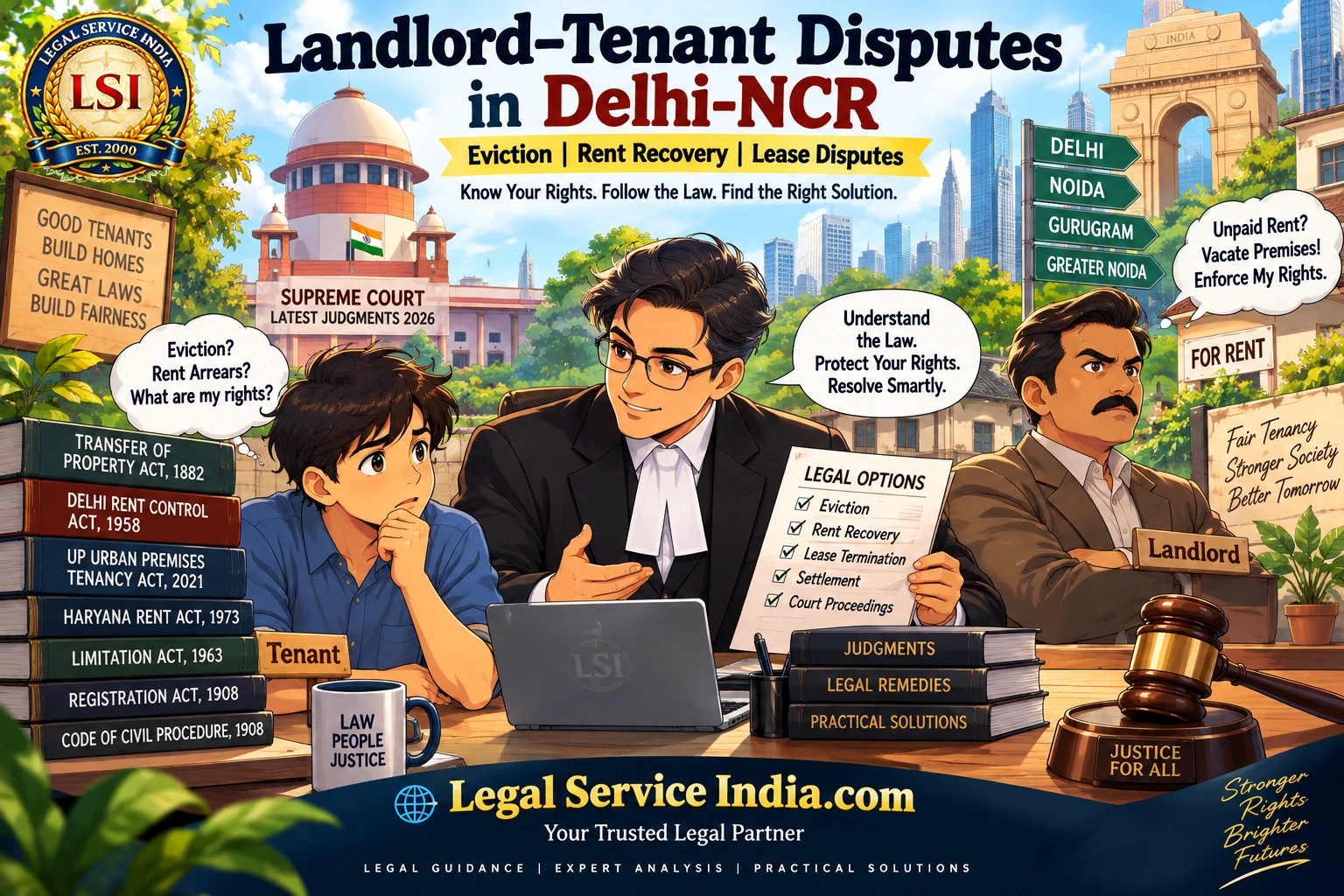
Landlord–Tenant Disputes in Delhi-NCR: Eviction, Rent Recovery and Lease Disputes
Eviction, Rent Recovery, Lease Termination and the Supreme Court’s Current Position in 2026
Landlord–tenant disputes are among the most persistent property disputes in Delhi and the National Capital Region. A dispute that begins with unpaid rent can quickly become a contest over possession, termination of tenancy, validity of the lease, ownership, subletting, bona fide requirement, limitation, registration and even the jurisdiction of the court.
The law is not governed by one statute alone.
Depending upon the property, rent, location and nature of the tenancy, the dispute may involve the Transfer of Property Act, 1882; Delhi Rent Control Act, 1958; Uttar Pradesh Regulation of Urban Premises Tenancy Act, 2021; Haryana Urban (Control of Rent and Eviction) Act, 1973; Limitation Act, 1963; Registration Act, 1908; Code of Civil Procedure, 1908, and the terms of the lease agreement itself.
The Supreme Court’s recent decisions show an important principle: there is no universal formula for landlord–tenant litigation. The first question is always: what legal relationship exists, which statute governs it, and what exactly does the lease document provide?
The Supreme Court’s Important 2026 Judgement: Union of India v. Sir Sobha Singh & Sons
A particularly important recent decision is Union of India v. Sir Sobha Singh & Sons Pvt. Ltd., 2026 INSC 406, decided on 22 April 2026 by the Supreme Court. The dispute arose from residential premises at Sujan Singh Park, New Delhi, and involved a fundamental question: was the Union of India occupying the premises as a tenant governed by the Delhi Rent Control Act, or did its occupation arise directly from a government grant whose terms controlled the relationship?
The factual history was unusual. A perpetual lease deed dated 26 April 1945 had been executed by the Governor General in Council in favour of Sir Sobha Singh & Sons. Residential flats, servant quarters and garages were subsequently constructed. The government occupied several premises and paid rent. When rent arrears accumulated, eviction proceedings were initiated under Section 14(1)(a) of the Delhi Rent Control Act.
The Union disputed the landlord–tenant relationship and argued that the occupation flowed from the government grant itself. The respondent argued that the long-standing payment of rent and the surrounding documents established an ordinary landlord–tenant relationship to which the Delhi Rent Control Act applied.
What Did the Supreme Court Decide?
The Supreme Court ultimately held that the Delhi Rent Control Act was not applicable on the facts of that case. The Court treated the government grant as controlling and emphasised Sections 2 and 3 of the Government Grants Act, 1895.
The Court relied upon the principle that a government grant is governed by its tenor. In other words, the rights and obligations flowing from such a grant must be determined primarily from the grant itself rather than automatically importing the ordinary rules of the Transfer of Property Act or rent-control legislation.
This is an important qualification for Delhi property litigation.
It would be incorrect to read the judgement as saying that every lease involving the government falls outside rent-control legislation. The decision turned substantially on the particular nature and terms of the government grant before the court.
Why the Judgement Matters
The case demonstrates a broader litigation principle:
Before asking whether a tenant can be evicted, the court must first determine what legal relationship actually exists between the parties.
A document described casually as a “lease” may in a particular statutory setting have a different legal character. Conversely, a landlord may not avoid rent-control legislation merely by giving a different description to an ordinary tenancy.
The Supreme Court itself examined competing interpretations of the Government Grants Act and the Delhi Rent Control Act before reaching its conclusion.
The Basic Statutory Framework: Transfer of Property Act, 1882
For ordinary contractual leases not displaced by special rent-control legislation, the Transfer of Property Act remains fundamental.
Section 105 defines a lease as a transfer of the right to enjoy immovable property for a certain time, express or implied, in consideration of a price, rent or other consideration.
Section 107 deals with the manner in which leases are created. A lease from year to year, for a term exceeding one year, or reserving yearly rent generally requires a registered instrument.
Section 108 sets out important rights and liabilities of lessor and lessee. Among other things, the lessor is bound, subject to the contract and applicable law, to put the lessee in possession, and the lessee is required to comply with the obligations imposed upon him.
Section 111 provides the principal methods by which a lease may be determined, including expiry of the term, surrender, forfeiture and expiration of a valid notice to quit.
Section 114 provides relief against forfeiture for non-payment of rent in appropriate cases.
Section 116 deals with holding over, where a tenant continues in possession after determination of the lease and the statutory requirements for a new tenancy by holding over are satisfied.
Thus, in an ordinary contractual tenancy, the precise wording of the lease and the statutory provisions governing determination of the lease become critical.
Section 106 TPA: Notice to Quit Is Important — But Its Role Depends on the Regime
Section 106 of the Transfer of Property Act deals with termination of certain leases where there is no contrary contract or local law.
For ordinary non-agricultural/non-manufacturing leases, the statutory rule is generally a month-to-month tenancy terminable by the prescribed notice, subject to the statutory requirements and the terms of the contract. The section also prescribes requirements concerning the form and service of notice.
But one of the most important lessons from Supreme Court jurisprudence is that Section 106 cannot be considered in isolation from a special Rent Control Act.
V. Dhanapal Chettiar: Rent Control Law Changes the Equation
The Constitution Bench decision in V. Dhanapal Chettiar v. Yesodai Ammal, (1979) 4 SCC 214 remains one of the foundational decisions in this area.
The Supreme Court explained the distinction between ordinary contractual tenancy under the Transfer of Property Act and tenancy protected by rent-control legislation.
Under the Transfer of Property Act, determination of the lease is ordinarily necessary before recovery of possession can be pursued. But under rent-control legislation, termination of the contractual tenancy does not by itself give the landlord an automatic right to possession. The landlord must establish one or more statutory grounds for eviction.
This distinction remains fundamental:
| Legal Regime | Requirements |
|---|---|
| TPA regime | Contract + valid determination of tenancy + legally sustainable claim for possession. |
| Rent-control regime | Landlord–tenant relationship + statutory ground for eviction + compliance with the special procedure. |
Therefore, a landlord cannot simply assume that serving a Section 106 notice automatically entitles him to possession where a rent-control statute governs the premises.
Nopany Investments: An Important Delhi Principle
In M/s Nopany Investments (P) Ltd. v. Santokh Singh (HUF), (2008) 2 SCC 728, the Supreme Court considered a Delhi tenancy dispute involving the Delhi Rent Control Act.
The Court dealt, among other issues, with termination of tenancy, rent enhancement and the interaction between the Delhi Rent Control Act and general law.
An important proposition from the judgement is that where the statutory protection of the Delhi Rent Control Act ceases to apply because the premises fall outside the Act’s protection, the landlord’s rights under general law can become enforceable again.
The judgement also recorded the principle that filing an eviction suit under general law itself can operate as notice to quit in the circumstances considered by the Court.
The case therefore illustrates another important proposition:
The same premises can move from one legal regime to another when statutory protection ceases to apply.
That is particularly relevant in Delhi because of the statutory rent threshold.
Delhi Rent Control Act: The ₹3,500 Question
Section 3(c) of the Delhi Rent Control Act excludes premises whose monthly rent exceeds ₹3,500 from the Act’s operation. The provision remains part of the statutory framework.
This produces an unusual but legally important situation in Delhi.
Where the DRC Act applies, the landlord ordinarily cannot obtain possession except on one or more statutory grounds.
Where the premises fall outside the Act because of Section 3(c), the dispute may instead be governed by the contractual lease and general property law, including the Transfer of Property Act.
The Supreme Court in Nopany Investments considered this statutory threshold and explained the legislative rationale behind the exclusion.
For practitioners, therefore, the first file-opening question should not be “Has the tenant defaulted?”
It should be:
“Does the Delhi Rent Control Act apply to these premises?”
Eviction for Non-Payment of Rent in Delhi
Where the Delhi Rent Control Act applies, Section 14(1)(a) is particularly important.
The landlord must establish that the tenant has neither paid nor tendered the legally recoverable arrears within two months of service of the statutory demand notice.
Section 15 then provides the mechanism for payment or deposit of rent during the eviction proceeding.
This is why an eviction case based on arrears is not simply a mathematical exercise.
The court may have to examine:
- Whether a landlord–tenant relationship exists;
- What rent was legally payable;
- What period of arrears is legally recoverable;
- Whether the demand notice was validly served;
- Whether the tenant paid or tendered the amount;
- Whether the tenant complied with the order under Section 15;
- Whether the tenant has previously obtained statutory protection;
- Whether the alleged arrears are barred by limitation.
Rent Recovery and the Three-Year Limitation Period
A landlord should not assume that every historical rent default can be recovered indefinitely.
Article 52 of the Limitation Act, 1963, prescribes a limitation period of three years for arrears of rent, calculated from when the arrears become due.
This has practical importance.
Suppose rent has remained unpaid for eight years. The landlord may have a substantial factual grievance, but that does not automatically mean that all eight years of arrears are legally recoverable.
The Supreme Court has also recognised, in the Delhi rent-control context, that an amount which is no longer legally recoverable because of limitation cannot simply be treated as recoverable arrears for the statutory eviction ground.
Therefore:
- Old arrears must be examined month-by-month and not merely added together.
2026 Supreme Court Development: Dharmendra Kalra v. Kulvinder Singh Bhatia
Another important 2026 decision is Dharmendra Kalra v. Kulvinder Singh Bhatia, 2026 INSC 492, arising from Uttar Pradesh.
The case involved non-payment of rent and an application under Order XV Rule 5 CPC seeking to strike off the tenant’s defence because of failure to deposit rent.
The Supreme Court stressed that striking out a tenant’s defence is a serious procedural consequence.
The Court held that the power should not be exercised mechanically and emphasised the importance of determining the correct “first date of hearing”, considering whether there was due or substantial compliance and examining whether the default was wilful or bona fide.
The matter was remanded for fresh consideration.
The Practical Lesson
A landlord should not assume:
“Tenant did not deposit rent on time = defence automatically disappears.”
Likewise, a tenant should not assume that procedural default can simply be ignored.
The court must examine the statutory requirements, procedural history and circumstances of the default.
Marietta D’Silva v. Rudolf Clothan Lacerda: Bona Fide Need in 2026
The Supreme Court’s decision in Marietta D’Silva v. Rudolf Clothan Lacerda & Ors., 2026 INSC 496, decided on 15 May 2026, provides another significant illustration.
The dispute concerned eviction under the Bombay Rent Act, including the bona fide requirement and comparative hardship.
The Court reiterated an important proposition: in a rent-control eviction proceeding, the landlord must establish the landlord–tenant relationship and the statutory ground relied upon.
The Court also recognised the significance of subsequent events where fairness to both sides is maintained.
On the facts of the case, the Court held that a tenant could not dictate to the landlord which property the landlord should use to satisfy a genuine requirement.
But this principle should not be misunderstood.
It does not mean that every assertion of personal need automatically establishes a ground for eviction. The applicable Rent Act still governs the statutory requirements, and the landlord must prove the relevant elements.
Co-Owner Can Institute Eviction Proceedings
A recurring defence in landlord–tenant cases is:
“The person who filed the case is not the sole owner.”
That argument does not necessarily defeat an eviction proceeding.
In Marietta D’Silva, the Supreme Court recognised the appellant as a co-owner and co-landlord because she had an interest in the property and was entitled to receive rent within the statutory definition of landlord.
Similarly, earlier Supreme Court jurisprudence has recognised circumstances in which a co-owner can maintain eviction proceedings.
The important question is therefore not simply whether the plaintiff possesses 100% ownership.
The court examines the applicable statute, the plaintiff’s legal status, the landlord–tenant relationship and the statutory ground of eviction.
Unregistered Lease Deeds: A Litigation Trap
Lease disputes frequently arise because parties sign agreements without properly considering registration.
Section 107 of the Transfer of Property Act requires registration for specified long-term leases.
The Registration Act also requires registration of specified instruments affecting immovable property and treats leases for terms not exceeding one year differently from leases falling within compulsory registration.
Unregistered Lease Deeds and Registration Law
The Supreme Court has repeatedly distinguished between:
- using an unregistered lease deed to prove the lease for the very term contained in it; and
- relying upon an unregistered document for a legally permissible collateral purpose.
In 2023, the Supreme Court considered the interaction of Sections 107 of the Transfer of Property Act and Sections 17 and 49 of the Registration Act, stressing that the precise purpose for which the document is sought to be relied upon matters.
Thus, an unregistered lease deed is not simply “valid” or “invalid” for every conceivable purpose.
The precise legal consequence depends upon:
- duration of the lease;
- nature of the document;
- relief claimed;
- purpose for which the document is relied upon;
- applicable stamp law;
- applicable registration law.
What Happens When the Tenant Denies the Landlord’s Title?
Another common defence is:
“The plaintiff is not the owner.”
The Supreme Court has consistently distinguished a landlord–tenant dispute from a full-scale title suit.
In many rent-control proceedings, the essential questions are whether a landlord–tenant relationship exists and whether the statutory ground for eviction is established.
The 2025 Supreme Court decision concerning the Karnataka Rent Act illustrates this approach. Where the statute provides that a lease document or rent receipt can constitute prima facie evidence of the landlord–tenant relationship, the court may proceed accordingly; where the foundational relationship itself is genuinely disputed in the manner contemplated by the statute, the matter may have to be taken to the competent civil court.
Title Disputes in Eviction Cases
The broader lesson is important:
A tenant cannot necessarily convert every eviction case into a complicated title suit merely by disputing the landlord’s ownership.
But where the statutory scheme makes title or relationship a foundational issue requiring determination by another competent court, that statutory mechanism must be respected.
Holding Over: When Does Continued Possession Create a New Tenancy?
A tenant remaining in possession after expiry of the contractual term does not automatically acquire a fresh tenancy on identical terms.
Section 116 of the Transfer of Property Act deals with holding over.
The Supreme Court has emphasised that two elements are important: continued possession after termination and the landlord’s acceptance of rent or other conduct amounting to assent to continued possession.
This is why landlords should be careful when accepting rent after expiry of a lease.
Acceptance of money does not invariably produce the same legal consequence in every factual situation. The surrounding circumstances, reservation of rights, communications and statutory regime matter.
A landlord who intends to insist that possession is unauthorised should document that position carefully.
Forfeiture for Non-Payment of Rent
Where the lease contains a forfeiture clause and the landlord seeks to determine the lease for non-payment of rent, Section 114 of the Transfer of Property Act may become relevant.
The provision permits the court, in appropriate circumstances and subject to its statutory requirements, to relieve a lessee against forfeiture where arrears, interest and costs are paid or appropriate security is furnished.
The Supreme Court has described this relief as an equitable and discretionary protection rather than an automatic entitlement in every case.
This creates an important distinction between:
- termination of tenancy by ordinary notice, and
- forfeiture based upon breach of a lease condition.
The two should not be mechanically treated as identical.
Delhi-NCR Is Not One Legal Jurisdiction
The expression “Delhi-NCR” is commercially convenient but legally dangerous.
A property in:
- Delhi,
- Noida,
- Greater Noida,
- Ghaziabad,
- Gurugram,
- Faridabad,
may be governed by substantially different statutory regimes.
Delhi
The Delhi Rent Control Act, 1958, remains important for premises to which it applies. Section 14 provides statutory grounds of eviction, while Section 25B creates a special procedure for certain bona fide-requirement cases.
Uttar Pradesh NCR
Uttar Pradesh enacted the Uttar Pradesh Regulation of Urban Premises Tenancy Act, 2021. It contains provisions dealing with tenancy agreements, rent, security deposits, eviction, rent authorities, tribunals and related procedures.
Section 21 deals with protection against eviction and enumerates statutory grounds upon which eviction and recovery of possession may be ordered.
This is particularly relevant to Noida, Greater Noida and other covered urban premises in Uttar Pradesh.
Haryana NCR
Haryana has the Haryana Urban (Control of Rent and Eviction) Act, 1973, which provides a separate statutory framework concerning rent control and eviction in covered urban areas.
Consequently, an eviction strategy that is legally appropriate in Delhi may be inappropriate for a property situated in Noida or Gurugram.
The Current Legal Position in 2026
The Supreme Court jurisprudence can be reduced to several practical propositions.
1. Identify the Legal Relationship First
The court must know whether the parties are:
- landlord and tenant;
- lessor and lessee;
- licensor and licensee;
- Government grantor and grantee;
- co-owners and occupants;
- or parties in some other legal relationship.
The 2026 Sir Sobha Singh judgement is a strong reminder of this principle.
2. Identify the Governing Statute
A contractual lease governed by the Transfer of Property Act is not litigated in exactly the same manner as a tenancy protected by a State Rent Control Act.
3. Establish the Landlord–Tenant Relationship
In a rent-control proceeding, the landlord ordinarily must establish the relationship and the statutory ground for eviction. The Supreme Court reiterated this in Marietta D’Silva.
4. Establish the Statutory Ground
Non-payment, bona fide requirement, subletting, misuse, material damage and other grounds are statutory concepts where rent-control legislation applies.
5. Calculate Legally Recoverable Arrears
Rent arrears cannot simply be claimed without examining limitation. Article 52 of the Limitation Act prescribes three years for arrears of rent.
6. Treat Procedure as Substantive Litigation Strategy
Notice, service, deposit of rent, pleadings, registration, limitation and jurisdiction can determine the outcome of an eviction case.
The 2026 Dharmendra Kalra judgement demonstrates why procedural defaults should not be treated mechanically.
A Landlord’s Practical Checklist
Before filing an eviction or rent-recovery case, a landlord should examine:
- Original lease/rent agreement.
- Registration status.
- Stamp duty.
- Rent receipts and bank statements.
- Exact rent payable.
- Date-wise arrears.
- Limitation.
- Security deposit.
- Notices exchanged.
- Proof of service.
- Applicable Rent Control/Tenancy Act.
- Whether the premises fall outside the relevant rent-control regime.
- Any sub-tenancy or assignment.
- Whether the tenant has changed the use of the property.
- Whether a bona fide requirement can legally be established.
- Whether the plaintiff has the necessary locus.
- Whether ownership/title is likely to become a contested issue.
- Whether damages or mesne profits are also claimable.
- Whether arbitration, mediation or negotiated settlement is commercially sensible.
- The appropriate forum and procedure.
A Tenant’s Practical Checklist
A tenant facing eviction should immediately examine:
- The exact terms of the lease.
- Whether the lease has expired.
- Whether the termination notice is legally valid.
- Whether rent claimed is correctly calculated.
- Whether some arrears are time-barred.
- Whether rent was tendered or deposited.
- Whether the applicable Rent Act provides statutory protection.
- Whether the landlord has established the landlord–tenant relationship.
- Whether the alleged ground of eviction is legally made out.
- Whether the landlord has complied with mandatory procedural requirements.
- Whether the lease deed is properly stamped and registered.
- Whether there has been a waiver, acceptance of rent or conduct creating a legal defence.
- Whether the landlord is claiming an incorrect forum.
- Whether any statutory right to contest or seek relief against forfeiture is available.
The Real Lesson From the Supreme Court’s Recent Jurisprudence
Landlord–tenant law is sometimes presented as a simple contest:
“The landlord owns the property; therefore the tenant must leave.”
That is not an accurate description of modern Indian tenancy law.
Ownership is important, but it is only one part of the legal analysis.
The court must consider the source of possession, the contract, the governing statute, the statutory protection available to the tenant, the grounds of eviction, limitation, procedure and the evidence produced by both sides.
The 2026 Union of India v. Sir Sobha Singh judgement demonstrates the importance of identifying the true legal character of the relationship.
Marietta D’Silva demonstrates the importance of proper pleadings, proof of landlord–tenant relationship and statutory grounds, while recognising that subsequent developments may sometimes be relevant.
Dharmendra Kalra demonstrates that procedural consequences such as striking out a tenant’s defence must be applied with attention to statutory requirements and the circumstances of the default.
And the older Constitution Bench decision in V. Dhanapal Chettiar continues to provide the conceptual foundation for distinguishing ordinary contractual tenancy from tenancy protected by rent-control legislation.
The Practical Conclusion
The practical conclusion is therefore simple:
In a landlord–tenant dispute, the strongest case is usually built not by relying upon one isolated provision, but by correctly identifying the legal regime and then aligning the lease, notices, evidence, limitation and relief with that regime.
Landlord–Tenant Dispute Lawyer in Delhi-NCR
Landlord–tenant litigation requires careful examination of the lease agreement, rent records, notices, statutory protection, limitation and the correct forum before proceedings are initiated.
Whether the dispute concerns eviction, recovery of rent, lease termination, possession, bona fide requirement, subletting, misuse of premises, forfeiture, holding over, damages or a disputed landlord–tenant relationship, an early legal assessment can prevent procedural mistakes that may substantially affect the case.
Adv. Tarun Choudhury
Supreme Court Advocate | 25+ Years of Legal Experience
Legal Assistance for Delhi-NCR Landlord–Tenant Disputes
📍 Delhi | Noida | Greater Noida | Ghaziabad | Gurugram | Faridabad and NCR
- ⚖️ Eviction & Possession Disputes
- 💰 Rent Recovery & Arrears
- 📜 Lease & Rent Agreement Disputes
- 🏠 Bona Fide Requirement Cases
- ⚖️ Sub-Letting & Misuse Disputes
- 📑 Lease Termination & Section 106 Notices
- 🔐 Forfeiture & Relief Against Forfeiture
- 💼 Commercial Tenancy Disputes
- 🏛️ Rent Control & Tenancy Litigation
- 📈 Damages / Mesne Profits / Recovery Claims
📞 Call: 9650499965
💬 WhatsApp: 8851978611
Legal disputes concerning property should be examined on their individual facts. The applicable statute can differ significantly between Delhi, Uttar Pradesh and Haryana, even within the NCR.
The article is deliberately written around the 2026 legal position, rather than treating older Delhi rent-control principles as universally applicable across NCR. The biggest practical SEO/legal angle is the distinction between the Delhi DRC Act, the UP Tenancy Act 2021, the Haryana Rent Control law, and the general TPA regime.
Frequently Asked Questions About Landlord–Tenant Disputes in Delhi-NCR
1. What Are the Legal Grounds for Eviction of a Tenant in Delhi?
The legal grounds for eviction depend on whether the premises are governed by the Delhi Rent Control Act, 1958, or by the general law of landlord–tenant relationships. Where the Delhi Rent Control Act applies, Section 14 provides statutory grounds, including non-payment of rent, bona fide requirement, subletting, misuse and certain other specified circumstances. For premises outside the Act, the Transfer of Property Act, 1882, and the terms of the lease may become particularly important.
2. How Can a Landlord Recover Unpaid Rent From a Tenant in Delhi-NCR?
A landlord can pursue rent recovery and arrears of rent through the appropriate legal proceeding, depending on the applicable tenancy law and the nature of the tenancy. The landlord should maintain the lease agreement, rent receipts, bank records, demand notices and a date-wise calculation of arrears. The limitation period for a claim for arrears of rent is generally three years under Article 52 of the Limitation Act, 1963.
3. Can a Landlord Evict a Tenant Without Giving a Notice in Delhi?
The answer depends upon the applicable legal regime. Under an ordinary tenancy governed by the Transfer of Property Act, termination requirements under the lease and applicable provisions such as Section 106 may be relevant. Where a special rent-control statute applies, however, termination of the contractual tenancy does not by itself necessarily give the landlord a right to possession; the landlord generally has to establish a statutory ground for eviction.
4. What Is the Difference Between Eviction Under the Delhi Rent Control Act and the Transfer of Property Act?
Under the Delhi Rent Control Act, a protected tenant can generally be evicted only on one or more statutory grounds prescribed by the Act. Under an ordinary contractual tenancy governed by the Transfer of Property Act, 1882, determination of the tenancy according to the lease and applicable law becomes central to a possession claim. The Supreme Court’s decision in V. Dhanapal Chettiar v. Yesodai Ammal explains this fundamental distinction.
5. Can a Landlord Recover Rent Arrears Older Than Three Years in India?
A claim for arrears of rent is generally subject to the three-year limitation period under Article 52 of the Limitation Act, 1963, calculated from when the arrears become due. Therefore, a landlord should not assume that all historical rent arrears are legally recoverable merely because the tenant remained in default for a longer period. The exact limitation position should be examined from the dates of accrual, payments, acknowledgements and the applicable statute.
6. Can a Tenant Be Evicted for Non-Payment of Rent in Delhi?
Yes, non-payment of rent can constitute a statutory ground for eviction where the Delhi Rent Control Act applies, but the landlord must satisfy the statutory requirements. In particular, Section 14(1)(a) concerns non-payment of legally recoverable rent, while Section 15 deals with payment or deposit of rent during the proceedings. Courts examine the demand, arrears, payment or tender, service and subsequent compliance rather than treating every delay as automatically resulting in eviction.
7. Can a Landlord Evict a Tenant for a Personal or Bona Fide Requirement in Delhi?
Where the applicable rent-control legislation recognises bona fide requirement as a ground of eviction, a landlord may seek possession on that basis, subject to satisfying the statutory requirements. The Supreme Court has repeatedly held that the landlord’s genuine requirement must be assessed according to the applicable law and evidence. A tenant generally cannot simply dictate which property the landlord must use, but the landlord must still establish the statutory requirements of the relevant eviction provision.
8. What Happens if a Tenant Continues to Occupy the Property After the Lease Expires?
Continued possession after expiry of a lease does not automatically create a new tenancy. Section 116 of the Transfer of Property Act, 1882, dealing with holding over, becomes relevant where the tenant remains in possession and the landlord’s conduct amounts to assent to continued possession. Acceptance of rent, communications between the parties and the surrounding circumstances may become important in determining whether a fresh tenancy has arisen.
9. Can an Unregistered Lease Agreement Be Used in a Landlord–Tenant Dispute?
The answer depends upon the duration of the lease, the nature of the document and the purpose for which it is being relied upon. Section 107 of the Transfer of Property Act and Sections 17 and 49 of the Registration Act are particularly relevant. An unregistered lease deed may face restrictions when relied upon to establish a lease requiring compulsory registration, although the law recognises certain permissible collateral uses of an unregistered document.
10. Which Law Applies to Landlord–Tenant Disputes in Delhi-NCR?
There is no single landlord–tenant law applicable throughout Delhi-NCR. Delhi may involve the Delhi Rent Control Act, 1958; properties in covered urban areas of Uttar Pradesh may involve the Uttar Pradesh Regulation of Urban Premises Tenancy Act, 2021; and Haryana has its own rent-control framework. Where special rent-control legislation does not apply, the Transfer of Property Act, 1882, the lease agreement and other applicable laws may govern the dispute. Therefore, the location of the property and the nature of the tenancy should be established before deciding the legal strategy.
Key Takeaways: Landlord–Tenant Disputes in Delhi-NCR
Landlord–tenant disputes in Delhi-NCR may involve eviction, recovery of unpaid rent, lease termination, possession, subletting, bona fide requirement, forfeiture and damages.
| Key Legal Issue | Practical Point |
|---|---|
| Applicable Tenancy Law | The applicable tenancy law depends on the location and nature of the property. |
| Delhi Rent Control Act | The Delhi Rent Control Act, 1958, provides statutory protection to tenants in premises covered by the Act and specifies grounds on which eviction may be sought. |
| Eviction Grounds | Section 14 of the Delhi Rent Control Act is particularly important in eviction proceedings involving grounds such as non-payment of rent, bona fide requirement, subletting and misuse of premises. |
| Rent Arrears | Rent arrears must be examined with limitation in mind. Article 52 of the Limitation Act, 1963, generally provides a three-year limitation period for recovery of arrears of rent. |
| Supreme Court Precedent | The Supreme Court’s decision in V. Dhanapal Chettiar v. Yesodai Ammal remains an important authority for understanding the distinction between ordinary contractual tenancies and tenancies protected by rent-control legislation. |
| 2026 Supreme Court Position | The 2026 Supreme Court judgement in Union of India v. Sir Sobha Singh & Sons Pvt. Ltd. demonstrates that courts must first determine the true legal nature of the relationship between the parties and identify the governing statutory regime. |
| Non-Payment of Rent | Non-payment of rent does not automatically produce eviction in every case. Where rent-control legislation applies, the landlord must satisfy the specific statutory requirements and procedural safeguards. |
| Bona Fide Requirement | A bona fide requirement is a statutory concept. A landlord seeking eviction for a personal or genuine requirement must establish the requirements prescribed by the applicable rent-control law. |
| Expired Lease | An expired lease does not automatically create a new tenancy merely because the tenant remains in possession. Section 116 of the Transfer of Property Act, 1882, concerning holding over, may become relevant depending on the landlord’s conduct and the surrounding circumstances. |
| Unregistered Lease | Unregistered lease agreements require careful legal examination. Sections 107 of the Transfer of Property Act and 17 and 49 of the Registration Act can affect the enforceability and evidentiary use of lease documents. |
| Delhi-NCR Jurisdiction | Delhi-NCR is not a single tenancy-law jurisdiction. Delhi, Noida, Greater Noida, Ghaziabad, Gurugram and Faridabad may fall under different statutory frameworks. |
| Uttar Pradesh Tenancy Law | The Uttar Pradesh Regulation of Urban Premises Tenancy Act, 2021, is particularly relevant to covered tenancy disputes in urban areas of Uttar Pradesh, including parts of the NCR. |
| Haryana Rent Control Law | Haryana has its own rent-control framework, including the Haryana Urban (Control of Rent and Eviction) Act, 1973, making the location of the property legally significant. |
| Evidence | A successful eviction or rent-recovery case depends on evidence as much as legal provisions. Lease deeds, rent receipts, bank statements, notices, proof of service and correspondence can become critical evidence. |
| Before Filing an Eviction Case | Before filing an eviction case, landlords should verify the applicable statute, limitation, rent arrears, notice requirements, jurisdiction and statutory ground for eviction. |
| Tenant’s Defence | Tenants facing eviction should immediately examine the lease agreement, alleged arrears, demand notice, limitation, statutory protection, payment records and the landlord’s legal entitlement to seek possession. |
| Central Legal Principle | The central principle of modern landlord–tenant litigation is to identify the correct legal regime before choosing the litigation strategy. Ownership, rent default or expiry of a lease alone may not determine the outcome. |
Summary
Landlord–tenant disputes in Delhi-NCR involve complex questions of eviction, rent recovery, lease termination, unpaid rent, bona fide requirement, possession, rent-control legislation and limitation. The applicable law may differ between Delhi, Uttar Pradesh and Haryana. Supreme Court precedents, including V. Dhanapal Chettiar, Nopany Investments, Union of India v. Sir Sobha Singh & Sons and recent 2026 decisions, provide important guidance on eviction, tenancy rights, rent arrears and lease disputes.