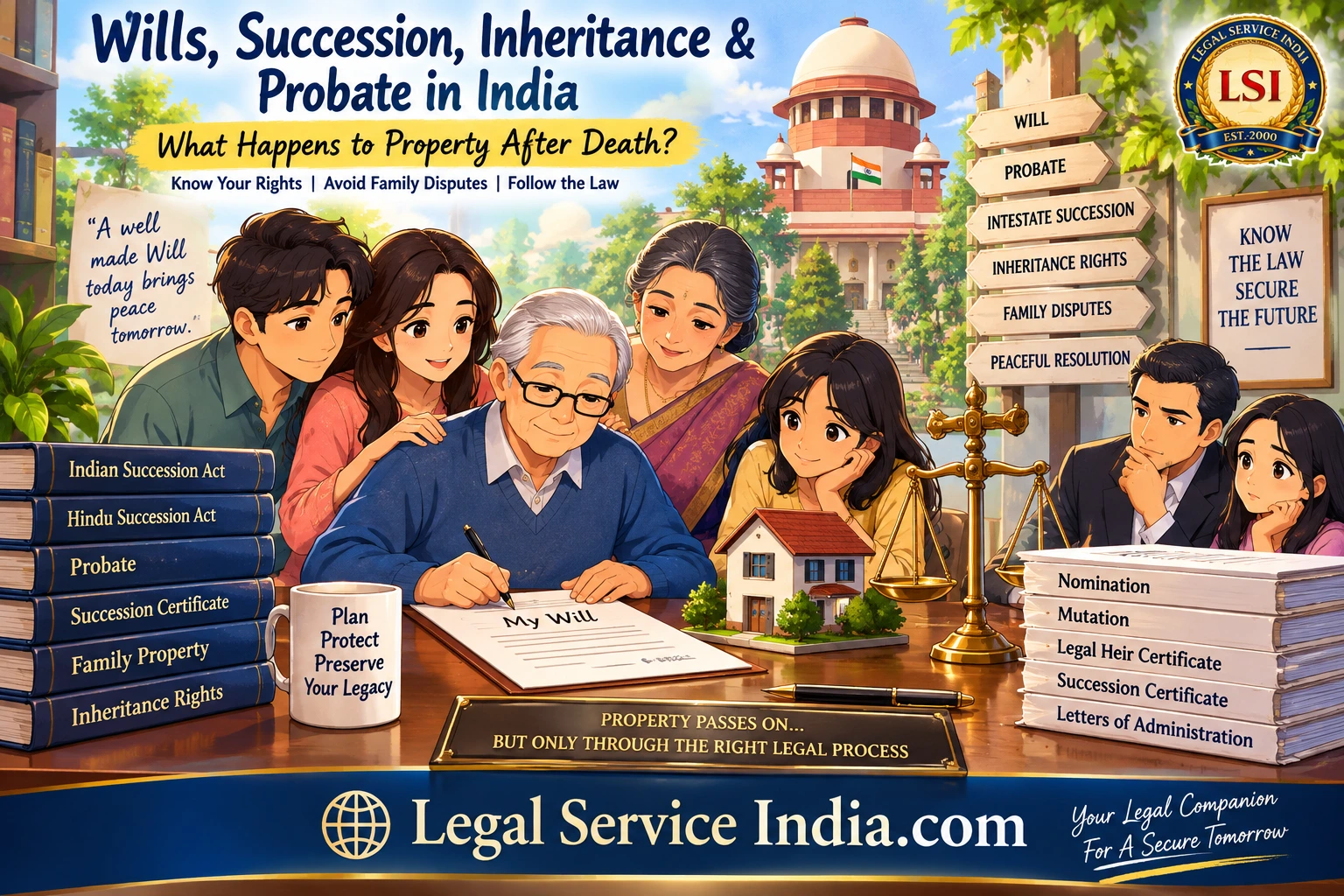
Wills, Succession, Inheritance & Probate in India: What Happens to Property After Death?
Introduction: When a Person Dies, the Property Does Not Simply “Go” to the Family
In my experience, some of the most difficult family disputes begin immediately after a death.
A father dies. One son produces a Will. A daughter says the Will is forged. The widow says the property was ancestral. Another family member says, “I am the nominee, so the money belongs to me.” Someone else produces a succession certificate. The revenue records show yet another person’s name.
Within months, a family that lived together for decades can find itself fighting over the same house, bank account, shares or agricultural land.
The difficulty is that all these people may be using the word “inheritance” to describe completely different legal concepts.
A Will, probate, letters of administration, succession certificate, legal-heir certificate, nomination, mutation and title deed are not interchangeable documents.
The first question is therefore not:
“Who gets the property?”
The first questions are:
- What did the deceased actually own?
- What law governs the succession?
- Did the deceased leave a valid Will?
- If there is a Will, has it been properly executed and proved?
- If there is no Will, who are the statutory heirs?
- What kind of asset is involved — immovable property, bank deposits, shares, securities or something else?
And, after the major statutory change of December 2025:
Is probate legally necessary in this particular case, or merely advisable?
The law of succession in India is therefore not contained in one simple rule. It is a layered system involving personal law, the Indian Succession Act, the Hindu Succession Act, evidence law, property law, registration law and civil procedure.
The 2025 amendment has also changed an important part of the traditional probate framework by omitting Section 213 of the Indian Succession Act, 1925. That provision had historically created a statutory bar in specified cases unless probate or letters of administration had been obtained. Parliament removed it through the Repealing and Amending Act, 2025.
But this does not mean that probate itself has disappeared.
That distinction is central to understanding the law as it stands in 2026.
1. The Two Basic Routes: Testamentary and Intestate Succession
Every succession case begins with one of two possibilities.
Testamentary Succession
The deceased left a legally valid Will.
The property capable of being bequeathed devolves according to the testamentary intention expressed in that Will, subject to the applicable personal law and the deceased’s actual ownership rights.
Intestate Succession
The deceased died without a valid Will.
The estate then devolves according to the succession law applicable to the deceased.
For Hindus, Buddhists, Sikhs and Jains, the Hindu Succession Act, 1956 is central to intestate succession, subject to its statutory exclusions and exceptions.
Muslim succession is principally governed by Muslim personal law as applied through the Muslim Personal Law (Shariat) Application Act, 1937.
Christians and Parsis are substantially governed by the Indian Succession Act’s intestate provisions.
Certain marriages governed by the Special Marriage Act may produce a different statutory succession framework.
This is why it is dangerous to give a family a succession answer merely by asking, “Who are the children?”
The applicable law must be established first.
2. What Is a Will?
Section 2(h) of the Indian Succession Act defines a Will as the legal declaration of the intention of a testator concerning property which the testator desires to be carried into effect after death.
A Will therefore has a fundamental characteristic:
It speaks after the death of its maker.
That is why a Will is different from an ordinary sale deed or gift deed.
The seller of a sale deed can ordinarily enter the witness box and say:
“Yes, I signed this.”
The testator of a Will cannot do that after death.
That simple fact explains much of the strict judicial approach to proving Wills.
A codicil is a testamentary instrument that explains, alters or adds to a Will and is treated as part of the testamentary arrangement.
An executor is the person appointed by the Will to carry out the testator’s directions.
An administrator is appointed through the court where administration of the estate requires it.
Probate is not the Will itself. It is the judicial grant associated with the Will and the executor.
3. A Person Can Give Only What He Legally Owns
This is perhaps the most important principle in the entire subject.
A person cannot make a Will transferring a greater interest than he legally possesses.
Suppose a father owns a house absolutely in his individual capacity.
His testamentary freedom is generally much wider.
But suppose the same house is actually coparcenary property in which the father owns only an undivided interest.
He cannot simply write:
“I give the entire house to my eldest son.”
The Will can operate only upon the interest which the testator was legally capable of disposing of.
Therefore, whenever a Will is challenged, I would always ask two separate questions:
Question 1
Is the Will genuine and legally valid?
Question 2
Even if it is genuine, what property could the testator legally bequeath?
Many inheritance cases fail because these two questions are mixed together.
4. How Is an Ordinary Will Executed?
Section 63 of the Indian Succession Act contains the principal requirements for an unprivileged Will.
In broad terms:
- the testator must sign or affix a mark, or have another person sign in his presence and by his direction;
- the signature must indicate an intention to give effect to the document as a Will;
- the Will must be attested by at least two witnesses;
- the witnesses must satisfy the statutory requirements concerning witnessing and attestation.
The witnesses do not necessarily have to know the contents of the Will.
The law is concerned with whether they properly witnessed its execution.
Privileged Wills have separate rules.
One important point should be remembered:
A Will does not become invalid merely because it is unregistered.
Registration may strengthen the evidentiary record, but registration itself does not transform an otherwise defective Will into a valid one.
5. How Is a Will Proved?
This is where many inheritance disputes become serious.
The old Section 68 of the Indian Evidence Act has been replaced by the corresponding provisions of the Bharatiya Sakshya Adhiniyam, 2023.
The fundamental principle remains:
Where a document is required by law to be attested, its execution ordinarily has to be proved through the statutory evidentiary mechanism, including examination of an attesting witness where available.
The special treatment of Wills remains important.
The reason is obvious.
The person who could have personally established the Will is dead.
Therefore, the court ordinarily wants independent evidence from someone who witnessed the execution.
6. The Supreme Court’s Great Will Case: H. Venkatachala Iyengar
Any serious article on Indian Will law must begin with:
H. Venkatachala Iyengar v. B.N. Thimmajamma, AIR 1959 SC 443.
The Supreme Court established the foundational approach to proof of Wills.
The propounder must satisfy the court that:
- the Will was executed by the testator;
- the testator possessed testamentary capacity;
- the testator understood the nature and effect of the document;
- the document was executed voluntarily; and
- the statutory requirements concerning execution and attestation were fulfilled.
This is not a mechanical exercise.
The court must evaluate the evidence as a whole.
The classic formulation remains important because the testator cannot return to court and explain his intentions.
The Supreme Court’s later decisions have repeatedly built upon this framework.
7. Suspicious Circumstances: Where Most Will Cases Are Actually Won or Lost
A Will may satisfy the apparent formal requirements and still generate serious suspicion.
The courts have repeatedly recognised circumstances which may require explanation, including:
- advanced age or serious illness of the testator;
- doubtful signature;
- unusual thumb impression;
- unexplained departure from previous Wills;
- exclusion of natural heirs;
- a beneficiary taking a disproportionately large benefit;
- the beneficiary participating in preparation of the Will;
- the beneficiary arranging witnesses;
- the Will being prepared shortly before death;
- suspicious circumstances surrounding registration;
- contradictions in the evidence of witnesses;
- the testator allegedly lacking understanding of the document.
The Supreme Court has developed this principle through cases such as Jaswant Kaur v. Amrit Kaur, Mahesh Kumar v. Vinod Kumar and the continuing Venkatachala Iyengar line.
But there is another equally important principle:
An unequal Will is not automatically a suspicious Will.
A parent is not legally required to divide self-acquired property equally among all children merely because the children are emotionally entitled to expect equality.
The court is not supposed to rewrite the Will according to its own idea of fairness.
The question is whether the unequal disposition was genuinely and voluntarily made by a testator possessing testamentary capacity.
8. Registration of a Will: Important, But Not Conclusive
Families frequently say:
“The Will is registered. Therefore, the case is over.”
It is not.
Registration can provide valuable evidence concerning execution and the surrounding circumstances.
But it does not conclusively establish:
- testamentary capacity;
- absence of undue influence;
- absence of fraud;
- absence of forgery;
- proper attestation; or
- genuine testamentary intention.
Conversely:
An unregistered Will is not automatically invalid.
The correct legal question remains whether the Will satisfies the applicable substantive and evidentiary requirements.
9. Can an Old Will Be Presumed Genuine Merely Because It Is Old?
Age alone does not transform a Will into an unquestionable document.
The law relating to proof of ancient documents cannot simply be used to bypass the special statutory requirements governing testamentary documents.
A Will remains a Will.
Its execution and attestation must be proved in accordance with the applicable legal framework.
This is another reason why families should preserve the identity and contact details of attesting witnesses.
10. What Happens If the Attesting Witness Is Dead?
The law contains alternative evidentiary mechanisms where an attesting witness cannot be found or is otherwise unavailable.
But the alternative provisions are not designed to give the propounder an easy escape from proving execution.
The court still has to be satisfied about the authenticity of the Will.
The practical lesson is important:
If a Will is going to matter twenty years later, evidence about its execution should be preserved today.
11. Testamentary Capacity
Testamentary capacity is another critical issue.
The testator should understand:
- that he is making a Will;
- what property he is dealing with;
- who the natural objects of his bounty are; and
- what effect the disposition will have.
Old age by itself does not destroy testamentary capacity.
Physical illness does not automatically destroy it either.
Conversely, a person can be relatively young and yet lack testamentary capacity at the relevant time.
The crucial question is usually:
What was the testator’s mental capacity when the Will was executed?
Medical evidence can therefore become extremely important in a contested Will.
12. Fraud, Coercion and Undue Influence
These concepts should not be casually mixed.
Fraud
The Will or its execution is procured through deception.
Coercion
The testator’s free choice is overborne by unlawful pressure.
Undue Influence
The testator’s independent judgment is improperly dominated or manipulated.
The mere presence of a beneficiary when a Will is executed does not automatically establish undue influence.
But if the beneficiary:
- controls the testator’s affairs;
- arranges the lawyer;
- takes the testator to the registration office;
- selects the witnesses;
- controls the documents; and
- receives almost everything under the Will,
the court may naturally examine the circumstances with much greater care.
13. Revocation and Later Wills
A Will is generally revocable during the testator’s lifetime, subject to the applicable legal framework.
A later Will may revoke an earlier Will.
A Will may also be revoked through the statutory mechanisms governing testamentary revocation.
Therefore, whenever a family produces a Will, I would not stop at that document.
I would ask:
- Was there an earlier Will?
- Was there a later Will?
- Was there a codicil?
- Was the earlier Will expressly revoked?
- Did the later Will validly replace the earlier one?
The “latest document” is not automatically the “latest valid Will.”
14. Probate, Letters of Administration and Succession Certificate: Three Different Legal Instruments
These three are routinely confused.
They perform different functions.
| Legal Instrument | Function Described in the Article |
|---|---|
| Probate | Probate is granted to an executor appointed by the Will. It provides judicial recognition in the testamentary jurisdiction and has important consequences concerning representative title and the administration of the estate. |
| Letters of Administration | Letters of administration may be granted where there is no executor capable and willing to act, or in other circumstances contemplated by the Succession Act. Letters may also be granted with the Will annexed where there is a Will but no effective executor. |
| Succession Certificate | A succession certificate is principally concerned with debts and securities. It is not a substitute for a title decree concerning land or a house. |
Probate
Probate is granted to an executor appointed by the Will.
It provides judicial recognition in the testamentary jurisdiction and has important consequences concerning representative title and the administration of the estate.
Letters of Administration
Letters of administration may be granted where there is no executor capable and willing to act, or in other circumstances contemplated by the Succession Act.
Letters may also be granted with the Will annexed where there is a Will but no effective executor.
Succession Certificate
A succession certificate is principally concerned with debts and securities.
It is not a substitute for a title decree concerning land or a house.
The statutory distinction is crucial.
15. The Effect of Probate
Probate is not merely a rubber stamp.
The Supreme Court has repeatedly treated probate proceedings as proceedings concerned with the testamentary validity of the Will.
In Chiranjilal Shrilal Goenka v. Jasjit Singh, (1993) 2 SCC 507, the Supreme Court explained the special character of probate jurisdiction and the judgment-in-rem effect associated with a probate grant.
The significance is considerable.
If a family has three competing versions of a Will, a judicial determination in testamentary jurisdiction can provide a much stronger foundation than an informal family arrangement.
This is one reason why the removal of Section 213 should not be misunderstood as the death of probate.
16. The 2025 Revolution: Section 213 Has Been Omitted
This is the most important recent development.
The Repealing and Amending Act, 2025 received Presidential assent on 20 December 2025 and omitted Section 213 of the Indian Succession Act.
The amendment also removed the reference to Section 213 in Section 3 and made consequential changes to Section 370.
Before this amendment, Section 213 provided a statutory restriction in specified circumstances:
- a person claiming as executor or legatee could not establish the right in a court unless probate or letters of administration with the Will annexed had been obtained.
The historical operation of Section 213 had to be read together with Section 57.
That created a complicated geographical and personal-law structure.
17. Why the Old Section 213 Regime Was So Complicated
The historical rule was not simply:
“Every Will in India requires probate.”
That was never an accurate description.
The Supreme Court explained the territorial operation of the provision in Kanta Yadav v. Om Prakash Yadav.
The case concerned Delhi and a Will concerning property in New Delhi. The Supreme Court held that the Section 213 bar did not apply in the circumstances before it.
Historically, the complicated interaction of Sections 57 and 213 meant that the need for probate depended upon factors such as:
- the community involved;
- where the Will was executed;
- the location of immovable property;
- the historical Presidency-town jurisdictions.
That is why an old statement such as:
“Hindu Wills always require probate in Maharashtra”
was legally overbroad.
18. Clarence Pais and the Old Constitutional Challenge
In Clarence Pais v. Union of India, (2001) 4 SCC 325, the Supreme Court considered a challenge to the differential probate framework.
The Court upheld the statutory arrangement.
The case is historically important because it demonstrates that the old probate regime was not merely an accidental administrative practice; it had been judicially examined and sustained.
But Parliament has now changed the statutory framework.
That distinction between what the Supreme Court once upheld under the old statute and what Parliament has subsequently changed is important.
19. What Has Actually Changed Since December 2025?
The safest way to express the new law is:
- Section 213’s statutory bar has been removed.
It is not accurate to say:
“Probate has been abolished.”
It has not.
The Indian Succession Act continues to contain provisions dealing with probate, executors, letters of administration and testamentary jurisdiction.
What has disappeared is the old statutory rule which, in the specified cases, prevented an executor or legatee from establishing the right in court without first obtaining probate or letters of administration.
The distinction is enormous.
20. Is Probate Now Completely Unnecessary?
No.
This is where I would improve the Grok formulation.
The deletion of Section 213 means that probate is no longer a statutory precondition in the old Section 213 situations.
But probate can remain highly useful.
Suppose three siblings dispute a ₹20 crore estate.
One says:
“The Will is genuine.”
Another says:
“It is forged.”
The third says:
“There was a later Will.”
The question is no longer merely administrative.
It is a contested testamentary dispute.
A formal testamentary proceeding may still be the appropriate route to obtain a judicial determination.
The continuing existence of probate and its judgment-in-rem character therefore remain highly significant.
Recent legal commentary following the 2025 amendment similarly distinguishes the disappearance of the Section 213 bar from abolition of probate itself.
21. The Better Way to Understand the New Probate Law
I would describe the post-2025 position in four sentences:
- Probate still exists.
- Probate is no longer universally compulsory merely because the old Section 213 conditions would once have applied.
- A disputed Will can still require judicial adjudication.
- A probate grant can still provide powerful judicial certainty concerning testamentary validity and representative title.
That is considerably more accurate than either extreme:
“Every Will needs probate.”
or
“Probate is dead.”
22. What About Existing Wills Executed Before 20 December 2025?
The date of execution of a Will should not by itself be treated as the decisive factor.
The legal issue is whether the right is being asserted under the law now in force, what proceedings were already pending, and what transitional consequences arise from the amendment.
There has already been legal discussion about whether the amendment should be treated as procedural and how it affects pending proceedings. Courts will have to resolve the difficult transitional questions in particular cases.
Therefore, I would avoid a blanket statement that:
“All old Wills automatically become subject to the new law.”
The safer approach is to examine the date and nature of the proceeding.
23. Succession Certificate: What It Really Does
Part X of the Indian Succession Act deals with succession certificates.
The certificate principally concerns debts and securities.
It can cover assets such as:
- bank debts;
- certain securities;
- shares;
- government securities;
- recoverable financial claims.
Its central purpose is practical:
to enable the person holding the certificate to collect the relevant debts or securities and protect the debtor or institution making payment.
It is not designed to finally determine ownership of every asset left by the deceased.
24. Banarsi Dass v. Teeku Dutta: The Succession Certificate Is Not a Title Decree
The Supreme Court’s decision in Banarsi Dass v. Teeku Dutta, (2005) 4 SCC 449, is extremely important.
The Court explained that a succession certificate is intended substantially to protect the debtor who pays the debt to the certificate holder.
It does not finally establish the holder as the ultimate owner of the estate.
The Court also rejected the idea that DNA testing should automatically become routine in succession-certificate proceedings.
This illustrates the summary character of such proceedings.
25. A Succession Certificate Does Not Transfer a House
Suppose a person dies owning:
- a Delhi house;
- ₹30 lakh in bank deposits;
- shares worth ₹50 lakh;
- government securities worth ₹20 lakh.
A succession certificate may become relevant to the financial assets falling within its scope.
It does not operate as a conveyance of the Delhi house.
If the house is disputed, the legal issue may require:
- probate or testamentary proceedings where appropriate;
- declaration;
- partition;
- title adjudication;
- possession proceedings;
- or other appropriate civil remedies.
This distinction should be printed in bold in every practical succession guide:
A succession certificate is not a property title certificate.
26. Legal-Heir Certificate Is Different Again
A legal-heir certificate issued by an administrative authority is primarily an administrative document identifying persons who appear to be the surviving legal heirs.
It is not equivalent to a civil court decree determining title.
It does not automatically establish:
- ownership of land;
- validity of a Will;
- validity of a family settlement;
- partition;
- absence of other claimants.
Therefore:
legal-heir certificate ≠ succession certificate ≠ probate ≠ title decree.
27. Nominee Does Not Necessarily Mean Owner
This is another source of enormous confusion.
Suppose the deceased nominates his daughter in a bank account.
After his death, the bank may pay the amount to the nominee.
That does not necessarily mean that the nominee becomes the ultimate beneficial owner against the other heirs.
The nominee may function as a receiving mechanism, depending on the governing statute and the nature of the asset.
The Supreme Court has repeatedly distinguished nomination from succession.
Therefore, whenever somebody says:
“I am the nominee, so everything belongs to me”
I would immediately ask:
“Nominee under which statute, for what asset, and with what legal consequences?”
28. Mutation Is Not Title
The same caution applies to land records.
Mutation records serve important administrative and revenue functions.
But mutation does not ordinarily create title.
A person cannot prove absolute ownership merely by saying:
“My name is in the municipal record.”
Likewise, if a Will has been acted upon for mutation, that does not necessarily prevent another heir from challenging the Will or claiming substantive title.
The revenue record and the title record perform different legal functions.
29. Hindu Family Property: This Is Where Many Inheritance Cases Become Complicated
The phrase “family property” sounds simple.
Legally, it is not.
One must distinguish between:
- coparcenary property;
- ancestral property;
- separate property;
- self-acquired property;
- property inherited under Section 8;
- property received by gift;
- property acquired through partition.
The classification can determine whether the deceased could dispose of the property by Will and what rights other family members already possessed.
30. Coparcenary Property and the Daughter’s Birthright
Section 6 of the Hindu Succession Act, as substituted by the 2005 amendment, made the daughter of a coparcener a coparcener by birth, in the same manner as a son.
The Supreme Court settled the major controversy in:
Vineeta Sharma v. Rakesh Sharma, (2020) 9 SCC 1.
The Court held that the daughter acquires coparcenary status by birth.
The father’s being alive on 9 September 2005 is not a condition for the daughter to claim that status.
This overturned the restrictive approach that had emerged from earlier decisions such as Prakash v. Phulavati.
31. The Cut-Off Date Under Vineeta Sharma
The law does not, however, reopen every historical transaction.
The Supreme Court recognised statutory protection for earlier dispositions, alienations and partitions.
A particularly important cut-off concerns transactions before 20 December 2004.
But the word “partition” cannot simply mean:
“Grandfather said thirty years ago that this land belongs to my eldest son.”
The Supreme Court has insisted upon the statutory standard for recognising a prior partition.
A registered partition or court decree has particular significance.
This prevents fabricated oral histories from being used decades later to defeat a daughter’s statutory coparcenary rights.
32. The Difference Between Section 6 and Section 8
This distinction is often missed.
Section 6
Deals with the coparcenary interest.
Section 8
Deals with succession to the separate property of a male Hindu dying intestate.
If a father owns genuinely self-acquired property and dies intestate, the question is generally one under Section 8.
If the property is coparcenary, Section 6 becomes central.
Confusing these two provisions can completely alter the result.
33. What Happens to Self-Acquired Property When the Father Dies Without a Will?
For a male Hindu dying intestate, Class I heirs succeed according to the statutory scheme.
The heirs take defined interests.
They do not automatically become a fresh Hindu joint family merely because they inherited the property together.
This point has recently been reinforced by the Supreme Court.
In Darubai v. Kamalabai, 2026 INSC 613, the Court reiterated that property devolving under Section 8 is held by the heirs as tenants-in-common, with defined shares, and that one heir cannot simply assume the powers of a karta over the entire inherited property.
This is an important 2026 development for family-property litigation.
34. Why Darubai v. Kamalabai Matters
The practical lesson is simple.
Suppose a father dies intestate leaving:
- his widow;
- two daughters; and
- a son.
If the property is his separate property and Section 8 applies, the heirs receive their statutory shares.
The widow does not become a “karta” entitled to sell everybody else’s shares.
The son does not become the owner merely because he is the eldest male heir.
The daughters do not become secondary claimants.
The property devolves according to the statutory scheme.
That is the modern position.
35. A Will Can Dispose of a Coparcenary Interest — But Not Somebody Else’s Interest
Section 30 of the Hindu Succession Act recognises testamentary disposition of property capable of being disposed of, including the testator’s interest in coparcenary property.
Therefore, a Hindu coparcener can make a Will concerning his own legally disposable interest.
But that does not mean:
“The father can Will away the entire ancestral property.”
He can testamentarily dispose of his interest, not the independent rights of other coparceners.
That distinction should be clearly explained in every Will drafted for a Hindu family owning ancestral property.
36. Hindu Women’s Property: Section 14
Another area that deserves more attention than it usually receives is Section 14 of the Hindu Succession Act.
Section 14(1) generally converts the property possessed by a Hindu woman into her absolute property where the statutory conditions are satisfied.
The classic authority is:
V. Tulasamma v. Sesha Reddy, (1977) 3 SCC 99.
But Section 14(2) creates an important qualification.
Where property is acquired for the first time through a gift, Will, instrument, decree or other arrangement which itself creates a restricted estate, the restriction may survive.
This distinction can completely change the result.
37. Section 14(1) Versus Section 14(2)
The practical question is:
Did the woman already possess a pre-existing legal right in the property, or did the instrument create a new restricted interest for the first time?
If the property represents the recognition or enlargement of a pre-existing right, Section 14(1) can operate strongly in favour of absolute ownership.
If the instrument creates an entirely new and expressly restricted estate, Section 14(2) may preserve that restriction.
The Supreme Court has dealt with these questions repeatedly, and the distinction remains fact-sensitive.
This is an area where one should not rely upon a one-line formula.
38. What Happens When a Hindu Woman Dies Intestate?
Section 15 of the Hindu Succession Act provides the statutory order for succession to the property of a Hindu female dying intestate.
The first level broadly includes:
- sons and daughters;
- children of predeceased children; and
- husband.
But the later statutory order can produce outcomes that differ from the succession scheme for a male Hindu.
The distribution must therefore be calculated under Section 15 rather than assuming that the rules for a male Hindu automatically apply.
There are continuing legal and constitutional discussions surrounding some aspects of Section 15, but those discussions should not be presented as though the statute has already been invalidated.
39. Muslim Succession: Do Not Apply Hindu Rules
Muslim succession requires a separate analysis.
There is no Hindu-style Mitakshara coparcenary system.
Classical Muslim succession operates through defined shares.
Testamentary power is also restricted.
As a broad principle under classical Muslim law, a Muslim may ordinarily make a Wasiyyat only up to one-third of the net estate, without the necessary consent of the heirs.
Questions concerning bequests to heirs and the effect of consent can become more complicated and may differ depending upon the school of Muslim law.
This is why a Muslim succession dispute should not be approached simply by applying the Hindu Succession Act.
40. Will Versus Hiba Under Muslim Law
Another important distinction is between a Wasiyyat and a Hiba.
A Will operates after death.
A completed gift during the lifetime of the donor operates differently.
Therefore, a person attempting to distribute Muslim property during life may use a legally valid gift structure rather than relying upon a testamentary disposition.
But the validity of such a gift must be separately examined.
It cannot be assumed that a document labelled “gift” automatically defeats all succession claims.
41. Christians and Parsis
The Indian Succession Act remains central to Christian and Parsi succession.
The 2025 omission of Section 213 changes the old mandatory-probate framework, but it does not eliminate the substantive requirements governing Wills.
Thus:
- the Will still needs to be valid.
- the Will still needs to be proved where disputed.
- testamentary capacity still matters.
- fraud and undue influence remain relevant.
The change is primarily about the old statutory requirement for probate, not about converting every document called a Will into a legally valid testament.
42. Scheduled Tribes and Customary Succession
Another area often ignored by generic succession articles concerns Scheduled Tribes.
Section 2(2) of the Hindu Succession Act contains an important statutory exclusion concerning Scheduled Tribes unless the Central Government directs otherwise.
Customary law can therefore become relevant.
This means that a lawyer should never assume:
“This person is Hindu, therefore the Hindu Succession Act automatically decides everything.”
The statutory applicability itself must be checked.
43. When Two Wills Exist
Imagine that a father executed:
- Will No. 1 — 2015
- Will No. 2 — 2023
The existence of the 2023 document does not automatically end the case.
The court may need to determine:
- whether Will No. 2 was actually executed by the deceased;
- whether the testator possessed capacity;
- whether the statutory formalities were satisfied;
- whether the testator understood the document;
- whether the Will was obtained through undue influence;
- whether Will No. 1 was revoked;
- whether Will No. 2 deals with the same property;
- whether there are suspicious circumstances.
The later valid Will normally becomes decisive.
But later in date does not automatically mean legally valid.
44. Can a Beneficiary Draft the Will?
There is no simple rule that every Will drafted at the request of a beneficiary is automatically invalid.
But it can create a suspicious circumstance depending upon the surrounding facts.
Consider two situations.
Situation A
The testator independently meets a lawyer, gives instructions, understands the Will, and later signs it before independent witnesses.
Situation B
The beneficiary takes an elderly and seriously ill testator to a lawyer, dictates the contents, arranges the witnesses, takes the testator to the registration office and receives almost the entire estate.
The legal documents might look superficially similar.
The evidentiary circumstances are not.
45. Estate Protection During Litigation
Sometimes the greatest danger is not whether the Will will ultimately succeed.
The danger is that the estate may disappear before the case ends.
Property may be:
- sold;
- mortgaged;
- transferred;
- withdrawn from bank accounts;
- dissipated;
- concealed.
The Succession Act contains mechanisms such as the appointment of an administrator pendente lite in appropriate testamentary proceedings.
The Supreme Court’s recent testamentary jurisprudence demonstrates that protection of the estate can become an important judicial concern where competing claims and allegations of depletion arise.
This is why succession litigation should not be approached merely as a final declaration case.
Sometimes the first objective must be:
Protect the estate.
46. Probate Court and Title Court Are Not the Same Thing
A probate court principally examines testamentary questions.
A title court may determine questions such as:
- ownership;
- possession;
- partition;
- declaration;
- cancellation;
- competing property rights.
The two jurisdictions should not be casually collapsed into one.
At the same time, where the testamentary court has statutory or constitutional powers necessary to protect the estate, its practical role can become wider in exceptional circumstances.
The recent Supreme Court jurisprudence demonstrates both sides of this distinction.
47. Can an Arbitration Tribunal Decide Whether a Will Is Genuine?
The Supreme Court’s probate jurisprudence has traditionally treated the genuineness and validity of a Will as matters for the testamentary court where probate jurisdiction is engaged.
This is consistent with the special character of probate proceedings and their judgment-in-rem consequences.
A family agreement saying:
“We will arbitrate whether the Will is genuine”
does not automatically transfer a matter of exclusive testamentary jurisdiction to a private arbitral tribunal.
Jurisdiction must be examined before the merits.
48. What Happens to Debts of the Deceased?
Inheritance is not simply an asset distribution exercise.
The estate may contain:
- mortgages;
- loans;
- unpaid taxes;
- contractual obligations;
- litigation liabilities;
- secured debts;
- administrative expenses.
The executor or administrator must identify and address liabilities according to law before the estate is finally distributed.
An heir does not automatically become personally liable for every debt of the deceased merely because that person inherits property.
The liability of the estate and personal liability of the heir must be kept separate.
49. What If There Are No Heirs?
The doctrine of escheat becomes relevant where a deceased Hindu leaves no heir entitled to succeed.
Section 29 of the Hindu Succession Act addresses such a situation.
But escheat is a last-resort mechanism.
It does not operate simply because the State prefers to take property.
The Supreme Court has recently emphasised that where a valid Will governs the estate, Section 29’s intestate succession mechanism cannot simply be invoked to defeat testamentary succession.
The logical principle is straightforward:
- First determine whether there is a valid testamentary disposition.
- Only if intestate succession is actually reached does the escheat provision become relevant.
50. Modern Estates Are No Longer Made Only of Houses and Land
A modern Will should consider:
- bank accounts;
- demat accounts;
- mutual funds;
- shares;
- partnership interests;
- company shares;
- insurance;
- provident funds;
- intellectual property;
- copyrights;
- trademarks;
- domain names;
- digital businesses;
- cryptocurrency;
- online revenue;
- valuable digital records.
Succession planning has therefore moved beyond the traditional family house.
But sensitive credentials such as passwords should not casually be placed inside a Will that may eventually become part of a court record.
A separate secure mechanism may be more appropriate.
51. A Video Recording of Will Execution: Helpful, But Not a Substitute
Technology can provide useful corroborative evidence.
A carefully made video may show:
- identity of the testator;
- voluntary execution;
- presence of witnesses;
- general awareness;
- absence of obvious coercion.
But it does not replace the statutory requirements of execution and attestation.
The safest approach is:
Use technology to strengthen evidence, not to replace legal formalities.
52. What If the Bank Says “Bring Probate”?
After the deletion of Section 213, the answer should not automatically be:
“The bank is wrong.”
Nor:
“The bank is always right.”
The institution’s demand must be examined against:
- the nature of the asset;
- the governing statute;
- the existence of a Will;
- nomination;
- competing claims;
- institutional rules;
- court orders;
- the need for indemnity.
The legal entitlement to an asset and the administrative document required to release that asset are not necessarily the same question.
53. A Succession Certificate Is About Collection, Not Final Ownership
This distinction deserves repetition because it causes enormous litigation.
Suppose the court grants a succession certificate to A.
B may still say:
“A is not the ultimate owner.”
The certificate may permit A to collect the relevant debt or security.
B may still have substantive rights which can be adjudicated in appropriate proceedings.
That is why the Supreme Court has described succession-certificate proceedings as essentially summary.
54. A Legal-Heir Certificate Does Not Defeat a Will
Suppose a tehsildar issues a certificate showing:
- son;
- daughter;
- widow.
Later a registered Will is produced giving the property to the daughter.
The legal-heir certificate does not automatically invalidate the Will.
The certificate identifies heirs under the relevant administrative process.
The Will raises a different legal question:
What testamentary disposition did the deceased validly make?
The two documents perform different functions.
55. The 2026 Position on Self-Acquired and Inherited Property
The recent Supreme Court decision in Darubai reinforces a point that families often misunderstand:
Once property has devolved under Section 8 of the Hindu Succession Act, the heirs receive defined shares.
It does not automatically become a fresh ancestral/coparcenary pool merely because several family members inherited it together.
Therefore, the legal character of property can change through succession.
The label “family property” is not enough.
The history of title has to be traced.
56. The Property-Title Audit: The First Thing I Would Do
If a client comes to me with a succession dispute, I would first prepare a property-title map.
For each property I would ask:
- How was it acquired?
- purchase;
- inheritance;
- partition;
- gift;
- settlement;
- allotment;
- government grant.
- In whose name?
- From whom?
- Was there a prior partition?
- Was the property ancestral?
- Was it self-acquired?
- Was it inherited under Section 8?
- Was there a family settlement?
- Was any share already transferred?
Only after this exercise can one safely analyse the Will.
57. The Family-Tree Audit
The second document should be a complete family tree.
It should identify:
- spouse;
- sons;
- daughters;
- predeceased children;
- grandchildren through predeceased children;
- adopted children where legally relevant;
- parents;
- earlier marriages;
- other legally relevant relationships.
A missing predeceased child can completely change the distribution.
A second marriage can create another layer of complexity.
A family tree is therefore not merely background information.
It is part of the legal calculation.
58. The Will Audit
The third document should be a Will audit.
Check:
- Original Will.
- Date.
- Place.
- Testator’s age.
- Medical condition.
- Signature or mark.
- Two attesting witnesses.
- Identity of witnesses.
- Registration details.
- Lawyer involved.
- Earlier Will.
- Later Will.
- Codicil.
- Beneficiary involvement.
- Disposition of major assets.
- Exclusion of natural heirs.
- Any explanation for unusual dispositions.
- Circumstances surrounding execution.
This often reveals the real litigation issue before the first petition is filed.
59. The Current Legal Position — September 2026
Putting the entire subject together:
- A valid Will generally governs testamentary succession to property which the testator was legally capable of disposing of.
- A Will must satisfy the statutory requirements of execution and attestation.
- The propounder must prove the Will where its execution or validity is contested.
- Suspicious circumstances can require a fuller explanation.
- Registration does not automatically cure defects in a Will.
- A succession certificate principally concerns debts and securities and is not a title decree.
- A legal-heir certificate is an administrative document and is not a substitute for title adjudication.
- Nomination does not automatically rewrite succession law.
- Mutation does not ordinarily create title.
- Hindu daughters are coparceners by birth under Section 6, subject to the statutory protection for earlier completed transactions recognised by Vineeta Sharma.
- Property devolving under Section 8 upon a male Hindu’s death intestate is held by the heirs in defined shares; Darubai v. Kamalabai is an important 2026 reaffirmation.
- Section 14 of the Hindu Succession Act requires careful distinction between a pre-existing right and a newly created restricted interest.
- Muslim succession must be analysed separately under Muslim personal law.
- The 2025 amendment omitted Section 213.
- Probate itself has not been abolished.
- A disputed Will can still require judicial adjudication and estate protection.
60. The Most Important Mistakes Families Make
- “The Will is registered, so nobody can challenge it.”
Wrong. - “The Will is unregistered, so it is invalid.”
Wrong. - “The nominee owns the money.”
Not necessarily. - “My name is in the mutation, so I own the property.”
Not necessarily. - “I have a succession certificate, so I own the house.”
Wrong. - “My father died before 2005, so my daughter cannot claim coparcenary rights.”
Not necessarily; Vineeta Sharma must be considered. - “The eldest son automatically becomes karta of inherited property.”
Not where the property has devolved under Section 8 in defined shares. - “Probate has been abolished.”
Wrong. - “Every Will in India requires probate.”
Also wrong. - “The latest Will automatically wins.”
Not unless it is legally valid. - “Unequal distribution proves forgery.”
No. - “A beneficiary helping prepare the Will proves undue influence.”
Not by itself.
The entire factual matrix matters.
61. What Should a Person Do While Still Alive?
The best succession litigation is the litigation that never starts.
A person with substantial property should consider:
- Make a professionally drafted Will
- Avoid downloaded templates for complicated estates.
- Identify the property precisely
- Do not simply write:
“My property.” - Specify the relevant asset.
- Clarify ownership
- If the property is jointly owned or coparcenary, identify the testator’s actual interest.
- Use independent witnesses
- Where practical, avoid witnesses who have a direct financial interest.
- Preserve testamentary capacity evidence where appropriate
- This can be particularly valuable for elderly testators.
- Keep previous Wills properly accounted for
- State whether earlier Wills are revoked.
- Review the Will periodically
- Marriage, divorce, birth, death, acquisition of new property and family changes can make an old Will inappropriate.
62. The Practical Test I Use: “What Will Happen Five Years After My Death?”
This is how I believe succession planning should be approached.
Do not ask only:
“Is my Will legally valid today?”
Ask:
“What happens when my children find this Will five years after my death?”
Will they know:
- which assets exist?
- where the originals are?
- who the witnesses were?
- which properties are self-acquired?
- which are jointly owned?
- what bank accounts exist?
- which shares are held?
- what debts exist?
- what earlier Will has been revoked?
- why a particular child receive a particular property?
A good will is not merely a document.
It is a litigation-prevention instrument.
63. My Final View of the New Succession Landscape
The Indian law of inheritance is moving away from several old assumptions.
The law no longer permits us to treat:
- nomination as ownership,
- mutation as title,
- succession certificate as a property decree,
- registration as conclusive proof of a will,
- or probate as universally compulsory.
At the same time, we should not make the opposite mistake.
A will is not self-proving merely because Section 213 has disappeared.
A forged Will remains forged.
An improperly attested Will remains vulnerable.
A will obtained through undue influence can still be challenged.
A testator cannot bequeath property that belongs to another person.
A succession certificate cannot transform a disputed title into an undisputed title.
And the deletion of Section 213 has not destroyed probate.
It has removed the old statutory gatekeeping rule.
That is a major difference.
Conclusion: Succession Law Is Ultimately About Four Questions
After looking at the entire framework, I would reduce almost every inheritance dispute to four questions.
- First — What did the deceased own? Without establishing ownership, there is nothing meaningful to distribute.
- Second — What law governs the succession? Hindu, Muslim, Christian, Parsi, tribal/customary or another statutory regime?
- Third — Did the deceased leave a legally valid will? If yes, was it properly executed, attested and voluntarily made?
- Fourth — What legal proceeding is actually required? Probate? Letters of administration? Succession certificate? Partition? Declaration? Possession? Mutation? Or some combination of these?
That is the approach I would adopt in practice.
Because inheritance litigation is rarely really about a piece of paper.
It is about the interaction of ownership, family relationships, testamentary intention, evidence and procedure.
And that is why the most dangerous sentence in a succession dispute is often the simplest one:
“Everybody knows this property belongs to the family.”
The law does not work on what everybody knows.
The law asks:
- Who owned it?
- What right did each person have?
- What did the deceased validly intend?
- And what evidence can prove it?
That is where succession law begins.
Protect Your Family’s Future Before a Succession Dispute Begins
Important Questions About Wills, Inheritance and Succession
Who will inherit your property after your death?
Is your will legally valid?
Do you need probate, letters of administration, or a succession certificate?
Can a nominee claim the entire amount?
Can a daughter claim coparcenary rights?
What happens when family members challenge a will?
Inheritance and property disputes can become complicated when wills, ancestral property, nomination, mutation, succession certificates and competing family claims overlap.
A carefully planned legal strategy can help you protect your property, preserve your testamentary wishes and reduce the risk of future family litigation.
👨⚖️ Need Legal Advice on Wills, Inheritance or Probate?
Adv. Tarun Choudhury
Supreme Court Advocate | 25+ Years of Legal Experience
📞 Call: 9650499965
💬 WhatsApp: 8851978611
Get Professional Legal Guidance On:
- ✔️ Will Drafting & Will Verification
- ✔️ Probate & Testamentary Matters
- ✔️ Succession & Inheritance Disputes
- ✔️ Ancestral & Family Property
- ✔️ Legal Heir & Succession Certificates
- ✔️ Nomination & Mutation Issues
- ✔️ Challenging Suspicious or Disputed Wills
- ✔️ Estate & Succession Planning
Don’t Wait Until a Family Dispute Becomes a Court Case.
Protect your rights. Clarify your inheritance. Secure your family’s future.
📞 Call 9650499965 | WhatsApp 8851978611