





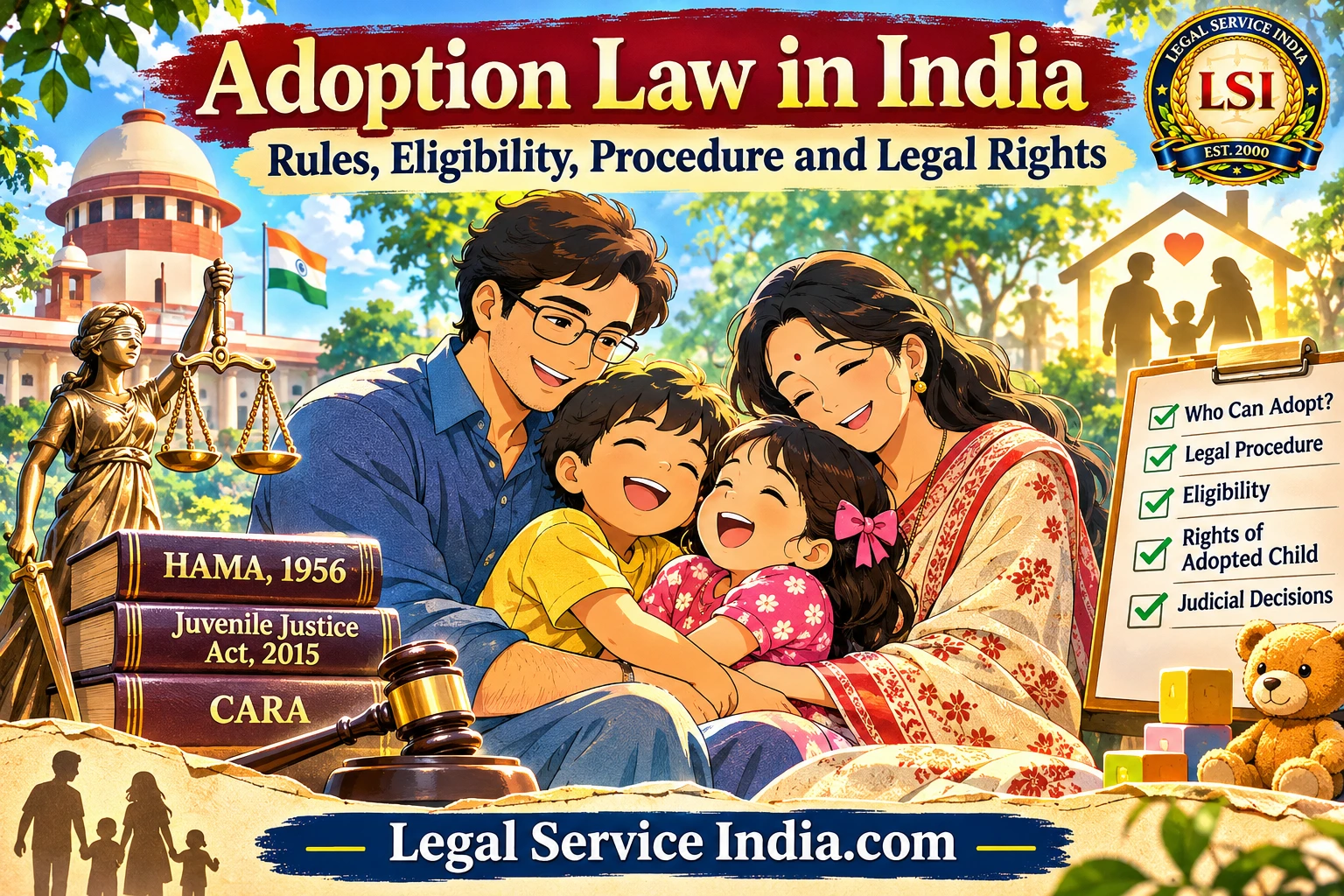
Abstract
Adoption is an important legal, social and emotional institution that establishes a permanent parent-child relationship between adoptive parents and an adopted child. Beyond its legal significance, adoption plays a vital role in building families, strengthening relationships and providing children with a sense of belonging, security, love and emotional stability. It offers children an opportunity to grow up in a nurturing family environment while allowing individuals and couples to experience parenthood and expand their families. Adoption also contributes to the development of meaningful family relationships, including sibling bonds, where adopted children become an integral part of the family and develop relationships based on affection, trust, equality and mutual understanding.
In India, adoption is governed primarily by the Hindu Adoption and Maintenance Act, 1956 and the Juvenile Justice (Care and Protection of Children) Act, 2015. This research paper aims to examine the evolution and legal framework of adoption in India, with particular emphasis on different forms of adoption, including adoption under Hindu law, domestic adoption and inter-country adoption. It also explores the position of adoption under different personal laws, the eligibility and legal requirements for adoption, and the role of the Central Adoption Resource Authority (CARA) in regulating and monitoring adoption procedures. Furthermore, the research examines the legal rights and status of adopted children, the importance of maintaining sibling relationships, and the role of family support in ensuring their emotional and social development. It also analyses relevant judicial decisions and contemporary challenges such as procedural delays, lack of awareness, social stigma, illegal adoption and difficulties associated with inter-country adoption.
Introduction
In India, adoption has been carrying out for thousands of years. As per Hindu Shastra, it is believed that the adopted son is a reflection of the natural son of the adoptive parents. Once a child for good is separated from his biological parents and becomes a legitimate child of his adoptive parents, he has all the rights that are related to adoptive parents. But there is a cause that the adoptive child cannot marry the other adoptive child or real child of his adoptive parent. Hindu law is the only law which addresses an adopted child as being compeer to a natural child because of the belief that a son was indispensable for spiritual as well as material welfare of the family.
Earlier, Hindu law allowed only males to be adopted, and restrictions were imposed on caste and gotra. Under Hindu law, a female child could not be adopted. Moreover, only the male had a right to adopt, and the dissent of his wife was immaterial. However, with changing social conditions, the concept gradually evolved towards equality and child welfare.
A significant development was the enactment of the Hindu Adoption and Maintenance Act, 1956 (HAMA), which codified and reformed Hindu adoption law. The Act recognises the adoption of both male and female children and establishes legal requirements concerning the capacity to adopt, eligibility of the child and conditions for a valid adoption. In Sawan Ram v. Kala Wanti (1967 AIR 1761), the Supreme Court examined the legal consequences of adoption by a Hindu widow under the 1956 Act. Similarly, in Laxmibai v. Bhagwantbuva (2013), the Supreme Court considered the presumption of validity attached to a registered adoption deed under Section 16 of HAMA.
Beyond its legal significance, adoption provides children with a family environment, emotional security and a sense of belonging. It also strengthens parent-child and sibling relationships, allowing adopted children to become an integral part of their adoptive families.
Essentials of a Valid Adoption Under the Hindu Adoption and Maintenance Act, 1956
According to the provisions of the Act, no adoption is a valid one except:
- The person who is willing to adopt should be capable of adopting a child.
- The person who is giving the child for adoption is capable of giving an adoption.
- The adopted child should be legally capable of getting adopted.
- This act applies to any person who is domiciled in the territories.
- A person who is a Hindu by religion.
- A person belonging to a Buddhist, Jain, or Sikh can’t adopt a child
The adoption should be completed by performing an actual giving and taking ceremony named ‘Data Homan’ (oblation to the fire). It is noteworthy that these points may not be essential in all cases when it comes to the validity of an adoption.
Who Can Adopt?
Adoption among Hindus in India is governed by the Hindu Adoptions and Maintenance Act, 1956 (HAMA), which amends and codifies the law relating to adoptions and maintenance among Hindus and specifies the conditions for a valid adoption. The Act applies to Hindus by religion, including Buddhists, Jains, and Sikhs, and not to Christians, Muslims, Jews, or Parsis. Under the Act, a Hindu who has legal capacity may adopt. A male adopter needs his wife’s consent, and an unmarried, widowed, or divorced woman may also adopt. The adoptee must ordinarily be Hindu, unmarried, and under fifteen years of age, unless a custom permits otherwise. The Act also bars adoption where the adopter already has a living child of the same sex as the adoptee, and it requires an age gap of at least twenty-one years where the adopter and the adoptee are of opposite sexes.
HAMA stands alongside the secular Juvenile Justice (Care and Protection of Children) Act, 2015, as amended in 2021. Section 56(3) of that Act provides that nothing in it applies to adoptions made under HAMA, a position the Supreme Court reaffirmed in Kannan v. Union Territory of Puducherry (2025), holding that no District Magistrate’s adoption order is required for such adoptions.
Courts have nonetheless sometimes harmonised the two statutes. In Adoption of Payal Sharinee v. Vinay Pathak (2010), the Bombay High Court held that the embargo on adopting a child of the same sex under Section 11 of HAMA must give way to the Juvenile Justice Act for children covered by that Act.
Procedure for a Valid Adoption
Under the Hindu Adoption and Maintenance Act, the party that is willing to adopt will apply to the Child Welfare Agency in 1956. Registration can be done either by an Adoption Coordinating Agency (ACA) located in the capital city of each state or by a Central Adoption Resource Authority (CARA) accredited agency in New Delhi. After that, the agency performs a preliminary interview with the adopting couple to understand their purpose behind adoption and motivation. Once the party decides the child they are going to adopt, they send the petition to the court of appropriate jurisdiction, where there is a court hearing on adoption (the court is required to hand down the adoption case within 2 months). Once the decision is issued by the court, approval is finalised.
Hindu Adoption and Maintenance Act, 1956
The Hindu Adoption and Maintenance Act, 1956, is a part of codifying and modernising Hindu law and was passed after independence. This act removes several gender-based discriminatory factors by reflecting the principles of equality and social justice. Section 6 to Section 11 of the Hindu Adoption and Maintenance Act states clearly the essential conditions for the valid adoption.
Section 6: Requisites of a Valid Adoption
All four must be met:
- The adopter has the capacity and the right to adopt.
- The giver has the capacity to give.
- The child is capable of being adopted.
- The adoption complies with the other conditions of the chapter.
Section 7: Capacity of a Male Hindu
He must be of sound mind and not a minor. If he has a wife living, he needs her consent. Her consent is not needed if she has completely renounced the world, ceased to be a Hindu, or been declared of unsound mind. If he has more than one wife, all of them must consent.
Section 8: Capacity of a Female Hindu
She must be of sound mind and not a minor. After the Personal Laws (Amendment) Act 2010, a married woman can adopt with her husband’s consent, subject to the same exceptions as in Section 7. This corrects my earlier paragraph, which described the older, narrower position.
Section 9: Who May Give in Adoption
- Sub-section (2): Father and mother have equal rights, but neither can give the child without the other’s consent, subject to the same exceptions.
- Sub-section (4): If both parents are dead, have renounced the world, or have abandoned the child; are of unsound mind; or the parentage is unknown, the guardian may give the child with the court’s permission.
- Sub-section (5): The court must be satisfied that the adoption serves the child’s welfare, must consider the child’s wishes, and must be satisfied that no payment is involved.
Section 10: Who May Be Adopted
The child must be Hindu, not already adopted, unmarried, and under 15. The last two requirements can be waived by custom.
Section 11: Other Conditions
- (i) and (ii): The adopter cannot have a living Hindu son, a son’s son, or a son’s son’s son when adopting a son. The same rule applies to daughters.
- (iii) and (iv): An adopter must be at least 21 years older than an adoptee of the opposite sex.
- (v): A child cannot be adopted by two people at once.
- (vi): The child must be actually given and taken, with intent to transfer it from the birth family. The Datta homam ceremony is not essential.
Section 12: Effects of Adoption
The child becomes the adopters’ child for all purposes from the date of adoption, and its ties to the birth family are severed. There are three provisos:
- (a) The child cannot marry anyone it could not have married in the birth family.
- (b) Property already vested in the child stays vested.
- (c) The adopted child cannot divest anyone of an estate that vested before the adoption.
Section 13
Unless there is an agreement to the contrary, adoption does not take away the adopters’ power to dispose of their property by transfer or will.
Section 14: Who Is the Adoptive Mother
- (1) The adopter’s living wife is the adoptive mother.
- (2) If several wives consented, the senior-most wife is the adoptive mother and the others are step-mothers.
- (3) and (4) A spouse the adopter marries later is a step-parent.
Section 15
A valid adoption cannot be cancelled, and the child cannot renounce the adoption and return to the birth family.
Section 16
A registered document recording an adoption, signed by the giver and the taker, raises a rebuttable presumption that the adoption complied with the Act.
Section 17
Receiving or giving payment in consideration of adoption is prohibited. The penalty is up to six months’ imprisonment, a fine, or both, and prosecution needs prior State Government sanction.
Eligibility of a Male Hindu to Take Adoption
Under Section 7 of the Hindu Adoptions and Maintenance Act, 1956 (HAMA), any male Hindu who is of sound mind and not a minor has the capacity to adopt a son or daughter. A married man must obtain the consent of his wife, or of all his wives if he has more than one. Consent is excused only where the wife has wholly and finally renounced the world, has ceased to be a Hindu, or has been declared by a court to be of unsound mind. Unmarried men, widowers and divorcees may adopt without any such consent.
Capacity under Section 7 is necessary but not sufficient. Under Section 11, the adoption must also satisfy the following:
- Same-sex child: To adopt a son, the adopter must have no living son, son’s son or son’s son’s son, whether natural or adopted. The same rule applies to adopting a daughter.
- Age gap: Where a male adopts a daughter, he must be at least 21 years older than her.
- Single adoption: The same child cannot be adopted by two or more persons simultaneously.
- Giving and taking: The child must actually be given and taken with intent to transfer them from the family of birth.
Under Section 9, only the child’s parents or guardian may give the child. The adoptee must also be eligible under Section 10: a Hindu, not previously adopted, unmarried (unless custom permits otherwise), and under 15 years of age (unless custom permits otherwise).
The restrictions in Section 11 apply only to adoptions under HAMA. The Juvenile Justice (Care and Protection of Children) Act provides a secular route, and the Supreme Court in Shabnam Hashmi v. Union of India (2014) upheld it as available irrespective of religion. Courts have also treated it as free of HAMA’s same-sex-child restriction.
Eligibility of a Female Hindu to Take Adoption
NOTE: before 2010, the Hindu Female is not eligible to take an adoption. She only gave consent to her husband for an adoption. But after 2010 she has the same right as Hindu Male in adoption.
Section 8 of the Hindu Adoptions and Maintenance Act, 1956 (HAMA) governs a female Hindu’s capacity to adopt. Originally, the Act let only unmarried women, widows and divorcees adopt, and a married woman could adopt only in limited cases, such as where her husband had renounced the world or been declared of unsound mind. The Personal Laws (Amendment) Act, 2010 (in force from 31 August 2010) removed this disparity. Any female Hindu who is of sound mind and not a minor now has the capacity to adopt a son or daughter. If she has a living husband, she must obtain his consent. Consent is excused only where the husband has completely and finally renounced the world, has ceased to be a Hindu, or has been declared of unsound mind by a court. Unmarried women, widows and divorcees need no consent.
Section 8 is read with Section 11, which imposes the same conditions as for male adopters:
- Same-sex child: To adopt a son, she must have no living son, son’s son or son’s son’s son. The same rule applies to adopting a daughter.
- Age gap: Where a female adopts a son, she must be at least 21 years older than him.
- Single adoption: The same child cannot be adopted by two or more persons simultaneously.
- Giving and taking: The child must be actually given and taken, by a person competent under Section 9, with intent to transfer the child from the family of birth.
The adoptee must also be eligible under Section 10: a Hindu, not previously adopted, unmarried (unless custom permits otherwise), and under 15 years of age (unless custom permits otherwise). As with male adopters, a woman who cannot adopt under HAMA can use the secular route under the Juvenile Justice (Care and Protection of Children) Act, which the Supreme Court upheld as available irrespective of religion in Shabnam Hashmi v. Union of India (2014).
Eligibility Forgiven an Adoption
Under Section 9 of the Hindu Adoptions and Maintenance Act, 1956, the following persons are legally competent to give a child in adoption:
- Father and Mother: Both parents have an equal right to give their child in adoption. However, the consent of the other parent is generally required.
- Guardian: A legal guardian may give a child in adoption only with the prior permission of the court.
- Circumstances for Guardian’s Authority: The guardian can give the child in adoption when:
- Both parents are dead.
- Both parents have completely and finally renounced the world.
- Both parents have abandoned the child.
- The parentage of the child is unknown.
- Both parents have been declared to be of unsound mind.
What Are the Effects of Adoption?
Section 12 sets out the legal consequences of a valid adoption. The general rule is that an adopted child is deemed to be the child of the adoptive father or mother for all purposes from the date of adoption. All ties with the family of birth are severed and replaced by those created in the adoptive family. The effect therefore has two parts:
- Transplantation: The child acquires full legal status in the adoptive family. This includes inheritance, maintenance and succession rights, and rights as a coparcener where the family is joint.
- Severance: The child loses rights and obligations in the natural family. For example, the child ceases to be an heir of the natural parents.
The section contains three provisos that qualify this general rule:
- Proviso (a), marriage: The child cannot marry anyone whom he or she could not have married had the child remained in the family of birth. The prohibited degrees of relationship therefore continue to apply.
- Proviso (b), property already vested: Property that vested in the child before the adoption continues to vest in the child, subject to the obligations attached to its ownership, including the obligation to maintain relatives in the family of birth.
- Proviso (c), no divesting: The adopted child cannot divest any person of an estate that vested in that person before the adoption.
Conclusion
The Hindu Adoptions and Maintenance Act, 1956 codified adoption among Hindus and replaced scattered customary rules with a uniform statutory framework. It prescribes who may adopt (Sections 7 and 8), who may give a child in adoption (Section 9), who may be adopted (Section 10), and the conditions for a valid adoption (Section 11). Section 12 then gives the adoption full effect: the child becomes the adoptive parents’ child for all purposes and loses ties with the family of birth, subject to limited provisos on marriage and property.
The Act has moved steadily toward gender equality. The Personal Laws (Amendment) Act, 2010 removed the earlier disparity in Section 8, so a married woman may now adopt with her husband’s consent, on terms parallel to those for a male Hindu.
The Act’s main limitation is its rigidity. The same-sex-child bar and the 21-year agegap rule can prevent otherwise suitable persons from adopting under personal law. The Juvenile Justice (Care and Protection of Children) Act provides a secular alternative, and Shabnam Hashmi v. Union of India (2014) confirmed that it is open to persons of every religion. The two regimes now run in parallel, with the secular route the more flexible of the two. Aligning HAMA’s conditions with the Juvenile Justice framework would make adoption law more uniform and keep it focused on the welfare of the child.
Written By: Suhavi Singh Rajput – UG Student, Jagran Lakecity University

