




229 Days Behind Bars: Mehraj Malik Is Free, But Who Answers For The Lost Liberty?
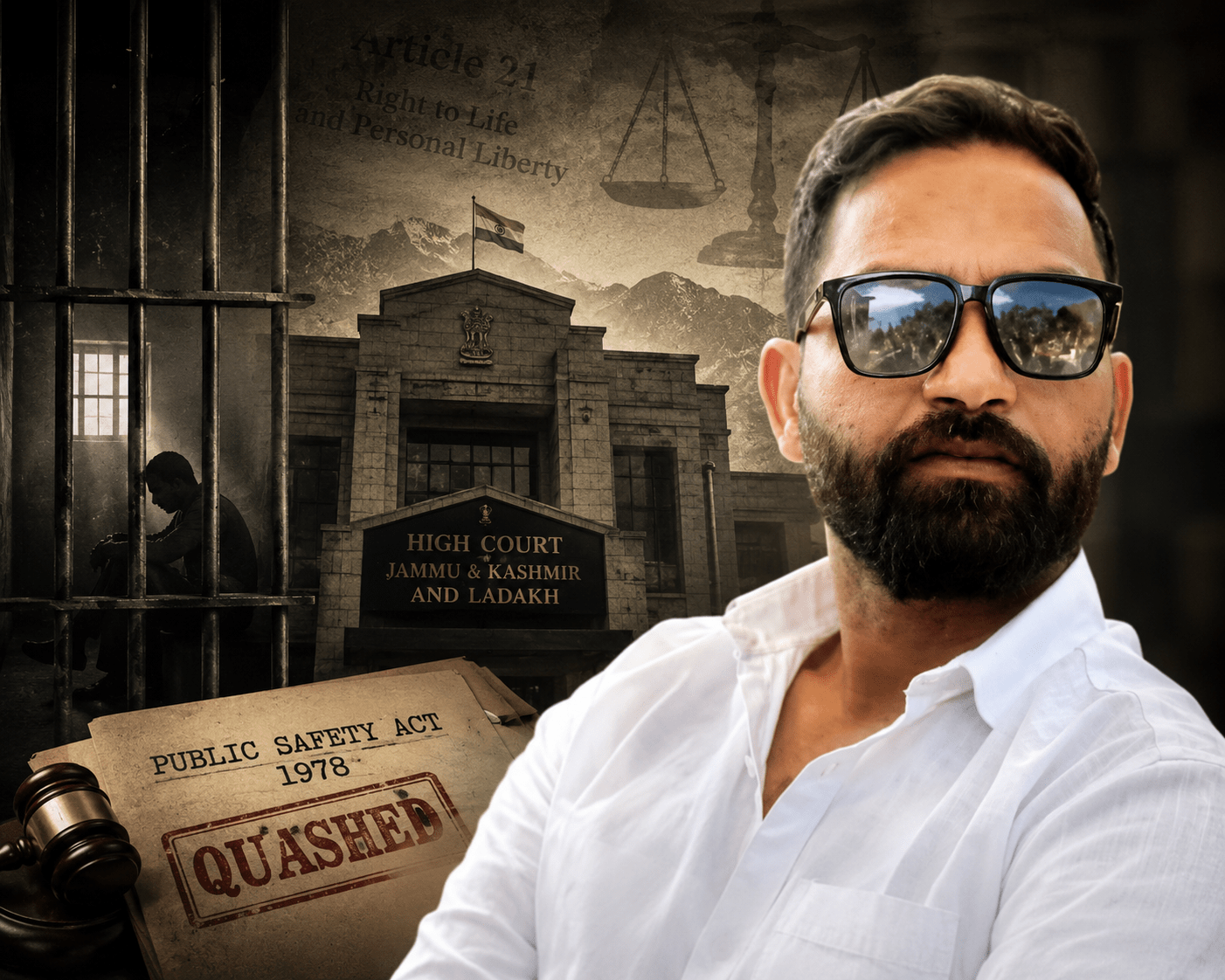
On April 27, 2026, Justice Mohd Yousuf Wani of the Jammu & Kashmir and Ladakh High Court delivered an 87-page judgement quashing the Public Safety Act, 1978 (PSA) detention order against AAP MLA Mehraj Din Malik from Doda East. The court directed his immediate release from Kathua District Jail unless he is required in any other case. Malik had spent nearly 229 days in preventive custody since his detention on September 8, 2025.
In a habeas corpus petition (HCP No. 139/2025), filed through his father Shamas Din, the MLA had challenged Detention Order No. PSA 05 of 2025 issued by the District Magistrate, Doda. The petitioner also sought ₹5 crore as compensation for the alleged illegal deprivation of his personal liberty under Article 21 of the Constitution. While the court allowed the petition on substantive grounds, it granted no monetary relief in its operative part.
This case once again highlights a recurring and troubling issue in Jammu and Kashmir: the human and constitutional cost when preventive detention under the PSA is later found unsustainable by the courts. A citizen — in this case an elected legislator — loses months of freedom, family life, and public service, while the question of a meaningful remedy often remains unanswered.
The Fine Line Between Law And Order And Public Order
Justice Wani carefully examined the grounds relied upon by the detaining authority—18 FIRs registered between 2014 and 2025 and 16 Daily Diary Reports. Most of these pertained to protests, advocacy regarding public issues such as the shifting of a health centre at Kencha, and alleged aggressive behaviour while raising concerns of a backward and flood-affected constituency.
The judgement drew a clear distinction between “law and order” and “public order”, relying on well-established Supreme Court precedents. In Ram Manohar Lohia v. State of Bihar (1965) INSC 176, the Court explained that every breach of law and order does not amount to public disorder. Public order concerns the even tempo of community life, while mere individual or localised disturbances fall within the domain of ordinary law and order.
In Mehraj Malik’s case, the High Court found that the allegations, even if taken at face value, did not cross this threshold. There was no sufficient “live link” or proximity showing a real apprehension that the MLA would act in a manner prejudicial to public order.
The court observed that an elected representative cannot be preventively detained merely for “hurting the feelings” of officials or vociferously raising public issues like health infrastructure and road connectivity. Invoking PSA in such circumstances appeared to be a “shortcut” when ordinary criminal law was already in motion.
Key Observations Made By The High Court
- The allegations did not satisfy the threshold required for disturbance of public order.
- Ordinary criminal law mechanisms were already available and operational.
- Preventive detention cannot replace normal criminal prosecution.
- An elected representative has the right to raise public grievances aggressively within democratic limits.
- The detention lacked sufficient proximity or “live link” to any imminent threat to public order.
Important Supreme Court Precedents Relied Upon
| Case | Principle Laid Down |
|---|---|
| Ram Manohar Lohia v. State of Bihar (1965) INSC 176 | Every breach of law and order does not amount to disturbance of public order. |
| Rekha v. State of Tamil Nadu (2011) INSC 267 | Preventive detention laws cannot be used as substitutes for ordinary criminal law. |
Preventive Detention And The Question Of Constitutional Remedy
The case raises larger constitutional concerns regarding preventive detention and personal liberty under Article 21 of the Constitution. While the court quashed the detention order and directed immediate release, the denial of monetary compensation leaves unresolved questions about accountability for wrongful deprivation of liberty.
For nearly 229 days, an elected legislator remained behind bars under a detention order that the High Court ultimately found legally unsustainable. The emotional, political, social, and constitutional consequences of such detention cannot easily be reversed.
The judgement also reflects judicial concern over the tendency to invoke preventive detention in situations where ordinary legal processes are already available. Courts have repeatedly warned that extraordinary powers must not become routine administrative tools.
Why The Mehraj Malik Judgment Is Significant
- It reinforces the constitutional distinction between “law and order” and “public order”.
- It reiterates judicial safeguards against misuse of preventive detention laws.
- It highlights the constitutional importance of personal liberty under Article 21.
- It questions the use of PSA against political dissent and public advocacy.
- It revives debate on compensation for wrongful detention.
Similar reasoning finds support in Rekha v. State of Tamil Nadu (2011) INSC 267, where the Supreme Court cautioned that preventive detention laws cannot be used as a substitute for the ordinary criminal justice system.
The Mehraj Malik judgement serves as another reminder that preventive detention, though legally permissible in limited circumstances, carries immense constitutional responsibility. When courts later find such detention unjustified, the larger question remains: who answers for the irreversible loss of liberty suffered by the individual?
The Cost of Lost Liberty
For 229 days, Mehraj Malik was separated from his elderly parents, wife, and four daughters. His legislative work in a remote and backward constituency in the Chenab Valley remained stalled at a time when people were struggling with flood-related infrastructure damage. His family bore a heavy emotional and practical burden.
Preventive detention under the PSA is intended to be precautionary, not punitive. Yet when courts later hold that the detention did not meet the legal standard, the detained person has already paid a heavy and irrecoverable price in lost time and liberty.
Constitutional Rights and Compensation
The petition had specifically prayed for compensation, citing violation of Article 21. The Supreme Court has, in a number of cases, recognised that monetary compensation can be awarded in public law for infringement of fundamental rights. In a landmark case involving an MLA, the court held that illegal detention calls for redress.
More recently, the Jammu & Kashmir and Ladakh High Court itself awarded ₹5 lakh as compensation in a case where PSA detention was found illegal (Advocate Ali Mohammad Lone alias Zahid v. Government of Jammu & Kashmir, 2024 SCC OnLine J&K 267). However, in Mehraj Malik’s judgement, no compensation was directed. This is not unusual. Habeas corpus proceedings frequently result only in release orders, leaving the question of damages to a separate, lengthy civil suit or fresh writ petition.
Legal Challenges Under PSA
Section 22 of the Jammu and Kashmir Public Safety Act, 1978, which protects officials acting “in good faith”, further complicates the fixing of accountability even when courts find non-application of mind or failure to distinguish between law and order and public order.
| Key Issue | Impact on Liberty |
|---|---|
| Preventive Detention Under PSA | Can lead to prolonged detention without regular criminal trial safeguards. |
| Lack of Compensation | Victims often receive release orders without financial or legal redress. |
| Good Faith Protection Under Section 22 | Makes accountability of officials more difficult. |
| Delayed Judicial Relief | Time lost in detention cannot be restored. |
Need for Stronger Safeguards and Remedies
The judgement reinforces judicial oversight and reminds detaining authorities that PSA powers must be exercised sparingly, with due application of mind, and only when ordinary laws are demonstrably insufficient. It also underscores that elected representatives carry a democratic mandate that cannot be lightly disregarded.
Yet the broader systemic concern persists. How many others have spent months or even years in detention only for the High Court to eventually quash the order on similar grounds? Release after prolonged incarceration offers little solace for the irreplaceable time lost — time away from family, livelihood, and public service.
Indian constitutional jurisprudence, from Maneka Gandhi v. Union of India (1978) INSC 16 onwards, has emphasised that the procedure depriving a person of liberty under Article 21 must be just, fair, and reasonable. When preventive detention is later declared unsustainable, the remedy should not stop at mere release.
There is a strong case for institutional mechanisms that provide prompt and meaningful reparation, including:
- Statutory compensation guidelines for unlawful detention.
- Faster adjudication of damage claims.
- Mandatory inquiry into repeated misuse of PSA.
- Stronger judicial oversight of preventive detention orders.
- Improved accountability mechanisms for misuse of state power.
Political and Constitutional Significance
As political voices, including Chief Minister Omar Abdullah, have described the detention as a “gross misuse”, this case calls for reflection beyond one individual. Strengthening safeguards in preventive detention laws, ensuring quicker judicial review, and creating enforceable remedies for unlawful deprivation of liberty would go a long way in upholding the constitutional promise of personal freedom.
Mehraj Malik is now free to resume his duties. His release upholds the rule of law. But the question lingers: when the state detains a person preventively and the court later finds it unjustified, who truly bears the cost – and who provides the remedy?
Constitutional Promise of Liberty
The Constitution demands more than eventual release. It demands accountability and justice that acknowledges the human price paid when liberty is curtailed without sufficient legal basis.
Written By: Sahil Najar, Final Year Law Student, Central University of Kashmir.
