





Abstract
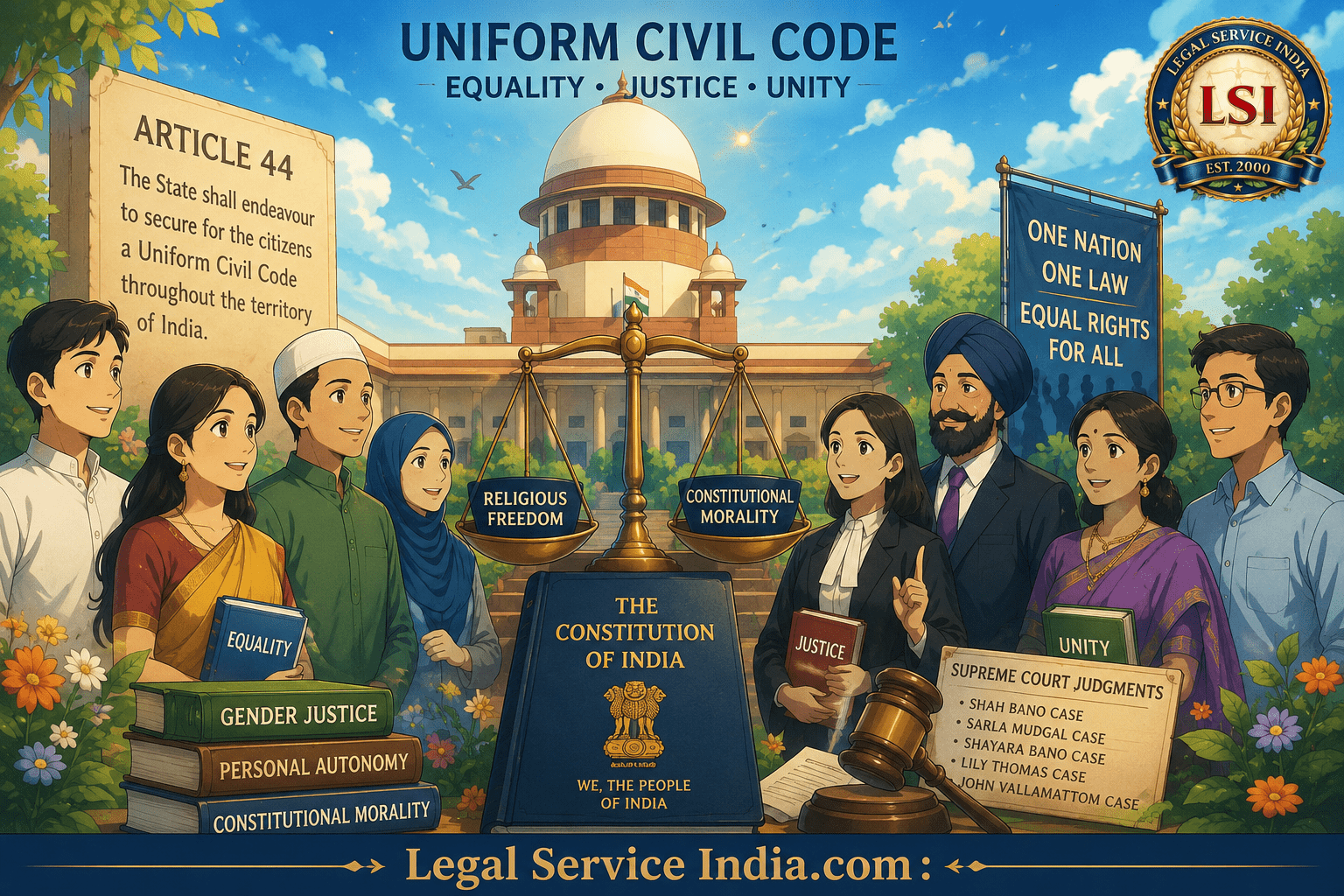
The constitutional discourse in India surrounding the implementation of a Uniform Civil Code (UCC) under Article 44 remains a deeply polarized legal debate. This paper examines the delicate constitutional tension between the state’s directive to secure a uniform civil architecture and the individual as well as collective fundamental rights to religious freedom guaranteed under Articles 25 to 28.
By evaluating the historical trajectory of personal laws from the colonial era to contemporary legislative shifts—such as the Uttarakhand Uniform Civil Code of 2024—this study analyzes how the Supreme Court of India has consistently navigated this friction using the “Essential Religious Practices” doctrine.
Through a comparative assessment of global secular models (France, Turkey, and South Africa), this article argues that a progressive UCC must not be an instrument of cultural homogenization. Instead, it must serve as a rights-based framework aimed at eliminating gender discrimination and harmonizing personal autonomy with constitutional morality.
Key Themes
- Uniform Civil Code (UCC) under Article 44
- Fundamental rights under Articles 25 to 28
- Constitutional tension between Directive Principles and religious freedom
- Historical evolution of personal laws in India
- Uttarakhand Uniform Civil Code, 2024
- Essential Religious Practices doctrine
- Comparative secular constitutional models
- Gender justice and constitutional morality
Constitutional Focus of the Study
| Constitutional Aspect | Focus |
|---|---|
| Article 44 | Directive for implementing a Uniform Civil Code |
| Articles 25–28 | Protection of religious freedom and related fundamental rights |
| Judicial Doctrine | Essential Religious Practices doctrine |
| Comparative Analysis | France, Turkey, and South Africa |
| Primary Objective | Balancing constitutional morality, personal autonomy, and gender equality |
Central Argument
The constitutional discourse in India surrounding the implementation of a Uniform Civil Code (UCC) under Article 44 remains a deeply polarized legal debate. This paper examines the delicate constitutional tension between the state’s directive to secure a uniform civil architecture and the individual as well as collective fundamental rights to religious freedom guaranteed under Articles 25 to 28.
By evaluating the historical trajectory of personal laws from the colonial era to contemporary legislative shifts—such as the Uttarakhand Uniform Civil Code of 2024—this study analyzes how the Supreme Court of India has consistently navigated this friction using the “Essential Religious Practices” doctrine.
Through a comparative assessment of global secular models (France, Turkey, and South Africa), this article argues that a progressive UCC must not be an instrument of cultural homogenization. Instead, it must serve as a rights-based framework aimed at eliminating gender discrimination and harmonizing personal autonomy with constitutional morality.
1. Introduction
The constitutional identity of the Republic of India is rooted in an extraordinary mosaic of religious, linguistic, and cultural pluralism. The Preamble to the Constitution charges the state with securing justice, liberty, equality, and fraternity for all citizens, creating a protective umbrella over this diversity. However, an enduring constitutional paradox persists: while public, commercial, and criminal laws apply uniformly across all territories, family and personal relationships remain legally fragmented.
Matters governing domestic relations—specifically marriage, dissolution, devolution of property, adoption, maintenance, and guardianship—are splintered along denominational lines. Hindus, Buddhists, Jains, and Sikhs are largely regulated by the codified Hindu personal law enactments of the 1950s. Muslims are governed by the uncodified classical jurisprudence operationalized via the Shariat Application Act of 1937. Christians, Parsis, and Jews navigate their own separate statutory or customary frameworks, leaving the Special Marriage Act of 1954 as a strictly optional secular alternative.
The Constitutional Paradox of Personal Laws
This legal pluralism was designed to protect minority identities, but it frequently triggers profound constitutional friction. Critics argue that diverse personal laws foster systemic vulnerabilities, particularly disadvantaging women and children regarding inheritance and marital security. This raises a fundamental question: Can the mandate of equality before the law under Article 14 be truly realized alongside a fragmented, religion-based civil framework?
Article 44 and the Uniform Civil Code
The framers of the Constitution sought to resolve this tension by inserting Article 44 within the Directive Principles of State Policy (DPSP), directing the state to “endeavor to secure for the citizens a uniform civil code throughout the territory of India.” Because DPSPs are non-justiciable under Article 37, this goal remained a long-term legislative aspiration rather than an immediate mandate. Concurrently, Articles 25 through 28 guarantee the fundamental right to freedom of conscience and the right to freely profess, practice, and propagate religion. 3
Therefore, the core challenge is determining whether a UCC would advance egalitarian constitutional protections or infringe upon religious autonomy. Rather than treating individual liberty and religious freedom as mutually exclusive, the Indian constitutional matrix requires a harmonious interpretation that balances personal autonomy.
Key Constitutional Issues Discussed
- Constitutional commitment to justice, liberty, equality, and fraternity.
- Existence of multiple religion-based personal law systems.
- Article 14 and the principle of equality before the law.
- Directive Principle under Article 44 advocating a Uniform Civil Code.
- Protection of religious freedom under Articles 25–28.
- Balancing individual rights with religious autonomy.
Overview of the Current Personal Law Framework
| Community | Applicable Personal Law |
|---|---|
| Hindus, Buddhists, Jains, Sikhs | Codified Hindu Personal Laws (1950s) |
| Muslims | Muslim Personal Law (Shariat) Application Act, 1937, and uncodified classical jurisprudence |
| Christians | Separate statutory personal laws |
| Parsis | Separate statutory personal laws |
| Jews | Customary legal framework |
| All Communities (Optional) | Special Marriage Act, 1954 |
2. Historical Background of Personal Laws in India
The origin of fragmented personal laws in India lies in the strategic legal policies of pre-colonial and colonial administrations. Ancient and medieval India relied heavily on decentralized legal traditions. Hindu communities adhered to localized interpretations of the Dharmashastras, while Muslim populations were governed by Fiqh (Islamic jurisprudence), alongside diverse tribal customs.
Personal Laws During British Rule
This pluralism was institutionalized during British rule through a policy of deliberate non-intervention in the domestic sphere, designed to prevent social unrest and solidify political control. This was codified by Warren Hastings’ Judicial Plan of 1772, which mandated that in all suits regarding inheritance, marriage, caste, and other religious usages or institutions, the laws of the Koran should be applied to Mohammedans and those of the Shaster to Gentoos (Hindus). While the colonial state actively unified criminal law through the Indian Penal Code of 1860 and contract law through the Indian Contract Act of 1872, it preserved the division of family law.
Post-Independence Reforms
In the post-independence era, this legal landscape underwent significant structural changes, but only unevenly. During the 1950s, the Indian Parliament codified and reformed Hindu law through four major pieces of legislation: the Hindu Marriage Act (1955), the Hindu Succession Act (1956), the Hindu Minority and Guardianship Act (1956), and the Hindu Adoptions and Maintenance Act (1956). These statutes dismantled several patriarchal customs, introduced absolute monogamy, recognized divorce, and granted distinct property rights to Hindu women.
Continuation of Legal Pluralism
Conversely, Muslim personal law remained largely uncodified, resting primarily on traditional texts and the statutory recognition provided by the Muslim Personal Law (Shariat) Application Act of 1937. Parsi and Christian personal laws underwent minor amendments but remained distinct regimes. As a result, the independent Indian state retained a pluralistic family law system that left civil rights tied directly to religious identity.
Timeline of the Development of Personal Laws
| Year | Development | Significance |
|---|---|---|
| 1772 | Warren Hastings’ Judicial Plan | Formal recognition of religion-based personal laws |
| 1860 | Indian Penal Code | Uniform criminal law introduced |
| 1872 | Indian Contract Act | Uniform contract law established |
| 1937 | Muslim Personal Law (Shariat) Application Act | Statutory recognition of Muslim personal law |
| 1955 | Hindu Marriage Act | Codified Hindu marriage law |
| 1956 | Hindu Succession Act | Reformed inheritance rights |
| 1956 | Hindu Minority and Guardianship Act | Codified guardianship laws |
| 1956 | Hindu Adoptions and Maintenance Act | Codified adoption and maintenance laws |
Key Historical Highlights
- Pre-colonial India followed decentralized religious and customary legal systems.
- The British unified criminal and commercial laws while preserving separate personal laws.
- Independent India substantially reformed Hindu law but retained separate legal systems for other religious communities.
- The resulting framework continues to link family law rights with religious identity.
3. Constitutional Framework
Evaluating the viability of a Uniform Civil Code requires examining the interplay between several key provisions within the Constitution of India:
| Constitutional Provision | Key Principle | Relevance to the Uniform Civil Code |
|---|---|---|
| Article 14 | Equality Before Law | Ensures equal protection of laws and discourages arbitrary legal distinctions. |
| Article 15 | Prohibition of Discrimination | Allows reforms that promote equality, particularly for women and children. |
| Article 21 | Right to Life and Personal Liberty | Protects dignity, privacy, and personal autonomy. |
| Articles 25–28 | Freedom of Religion | Protects religious freedom while permitting regulation of secular activities. |
| Article 44 | Directive Principle | Encourages the state to secure a Uniform Civil Code. |
Article 14 (Equality Before Law)
This article guarantees equality before the law and equal protection of the laws within the territory of India.7 It prohibits arbitrary classification. Proponents of a UCC argue that maintaining distinct, faith-based legal standards creates unequal civil rights among citizens based solely on their birth into a specific religious community.
Article 15 (Prohibition of Discrimination)
This provision explicitly bars the state from discriminating against any citizen on grounds only of religion, race, caste, sex, or place of birth.8 Crucially, Article 15(3) empowers the state to make special provisions for women and children, providing a clear constitutional justification for reforming discriminatory personal laws.
Article 21 (Right to Life and Personal Liberty)
The Supreme Court has expanded the scope of Article 21 to include the rights to human dignity, personal privacy, and individual autonomy.9 When personal laws deny an individual equal status or choice within a domestic relationship, they directly implicate these core guarantees under Article 21.
Articles 25–28 (Freedom of Religion)
Article 25(1) guarantees freedom of conscience and the right to freely profess, practice, and propagate religion.10 However, this right is explicitly subject to public order, morality, health, and the other provisions of Part III.
Crucially, Article 25(2)(a) permits the state to regulate or restrict any economic, financial, political, or other secular activity associated with religious practice.11 Furthermore, Article 26 protects the right of religious denominations to manage their internal affairs, but this must be balanced against individual fundamental rights.
Article 44 (Directive Principle for a UCC)
Located in Part IV, this article states that the state shall endeavor to secure a Uniform Civil Code for all citizens.12 While Article 37 clarifies that Directive Principles cannot be enforced via writ jurisdiction, it declares them fundamental to the governance of the country, making it the state’s duty to apply them when passing laws.13
Harmonious Constitutional Interpretation
The constitutional task is not to choose between Article 25 and Article 44 but to interpret them harmoniously. The text of the Constitution protects genuine religious pluralism, but it does not shield practices that violate fundamental human dignity or equality from legislative reform.
4. Relationship Between Religious Freedom and the Uniform Civil Code
The perceived conflict between Article 44 and Article 25 often stems from treating personal laws as entirely inseparable from religious faith. However, Indian constitutional jurisprudence distinguishes between core spiritual beliefs and secular activities that are associated with religion.
Constitutional Distinction Between Religious and Secular Matters
While religious rituals, forms of worship, and foundational doctrines are protected under Article 25(1), the civil consequences of human relationships—such as the contractual or sacramental structures of marriage, the devolution of property, and financial maintenance—constitute secular matters regulated by the state.
The Supreme Court has affirmed that the state may intervene in secular areas linked to religion to advance social welfare and reform.14
How a Balanced Uniform Civil Code Can Operate
A balanced Uniform Civil Code does not need to alter religious ceremonies, weddings, or spiritual practices. Instead, it can establish common legal standards for civil rights, such as:
- Securing equal inheritance portions.
- Providing uniform maintenance.
- Prohibiting polygamy.
This approach respects diverse cultural expressions while ensuring that civil rights are protected equally by law.
5. Judicial Interpretation of the Uniform Civil Code and Religious Freedom
Because Parliament has hesitated to enact a nationwide UCC, the Supreme Court of India has become the primary forum for addressing conflicts between personal laws and fundamental rights.
Key Supreme Court Decisions on the Uniform Civil Code
| Case | Year | Key Legal Issue | Outcome |
|---|---|---|---|
| Mohd. Ahmed Khan v. Shah Bano Begum15 | 1985 | Maintenance after divorce | Section 125 CrPC applies irrespective of religion. |
| Sarla Mudgal v. Union of India16 | 1995 | Religious conversion for second marriage | Conversion cannot be used to avoid bigamy laws. |
| Lily Thomas v. Union of India18 | 2000 | Review of Sarla Mudgal | Religious freedom cannot defeat marital obligations. |
| John Vallamattom v. Union of India19 | 2003 | Discriminatory succession law | Section 118 was struck down as unconstitutional. |
| Shayara Bano v. Union of India20 | 2017 | Triple Talaq | Instant Triple Talaq is declared unconstitutional. |
| Jose Paulo Coutinho v. Maria Luiza Valentina Pereira22 | 2019 | Goa Civil Code | Goa is recognized as a working example of a common civil code. |
5.1 Mohd. Ahmed Khan v. Shah Bano Begum (1985)15
In this landmark case, a 62-year-old divorced Muslim woman sought maintenance under Section 125 of the Code of Criminal Procedure, 1973, after her husband invoked triple talaq. The husband argued that his financial obligations were strictly governed by Muslim personal law, which limited support to the iddat period (three months post-divorce).
A Constitution Bench rejected this argument, ruling that Section 125 is a secular, public policy provision designed to prevent destitution and applies to all citizens regardless of faith. Chief Justice Y.V. Chandrachud noted that a common civil code would help secure national integration by removing conflicting legal loyalties, urging the state to fulfill its mandate under Article 44.
5.2 Sarla Mudgal v. Union of India (1995)16
Here, the Supreme Court addressed whether a married Hindu man could legally convert to Islam solely to contract a second bigamous marriage without dissolving his first monogamous marriage.
The Court ruled that such conversions were a misuse of personal law and did not dissolve the first marriage. Consequently, the second marriage was void, and the husband remained liable for bigamy under Section 494 of the Indian Penal Code.17 Justice Kuldip Singh strongly advocated for a UCC, arguing that the lack of uniform laws created legal loopholes and allowed individuals to evade their civil duties.
5.3 Lily Thomas v. Union of India (2000)18
Reviewing its earlier findings in Sarla Mudgal, the Supreme Court clarified that while freedom of conscience allows for genuine religious conversion, it cannot be used as a legal stratagem to violate existing marital obligations or infringe upon the rights of the first spouse.
This decision reinforced the supremacy of the rule of law over the tactical misuse of personal laws.
5.4 John Vallamattom v. Union of India (2003)19
A Christian priest challenged Section 118 of the Indian Succession Act, 1925, which restricted Christians from bequeathing property to religious or charitable causes if they died within twelve months of executing their will.
The Supreme Court struck down the provision for violating Article 14, finding it discriminatory against Christian citizens. Chief Justice V.N. Khare expressed regret that Article 44 had not yet been implemented, calling it a vital tool for eliminating discriminatory anomalies across personal laws.
5.5 Shayara Bano v. Union of India (2017)20
This case directly challenged the practices of Talaq-e-Biddat (instantaneous triple talaq), polygamy, and Nikah Halala.
A five-judge Constitution Bench set aside instant triple talaq by a 3:2 majority. The majority found the practice arbitrary and a violation of a woman’s right to equality under Article 14, ruling that it was not an essential aspect of Islamic faith. This decision led directly to the passage of the Muslim Women (Protection of Rights on Marriage) Act in 2019.21
5.6 Jose Paulo Coutinho v. Maria Luiza Valentina Pereira (2019)22
While resolving a property dispute under the Goa Civil Code, the Supreme Court praised the state’s uniform legal framework.
The Court noted that Goa serves as a practical example of a jurisdiction implementing a common civil code for all residents regardless of religion, protecting citizenship rights while preserving local cultural practices.
6. The Essential Religious Practices Doctrine
To determine when the state can reform personal laws without infringing on religious liberty, the judiciary relies heavily on the Essential Religious Practices (ERP) Doctrine.
First outlined in the Shirur Mutt case, this doctrine requires courts to determine whether a disputed practice forms an essential, core part of a religion.23 If a practice is non-essential, superstitious, or purely secular in nature, it can be modified or abolished by the legislature under Article 25(2)(b) to promote social welfare and reform.
Key Cases Applying the Essential Religious Practices Doctrine
| Case Law Reference | Legal Matter Inspected | Judicial System Finding |
|---|---|---|
| Shirur Mutt (1954) | Autonomy of religious trusts | Established the ERP doctrine; core doctrines are protected, secular administration is not. |
| Shah Bano (1985) | Post-divorce spousal maintenance | Section 125 CrPC overrides restrictive personal laws; maintenance is a secular obligation. |
| Shayara Bano (2017) | Instantaneous Talaq-e-Biddat | Arbitrary dissolution is unconstitutional and forms no essential part of Islamic faith. |
Application of the ERP Doctrine to Personal Laws
Applying this test to personal laws, the legal mechanisms governing inheritance, adoption, and marriage are classified as civil and social structures rather than immutable spiritual mandates. Therefore, they fall within the regulatory domain of Parliament.
However, critics point out that this doctrine forces secular judges to interpret religious texts, which carries a risk of judicial overreach into matters of faith.
Key Takeaways
- The Supreme Court has played a central role in shaping the debate on the Uniform Civil Code.
- Shah Bano established that secular maintenance laws apply to all citizens.
- Sarla Mudgal and Lily Thomas prevented misuse of religious conversion to evade marital obligations.
- John Vallamattom struck down discriminatory succession provisions affecting Christians.
- Shayara Bano declared instant Triple Talaq unconstitutional.
- The ERP Doctrine distinguishes protected religious practices from secular matters that Parliament may regulate.
7. Comparative Perspective
Other constitutional democracies offer useful insights into how states balance uniform civil rights with religious diversity.
Comparative Overview of Civil Law Models
| Country | Legal Model | Key Features |
|---|---|---|
| France | Strict Secular Civil Code | Uniform civil law with mandatory civil marriage registration. |
| Turkey | Secular Civil Code | Swiss-inspired civil code replacing religious family law. |
| South Africa | Pluralistic Constitutional Model | Recognition of customary and religious marriages subject to constitutional rights. |
| United Kingdom | Religious Arbitration with Civil Supremacy | Religious tribunals function only as voluntary private forums. |
France
France operates under the strict principle of laïcité (institutional secularism), which mandates a complete separation between state functions and religious institutions.24 The French Civil Code applies uniformly to all citizens. While individuals are free to perform religious marriage ceremonies, these have no legal validity until a civil registration is completed before state authorities.
Turkey
Under the leadership of Mustafa Kemal Atatürk in 1926, Turkey abolished traditional religious courts and replaced Islamic family law with a secular code based on the Swiss Civil Code.25 This reform made civil marriage mandatory, outlawed polygamy, and established equal rights for women in divorce and asset distribution.
South Africa
South Africa uses a pluralistic legal model operating under a supreme constitution. The state recognizes customary and religious marriages (such as Islamic and indigenous weddings), but all personal laws remain subject to the Bill of Rights.26 South African courts regularly invalidate customary practices that violate constitutional principles of gender equality or human dignity.
United Kingdom
The UK allows religious bodies (such as Shariah councils or Jewish Beth Din courts) to offer voluntary arbitration for community disputes.27 However, these bodies operate purely as private tribunals. They have no power to alter statutory rights, and their decisions cannot override the jurisdiction of the formal UK family court system.
8. Arguments Supporting a Uniform Civil Code
The following arguments are commonly advanced in support of implementing a Uniform Civil Code (UCC):
- Advancing Substantive Equality: A UCC fulfills the promise of Article 14 by ensuring all citizens are governed by the same civil laws, regardless of their religious identity.
- Promoting Gender Justice: Many uncodified or traditional personal laws contain structural inequalities regarding inheritance percentages, polygamy, and guardianship rights. A uniform code provides an opportunity to establish gender-neutral civil rights for women across all communities.
- Enhancing National Integration: Replacing fragmented, faith-based legal systems with a unified code can reduce identity-based divisions and strengthen a shared sense of citizenship.
- Simplifying the Legal System: A single, clear statutory framework would replace a complex web of overlapping personal laws, lowering litigation costs and reducing judicial delays.
Summary of Supporting Arguments
| Argument | Purpose |
|---|---|
| Advancing Substantive Equality | Ensures equal civil laws for every citizen. |
| Promoting Gender Justice | Removes discriminatory provisions affecting women. |
| Enhancing National Integration | Strengthens a common national identity through uniform civil laws. |
| Simplifying the Legal System | Reduces complexity, litigation costs, and judicial delays. |
9. Arguments Opposing a Uniform Civil Code
The following concerns are frequently raised by those who oppose the implementation of a Uniform Civil Code:
- Infringement on Cultural and Minority Rights: Opponents argue that personal laws are deeply tied to religious identity. Imposing a uniform code could be seen as an attempt to erode minority protections and enforce cultural conformity.
- Concerns Over Structural Homogenization: Critics worry that a uniform code might selectively adopt majority traditions, effectively marginalizing the distinct customs of minority groups and indigenous tribes.
- Legislative and Codification Challenges: Drafting a single code that accommodates India’s vast diversity—including the unique customs of northeastern states protected under Article 371—presents immense practical challenges.
- Preference for Internal Reform: Many legal scholars argue that the best way forward is to encourage organic, internal reforms within each personal law system rather than imposing a single, uniform code from above.
Summary of Opposing Arguments
| Concern | Reason |
|---|---|
| Infringement on Cultural and Minority Rights | May affect religious identity and minority protections. |
| Concerns Over Structural Homogenization | Risk of marginalizing minority customs and traditions. |
| Legislative and Codification Challenges | Difficult to accommodate India’s constitutional and cultural diversity. |
| Preference for Internal Reform | Supports gradual reform within existing personal law systems. |
10. Critical Analysis
The debate surrounding the Uniform Civil Code is often oversimplified as a choice between secularism and religious freedom. In reality, it reflects a complex constitutional effort to reconcile community pluralism with individual rights. The Constitution does not demand the eradication of religious identity; rather, it provides a framework where faith can coexist with human dignity.
A common misunderstanding is that a UCC would ban all distinct religious customs and traditional ceremonies. Article 44 addresses only civil matters—such as asset distribution, spousal support, and legal guardianship. Religious rituals, styles of marriage ceremonies, and spiritual beliefs remain protected under Articles 25 and 26.
However, religious freedom cannot be used to justify practices that cause systemic discrimination. Personal laws have real-world civil impacts on the economic and social security of women and children. When these laws result in clear inequalities, the state has a constitutional responsibility to intervene. The Supreme Court’s decisions in Shah Bano and Shayara Bano show a consistent effort to protect individual rights while respecting the core spiritual aspects of religious identity.
Key Takeaways
| Issue | Constitutional Position |
|---|---|
| Religious Freedom | Protected under Articles 25 and 26. |
| Scope of Article 44 | Limited to civil matters such as marriage, divorce, inheritance, guardianship, and maintenance. |
| Religious Rituals | Traditional ceremonies and spiritual beliefs remain protected. |
| Gender Justice | The State may intervene where personal laws create systemic discrimination. |
| Judicial Approach | Shah Bano and Shayara Bano emphasize balancing religious freedom with constitutional rights. |
11. Contemporary Developments
The UCC debate has moved from theoretical discussions to active legislation with the passage of the Uniform Civil Code, Uttarakhand, 2024.28 This enactment makes Uttarakhand the first state since independence to implement a comprehensive civil code covering marriage, divorce, asset devolution, and the registration of live-in relationships. While the Act exempts Scheduled Tribes to protect their distinct cultural identity, it provides a template for state-level civil codification.
Concurrently, the Law Commission of India has sought views from the public and religious organizations to review family law frameworks. Rather than rushing into immediate nationwide uniformity, recent commission reports suggest focusing first on eliminating discriminatory provisions within existing personal laws, ensuring wide consultation before enacting broader statutory changes.
Recent Developments at a Glance
| Development | Significance |
|---|---|
| Uniform Civil Code, Uttarakhand, 2024 | First comprehensive state-level UCC after independence. |
| Coverage | Marriage, divorce, asset devolution, and registration of live-in relationships. |
| Scheduled Tribes Exemption | Protects distinct cultural and customary practices. |
| Law Commission Consultation | Focuses on public participation and review of existing personal laws. |
| Current Reform Strategy | Prioritizes removal of discriminatory provisions before nationwide implementation. |
12. Challenges in Implementing a Uniform Civil Code
Implementing a Uniform Civil Code involves several constitutional, legal, and social challenges that require careful consideration.
Major Challenges
- Accommodating Deep Diversity: Creating a single legal framework that satisfies the varied customs of India’s numerous communities, sects, and regional groups remains a highly complex task.
- Building Public Trust: Implementing major legal reforms without broad consultation risks creating public anxiety and undermining trust in secular governance.
- Protecting Tribal Autonomy: Constitutional exemptions, such as those under the Sixth Schedule and Article 371, protect the customary laws of indigenous tribes. Integrating these areas into a uniform code requires careful legal balancing.
- Reconciling Diverse Legal Concepts: Blending fundamentally different legal traditions—such as the contract-based structure of Muslim marriages and the historically sacrament-based structure of Hindu marriages—into a single law requires careful and precise legislative drafting.
Implementation Challenges Summary
| Challenge | Primary Concern |
|---|---|
| Deep Diversity | Reconciling varied customs and traditions. |
| Public Trust | Ensuring widespread consultation and acceptance. |
| Tribal Autonomy | Respecting constitutional protections for Indigenous communities. |
| Diverse Legal Traditions | Drafting legislation that harmonizes different legal concepts. |
13. Suggestions and Recommendations
To develop a legally sustainable and inclusive Uniform Civil Code, the following steps are recommended:
Recommended Reforms
- A Phased, Consultative Approach: The state should avoid hasty legislation. Instead, it should introduce changes in phases, actively consulting with legal experts, religious representatives, women’s rights groups, and civil society organizations.
- Focusing on a Rights-Based, Rather Than a Uniformity-Based, Framework: The primary goal of a UCC should be to eliminate discrimination and protect vulnerable parties, rather than enforcing uniformity for its own sake. Cultural variations that do not cause harm should be preserved.
- Prioritizing Gender Justice: Reform efforts must focus on securing equal rights for women across all communities regarding inheritance, property ownership, spousal support, and child guardianship.
- Codifying and Modernizing Existing Personal Laws: Before creating a single national code, existing personal laws should be updated individually to remove discriminatory elements and ensure alignment with fundamental constitutional rights.
- Enacting an Optional, Progressive Civil Framework: A practical intermediate step would be to update and expand existing secular laws, like the Special Marriage Act, making them more accessible and attractive as an alternative to faith-based systems.
Recommendations Summary
| Recommendation | Objective |
|---|---|
| Phased Consultation | Build consensus before implementation. |
| Rights-Based Framework | Protect constitutional rights instead of pursuing uniformity alone. |
| Gender Justice | Ensure equal rights across all communities. |
| Modernize Personal Laws | Remove discriminatory provisions and align with constitutional values. |
| Optional Progressive Civil Framework | Strengthen secular legal alternatives while respecting religious diversity. |
Conclusion
The Uniform Civil Code remains a key constitutional goal envisioned by the framers of India’s republic. Its purpose is not to diminish the country’s rich religious diversity but to build a shared civil foundation based on equality, justice, and human dignity.
The relationship between Article 44 and Articles 25–28 can be harmonized. Article 44 directs the state to seek legal fairness in civil matters, while Articles 25–28 protect the freedom of religious belief. These provisions work together to support a secular democracy that values both pluralism and equal rights. As the Supreme Court has frequently noted, religious freedom does not protect practices that violate fundamental human rights.
The successful implementation of a UCC will depend on open democratic discussion and a shared commitment to protecting individual rights. By focusing on justice and equality rather than enforced conformity, an inclusive civil code can strengthen national unity while respecting India’s diverse heritage.
Key Takeaways
- Understand the applicable legal principles and statutory framework.
- Stay updated with recent judicial decisions and legal developments.
- Evaluate each case based on its specific facts and circumstances.
- Seek professional legal advice where necessary to protect your rights and interests.
| Aspect | Summary |
|---|---|
| Legal Significance | Highlights the importance of understanding the applicable legal framework. |
| Practical Impact | Helps individuals and professionals make informed legal decisions. |
| Future Outlook | Continued legal developments and judicial interpretations may further shape this area of law. |
Endnotes
- Constitution of India, 1950, art. 44.
- Id., art. 37.
- Id., arts. 25–28.
- Warren Hastings’ Judicial Plan of 1772, § 27.
- See Hindu Marriage Act, No. 25 of 1955; Hindu Succession Act, No. 30 of 1956; Hindu Minority and Guardianship Act, No. 32 of 1956; Hindu Adoptions and Maintenance Act, No. 78 of 1956.
- Muslim Personal Law (Shariat) Application Act, No. 26 of 1937.
- Constitution of India, 1950, art. 14.
- Id., art. 15.
- K.S. Puttaswamy v. Union of India, (2017) 10 SCC 1.
- Constitution of India, 1950, art. 25(1).
- Id., art. 25(2)(a).
- Id., art. 44.
- Id., art. 37.
- State of Bombay v. Narasu Appa Mali, AIR 1952 Bom 84.
- (1985) 2 SCC 556.
- (1995) 3 SCC 635.
- Indian Penal Code, No. 45 of 1860, § 494.
- (2000) 6 SCC 224.
- (2003) 6 SCC 611.
- (2017) 9 SCC 1.
- Muslim Women (Protection of Rights on Marriage) Act, No. 20 of 1919.
- (2019) 20 SCC 85.
- The Commissioner, Hindu Religious Endowments, Madras v. Sri Lakshmindra Thirtha Swamiar of Sri Shirur Mutt, 1954 SCR 1005.
- French Constitution of 1958, art. 1.
- Turkish Civil Code of 1926 (Law No. 743).
- Constitution of the Republic of South Africa, 1996, § 15.
- Arbitration Act 1996 (United Kingdom).
- Uniform Civil Code, Uttarakhand, 2024 (Uttarakhand Act No. 3 of 2024).
Select Bibliography
Constitutional and Statutory Materials
- Constitution of India, 1950.
- Hindu Marriage Act, 1955 (Act No. 25 of 1955).
- Hindu Succession Act, 1956 (Act No. 30 of 1956).
- Muslim Personal Law (Shariat) Application Act, 1937 (Act No. 26 of 1937).
- Special Marriage Act, 1954 (Act No. 43 of 1954).
- Uniform Civil Code, Uttarakhand, 2024 (Uttarakhand Act No. 3 of 2024).
Judicial Precedents
- John Vallamattom v. Union of India, (2003) 6 SCC 611.
- Jose Paulo Coutinho v. Maria Luiza Valentina Pereira, (2019) 20 SCC 85.
- Lily Thomas v. Union of India, (2000) 6 SCC 224.
- Mohd. Ahmed Khan v. Shah Bano Begum, (1985) 2 SCC 556.
- Sarla Mudgal v. Union of India, (1995) 3 SCC 635.
- Shayara Bano v. Union of India, (2017) 9 SCC 1.
- The Commissioner, Hindu Religious Endowments, Madras v. Sri Lakshmindra Thirtha Swamiar of Sri Shirur Mutt, 1954 SCR 1005.
Treatises and Monographs
- Agnes, Flavia, Family Law and Constitutional Claims (Oxford University Press 2011).
- Diwan, Paras, Family Law (Allahabad Law Agency 2021).
- Jain, M.P., Indian Constitutional Law (8th edn, LexisNexis 2018).
- Seervai, H.M., Constitutional Law of India (4th edn, Universal Law Publishing 2015).
- Shukla, V.N., Constitution of India (13th edn, Eastern Book Company 2019).
Reports and Periodicals
- Law Commission of India, Consultation Paper on Reform of Family Law (2018).
- Menski, Werner, “Uniform Civil Code in India: A Never-Ending Debate” (2008) 9 National Law School of India Review 90.
Key Takeaways
- The Uniform Civil Code (UCC) under Article 44 of the Constitution of India is a directive principle that encourages the state to establish uniform civil laws while respecting India’s constitutional framework.
- Articles 25 to 28 protect religious freedom, but these rights are subject to public order, morality, health, and other fundamental rights, allowing Parliament to regulate secular aspects of personal laws.
- The central constitutional challenge is balancing religious liberty with equality, gender justice, constitutional morality, and individual dignity, rather than choosing one over the other.
- The Supreme Court of India has repeatedly emphasized that discriminatory personal laws cannot override fundamental rights, particularly in landmark judgments such as Shah Bano, Sarla Mudgal, Lily Thomas, John Vallamattom, Shayara Bano, and Jose Paulo Coutinho.
- The Essential Religious Practices (ERP) Doctrine enables courts to distinguish between protected religious beliefs and secular legal practices that may be reformed through legislation.
- India’s personal law system evolved from colonial legal policies, resulting in different family laws for different religious communities while maintaining uniform criminal and commercial laws.
- The Uniform Civil Code, Uttarakhand, 2024 marks India’s first comprehensive state-level UCC after independence and provides an important model for future civil law reforms.
- International constitutional models such as France, Turkey, South Africa, and the United Kingdom demonstrate different approaches to balancing secular governance with religious diversity.
- A well-designed Uniform Civil Code should focus on protecting constitutional rights rather than imposing cultural uniformity, ensuring equal treatment while respecting genuine religious practices.
- Gender justice remains one of the strongest constitutional arguments for a UCC, particularly in matters relating to marriage, divorce, inheritance, maintenance, adoption, and guardianship.
- The implementation of a nationwide UCC requires extensive public consultation, careful legislative drafting, protection of tribal and minority rights, and gradual constitutional reform.
- The Constitution supports a harmonious interpretation of Article 44 and Articles 25–28, ensuring that civil law reforms strengthen equality without interfering with essential religious beliefs.
- The future of the Uniform Civil Code in India will likely depend on incremental reforms, judicial guidance, Law Commission recommendations, and broad democratic consensus.
- The UCC debate is fundamentally about constitutional governance, equal civil rights, social justice, and legal certainty, not about eliminating India’s religious or cultural diversity.
- Understanding the constitutional provisions, Supreme Court precedents, and recent legislative developments surrounding the Uniform Civil Code is essential for lawyers, students, policymakers, researchers, and citizens interested in India’s evolving constitutional law landscape.
Quick Reference Summary
| Constitutional Area | Key Takeaway |
|---|---|
| Article 44 | Encourages the state to work towards a Uniform Civil Code. |
| Religious Freedom | Articles 25–28 protect religion while permitting regulation of secular aspects of personal laws. |
| Fundamental Rights | Equality, dignity, and constitutional morality remain central to UCC debates. |
| Supreme Court | Multiple landmark judgments have supported reform of discriminatory personal laws. |
| ERP Doctrine | Separates essential religious practices from secular practices open to legislative reform. |
| Historical Development | India retained religion-specific personal laws while adopting uniform criminal and commercial laws. |
| Recent Reform | The Uniform Civil Code, Uttarakhand, 2024, is the first comprehensive post-independence state-level UCC. |
| International Perspective | Different constitutional democracies balance secular governance and religious diversity differently. |
| Gender Justice | Marriage, divorce, inheritance, maintenance, adoption, and guardianship remain major reform areas. |
| Future Implementation | Requires consultation, careful legislation, judicial guidance, and democratic consensus. |
