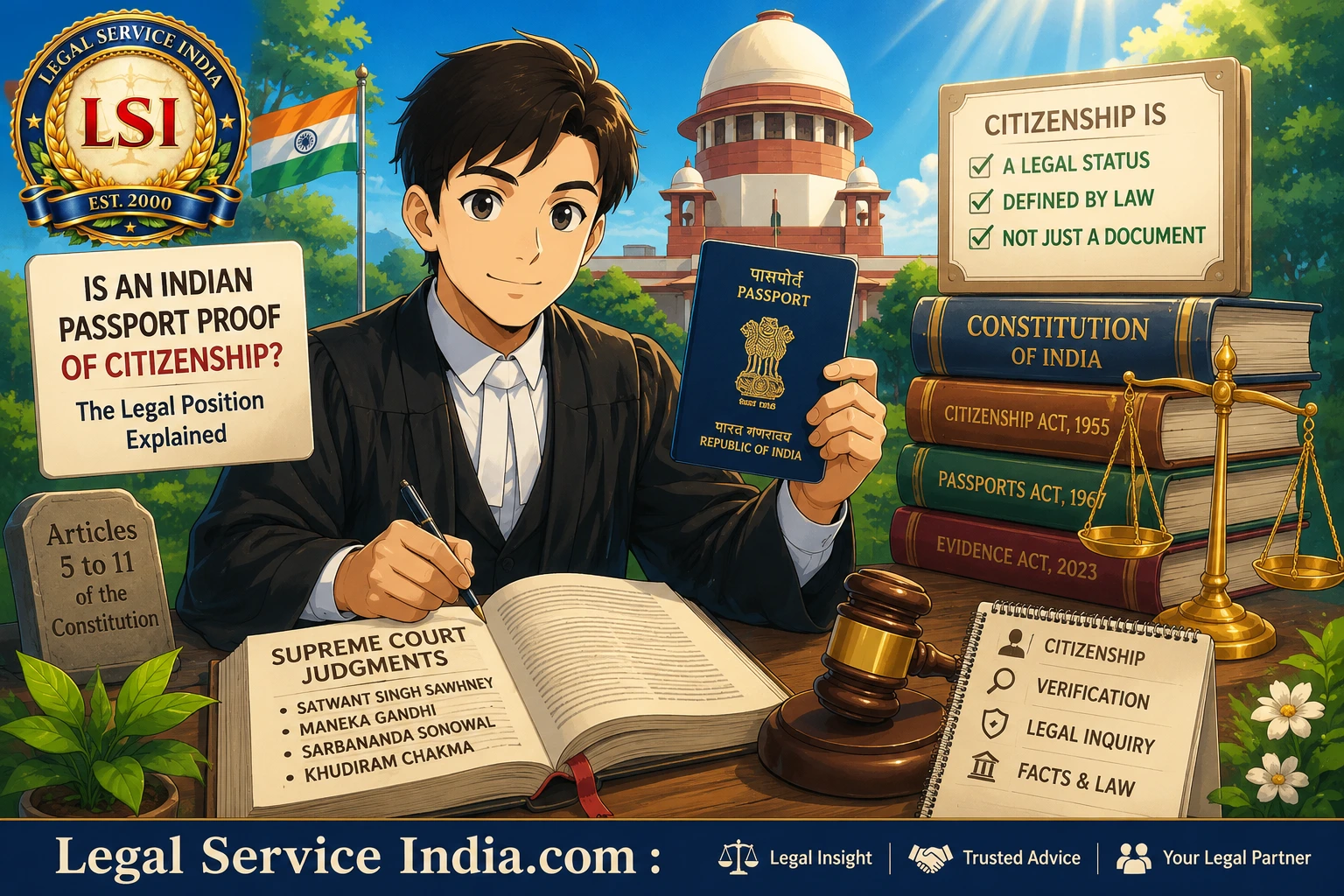
Indian Passport Is Not Proof of Citizenship? Justice Madan Lokur Flags Constitutional Concerns
Introduction
Can an Indian citizen rely on an Indian passport as proof of citizenship?
The question, which would have seemed almost unthinkable a few years ago, has suddenly become one of the most debated constitutional issues in India. The controversy arose after the Ministry of External Affairs (MEA) reportedly stated that an Indian passport is merely a travel document and should not automatically be treated as proof of Indian citizenship.
The statement has acquired far greater significance because it coincides with the ongoing Special Intensive Revision (SIR) of electoral rolls in several states and the litigation pending before the Supreme Court concerning citizenship verification and voting rights.
Former Supreme Court Judge Justice Madan B. Lokur has expressed serious reservations about this position, warning that reducing a passport to “nothing more than a bus ticket” risks creating uncertainty about one of the most fundamental aspects of democracy—the identity and rights of Indian citizens.
The controversy is not merely about passports. It raises deeper constitutional questions concerning citizenship, voting rights, the burden of proof, and the relationship between the individual and the state.
A Passport: More Than a Travel Document?
For decades, an Indian passport has been universally regarded as one of the strongest official documents issued by the Government of India.
It enables international travel, secures visas, and represents the holder before foreign governments. More importantly, it is issued only after extensive verification of identity and citizenship under Indian law.
However, the recent stand attributed to the MEA suggests that a passport should be viewed only as a travel document and not as conclusive proof of citizenship.
That distinction has generated considerable public concern.
If a passport issued by the Government of India cannot establish citizenship, many naturally ask, ‘What document can?’
Key Issues Raised by the Controversy
- Whether an Indian passport can be relied upon as proof of citizenship.
- The legal distinction between a travel document and proof of citizenship.
- The implications for the Special Intensive Revision (SIR) of electoral rolls.
- The impact on citizenship verification and voting rights.
- The constitutional relationship between the individual and the state.
Constitutional Questions Emerging from the Debate
| Issue | Question Raised |
|---|---|
| Indian Passport | Can it be relied upon as proof of Indian citizenship? |
| MEA Position | Should a passport be treated only as a travel document? |
| Electoral Rolls (SIR) | How will citizenship verification affect voting rights? |
| Burden of Proof | Who bears the responsibility of proving citizenship? |
| Constitutional Rights | How does this debate affect democratic participation and legal identity? |
Why This Debate Matters
The controversy is not confined to the legal status of passports. It directly touches upon the broader constitutional framework governing citizenship, electoral participation, and the protection of fundamental rights.
As debates continue over citizenship verification and electoral roll revisions, the questions surrounding the evidentiary value of an Indian passport are likely to remain central to public discussion as well as judicial scrutiny.
What Does the Passports Act Do? Actually, say?
The answer begins with the Passports Act, 1967.
Its preamble authorises the issuance of “passports and travel documents” for regulating the departure from India of “citizens of India and other persons”.
The wording is significant.
Parliament Made a Clear Distinction
Parliament deliberately differentiated between the following:
- passports; and
- travel documents.
Likewise, it separately referred to:
- citizens; and
- other persons.
| Expression Used in the Act | Separate Category Recognised |
|---|---|
| passports | travel documents |
| citizens | other persons |
Legislative drafting is rarely accidental.
Where Parliament employs different expressions, courts ordinarily presume that distinct meanings were intended.
Consequently, equating every passport with a generic travel document arguably overlooks the careful distinction embedded in the statute.
Why the Distinction Matters
The issue is far from academic.
Across the world, immigration authorities routinely treat an Indian passport as confirmation that its holder is an Indian national.
For example:
- Foreign governments issue visas on that assumption.
- International employers recruit Indian professionals on that basis.
- Universities admit Indian students relying on the passport as evidence of nationality.
If India itself were to state that the passport is not proof of citizenship, difficult questions inevitably arise.
Practical Questions That Follow
- Would foreign governments be expected to independently verify citizenship before issuing visas?
- Would overseas Indians suddenly face uncertainty regarding their legal status?
- Would the passport lose the credibility that has long been attached to it internationally?
These are practical consequences that cannot be ignored.
Section 20 and Exceptional Cases
Supporters of the government’s position often point to Section 20 of the Passports Act, which permits the central government, in exceptional situations and in the public interest, to issue a passport or travel document even to a person who is not an Indian citizen.
The existence of this provision, however, does not necessarily transform every passport into a document of doubtful citizenship.
General Rule Versus Exception
The power appears to be an extraordinary exception rather than the general rule.
There is little evidence to suggest that regular Indian passports are routinely issued to foreign nationals.
| Aspect | Position Described in the Text |
|---|---|
| Section 20 | Allows issuance of a passport or travel document in exceptional situations and in public interest to a person who is not an Indian citizen. |
| Nature of the Power | Presented as an extraordinary exception rather than the general rule. |
| Routine Practice | There is little evidence to suggest that regular Indian passports are routinely issued to foreign nationals. |
Exceptional statutory powers cannot ordinarily redefine the nature of the document issued in the vast majority of cases.
The Constitutional Dimension
The controversy assumes far greater significance because citizenship determines the enjoyment of several constitutional freedoms.
While Article 14 (equality before law) and Article 21 (protection of life and personal liberty) extend to every person within India, several important rights under Article 19 belong exclusively to citizens.
Fundamental Rights Available Exclusively to Citizens
These include:
- freedom of speech and expression;
- freedom of movement throughout India;
- the right to reside anywhere in the country;
- the freedom to practise any profession or carry on any occupation.
| Constitutional Provision | Who Can Exercise the Right? |
|---|---|
| Article 14 – Equality Before Law | Every person |
| Article 21 – Protection of Life and Personal Liberty | Every person |
| Article 19 – Fundamental Freedoms | Citizens only |
If an individual’s citizenship itself becomes uncertain, these freedoms may also come under question.
This is where the passport debate intersects with electoral roll verification.
The Special Intensive Revision (SIR) Controversy
The Election Commission’s Special Intensive Revision (SIR) of electoral rolls has generated widespread legal and political debate.
Large-scale verification exercises have been undertaken in states such as Bihar and West Bengal, involving extensive house-to-house verification and scrutiny of voter eligibility.
The objective is understandable.
Electoral rolls must remain accurate.
Names of deceased persons, duplicate entries, and persons who are legally ineligible to vote should not remain on the voter list.
Few would dispute that principle.
The controversy instead concerns the manner in which these exercises are being conducted.
Who Bears the Burden of Proof?
One of the most important legal questions is whether the burden of proving citizenship has shifted.
Historically, if an individual’s name already appeared on the electoral roll, there existed a presumption of eligibility.
Anyone challenging that eligibility bore the responsibility of producing evidence.
Recent verification exercises appear, at least in practice, to require the individual citizen to affirmatively establish citizenship once again.
That reversal carries significant constitutional implications.
For economically weaker sections, migrant workers, elderly citizens, and persons lacking easy access to historical documents, proving citizenship can become an extremely difficult exercise.
When millions are subjected to such scrutiny simultaneously, the possibility of genuine citizens facing exclusion cannot be overlooked.
Does Existing Law Already Provide Safeguards?
The Representation of the People Act, 1950, already provides a comprehensive framework for maintaining electoral rolls.
Regular revisions account for:
- births;
- deaths;
- migration;
- corrections;
- claims and objections.
| Regular Electoral Roll Revision Covers | Purpose |
|---|---|
| Births | Add newly eligible voters |
| Deaths | Remove deceased voters |
| Migration | Update place of residence |
| Corrections | Rectify errors in electoral records |
| Claims and Objections | Resolve disputes regarding voter eligibility |
A special intensive revision is generally viewed as an extraordinary mechanism intended for exceptional circumstances.
Therefore, questions naturally arise regarding the following:
- the necessity for such large-scale exercises;
- the reasons supporting them;
- whether ordinary statutory mechanisms were insufficient.
Greater transparency regarding these aspects could strengthen public confidence in the process.
Article 324 and the Limits of Administrative Power
The Election Commission derives substantial authority from Article 324 of the Constitution.
However, constitutional powers coexist with parliamentary legislation.
Where Parliament has enacted detailed statutory procedures, constitutional authorities ordinarily operate within that legislative framework rather than replacing it through administrative interpretation.
This balance between constitutional authority and statutory safeguards lies at the heart of several challenges presently before the Supreme Court.
The Human Cost of Uncertainty
Citizenship is not merely a legal label.
It affects everyday life.
Removal from electoral rolls may have consequences extending beyond the right to vote.
Individuals may face difficulties in establishing identity, accessing welfare schemes, or obtaining official certifications that depend upon recognised citizenship.
For those with limited financial resources, correcting administrative errors often requires lengthy litigation—something many simply cannot afford.
The resulting uncertainty can leave people feeling effectively excluded from the constitutional community, despite having lived in India throughout their lives.
Impact of Citizenship Uncertainty
| Area | Potential Consequence |
|---|---|
| Voting Rights | Removal from electoral rolls |
| Identity | Difficulties in establishing identity |
| Government Benefits | Challenges in accessing welfare schemes |
| Official Documentation | Problems obtaining official certifications dependent upon recognised citizenship |
| Legal Remedies | Lengthy and expensive litigation to correct administrative errors |
Justice Madan B. Lokur’s Warning
Justice Madan B. Lokur’s observations capture a wider constitutional concern.
When an official document issued by the Government of India itself ceases to inspire confidence regarding citizenship, public faith in legal institutions inevitably weakens.
His remark comparing the passport to “a bus ticket” is not merely rhetorical.
It reflects anxiety that a document historically regarded as evidence of nationality could lose much of its legal significance if official positions remain ambiguous.
The concern ultimately extends beyond passports.
It is about preserving certainty in matters affecting the constitutional identity of citizens.
Key Constitutional Concerns
- Public confidence in official government documents.
- Legal significance of passports as evidence of nationality.
- Constitutional identity of citizens.
- Need for certainty in citizenship-related matters.
The Need for Judicial Clarity
Several petitions concerning the Special Intensive Revision of electoral rolls are already pending before the Supreme Court of India.
The court’s eventual determination may clarify the following:
- whether the burden of proving citizenship has shifted;
- the scope of the Election Commission’s powers under Article 324;
- the safeguards required before excluding individuals from electoral rolls; and
- the evidentiary value of official documents, including passports.
Issues Before the Supreme Court
| Issue | Possible Clarification |
|---|---|
| Burden of Proof | Whether the burden of proving citizenship has shifted |
| Article 324 | Scope of the Election Commission’s constitutional powers |
| Electoral Roll Verification | Safeguards before excluding individuals from electoral rolls |
| Official Documents | Evidentiary value of passports and other government-issued documents |
Judicial guidance on these issues would not merely resolve legal disputes—it would restore certainty to millions of citizens.
Conclusion
The current debate is about much more than passports or electoral rolls.
It concerns the very nature of citizenship in a constitutional democracy.
A passport has long symbolised the bond between the individual and the Republic of India. If that symbol is weakened through ambiguous official interpretations, uncertainty inevitably spreads into other areas of public life.
Similarly, while electoral integrity unquestionably requires accurate voter lists, the process of verification must remain transparent, proportionate, and firmly rooted in constitutional safeguards. Administrative efficiency can never come at the cost of fundamental rights.
India’s constitutional framework is built upon clarity, fairness, and the rule of law. Questions as fundamental as who is a citizen, what documents establish that status, and how constitutional freedoms are protected deserve careful judicial scrutiny rather than uncertain administrative interpretation.
As the Supreme Court examines these issues, its eventual pronouncement will have implications far beyond elections. It will define how the State recognises its citizens and how citizens, in turn, understand their place within the world’s largest democracy.
Key Takeaways
- Citizenship affects fundamental rights and access to public services.
- Uncertainty over official documents may weaken public confidence.
- The Supreme Court’s decision is expected to clarify important constitutional questions.
- Judicial certainty is essential for protecting constitutional rights and the rule of law.