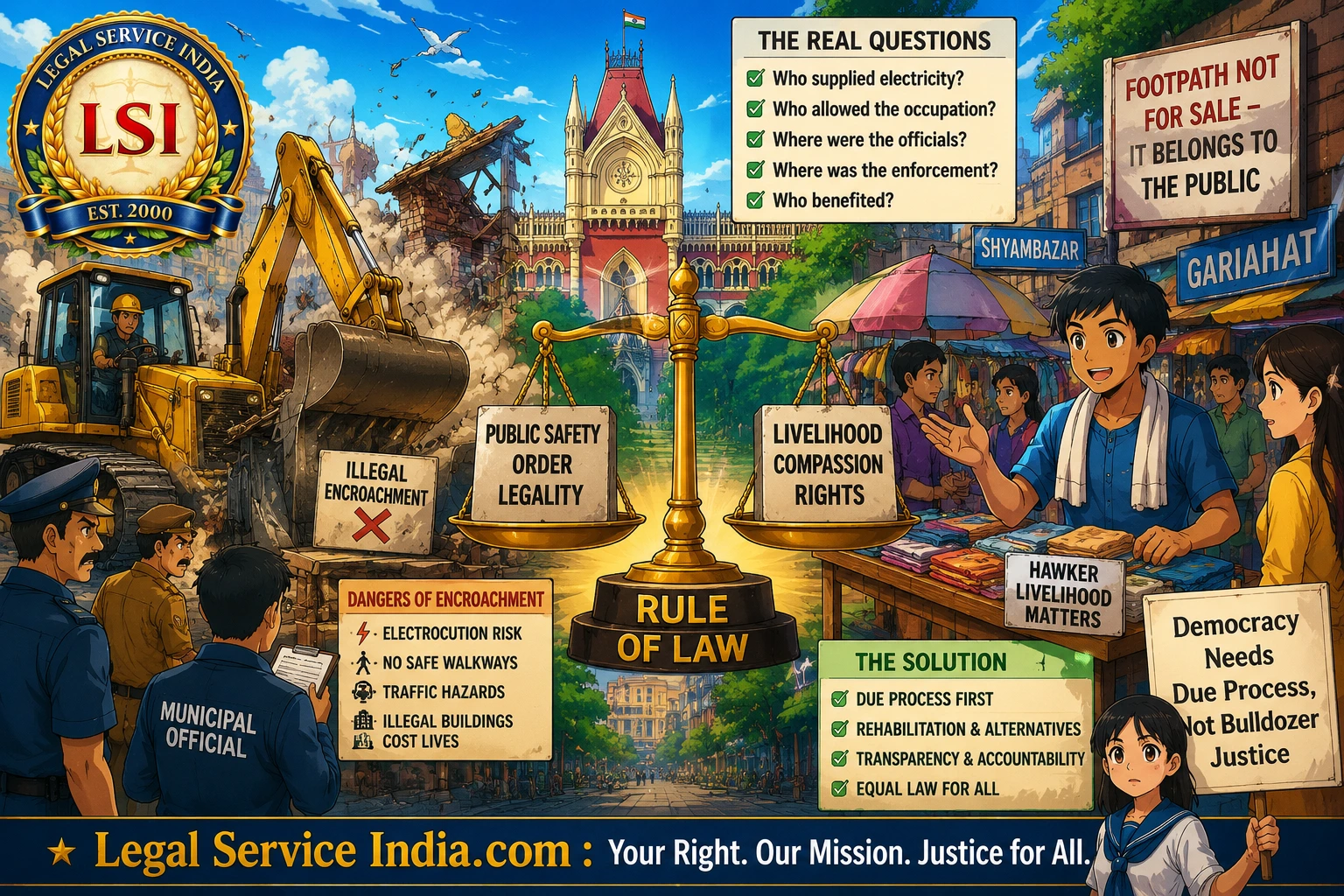
The Bulldozer, the Hawker, and the Rule of Law: A Question Bengal Cannot Ignore
When a bulldozer rolls into a crowded marketplace and tears down rows of shops, the public reaction is almost always divided.
One section of society applauds. They see order replacing chaos, legality replacing encroachment, and public spaces being reclaimed for the public.
Another section sees something very different. They see poor families losing livelihoods, small traders being uprooted, and ordinary people paying the price for failures that began much higher up the chain of power.
Both sides claim to stand for justice.
But what if the real issue is not demolition versus sympathy?
What if the real question is whether a society can enforce legality while simultaneously respecting the rule of law?
Nobody Can Defend the Illegal
Let us begin with an uncomfortable truth.
Illegal occupation of public land, unauthorised construction, and forcible encroachment cannot be defended merely because they have existed for a long time.
- A footpath belongs to pedestrians.
- Railway stations belong to commuters.
- Public roads belong to the public.
If these spaces have been occupied unlawfully, governments have both the authority and the responsibility to remove those occupations.
On this point, there should be little disagreement.
Whether it is a hawker stall blocking a pavement, a structure built on government land, or a multi-storey building raised in violation of regulations, illegality does not become legality simply because years have passed.
Yet that is only half the story.
The Convenient Myth of the “Encroacher”
A common narrative is often presented to the public.
According to this story, a person arrives one day, occupies a piece of land, refuses to leave, and eventually establishes permanent control over it.
It sounds simple.
Reality is not.
If an illegal structure stood for years, who supplied electricity?
Who approved connections?
Who looked away?
Where were the police?
Where was the municipality?
Where were local political leaders?
Where were the officials whose job was to prevent exactly such occupations?
An illegal settlement that survives for ten years is rarely the work of one individual. It is usually the product of an entire ecosystem of tolerance, protection, and silent cooperation.
Questions That Demand Answers
| Issue | Question Raised |
|---|---|
| Electricity Connections | Who supplied and approved them? |
| Municipal Oversight | Why was action not taken earlier? |
| Police Enforcement | Who allowed the occupation to continue? |
| Political Accountability | Were local leaders aware of the situation? |
| Administrative Responsibility | Why did enforcement mechanisms fail? |
The uncomfortable question is not how the encroachment happened.
The uncomfortable question is who allowed it to happen.
The Hidden Economy Behind Encroachment
Many people imagine hawkers occupying public spaces without paying anyone.
But stories emerging from Kolkata suggest something very different.
For years, small vendors have spoken about a daily chain of payments—money allegedly flowing to various intermediaries, local power brokers, municipal functionaries, police personnel, and neighbourhood influences.
The result is the creation of an unofficial economy that operates openly while pretending to be invisible.
Shocking Reports from Shyambazar and Gariahat
The most shocking examples emerged from places like Shyambazar and Gariahat.
Reports suggested that portions of occupied footpaths were being “transferred” from one person to another for large sums of money.
A four-and-a-half-foot stretch of pavement reportedly changed hands for ₹1.5 lakh.
In some cases, these transfers were allegedly documented on stamped legal papers, complete with signatures, as though public property could be privately sold.
Government Land Treated as Private Property
Think about the absurdity.
Government land was being traded as if it were personal real estate.
People were paying substantial amounts for spaces they knew they did not legally own.
Others were collecting money for property they had no legal right to sell.
An entire parallel marketplace emerged around something that should never have been a commodity in the first place.
| Activity | Concern Raised |
|---|---|
| Transfer of occupied footpath space | Public land treated like private property |
| Payments to intermediaries | Creation of an unofficial economy |
| Use of stamped documents | Appearance of legitimacy for illegal transactions |
The hawker was not merely occupying space.
The hawker was entering a system.
And that system involved far more people than the hawker alone.
When Illegality Becomes Dangerous
Supporters of unrestricted encroachment often frame the issue entirely as a question of livelihood.
Livelihood matters.
But so does public safety.
Electrocution Risks During Monsoon
Every monsoon, stories emerge of people dying from electrocution caused by illegal electrical connections.
Makeshift wiring snakes through crowded areas, often submerged in waterlogged streets.
One exposed wire can become a death sentence.
Pedestrian Safety and Vanishing Footpaths
Footpath occupation creates another danger.
When pavements disappear, pedestrians are pushed onto roads.
Children, elderly citizens, and commuters are forced into traffic.
The consequences are often tragic.
- Pedestrians lose safe walking space.
- Children face increased traffic exposure.
- Elderly citizens encounter greater accident risks.
- Daily commuters are forced onto busy roads.
A society cannot celebrate encroachment while ignoring the deaths it sometimes causes.
Compassion for one group cannot come at the cost of safety for everyone else.
The Larger Threat: Illegal Buildings
The debate becomes even more serious when unauthorised constructions are involved.
West Bengal has witnessed repeated controversies over illegal buildings.
Garden Reach Collapse and Public Outrage
The memory of the Garden Reach collapse remains particularly painful.
Lives were lost.
Families were shattered.
Questions were asked.
- How did the building receive approval?
- Who inspected it?
- Who certified it?
- Who ignored warning signs?
The public outrage lasted for days.
Then, as often happens, attention moved elsewhere.
Yet the underlying problem remained.
Continuing Concerns Over Regulatory Oversight
Across cities and towns, countless structures continue to raise questions about safety, legality, and regulatory oversight.
Many survive not because they are lawful but because someone, somewhere, chose not to act.
When those buildings eventually collapse, the cost is measured not in money but in human lives.
| Issue | Potential Consequence |
|---|---|
| unauthorised construction | Structural failure and safety hazards |
| Lack of enforcement | Continued regulatory violations |
| Ignored warning signs | Risk to human life |
The Danger of Bulldozer Justice
But acknowledging illegality does not automatically justify every demolition.
This is where the second half of the debate begins.
India has increasingly witnessed what critics call “bulldozer justice”—the practice of demolishing structures first and sorting out legal questions later.
Courts across the country have repeatedly expressed concern about such actions.
Why Procedure Matters
The problem is simple.
If a structure is demolished illegally, the damage cannot be undone.
A court may later award compensation.
A court may later declare the demolition unlawful.
But a family cannot instantly rebuild a home.
A small trader cannot instantly rebuild a business.
Justice delayed is painful.
But irreversible action taken before justice is even determined can be worse.
That is why procedure matters.
Balancing Legality, Livelihood, and Rights
- Public land must remain subject to the rule of law.
- Public safety cannot be ignored.
- unauthorised constructions require accountability.
- Demolitions must follow due process.
- Livelihood concerns deserve consideration.
- Legal rights must be protected before irreversible action is taken.
Why Courts Keep Intervening
Recent interventions by the Calcutta High Court underline an important principle.
The issue is not whether illegal structures can be removed.
Of course they can.
The issue is whether authorities follow due process.
A government must demonstrate why a structure is illegal.
- It must issue notices.
- It must allow people an opportunity to produce documents.
- It must establish facts through evidence.
- It must justify urgency.
- It must follow statutory procedures.
Only then should demolition proceed.
This is not a technicality.
This is the foundation of the rule of law.
Otherwise, enforcement becomes dependent on power rather than legality.
And once power replaces law, nobody is truly safe.
Selective Action Is Another Form of Injustice
There is another concern that cannot be ignored.
For years, many influential developers have allegedly engaged in unauthorised construction, environmental violations, and land misuse.
- Some filled ponds.
- Others raised structures where they should never have been allowed.
- Many enjoyed political protection.
The public has repeatedly seen situations where small violations are punished immediately while larger violations survive for years.
| Situation | Public Perception |
|---|---|
| A tiny shop disappears overnight. | Immediate enforcement action. |
| A massive illegal building remains untouched. | Selective enforcement. |
That inconsistency destroys public trust.
The law cannot be strong against the weak and weak against the powerful.
Either legality matters for everyone, or it matters for no one.
What Bengal Really Needs
The debate is often presented as a choice between two extremes.
- Either support every demolition.
- Or oppose every demolition.
That is a false choice.
A mature democracy requires something more difficult.
It requires the courage to remove illegal encroachments and unauthorised constructions.
At the same time, it requires the discipline to follow legal procedures without exception.
The real issue is not whether a bulldozer arrives.
The real issue is what happens before it arrives.
Key Questions Before Demolition
- Were notices issued?
- Was evidence examined?
- Were hearings conducted?
- Were legal safeguards respected?
If the answer is yes, then enforcement strengthens democracy.
If the answer is no, then enforcement risks becoming arbitrary power.
The Final Test
West Bengal’s government has repeatedly spoken about establishing the rule of law.
That promise now faces its real test.
Removing illegal structures is not difficult.
Any government can demolish it.
The harder challenge is to demolish legally.
The harder challenge is to prove every action with evidence.
The harder challenge is to ensure that the same standards apply to hawkers, builders, developers, political allies, and ordinary citizens alike.
The True Measure of Democracy
Because in the end, the true measure of a democracy is not how quickly it can bring down a building.
It is whether the law stands taller than the bulldozer.
And whether justice remains stronger than power.