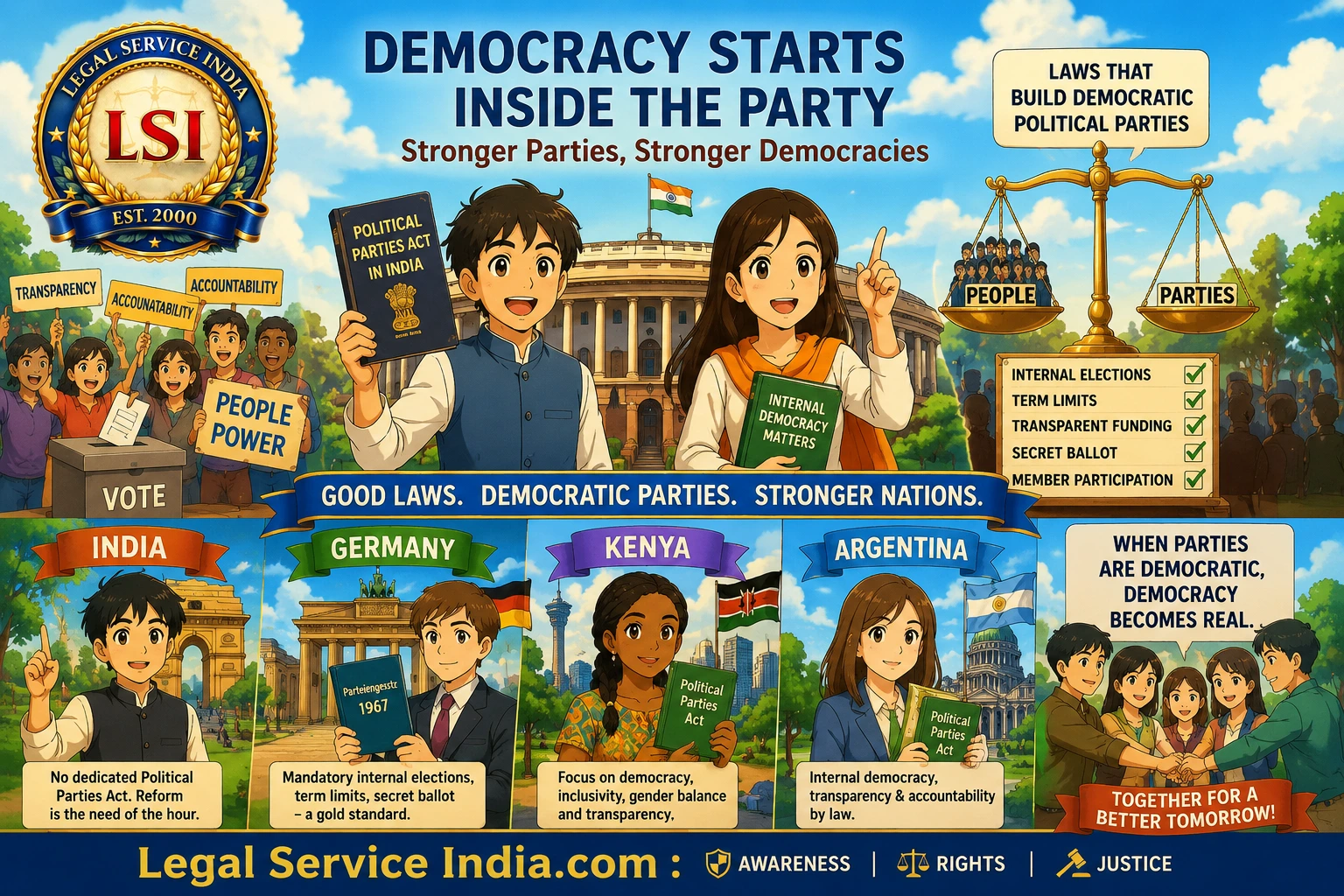
Democracy, Political Parties, and Internal Governance
There is something quietly ironic about the way democracy works. Nations hold elections, celebrate freedom of choice, and build entire constitutions around the idea that power must flow from the people. Yet inside the very organisations that deliver those elections – political parties – the same rules rarely apply. Leaders are handpicked, candidates are anointed, and ordinary members are left with little more than a membership card and a sense of loyalty.
Around the world, a growing number of countries are pushing back against this contradiction. Some have gone further than others. The story of how different nations have tried to regulate what a political party must look like from the inside is, in many ways, a story about how seriously a country takes its own democracy.
India: A Democracy Without a Political Parties Act
India is the world’s largest democracy by population, and it runs one of the most complex electoral systems on the planet. Yet when it comes to governing political parties themselves, the legal framework is surprisingly thin.
There is no standalone Political Parties Act in India. The primary law that deals with parties is the Representation of the People Act, 1951, and even that only addresses parties in a limited way. The key provision is Section 29A, which requires any association calling itself a political party to register with the Election Commission of India within 30 days of its formation. The Commission checks the party’s constitution, structure, membership, and funding before granting registration. That is more or less where the mandatory requirements end.
The Indian Constitution, for most of its history, did not even mention political parties by name. The term entered the Constitution only in 1985 through the 52nd Amendment, which introduced the Tenth Schedule — the Anti-Defection Law. And even then, parties were mentioned only in the context of stopping elected legislators from switching sides, not in the context of how parties should be run internally.
The result is a situation where parties that contest elections for the highest offices in the land are under no legal obligation to hold internal elections. Party presidents can serve indefinitely. Candidates can be chosen by a single leader or a small group at the top. There is no requirement for secret ballots within parties, no mandatory term limits for office-bearers, and no law compelling parties to practise the democracy they preach on the campaign trail. Critics have long pointed out that this is not a small gap in the law — it is a structural weakness at the heart of Indian democracy.
Key Features of Political Party Regulation in India
| Aspect | Current Position in India |
|---|---|
| Standalone Political Parties Act | No |
| Main Governing Law | Representation of the People Act, 1951 |
| Party Registration | Required under Section 29A |
| Mandatory Internal Elections | No |
| Mandatory Secret Ballots | No |
| Term Limits for Party Office-Bearers | No |
| Constitutional Recognition of Parties | Since 1985 through the 52nd Amendment |
Major Criticisms of the Indian Framework
- No legal requirement for internal party democracy.
- Leadership positions can be held indefinitely.
- Candidate selection can remain highly centralised.
- Ordinary party members have limited influence over decision-making.
- Weak legal mechanisms to ensure democratic functioning within parties.
Germany: The Gold Standard
If India represents one end of the spectrum, Germany sits firmly at the other.
Germany’s Parteiengesetz — the Political Parties Act — was enacted in 1967 and remains one of the most comprehensive pieces of party regulation in the world. It did not emerge from nowhere. Germany had lived through the consequences of parties operating without democratic accountability, and the architects of the post-war republic were determined to build safeguards into the system.
The Basic Law itself — Germany’s constitution — lays the foundation. It states plainly that political parties may be freely established but that their internal organisation must conform to democratic principles. The Parteiengesetz then fills in the details with a level of specificity that is almost remarkable.
Under the Act, every party must hold a party convention — essentially a general assembly — that has genuine power. The convention must elect the party’s leadership, including the chairperson, deputies, and executive committee members. These elected office-bearers cannot serve indefinitely: the law caps their terms at a maximum of two years, after which fresh elections must be held. When it comes to selecting candidates for parliamentary elections, the law is equally firm — nominations must be made by secret ballot, with no exceptions.
The Act also defines what a political party actually is. It must be an association of citizens that seeks to influence political opinion at the federal or state level on a continuing basis. An organisation that only wants to be politically active at the local level does not qualify as a party in the legal sense. And if a registered party fails to nominate candidates in either a federal or state election for six consecutive years, it automatically loses its status as a political party altogether.
Germany does not just set these rules and walk away. The Federal Returning Officer has the power to compel party executive committees to comply, with financial penalties available as enforcement tools. The whole framework rests on a simple but powerful idea: if parties are going to play a central role in democracy, they have to be democratic themselves.
Key Features of Germany’s Political Parties Act
| Aspect | Requirement in Germany |
|---|---|
| Political Parties Act | Parteiengesetz (1967) |
| Constitutional Basis | Basic Law requires democratic internal organisation |
| Party Convention | Mandatory with genuine decision-making powers |
| Leadership Elections | Mandatory |
| Maximum Leadership Term | Two years |
| Candidate Selection | Secret ballot required |
| Enforcement Mechanism | Federal Returning Officer and financial penalties |
| Loss of Party Status | No federal or state election participation for six consecutive years |
Why Germany Is Considered the Gold Standard
- Internal democracy is mandated by both the constitution and statute.
- Leadership elections must be held regularly.
- Candidate nominations require secret ballots.
- Clear legal definition of what qualifies as a political party.
- Strong enforcement mechanisms ensure compliance.
- Parties are treated as democratic institutions, not merely electoral vehicles.
Kenya: Africa’s Most Progressive Party Law
On the African continent, Kenya has built what many observers consider the most ambitious legal framework for political party governance.
The foundation was laid by the Constitution of Kenya, 2010, which dedicated an entire section — Article 91 — to setting out basic requirements for political parties. This was not boilerplate language. The Constitution explicitly requires every political party to have a democratically elected governing body, to promote and practise democracy through regular, fair, and free elections within the party, and to respect the rights of minorities and marginalised groups to participate in the political process.
Constitutional Requirements for Political Parties
| Requirement | Description |
|---|---|
| Democratically Elected Governing Body | Every political party must have a democratically elected governing body. |
| Internal Democracy | Parties must promote and practise democracy through regular, fair, and free elections within the party. |
| Minority Participation | Parties must respect the rights of minorities and marginalised groups to participate in the political process. |
The Political Parties Act, 2011, then built on this constitutional base. It created an institutional structure — the Office of the Registrar of Political Parties — to oversee compliance. Under the Act, parties must promote inclusiveness, maintain gender balance in their governing bodies, and ensure accountability and transparency in their financial dealings. A party whose governing body has more than two-thirds of its members from a single gender is not entitled to receive public funds.
Key Provisions of the Political Parties Act, 2011
- Promote inclusiveness within political parties.
- Maintain gender balance in governing bodies.
- Ensure accountability and transparency in financial dealings.
- Restrict public funding for parties that fail to meet gender representation requirements.
| Area | Legal Requirement |
|---|---|
| Inclusiveness | Political parties must promote inclusiveness. |
| Gender Balance | No more than two-thirds of governing body members may be from a single gender if the party seeks public funding. |
| Financial Governance | Parties must maintain accountability and transparency in financial dealings. |
The Act also draws clear red lines. A party cannot be founded on religious, linguistic, racial, ethnic, gender, or regional grounds. It cannot maintain a paramilitary force. It cannot engage in bribery or accept funding from foreign governments or non-citizens. And critically, if a party fails to comply with any of these requirements, there are real consequences — including de-registration.
Prohibited Practices Under the Act
- Founding a party on religious grounds.
- Founding a party on linguistic grounds.
- Founding a party on racial or ethnic grounds.
- Founding a party on gender or regional grounds.
- Maintaining a paramilitary force.
- Engaging in bribery.
- Accepting funding from foreign governments.
- Accepting funding from non-citizens.
| Violation | Potential Consequence |
|---|---|
| Failure to meet statutory requirements | De-registration of the political party. |
| Prohibited funding sources | Regulatory sanctions and possible de-registration. |
| Operating outside legal requirements | Loss of legal status and associated benefits. |
Kenya’s framework is not without its challenges in practice, and party discipline on the continent often remains a work in progress. But the aspiration embedded in the law is unmistakable: political parties must be governed by the same democratic values they claim to represent.
Argentina and Latin America: Mandatory Internal Elections by Law
Kenya and Germany are not alone in recognising the problem. Across Latin America, a wave of countries have confronted the same question and responded with legislation requiring parties to elect their leaders democratically.
Argentina is one of the clearest examples. After the fall of its military dictatorship in 1983, one of the first acts of the newly democratic Congress was to pass a Parties Law in 1985 that required all political parties to have formal rules for internal governance and to use democratic elections to fill party-leadership positions. The country understood intuitively that you could not build a democracy on a foundation of undemocratic parties.
Argentina Political Party Reforms
- Parties Law enacted in 1985.
- Required formal rules for internal governance.
- Mandated democratic elections for party leadership positions.
- Strengthened democratic institutions after military rule.
Paraguay has gone even further, embedding in its Electoral Code a requirement for mandatory elections to nominate candidates within political parties. Costa Rica’s Constitution requires that the appointment of party officials and candidates must respect democratic principles and prohibit discrimination on grounds of sex.
Latin American Approaches to Party Democracy
| Country | Democratic Party Governance Requirement |
|---|---|
| Argentina | Democratic elections are required for party leadership positions under the Parties Law of 1985. |
| Paraguay | Mandatory elections for candidate nominations within political parties. |
| Costa Rica | Appointment of party officials and candidates must respect democratic principles and prohibit discrimination on grounds of sex. |
The Global Conversation
The question of internal party democracy has attracted serious attention from international institutions. The Venice Commission — the Council of Europe’s advisory body on constitutional matters — has published detailed guidelines on political party regulation, identifying internal democracy as a key standard for mature democracies. The guidelines note that while some level of regulation is necessary to ensure the proper functioning of democratic society, the law must be carefully crafted so as not to unduly interfere with freedom of association.
This tension is real. There is a legitimate debate about how far the state should reach into the internal workings of what are, at their core, private associations. But the counterargument is equally powerful: political parties are not ordinary private associations. They receive public funding, they contest public elections, they form governments, and they wield enormous power over public life. The idea that they should be exempt from the democratic requirements they impose on everyone else is increasingly difficult to defend.
What India Could Learn
For India, the contrast is instructive. The country has a robust Election Commission, a lively multi-party system, and a tradition of elections that is the envy of many developing nations. But the internal functioning of parties remains largely unregulated and, in many cases, deeply feudal.
Dynasties dominate major parties. Candidates are chosen by high commands rather than by members. Internal dissent is often punished rather than accommodated. There are no term limits, no mandatory conventions, and no secret ballot requirements for leadership elections. The Election Commission has periodically flagged this issue, and reform-minded politicians and scholars have called for a dedicated Political Parties Act for decades – without success.
Key Challenges in Party Democracy
- Dynasties dominate major parties.
- Candidates are chosen by high commands rather than by members.
- Internal dissent is often punished rather than accommodated.
- No term limits for party leadership.
- No mandatory party conventions.
- No secret ballot requirements for leadership elections.
India Party Governance Overview
| Area | Current Situation in India |
|---|---|
| Leadership Selection | Often controlled by party high commands |
| Internal Elections | Limited regulation and oversight |
| Term Limits | Generally absent |
| Party Conventions | Not mandatory |
| Internal Dissent | Frequently discouraged |
| Legal Framework | No dedicated Political Parties Act |
Germany’s model does not need to be copied wholesale. Every country has its own political culture and traditions that must be respected. But the core principle — that parties which govern a democracy must themselves be governed democratically — is not a cultural preference. It is a logical necessity.
Why Internal Democracy Matters
The voters of India, Argentina, Kenya, and Germany all deserve to know that the people who ask for their votes have themselves been chosen through a process that is fair, transparent, and accountable. Laws that make this mandatory are not an interference in party affairs. They are the minimum standard that democracy requires of itself.
Core Democratic Principles
- Fair candidate selection processes.
- Transparent leadership elections.
- Accountability within party structures.
- Equal participation opportunities for members.
- Protection of internal dissent and debate.
The Future of Political Party Regulation
The conversation about how democracies regulate their political parties is far from settled. But the direction of travel, in countries that take this question seriously, is clear: internal democracy in parties is not optional — it is foundational.
Internal party democracy refers to the democratic functioning of political parties through regular leadership elections, transparent decision-making, secret ballots, and member participation. It is important because political parties are the foundation of democratic governance, and parties that seek public office should themselves operate democratically.
No. India does not have a standalone Political Parties Act. Political parties are primarily governed by the Representation of the People Act, 1951, particularly Section 29A, which deals mainly with party registration. There is currently no legal requirement for mandatory internal elections, term limits, or secret ballots within political parties.
Germany’s Political Parties Act (Parteiengesetz) requires political parties to maintain democratic internal structures. Parties must hold regular leadership elections, conduct candidate selection through secret ballots, and comply with strict rules on accountability and internal governance. Leadership terms are limited, and enforcement mechanisms ensure compliance.
India can learn the value of mandatory internal elections, transparent candidate selection, leadership term limits, financial accountability, and greater member participation. Countries such as Germany, Kenya, and Argentina have enacted laws that require political parties to follow democratic principles, strengthening public trust and institutional accountability.
Many experts, election reform advocates, and constitutional scholars argue that India’s political parties are often dominated by dynasties, centralised leadership, and limited internal accountability. Calls for a dedicated Political Parties Act focus on promoting internal democracy, transparency, fair leadership elections, and greater participation of ordinary party members in decision-making.
Supporters of political reform believe that a Political Parties Act could improve internal party democracy, reduce excessive centralisation of power, encourage transparent leadership elections, and ensure that political parties uphold the same democratic values they advocate in public elections. Such reforms could strengthen India’s democratic institutions and political accountability.
Key Takeaways
- Democracy often faces contradictions within political parties, where true democratic principles rarely apply.
- India lacks a standalone Political Parties Act, leading to unregulated internal governance and unchecked leadership.
- Germany exemplifies internal democracy with mandatory elections and strict regulations for political parties under its Political Parties Act.
- Kenya’s Constitution and Political Parties Act mandate internal democracy, inclusivity, and accountability within parties.
- Countries like Argentina also emphasise mandatory internal elections to ensure democratic governance in political parties.