Introduction
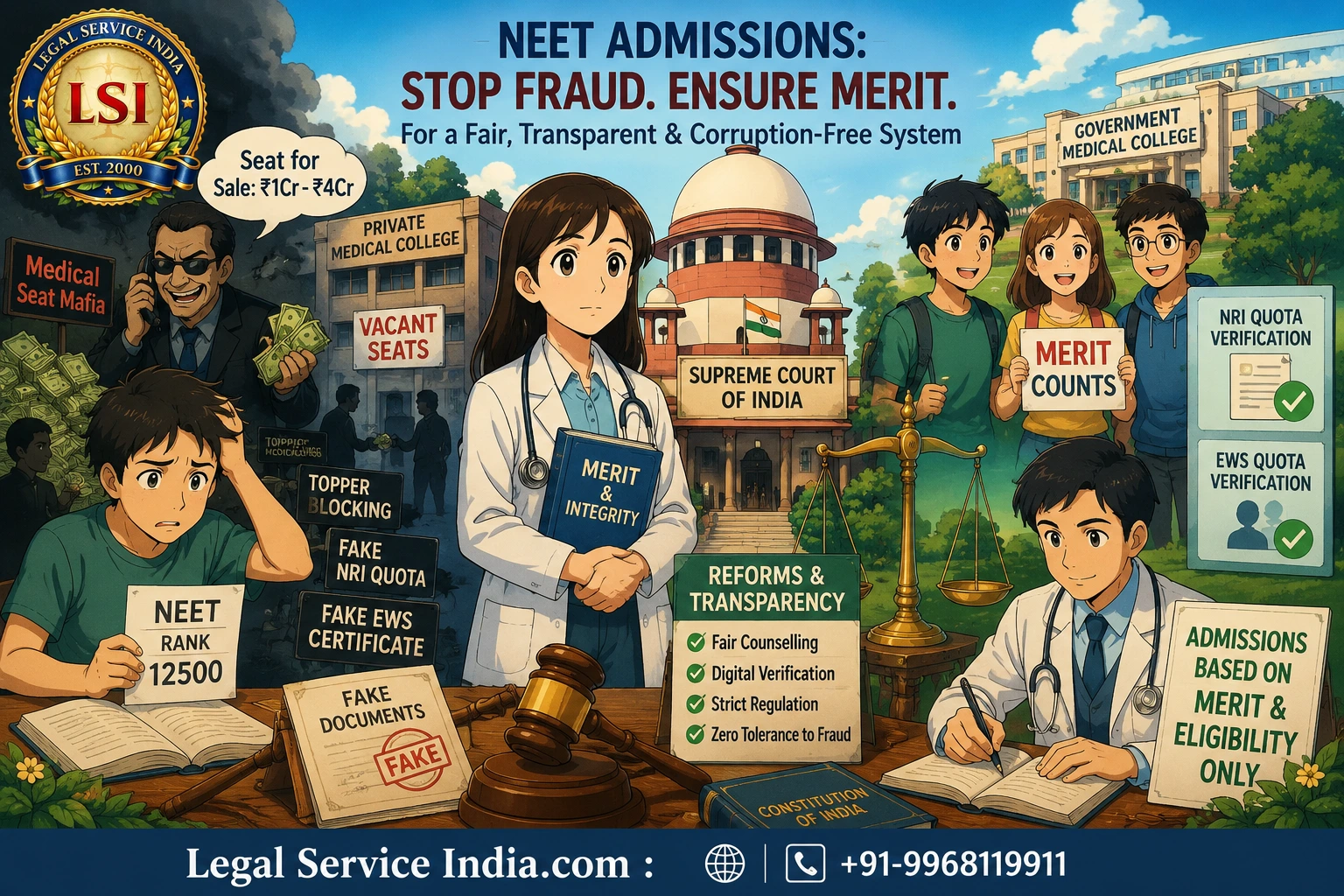
The controversy surrounding the NEET examination has reignited a larger debate on the integrity of India’s medical education system. While paper leaks and examination irregularities have dominated public discourse, many experts argue that these issues are merely symptoms of a far deeper institutional crisis. The real concern lies in what has often been described as the medical seat mafia—an alleged network of intermediaries, private institutions, forged documentation, and regulatory failures that has turned medical admissions into an enormously profitable enterprise.
At the heart of this crisis is a simple contradiction. India desperately needs more doctors, yet thousands of deserving students are unable to secure medical seats every year. This scarcity has allegedly created fertile ground for corruption, where admissions can be manipulated through loopholes in the counseling process, misuse of reserved quotas, and regulatory failures. Recognizing the seriousness of these allegations, the Supreme Court has also stepped in to introduce reforms aimed at restoring transparency in the admission process.
The Medical Seat Mafia: When Scarcity Creates an Underground Market
Medical seats in India are among the most sought-after educational opportunities. Every year, lakhs of students compete for a limited number of MBBS and postgraduate seats. This enormous imbalance between demand and supply has transformed medical education into an industry worth thousands of crores.
Legally, admissions are supposed to be based entirely on merit through the National Eligibility cum Entrance Test (NEET). However, investigations over the years have repeatedly revealed allegations that some seats ultimately become available for sale through illegal channels after the official counseling process concludes.
The business model allegedly thrives on one basic principle: artificial scarcity. As long as the number of eligible students significantly exceeds the available seats, desperate candidates and their families become vulnerable to exploitation. According to various investigative reports cited in the source material, agents, intermediaries, and certain private institutions have allegedly capitalized on this desperation by monetizing admissions that should have been governed exclusively by merit.
| Issue | Impact |
|---|---|
| High demand for medical seats | Intense competition among students |
| Limited availability of MBBS and PG seats | Creates artificial scarcity |
| Alleged illegal admission networks | Potential manipulation of merit-based admissions |
Counselling Manipulation: How the Admission Process Can Be Exploited
Medical admissions in India follow multiple counseling rounds. Candidates with higher ranks are allotted seats first. As students upgrade to better colleges during successive rounds, previously allotted seats become vacant and are offered to the next eligible candidate.
This mechanism is intended to maximize fairness. However, according to the material provided, certain loopholes allegedly enabled manipulation of this process.
One of the most controversial practices described is the alleged “topper blocking” mechanism.
How the Alleged “Topper Blocking” Scheme Worked
- High-ranking candidates were reportedly persuaded by agents to temporarily occupy seats in private colleges despite already having secured government seats.
- Since the counseling system earlier permitted candidates to hold multiple options simultaneously, these private seats remained blocked during critical counseling rounds.
- Once the official rounds concluded, the high-ranking candidate would surrender the seat.
- The surrendered seat would then revert to the concerned institution instead of immediately passing to the next eligible student.
- This allegedly enabled institutions to exercise discretionary control over those vacant seats, creating opportunities for illegal sale at exorbitant prices.
According to the transcript, these seats were allegedly sold for amounts ranging from ₹1 crore to ₹4 crore, depending upon the specialty and institution. While these allegations have surfaced in multiple investigations over the years, each case ultimately depends upon the evidence collected by investigating agencies and judicial findings.
| Stage | Alleged Outcome |
|---|---|
| Seat temporarily occupied | The seat remains unavailable to deserving candidates |
| Seat surrendered after counselling | Returns to institution |
| Institution gains discretionary control | Potential illegal commercial sale of seat |
An Expensive Business Built on Student Desperation
The alleged counseling manipulation demonstrates how systemic loopholes can transform merit-based admissions into commercial transactions.
Families often invest years of preparation and enormous financial resources in their children’s medical aspirations. When students narrowly miss government seats but remain academically capable, some become easy targets for illegal admission rackets promising guaranteed seats through unofficial channels.
The transcript refers to investigations in Telangana and Karnataka where authorities reportedly uncovered large-scale seat-selling operations involving hundreds of crores of rupees. Such investigations have highlighted how educational institutions, brokers, and other intermediaries may collectively benefit from the artificial scarcity of medical seats.
If proven, such practices not only undermine merit but also erode public confidence in India’s healthcare system by compromising the fairness of medical education.
The Fake NRI Quota Scam
India permits a certain percentage of medical seats to be reserved under the Non-Resident Indian (NRI) quota. The rationale behind this policy is that higher fees paid by NRI candidates help institutions generate additional revenue while expanding educational opportunities.
However, according to the transcript, investigative reports have revealed allegations that this category has also been misused.
Alleged Modus Operandi
- Fabricating sponsorship certificates.
- Creating false NRI documentation.
- Producing forged residency records.
- Using intermediaries to obtain admission under the NRI category despite candidates having no genuine eligibility.
The result, according to the material, is that seats intended for legitimate NRI candidates allegedly become available for sale to wealthy applicants willing to pay significantly higher amounts.
Alleged Misuse of the EWS Quota
Perhaps even more disturbing are allegations concerning the Economically Weaker Sections (EWS) quota.
The EWS reservation was introduced to ensure that students from financially disadvantaged backgrounds could pursue professional education despite economic hardship.
According to the transcript, however, investigative findings suggest that fake income certificates have allegedly enabled affluent families to secure admissions under this category.
The Alleged Process
- Fabrication of income certificates.
- Manipulation of supporting documentation.
- Collusion between agents and institutional authorities.
- Admission of financially well-off candidates under the EWS category.
If these allegations are established in individual cases, deserving economically weaker students suffer twice—they lose educational opportunities while watching reserved seats allegedly being purchased by wealthier applicants.
The transcript even refers to reports claiming that certain postgraduate seats under the EWS category were allegedly sold for several crores of rupees.
Regulatory Failure: The National Medical Commission Under Scrutiny
Every medical college in India operates under the regulatory supervision of the National Medical Commission (NMC).
The NMC is responsible for:
- Granting permission for new medical colleges.
- Inspecting infrastructure.
- Assessing faculty strength.
- Verifying clinical facilities.
- Ensuring educational standards.
In theory, surprise inspections are meant to ensure that institutions genuinely comply with statutory requirements.
However, the transcript highlights allegations investigated by the Central Bureau of Investigation (CBI), suggesting that advance information regarding inspection schedules was allegedly leaked before inspections took place.
When Surprise Inspections Are No Longer a Surprise
According to the allegations discussed in the transcript, once institutions became aware of upcoming inspections, elaborate preparations allegedly followed.
Investigators reportedly alleged practices such as:
- Hiring temporary faculty members only for inspection days.
- Arranging fake patients to create an appearance of functional hospitals.
- Temporarily filling infrastructure gaps.
- Presenting misleading records before inspection teams.
Such allegations strike at the very foundation of medical education because regulatory inspections exist precisely to prevent substandard institutions from operating.
If inspection mechanisms themselves become compromised, the consequences extend far beyond admissions—they directly affect the quality of future healthcare professionals graduating from these institutions.
Political Economy of Medical Education
The transcript also raises concerns regarding the ownership structure of private medical institutions and the broader political economy surrounding medical education.
While ownership of educational institutions by politically connected individuals is not unlawful in itself, the transcript argues that effective reform becomes considerably more difficult when powerful interests have significant financial stakes in the existing system.
These observations underscore why meaningful reform requires institutional transparency, independent oversight, and robust accountability mechanisms rather than reliance upon individual office-bearers alone.
Supreme Court’s Intervention to Strengthen the Admission Process
Recognizing repeated allegations relating to counseling irregularities, the Supreme Court reportedly issued significant directions in 2025 aimed at curbing manipulation in the medical admission process.
According to the transcript, the court sought to eliminate loopholes that enabled seats to remain vulnerable to commercial exploitation after counseling rounds concluded. The objective of these reforms was to strengthen transparency, protect merit, and ensure that vacant seats were allocated fairly rather than becoming instruments of profiteering.
The transcript, however, also notes that only part of the proposed reforms had reportedly been implemented, leaving concerns that certain systemic vulnerabilities still require attention.
Why Structural Reform Matters More Than Individual Accountability
One of the strongest themes emerging from the discussion is that replacing individuals alone cannot eliminate institutional corruption.
Even if individual wrongdoers are removed, the same incentives may continue to produce similar outcomes unless structural reforms address the underlying weaknesses.
Among the Reforms Discussed Are
- A unified national counseling mechanism that minimizes opportunities for seat blocking.
- Independent digital verification of NRI and EWS eligibility using government databases.
- Greater public transparency regarding quota allocations.
- Stronger and genuinely independent regulatory oversight.
- Severe penalties for admission fraud involving institutions, intermediaries, and forged documentation.
Such reforms focus on making the system itself resistant to manipulation rather than depending solely on the integrity of individual officials.
| Recommended Reform | Expected Benefit |
|---|---|
| Unified national counselling | Reduces opportunities for seat blocking |
| Digital verification of NRI & EWS documents | Minimises document fraud |
| Transparent quota allocation | Enhances public trust |
| Independent regulatory oversight | Improves accountability |
| Strict penalties for admission fraud | Acts as a deterrent against malpractice |
Conclusion
The controversy surrounding India’s medical admissions is not merely an education issue—it is a matter of public health, constitutional equality, and institutional credibility. Allegations relating to counseling manipulation, quota fraud, regulatory failures, and commercialization of medical seats highlight the urgent need for comprehensive reforms.
While investigations and judicial interventions have exposed significant weaknesses, long-term change will depend upon transparent admission systems, technology-driven verification, independent regulation, and consistent enforcement of the law. Restoring public confidence requires ensuring that every medical seat is awarded solely on merit and lawful eligibility—not on financial capacity or institutional manipulation.
Ultimately, strengthening India’s healthcare system begins with protecting the integrity of medical education itself.
Key Takeaways
The following key takeaways summarize the major findings and legal issues discussed in this article on NEET admissions, the alleged medical seat mafia, counseling manipulation, NRI quota misuse, EWS quota fraud, National Medical Commission (NMC) oversight, and Supreme Court reforms.
- NEET paper leaks are only one part of the larger problem. The article argues that the deeper concern is the alleged “medical seat mafia,” where systemic loopholes in India’s medical admission process may enable corruption and commercialization.
- Artificial scarcity of medical seats allegedly fuels illegal admission practices. With lakhs of aspirants competing for limited MBBS and postgraduate seats, the demand-supply gap creates opportunities for exploitation.
- Counselling loopholes have allegedly been exploited through “topper blocking.” According to various investigations, temporary occupation and later surrender of seats may have allowed institutions to regain control over vacant seats, creating opportunities for illegal sale.
- Fake NRI quota documentation is a major concern. Allegations include forged sponsorship certificates, fabricated residency documents, and misuse of the NRI quota by ineligible candidates.
- EWS quota misuse allegedly deprives deserving students. Fake income certificates and manipulated documents may have enabled financially well-off candidates to obtain seats reserved for economically weaker sections.
- Regulatory oversight has come under scrutiny. Allegations of advance leaks of National Medical Commission (NMC) inspection schedules and temporary compliance measures raise questions about the effectiveness of medical college inspections.
- The Supreme Court has sought to strengthen transparency in medical admissions. Judicial intervention has focused on closing counseling loopholes, protecting merit-based admissions, and preventing commercial exploitation of vacant medical seats.
- Technology-driven verification is essential. Digital verification of NRI and EWS eligibility through government databases can significantly reduce document fraud and improve transparency.
- Structural reforms matter more than replacing individuals. Long-term solutions require transparent counseling, independent regulation, stronger enforcement, and severe penalties for admission fraud.
- Merit-based admissions are critical for India’s healthcare system. Ensuring that every medical seat is allocated solely on merit and lawful eligibility is essential for maintaining public trust, constitutional equality, and the quality of future healthcare professionals.
Quick Overview Table
| Key Issue | Main Takeaway |
|---|---|
| NEET Paper Leaks | Only one aspect of the broader systemic challenges in medical admissions. |
| Medical Seat Mafia | Alleged exploitation of counseling loopholes and seat scarcity. |
| Counselling Manipulation | Alleged “topper blocking” may have enabled the illegal sale of vacant seats. |
| Fake NRI Quota | Use of forged documents allegedly enabled ineligible admissions. |
| EWS Quota Fraud | Fake income certificates allegedly deprived deserving candidates. |
| NMC Oversight | Inspection-related allegations have raised concerns over regulatory effectiveness. |
| Supreme Court Reforms | Focused on improving transparency and protecting merit-based admissions. |
| Technology | Digital verification can reduce fraud and improve accountability. |
| Structural Reform | Institutional reforms are more effective than replacing individuals alone. |
| Merit-Based Admissions | Essential for constitutional equality, public trust, and quality healthcare. |
Summary
This article examines the systemic issues surrounding NEET admissions, the alleged medical seat mafia, counseling manipulation, fake NRI quota admissions, EWS quota fraud, National Medical Commission (NMC) oversight, and Supreme Court reforms. It argues that strengthening digital verification, ensuring transparent counseling, and enforcing strict regulatory oversight are essential to protect merit-based medical education in India and restore public confidence in the healthcare system.
Need Expert Legal Guidance on Education Law or Constitutional Matters?
The integrity of India’s education system affects millions of students and families. Whether the issue involves NEET disputes, admission irregularities, educational fraud, constitutional rights, or public interest litigation, timely legal advice can make a significant difference.
At LegalServiceIndia.com, our experienced legal professionals provide reliable insights and practical guidance on complex legal issues affecting students, educational institutions, and the public at large.
If you require legal assistance or wish to understand your legal remedies, connect with our team today.
- Call: +91-9891244487
- Email: admin(at)legalserviceindia.com
- Website: https://www.legalserviceindia.com/lawyers/lawyers_home.htm
Stay informed with the latest Supreme Court judgments, constitutional developments, and expert legal analysis by visiting LegalServiceIndia.com regularly.